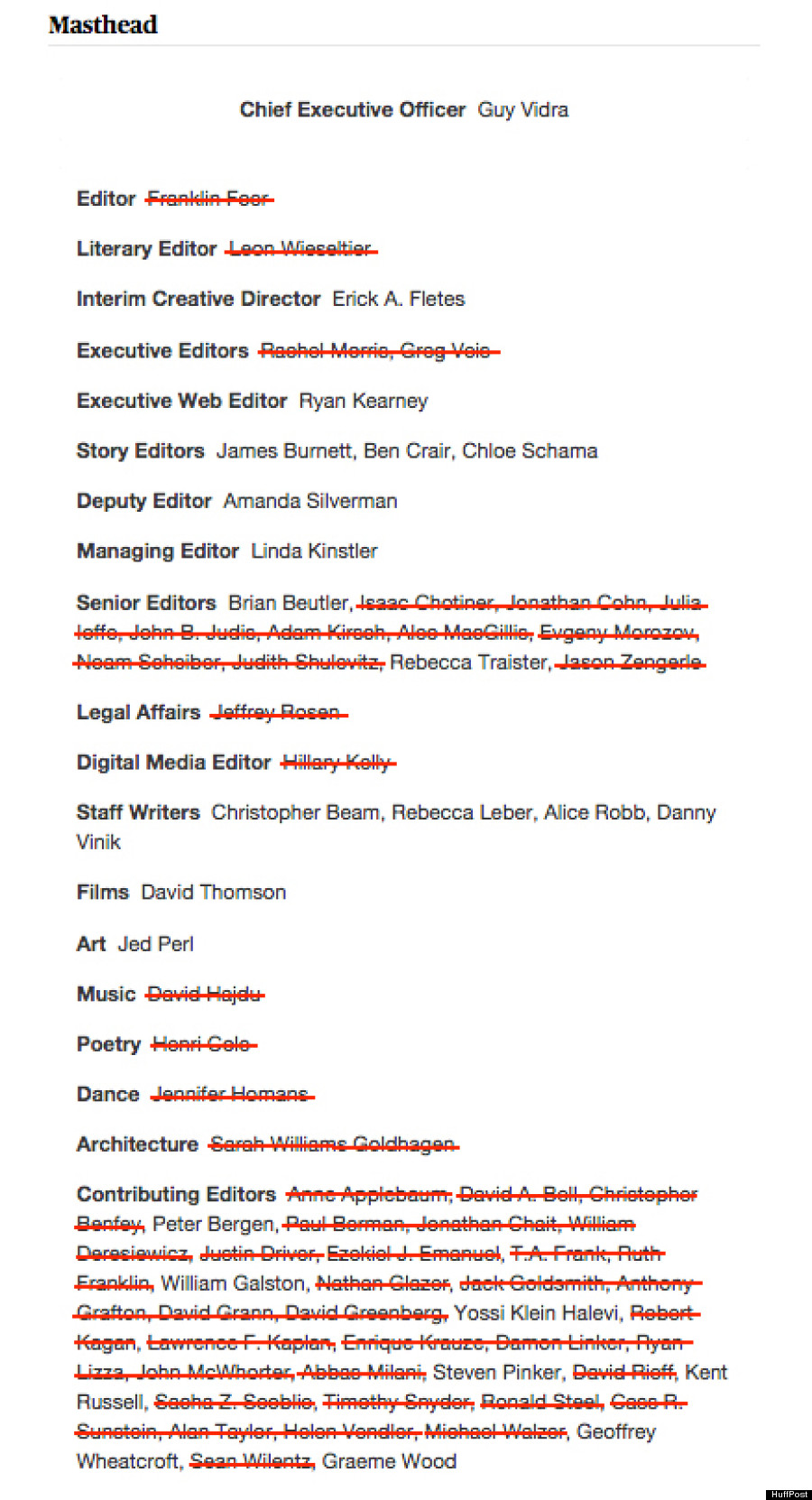
It sure looks like it.
TNR used to be my favorite magazine. I've been reading it since I was in high school. It played a significant role in teaching me how to write and how to think.
It used to be known as a liberal magazine that would question orthodox liberalism and conventional wisdom. TNR's outgoing editor, Franklin Foer, even wrote an article in 2001 challenging the conventional wisdom that conventional wisdom is often wrong!
But lately it's become predictably liberal — I can't think of the last thing I've read in TNR that differs from "what you'd expect a generic liberal to say."
The magazine seems to have been taken over by people who are more interested in transforming it into a "digital media company" than in taking over the helm of an august journalistic institution. It's going to move from DC to NYC and switch from 20 to 10 issues a year — not even a monthly. Its top two editors (Foer and Leon Wieseltier) just quit. The new CEO has warned of a "staff restructuring"; some are predicting "mass resignations"; and two of its former writers whose names are still on the masthead (Ryan Lizza and Jon Chait) have asked for their names to be taken off the masthead "immediately."
Chait has written a "Eulogy for The New Republic," and the consensus seems to be that "eulogy" is the appropriate term. This is a sad day for opinion journalism.
UPDATE: The "mass resignations" prediction was correct — look at TNR's masthead now! (Source.)
UPDATE:
On Friday morning, 28 senior staff and contributing editors resigned from The New Republic en masse. A letter of resignation to Chris Hughes was signed by ten contributing editors, including Lizza, poet and literary critic Helen Vendler and Princeton history professor Sean Wilentz:UPDATE: TNR's Facebook page is flooded with negative comments from readers. Just look at the comments on any recent article. Example:
“Dear Mr. Hughes, We are contributing editors of the New Republic, and our commitment to the venerable principles of the magazine requires us now to resign. Please remove our names from the masthead.
" Yours truly, Paul Berman, Jonathan Chait, William Deresiewicz, Ruth Franklin, Anthony Grafton, Enrique Krauze, Ryan Lizza, Sacha Z. Scoblic, Helen Vendler, Sean Wilentz.”
For Foer, Wieseltier and others at the magazine, the brutal shakeup by [Guy] Vidra, 40, who was hired in September, and his 30-year-old patron, [Chris] Hughes--who purchased TNR two-and-a-half years ago for an undisclosed sum from a consortium that included longtime owner Martin Peretz--didn’t come as a surprise. Tensions have been building since the summer. According to multiple sources, Hughes came to think of his writers and editors as “spoiled brats,” and especially disliked the flamboyant, feud-prone, white-maned Wieseltier, who was more than twice his age. Much of Hughes’s distaste was telegraphed in his body language; he strikes many TNR staffers as passive-aggressive and averse to confrontation.
The friction escalated with the arrival of Vidra, who is said to have complained to Foer that the magazine was boring and that he couldn’t bring himself to read past the first 500 words of an article. According to witnesses, Vidra did little to hide his disrespect for TNR’s tradition of long-form storytelling and rigorous, if occasionally dense, intellectual and political analysis--to say nothing of his lack of interest in the magazine’s distinguished history--at an all-hands meeting in early October.
Presiding at the head of a long conference table, Vidra didn’t acknowledge Foer, who was seated beside him; he didn’t look at him; he didn’t mention him. Instead, as he started to speak, Vidra confided that he liked to stand up and move around the room as he communicated his thoughts, as though he were Steve Jobs unveiling the latest technological marvel. Oddly, he stood up, but he didn’t move.
Vidra spoke in what one witness described as “Silicon Valley jargon,” and, using a tech cliché, declared: “We’re going to break shit”--a vow hardly calculated to ingratiate himself with TNR’s veteran belle-lettrists, who feared that he was threatening the magazine’s destruction. Only a few interns dared to ask questions, which Vidra repeatedly dodged. “The senior people were too shocked to speak,” said a witness. “Jaws were dropping to the floor.” Through it all, Chris Hughes nodded approvingly, an unnerving grin on his face.
To be sure, that meeting was a warning sign. But the manner in which the two technology mavens administered their coup de grâce only two months later has left a bitter taste.
According to informed sources, Hughes and Vidra didn’t bother to inform Foer that he was out of a job. Instead, the editor was placed in the humiliating position of having to phone Hughes to get confirmation after Gawker.com posted an item at 2:35 p.m. reporting the rumor that Bloomberg Media editor Gabriel Snyder, himself a onetime Gawker editor, had been hired as Foer’s replacement. Yes, it’s true, Hughes sheepishly admitted, notwithstanding that he and Vidra had given Foer repeated assurances that his job was safe. . . .
“It was cowardly, the way Chris and Guy went about this,” Ioffe said. “Media reporters have been calling for months, asking, ‘Is Frank fired?,’ and they’ve been lying to everybody, including Frank.”
It is far from clear whether the remaining, relatively inexperienced staff will be able to get out the next issue, which is scheduled to close on Wednesday. Two multi-thousand-word pieces slated for publication--a profile of Jeb Bush by Alec MacGillis and a report on Vladmir Putin’s political arch enemy, Mikhail Khodorkovsky, by Russian expert Ioffe--were still being edited when the ax fell. And even if the newbies manage to produce the issue, it will be accomplished in an atmosphere of outrage, recrimination and sorrow over the apparent death--some would say murder--of an American institution that was, for decades, a bulwark of liberal thought, cultural criticism and groundbreaking journalism.
“The New Republic was always a small political magazine that was trying to change the world,” said senior editor John Judis, who was trying to figure out late Thursday night if he could continue to work for the magazine. “My impression of what happened is Hughes and Vidra have decided to transform the magazine into a profit-making media center that is entirely different from what the magazine historically has been and what it has represented and entirely different from what The New Republic has been at its core--and this has led to this cataclysm where Frank and Leon have both left. I liked the old New Republic. I thought it had a really important role to play in America and I’m sorry if it’s no longer going to play that role.”
A once storied institution with unsurpassed journalistic prestige & my source for thoughtful engaging content. An unfortunate end to The "old" New Republic. I will be unliking your page . . .So much for adapting to the digital age.
UPDATE: If there was any doubt about whether TNR as we know it has gone, the fact that Noam Scheiber and Jonathan Cohn just quit today (December 5) has put an end to any suspense. Scheiber says:
So I just resigned from @tnr. People do muuuuch harder things every day. But boy was it brutal. A great ride for 14 years.Cohn says:
Feel so lucky that I got to work at Herbert Croly's and Walter Lippmann's magazine for 17 years. Thanks to readers and my great colleagues.UPDATE: Julia Ioffe quit but still attended the staff meeting — and she tweeted it:
Chris Hughes at staff mtg: "This is a setback. These are great journalists that we lost this morning. But we are incredibly well positioned."UPDATE: The New York Times reports:
Chris Hughes at the meeting: "This institution has been around for 100 fucking years." no fucking kidding
Guy Vidra treats the remaining staff to more deep thoughts at mtg: "This is hard. But we will get through it and we will be better for it."
Chris Hughes telling the staff that he is different from other FB founders bc he cares about institutions, that he's always sent that signal
Thing is, neither Chris Hughes nor Guy Vidra bothered to communicate anything to the editorial staff. Nothing. It's been silence for months.
Chris Hughes, some advice for you: instead of "sending signals" to your staff, talk to them. Honestly.
Some staff members have asked that their work be pulled from the coming issue of the magazine, which will have to be completed without an editor, and a greatly diminished staff.The next issue is supposed to come out on Wednesday, but TNR won't have an editor-in-chief from now through then!
Mr. Foer was replaced by Gabriel Snyder, the former editor of The Atlantic Wire, who will start on Dec. 22.
It looks like Hughes was right about his announcement to the staff: TNR is no longer a magazine.