Showing posts with label 2012. Show all posts

Thursday, July 30, 2020

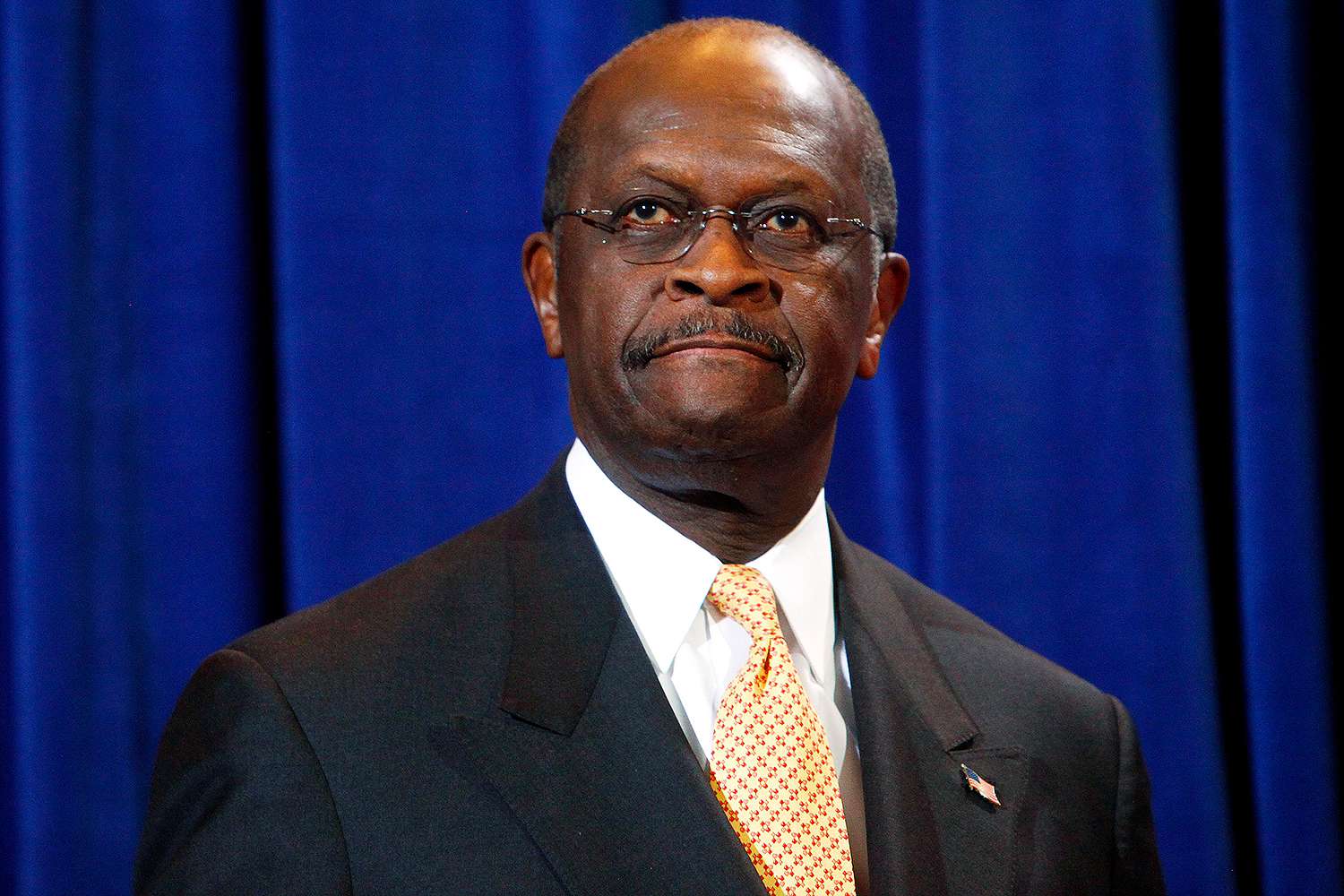
Herman Cain dies at 74

The New York Times reports:

Herman Cain, the former Republican presidential candidate and business executive who was hospitalized this month with the coronavirus, has died. He was 74.…

Mr. Cain, the former chief executive of Godfather’s Pizza, ran for the Republican nomination for president in 2012, and his irreverent style and rags-to-riches story made him an unlikely hero of Tea Party conservatives. He dropped out of the race after he was accused of sexual misconduct, which he denied.…

His platform was likely best known for his 9-9-9 tax plan: a flat 9 percent individual income tax rate, a 9 percent corporate tax rate and a 9 percent national sales tax.
Normally I'd link to the Wikipedia page for someone who's just died, but when I checked it today it had been vandalized with disgusting photos. I'm sure that problem will be fixed, but please use caution when visiting Herman Cain's Wikipedia page.

Axios notes:
Cain, the co-chair of Black Voices for Trump, was in a high-risk group due to his history with cancer. Cain's positive coronavirus test came less than two weeks after he attended President Trump's controversial June 20 campaign rally in Tulsa, where he tweeted a picture of himself without a mask.… It's unclear whether Cain contracted the virus at the Trump rally.
From 2011: Herman Cain on America's racial progress.


(Photo by Eric Thayer/Getty.)

Monday, September 7, 2015

Paul Krugman explains why Donald Trump's economic policies are better than most Republican candidates'

Krugman writes (via):

[Jeb] Bush has chosen to attack Mr. Trump as a false conservative, a proposition that is supposedly demonstrated by his deviations from current Republican economic orthodoxy: his willingness to raise taxes on the rich, his positive words about universal health care. And that tells you a lot about the dire state of the G.O.P. For the issues the Bush campaign is using to attack its unexpected nemesis are precisely the issues on which Mr. Trump happens to be right, and the Republican establishment has been proved utterly wrong.

To see what I mean, consider what was at stake in the last presidential election, and how things turned out after Mitt Romney lost.

During the campaign, Mr. Romney accused President Obama of favoring redistribution of income from the rich to the poor, and the truth is that Mr. Obama’s re-election did mean a significant move in that direction. Taxes on the top 1 percent went up substantially in 2013, both because some of the Bush tax cuts were allowed to expire and because new taxes associated with Obamacare kicked in. And Obamacare itself, which provides a lot of aid to lower-income families, went into full effect at the beginning of 2014.

Conservatives were very clear about what would happen as a result. Raising taxes on “job creators,” they insisted, would destroy incentives. And they were absolutely certain that the Affordable Care Act would be a “job killer.”

So what actually happened? As of last month, the U.S. unemployment rate, which was 7.8 percent when Mr. Obama took office, had fallen to 5.1 percent. For the record, Mr. Romney promised during the campaign that he would get unemployment down to 6 percent by the end of 2016. Also for the record, the current unemployment rate is lower than it ever got under Ronald Reagan. And the main reason unemployment has fallen so much is job growth in the private sector, which has added more than seven million workers since the end of 2012.

I’m not saying that everything is great in the U.S. economy, because it isn’t. There’s good reason to believe that we’re still a substantial distance from full employment, and while the number of jobs has grown a lot, wages haven’t. But the economy has nonetheless done far better than should have been possible if conservative orthodoxy had any truth to it. And now Mr. Trump is being accused of heresy for not accepting that failed orthodoxy?

So am I saying that Mr. Trump is better and more serious than he’s given credit for being? Not at all — he is exactly the ignorant blowhard he seems to be. It’s when it comes to his rivals that appearances can be deceiving. Some of them may come across as reasonable and thoughtful, but in reality they are anything but.

Mr. Bush, in particular, may pose as a reasonable, thoughtful type — credulous reporters even describe him as a policy wonk — but his actual economic platform, which relies on the magic of tax cuts to deliver a doubling of America’s growth rate, is pure supply-side voodoo.

And here’s what’s interesting: all indications are that Mr. Bush’s attacks on Mr. Trump are falling flat, because the Republican base doesn’t actually share the Republican establishment’s economic delusions.

The thing is, we didn’t really know that until Mr. Trump came along. The influence of big-money donors meant that nobody could make a serious play for the G.O.P. nomination without pledging allegiance to supply-side doctrine, and this allowed the establishment to imagine that ordinary voters shared its antipopulist creed. Indeed, Mr. Bush’s hapless attempt at a takedown suggests that his political team still doesn’t get it, and thinks that pointing out The Donald’s heresies will be enough to doom his campaign.

But Mr. Trump, who is self-financing, didn’t need to genuflect to the big money, and it turns out that the base doesn’t mind his heresies. This is a real revelation, which may have a lasting impact on our politics.

Wednesday, September 2, 2015

Have moderate Republicans been losing the presidency because conservative voters stayed home in protest?

Ramesh Ponnuru says no:

Conservatives sometimes argue that Republicans lost the last two presidential elections because they nominated moderates who did not inspire conservatives to vote. On NRO today, Bernard Goldberg places blame on those conservatives who stayed home. He writes that “millions of the ideologically pure — who normally would vote Republican — did in fact sit home, if not handing the elections to Barack Obama, at least making it a lot easier for him to win.”

The premise of both arguments–Republicans shouldn’t have nominated moderates because they can’t turn out conservatives, and conservatives shouldn’t have sat out the elections–does not appear to be correct, based on the exit polls. There was no drop-off in conservative turnout in either 2008 or 2012. Conservatives were 34 percent of the electorate in 2004, 34 percent in 2008, and 35 percent in 2012. They voted Republican at a normal rate in 2012 too: Romney got 82 percent of them, a bit lower than George W. Bush’s 84 percent in 2004 but higher than his 81 percent in 2000. (McCain did a bit worse in 2008, with 78 percent.) Goldberg’s argument could end up being true about 2016, but it has not been true in the last two elections.

Monday, November 10, 2014

A conversation about politics

This is me and Alex Knepper talking about politics a few weeks ago on IM. It should go without saying that I would never post something like this without the other person's permission! I've added links and rearranged the text into a coherent dialogue.

A: You voted for Kerry in 2004, right?

J: Yes

A: Did you think that was a particularly dirty campaign?

J: Well, I ignored the swift boat stuff.

A: Interesting. The right-wing base was obsessed with it.

J: That just didn't interest me. I voted for him because I was inclined to vote Democratic, he seemed solid and reasonable, and Bush wasn't very good. I wasn't going to be influenced by personal attacks.

A: Do you think, though, I mean, that the election was a particularly poor display of democratic campaigns at work?

J: Well, my view of a presidential race is mainly based on the debates, plus random TV interviews and speeches and stuff like that, not the ads. I thought the 2004 debates were incredibly serious and substantive, almost to a fault.

A: Who was the last Republican candidate you voted for before Romney?

J: I didn't vote for Romney.

A: Oh yeah. You voted for Gary Johnson. But you preferred Romney to Obama, no?

J: I couldn't decide. For a while, I considered voting for Romney. I wrote up a whole blog post about why I would vote for him, but I didn’t publish it. I can't bring myself to vote for someone who's against legal abortion, against gay rights, etc.

A: I really was stunned that he continued to advocate for the FMA. If he runs in 2016 will he still support the FMA? Geez

J: I voted for Joe Lhota for Mayor. That's the most significant Republican I've voted for. Lhota is pro gay rights, and abortion rights don't matter for NYC mayor. Note: when social issues are off the table, I suddenly start voting Republican — an example of how Republicans lose young voters through their unreasonable social views.

A: I’m at the point now where as long as the Democrat is basically reasonable on economics and foreign policy, even if I disagree a bit (to the right), I'd prefer to vote for the Democrat over a socially conservative Republican. These social issues are clearly being resolved in favor of the liberal position, as is usually the case in American history, and it's time to let these issues go. The longer the GOP holds onto them the more of a drag it is on their ability to do anything substantive.

J: Another reason I wouldn't say I thought Romney was definitely better: I found him appealing because he seemed really smart on economics, more so than Obama. But then I had to step back and say: OK, he can talk about economics smartly, but what is he going to do? And I thought: well, he wants to take money away from Medicaid and spend it on the military. And I just think that's wrong.

A: I was deeply disappointed when he sort of shelved Ryan's Medicare plan, and shamelessly started criticizing the Medicare cuts in Obamacare. The GOP freakin' ran ads in 2010 that juxtaposed the words 'government takeover of healthcare' with 'Obama getting in your Medicare.’

J: Romney was obviously in a bind on health care. What a weird choice for a nominee! I can't believe the Republicans nominated the governor responsible for the precursor to Obamacare.

A: Yeah, well, what was the alternative? Newt Gingrich? Rick Santorum? Herman Cain? All the serious candidates declined to run.

J: Yeah, there was no good candidate. But why was there no good candidate?

A: Because Romney blocked them from entering.

J: Oh, Romney didn't stop anyone from doing anything!

A: Ever since 2008, when I first started writing, I've been mystified by Romney's appeal.

J: I find him appealing! I think he's gotten a bad rap. There's plenty of stuff I disagree with him about. But considering that the Republican party exists, I like him about as much as any Republican. I hope he runs again. And I think he probably will. When I watched Romney, I thought: that's probably what I'd be like if I ran for president. I'd be stilted and awkward and overly calculating. Probably most people I know would be. Most normal people would be uncomfortable as national politicians. Very few people would be as cool and effortless as Obama.

A: Given how lukewarm my opinion about Romney is, it is sad to say that I'd still prefer him to just about anyone else the Republican Party is putting up. I just don't trust him.

J: We should never trust any politician.

Tuesday, December 4, 2012

Epistemic closure

Public Policy Polling says that "Republicans are taking the results [of the election] pretty hard":

49% of GOP voters nationally say they think that ACORN stole the election for President Obama. We found that 52% of Republicans thought that ACORN stole the 2008 election for Obama, so this is a modest decline, but perhaps smaller than might have been expected given that ACORN doesn't exist anymore.

Saturday, November 10, 2012

How can Republicans win after 2012?

Self-proclaimed "liberal Democrat" Bill Scher has some advice for Republicans on how to win in the future. (And yes, it's genuinely good advice, not sarcastic or insincere!)

Condoleezza Rice says:

When you look at the composition of the electorate, clearly we are losing important segments of that electorate. And what we have to do is to appeal to those people not as identity groups, but understanding that if you get the identity issues out of the way, then you can appeal to Americans on the broader issues that all Americans share concerns for.


Alex Knepper (a libertarian Republican) agrees and elaborates:
That’s exactly right. The social issues serve as a barrier to persuasion. New voters — young people, immigrants — tend to identify with one of the parties on a ‘big picture’ basis — not by going down a checklist of issues and comparing the party platforms. The social issues are not only the easiest for the uninitiated to understand, but they have the most emotional impact. It’s one thing to argue over the merits of adjusting the capital gains tax rate — most people will submit that it’s an issue about which reasonable people can civilly disagree. But when Hispanics hear that the Republican presidential nominee has openly advocated making life so miserable for illegal immigrants that they won’t even want to live here anymore (that’s what “self-deportation” means, people), then an enormous wall has been created. When you’ve lost the trust of a minority group, they won’t listen to a word you have to say about Medicare, tax reform, or deficit-reduction. There’s nothing inherent about brown skin that makes a person hostile toward capitalism. But if people with brown skin think that the party of the free market hates them, then they’ll run into the arms of the party of statism. And why not? People need to feel assured that you view them with dignity and respect, not with contempt and loathing. There’s nothing that should be surprising about that.

We don’t need to win the Hispanic vote — we just need to increase our share back to levels more like George W. Bush’s. Changing our policies and tone toward immigration issues is only a first step to achieving that — not only because it is practical, but because it is the right thing to do. Once that issue is out of the way, then we can go about the vital task of reaching out to Hispanic voters on the basis of the timeless American values of upward mobility, economic freedom, and individual liberty.
I think a lot of people go along with Democratic economic policies largely because they've already decided to be Democrats based on social issues. As Knepper points out, social issues are relatively easy to have clear, unwavering views about. Given the choice between memorizing and repeating a few slogans to sum up the mainstream Democratic positions on economic issues, or reaching your own conclusions on those issues by soberly weighing the smartest arguments on all sides, many people just don't have time for the latter, no matter how much more intellectually honest it would be.

Yet people would rather feel a sense of clarity than uncertainty on the major issues of the day. So, when they don't have time to master those issues, they develop shortcuts, like saying their side cares, and the other side doesn't care — or, only cares about the wrong people. That approach is simplistic but powerful enough to be able to explain almost any political divide. Given that Republicans are the party of social and economic conservatism, and that their social conservatism is blatantly uncaring, socially liberal voters have a readily available shortcut for taking a stand on Republican economic policies: just as Republicans' social policies show that they don't care about women, blacks, gays, immigrants, etc., their economic policies show that they don't care about the middle class (or the poor), and that they only care about the rich (or corporations).

It's not just that many voters are socially liberal and prioritize social issues, causing Republicans to lose a portion of the electorate every Election Day based on those issues. Of course, that's true, but Republicans have a broader problem: their positions on social issues are turning off many voters from the very idea of agreeing with them on any issue. Conservatives like to bring up "the law of unintended consequences." Well, how many professional Republicans are willing to face the fact that their party's retrograde positions on social issues have been inadvertently holding economic conservatism hostage?

Monday, November 5, 2012

Live-blogging the final presidential debate of 2012

I'll say anything I have to say about tonight's presidential debate, which you can watch live online, in this post.

I'll be writing down any quotes on the fly, without the aid of a transcript or pause/rewind button. So they might not be 100% verbatim, but I'll try to keep them as accurate as possible.

9:07 - Jill Stein (Green Party) wants to "bail out the students, not the banks." I'm not so sure. Stein makes it sound like of course we should bail out someone, and the question is who to bail out. Maybe the real problem is the very idea of bailouts.

9:09 - Stein criticizes President Obama for "expanding free-trade agreements," which will "continue to offshore our jobs" and "undermine American sovereignty." She wants a "fair-trade agreement" to protect workers and the environment. Isn't supporting "fair trade" really a euphemism for opposing free trade?

9:12 - Gary Johnson (Libertarian Party) unsurprisingly starts out by expressing his support for free trade, pointing out that it makes goods and services cheaper for us as consumers. The problem is when free trade turns into "crony capitalism." Instead of creating loopholes, government should "get out of the way" and "create a level playing field for everybody." He'd eliminate the corporate tax.

9:16 - Stein describes a scenario where 100 loaves of bread are distributed to 100 people, and says that 1 person would get 40 loaves, while 50 people would get just 1 loaf. The bread is all of America's wealth, and the 100 people are the American people. She then says she supports a "living wage," which presumably means dramatically increasing the minimum wage. She doesn't explain how forbidding employers and employees from entering into mutually beneficial arrangements would equalize the distribution of wealth, rather than increasing unemployment.

9:20 - Johnson lambastes Stein for her support of increasing corporate taxes: "Why not increase the corporate tax rate to 70%? Why not 100%?" He argues: "Whatever we tax, we get less of" — raising corporate taxes causes businesses and jobs to leave the United States.

9:22 - Johnson warns of a "monetary collapse" resulting from government-backed inflation. "I am livid over the fact that we bail out Wall Street from making incredibly bad decisions — that they don't lose their money. . . . Capitalism on the way up, communism on the way down!"

9:26 - Stein is also against the fact that banks are considered "too big to fail." It seems like everyone is.

9:28 - Stein: "After a decade of war, over $5 trillion spent, and thousands of American lives lost, what have we accomplished?" Not stable allies or women's rights. Unlike in the Obama/Romney debate on foreign policy, she raises criticisms of Obama's drone war.

9:32 - Johnson: "Drone attacks potentially take out the target, but only 2% of its effectiveness is on the target. The rest is unintended consequences."

9:33 - Johnson flatly says that foreign aid "should stop." "Contrary to what we were brought up to believe, foreign aid does not go to poor people. It goes to prop up dictatorships. But it goes to dictatorships that are supposedly in America's best interests. . . . It's poor people in this country giving money to rich people in foreign countries."

9:35 - Stein seems to support foreign aid in principle, but says we need to "end the predominant form of foreign aid, and that is military aid." But even if our foreign aid didn't include any military aid, wouldn't it effectively make it easier for the recipient countries to spend more on their militaries?

9:39 - Johnson: "There are unintended consequences to our military interventions — always worse rather than better!"

9:40 - Stein says that "there are countries in the Middle East that do have nuclear weapons now, and that includes Israel." That's not officially public knowledge, so it appears unpresidential for a candidate to state it explicitly.

9:42 - Stein connects anthropogenic climate change to currently displaced people in New York. She pins the blame on "fossil-fuel politics," which she says Obama has participated in as much as Republicans.

9:45 - Johnson says he believes climate change is anthropogenic, but he doesn't think he as president could stop it. As always, his solution is economic growth spurred by free markets: consumers will demand that their products somehow reduce carbon emissions.

9:48 - Johnson bravely supports price gouging. $7 per gallon gasoline would lead to shorter car lines at the pump, and would attract entrepreneurs.

9:51 - Johnson says that all government action is "well-intentioned"; of course, the problem is unintended consequences. He describes his efforts as Governor of New Mexico to respond to a forest fire — which itself was caused by government. (Wikipedia has information on this episode.)

9:53 - Stein says climate change is an "emergency." "It's as if we've been attacked." She says it's a bigger emergency than Pearl Harbor.

9:57 - Johnson says that Stein seems to think government is the answer to all our problems, and he asks Stein what she thinks about net neutrality. Stein says she's for it, and adds that she doesn't assume government is the answer to every problem. "I'm not an ideologue. I'm a doctor. I don't actually know much about ideology. As a doctor, I look for practical solutions."

9:59 - Both candidates say that they're not aware of any way that Wikileaks is a threat to national security. Stein goes further and says that secrecy is the greatest threat to security.

10:03 - Stein warns that President Obama has "reinterpreted" the 2001 Authorization of the Use of Military Force to authorize himself to "assassinate anyone, including American citizens."

10:05 - When asked about police brutality and excesses, Stein brings up a recent experience when she showed up at a presidential debate to insist on being included. She was arrested and "cuffed tightly to a chair for 8 hours."

10:07 - Johnson's response to the police question focuses on drugs: "I am going to do everything I possibly can to bring an end to the drug war. I would like to see the legalization of marijuana now."

10:08 - Johnson calls the TSA a "Constitution-free zone."

10:09 - Johnson says that if either Obama or Romney wins, we'll have "a heightened police state," "a continued state of war," and "unsustainable spending."

10:12 - Johnson does an extended impression of Obama giving a press conference where he started out saying that European countries that practiced austerity avoided the problems of countries that spent more money than they had — Obama then went on to say (according to Johnson) that the United States is different because we can print more money and use "leverage."

10:14 - Stein disagrees with Johnson, saying that the track record of "austerity" in Europe and the United States is abysmal. Johnson: "I think that's just baloney!" He says we need to stop spending more money than we have, or we'll have a "national collapse."

10:21 - Stein and Johnson both support labeling of genetically modified foods. Johnson connects this to the idea of a free market: consumers should make choices based on accurate information. He says he wouldn't be able to function if not for food labels, since he has Celiac disease and can't eat gluten.

10:23 - In her closing statement, Stein says she'll "put an end to student debt." She calls students "indentured servants."

10:24 - Johnson says in his closing statement: "Vote for the person you believe in. That's how you change this country for the better. I'm more liberal than Obama when it comes to civil liberties. I'm more conservative than Romney when it comes to dollars and cents. . . . I made a name for myself [as governor] by being a penny-pincher. . . . I don't know if there's a more important vote right now if you want to register your distaste with what's happening in this country." Johnson ends by asking for 5% of the vote, which will let the Libertarian Party get more ballot access and receive federal matching funds. So, the libertarian's slam-dunk argument for why you should vote for him is that it will let him receive federal-government benefits.

Why it matters that drones haven't been debated in this presidential race

Ramesh Ponnuru explains:

Neither side wants to look softer than the other on terrorists. Hence the bipartisan support for the strikes. Liberal groups that might be inclined to protest the policy have been quiet because Obama put it in place. The lack of debate about our reliance on drones is a shame, because there are both practical and moral objections to it.

A few conservatives have raised one practical concern: Killing terrorists is justified, they say, but we need to kill fewer and capture more to gain intelligence. You don’t have to support waterboarding, as some of these critics do, to agree with that point.

Another concern, raised by a few liberals, is that the strikes have increased anti-Americanism abroad. . . . The Pew Research Center has found strong opposition to drone strikes in almost every country.

But the morality of the policy is what most deserves scrutiny. . . . In January, Obama said, “I want to make sure that people understand actually drones have not caused a huge number of civilian casualties.” A report by the Bureau of Investigative Journalism found hundreds of civilian casualties in Pakistan, including 176 children.

In May, the New York Times reported one possible explanation for the discrepancy in estimates: Obama “in effect counts all military-age males in a strike zone as combatants, according to several administration officials, unless there is explicit intelligence posthumously proving them innocent.” In other words, Obama has not found much evidence of civilian casualties because he’s not looking for any. . . .

The president’s aides told the Times that he is a “student of writings on war by Augustine and Thomas Aquinas” and can be trusted to make the right judgments. His practical definition of combatants as anyone we happened to kill suggests otherwise, although too much of the program is secret to say for sure. The fact that we have barely debated this issue makes it hard to believe that our political system is getting it right, either.
Read the whole article for more thoughts on how just-war theory applies to Obama's drone war.

Previously: What is President Obama's drone war in Pakistan doing?

Monday, October 22, 2012

Live-blogging the foreign policy debate

9:22 - President Obama says that every time Mitt Romney has taken a position on foreign policy, he's been wrong. Then he praises Romney for supporting Obama's war in Libya.

9:38 - Obama criticizes Romney for cutting education spending as Governor of Massachusetts. I thought this was supposed to be a foreign policy debate. Also, I hate the debate tactic of pointing out that someone has cut spending. That's not very informative, and it's not inherently bad to cut spending on something important. How efficiently were those dollars spent?

9:41 - Romney: "Our Air Force is older and smaller than it's been since 1947." Well, of course it's older than it's ever been before! Everything is always older than ever before.

9:44 - Obama to Romney: "Governor, we also have fewer horses and bayonets. . . . It's not a game of counting battleships." Good point, but Obama made the same fallacy on education spending. [Update: Actually, the point about bayonets wasn't so great.]

9:46 - Obama says our sanctions against Iran are "crippling its economy." He adds: "Their economy is in shambles." Bragging about destroying a whole nation's economy seems rather callous.

9:59 - Romney has said the word "tumult" several times tonight.

10:01 - Romney describes Obama's foreign policy with words like "tumult," "turmoil," "tension." Obama says Romney has been "all over the map," whereas Obama's decisions aren't "poll-tested." If this debate has any purpose, it's for the candidates to seem presidential while repeating these kinds of buzzwords to frame the other side. I find it hard to believe that many voters are going to make their decision based on any substantive differences on foreign policy the candidates are airing tonight.

10:04 - Obama points out that many people in his administration, including his own vice president, were opposed to his decision to kill Osama bin Laden.

10:08 - Obama is beating Romney in the contest to mention as many regular citizens as possible.

10:11 - Romney is asked what he thinks about Obama's drone war. We don't get much in the way of details about what the drone war is actually doing, either from the moderator's question or Romney's answer: "I support that entirely." When it's Obama's turn to respond, he doesn't even mention his drone attacks, but talks vaguely about feel-good concepts like government reform in nations we're "engaging with," women's rights, etc.

10:15 - A Facebook friend says the moderator, Bob Schieffer, referred to "Obama bin Laden," but I didn't notice it.

10:19 - Romney accuses China of "artificially holding down the value of their currency." In other words, China is making our dollar stronger, and Romney would like our dollar to be weaker.

10:24 - Romney criticizes the US policy of "writing checks" to bail out the car industry — which, he points out, started with President Bush.

10:25 - Romney says he's in favor of public investing in "basic research," not "investing in companies." Actually, that's a surprisingly euphemistic way for him to refer to Obama's policy of transferring taxpayers' money to corporations.

10:28 - Romney finally catches up with his references to ordinary people in swing states. This is now the second debate where Appleton, Wisconsin (population 78,000) has been mentioned.

10:35 - The debates are over. Do you think the campaigns made an agreement that the candidates would have the exact same interaction at the beginning and end of each debate? They always pat each other on the side of the arm while laughing, as if one of them had said something funny in the previous split-second.

My mom, Ann Althouse, sums up the debate:

By adopting a strategy of only modestly challenging Obama and mostly seeming the same as Obama on foreign policy, Romney neutralized foreign policy as an issue and kept the election focus on the economy. He even refocused the discussion on the economy whenever he could over the course of the evening. The election is about the economy, and nothing either candidate said tonight will change that. The only way Obama really could have won is if Romney had tumbled into some kind of exploitable gaffe. That didn't happen.

Wednesday, October 17, 2012

A hypothetical, inspired by last night's debate

Say you're a police investigator, and you find a dead body with no clear cause of death. It's a high-profile case, and the public wants to know if there was foul play. You give a press conference in which you say, "One thing's for sure: no act of murder will ever shake our resolve." By making that statement, have you announced that the person was definitely murdered? No. You've just uttered a platitude to express the fact that you're taking the case seriously, without committing to a position on what actually happened.

(See the "10:15" update on my live-blog of the debate.)

Tuesday, October 16, 2012

Live-blogging the "town hall" presidential debate

[Here's the transcript.]

I'll be live-blogging the 2nd presidential debate here. Keep reloading for more updates.

For more live-blogging, check out Althouse (my mom), TalkingPointsMemo, and the Economist's Democracy in America.

As always, any quotes will be written down on the fly, so they might not be verbatim but I'll try to make them reasonably accurate.

9:04 - A college student asks Mitt Romney how he's going to be assured of having a job after graduating. Mitt Romney says we need to continue giving Pell grants. "I know what it takes to create good jobs again. . . . I'm going to make sure you get a job."

9:05 - President Obama seems very upbeat: "Your future is bright!" He segues into paraphrasing Romney as saying: "We're going to let Detroit go bankrupt." He also strains to connect education to "investing in solar energy."

9:09 - Romney: "We have fewer people working today than when President Obama took office." Romney says that the unemployment rate is the same, but it would be much higher — over 10% — if the work force were as big as it was 4 years ago. He also retorts to Obama: "You say I wanted to let Detroit go bankrupt; you did let Detroit go bankrupt!"

9:11 - Obama: "Governor Romney doesn't have a 5-point plan. He has a 1-point plan: to make sure that folks at the top play by a different set of rules. . . . That's exactly the philosophy that's been in place for the past decade." It seems like a questionable strategy to impute the whole time he's been in office to his challenger's philosophy.

9:14 - Obama promises a questioner: "You're not going to pay as much for gas." Both of the candidates seem to be under the impression that the president is the Commander of the Economy.

9:17 - Obama says when Romney was governor, "you stood in front of a coal plant and said: 'This plant kills. We're shutting it down.'"

9:18 - While continuing the debate on coal, the two of them both walk slowly toward each other while accusing the other of lying about coal statistics. Romney to Obama: "You'll get your chance soon; I'm still speaking." [Here's the video:]


9:22 - Candy Crowley starts to move on to a new topic, and Romney, as usual, starts to debate the debating rules with her. She insists on going to a new topic, but Romney talks about the old topic (energy) anyway. Obama: "Candy, it's OK, I'm used to being interrupted."

9:25 - Romney is asked about his tax plan. He emphasizes: "The top 5% of taxpayers will continue to pay 60% of income tax the government collects. So that will stay the same." He also repeats what Paul Ryan said last week: that Obama's spending increases will lead to higher taxes on the middle class. Of course, Obama says the opposite: that he's going to cut taxes for the middle class. We've heard all this before, and neither candidate's "plan" is very convincing. (See the 9:47 update in my live-blog of the vice-presidential debate, where I said Ryan had a "brilliant tactic.")

9:30 - Obama says that Romney said during the primaries that he'd give a "tax cut" — not a "tax rate cut" — for everyone, including the rich. Does Obama really think it's going to be effective for his critique of Romney on taxes to hinge on that semantic distinction?

9:31 - Romney blatantly panders to women by referring to the increase in "women living in poverty" during the Obama administration. Has there not been an increase in men living in poverty, or do men living in poverty just not matter as much?

9:36 - Obama points out that Romney was "a very successful investor," and would never have accepted a plan as "sketchy" as Romney's proposal of tax cuts and military-spending increases. Romney flips this around by suggesting that you should trust him because he's been so successful in business and government. Romney's retort to Obama: "How about $4 trillion in deficits? That's math that doesn't add up. . . . He said he would cut the deficit in half; instead he's doubled it."

9:37 - Obama is asked what he's going to do about women earning less on average than men. "That's a great question." Why should we trust Obama's explanation of any statistics, if he isn't willing to point out the statistical fallacy with inferring discrimination from raw averages which don't consider any of the legitimate factors that cause people to be paid differently based on the different choices they make?

9:41 - Romney says we need to have "flexible schedules" to help women. How is it the job of the president to decide what job schedules people have?

9:45 - A member of the audience asks Romney what the biggest differences are between him and George W. Bush. "Trade — I'll crack down on China. President Bush didn't." "I'm going to get us to a balanced budget; President Bush didn't." He says "President Obama was right" to say that deficits were outrageous under Bush; of course, Obama increased them even more. "President Bush had a very different path, for a very different time."

9:50 - Obama goes for the jugular, pointing out that Romney is investing in China while promising to crack down on China. "Governor, you're the last person who's going to get tough on China."

9:51 - Obama says Romney is different from Bush: "George Bush didn't propose turning Medicare into a voucher. George Bush supported comprehensive immigration reform; he didn't suggest self-deportation. George Bush didn't stop funding Planned Parenthood."

9:53 - Obama lists his accomplishments in a much snappier way than he did in the first debate: he ended the war in Iraq, he's fought terrorism, something about health care, etc. He then lists several of Romney's promises, repeating that he's vowed to defund Planned Parenthood.

9:55 - Romney walks toward someone whose question has just been answered by Obama, speaking to him directly: "I think you know better. I think you know that the economy for the last 4 years hasn't been as good as the president just described. . . . He keeps saying: look, I've created 5 million jobs. That's after losing 5 million jobs!" Ah, Romney nows says there are more "people in poverty." So, men do count after all! Romney is very fluent with his statistics: "Median incomes are down $4,300 per family."

9:59 - An immigration question. Romney: "America is a nation of immigrants. . . . We welcome legal immigrants into this country." Anyone with a degree in science or math should "get a green card stapled to their diploma." He'd punish employers for hiring "those who came here illegally." He uses that phrase — "those who came here illegally" — over and over. He's clearly been advised that some people are offended by the word "illegal" being used as an adjective applied to a whole person.

10:01 - Obama starts out by echoing Romney's answer: "We are a nation of immigrants. But we're also a nation of laws." Like Romney, he says we need to encourage highly skilled people to immigrate.

10:04 - The moderator, Crowley, asks Romney to "speak to self-deportation." Romney: "No!" But a minute later, he does explain his views on "self-deportation." Romney likes to pick fights with the moderators.

10:06 - Romney brings back the issue of China, repeatedly asking Obama: "Have you looked at your pension lately?" Obama: "No, mine isn't as big as yours, so it doesn't take as long to look at." Romney: "Look at your pension — you also have Chinese investments." Crowley asks Romney "if I could have you sit down." [Here's the video:]


10:11 - Obama on the killings in Benghazi, Libya: "We'll find out who did this, and we will hunt them down. When folks mess with Americans, we go after them. . . . These are my folks, and I'm the one who's got to greet those coffins when they come home."

10:12 - Romney on Benghazi: "This was not a demonstration — it was a terrorist attack. It took a long time for that to be told to the American people."

10:13 - Romney goes on autopilot, listing his talking points about Obama's foreign policy: "The president's policies throughout the Middle East began with an apology tour," Obama is "leading from behind," his foreign policy is "unraveling."

10:15 - Obama gives a forceful rebuke to Romney's description of his response to the Benghazi attacks:  "That's not what we do." He says that he called it a "terrorist attack" immediately afterwards, in his Rose Garden address. Romney says it actually took him 14 days before he used that language. Crowley intercedes, saying that Obama is right that he immediately used the word "terrorist," but Romney is right about his larger point that it took the administration 2 weeks to stop characterizing it as a spontaneous reaction to a video. [Added: A transcript on Fox News quotes Obama in the Rose Garden address, the day after the attacks:]

The United States condemns, in the strongest terms this outrageous and shocking attack. . . .

We reject all efforts to denigrate the religious beliefs of others. But there is absolutely no justification to this type of senseless violence. None.

The world must stand together to unequivocally reject these brutal acts. . . .

No acts of terror will ever shake the resolve of this great nation, alter that character or eclipse the light of the values that we stand for.
What do you think? Did he refer to the killings as terrorism? If you take his words literally, he was talking about what no acts of terror will ever do, without specifying whether terrorism had just occurred. At most, there's an implication that the Benghazi killings were terrorist attacks that would not shake our resolve and so on. But that's too debatable for the moderator to be weighing in on who got it right.

[Update: A hypothetical.]

[Added: Here's the video of the whole section on Libya:]


10:26 - They're asked what their plan is to reverse the trend of jobs being outsourced to foreign countries. Romney brings back the line he used at the beginning of the first debate, saying that Obama has used "trickle-down government." American businesses can't compete with countries that have more lax regulation. He threatens to impose "tariffs" on China.

10:35 - Romney shouts at Obama: "Government does not create jobs! Government does not create jobs!" That's not what he said in his first answer in the debate!

10:35 - Romney uses a line he often repeated during the primaries, but which he didn't say in the last debate: "I spent my life in the private sector, not government." A few minutes later, he makes a list of promises and says: "I served as governor and showed that I can get this done."

10:38 - Obama rattles off platitudes: "Everybody should have a fair shot, and everybody should do their fair share, and everybody should play by the same rules."

10:38 - Finally, Obama brings up the fact that Romney said that 47% of the country refuses to take personal responsibility for themselves. "When my grandfather fought in World War II and came back and got a G.I. Bill that enabled him to go to college, that wasn't a handout." And with that, Obama has the last word in the debate. It seems quite unfair that Romney wasn't given a chance to respond to Obama's attack.

At the very least, Obama "won" the debate by cutting off the narrative that had been going on since the last debate about his lack of vitality.

Sunday, October 14, 2012

Why have the Democrats gotten the most attention in the debates?

Isn't it weird how in both debates so far, the candidate whose performance got the most attention was the Democrat? But they're the incumbents! We can judge them on their record in office. We don't need to resort to looking at how well they handle themselves in debates. The debates should be a more crucial test for the Republicans. Everyone seems to have this backwards.

Thursday, October 11, 2012

Live-blogging the vice-presidential debate of 2012

[Added: Here's the transcript.]

I'll be live-blogging the only vice-presidential debate between Joe Biden and Paul Ryan here, starting at 9:00 Eastern tonight.

Keep reloading this post for more updates.

You can watch the debate online on C-SPAN.org or YouTube.

As always, I'll be doing writing down quotes on the fly without the aid of a transcript or pause/rewind button, so they won't necessarily be verbatim but I'll try to keep them as close to accurate  possible.

Feel free to comment on the debate in the comments.

9:03 - They're sitting down. That might produce a calmer vibe than in the last debate.

9:04 - Biden promises "to find and bring to justice the men" who killed Christopher Stevens and three other Americans.

9:05 - Biden says that Obama on day 1 made it a top priority to get Osama bin Laden, whereas Romney said during his previous campaign that he "wouldn't move Heaven and Earth" to kill bin Laden. "It was about more than taking a murderer off the battlefield. It was about restoring America's heart, and sending a message to terrorists."

9:06 - Ryan says that "if we're hit by terrorists, we'll call it what it is." Instead, the Obama administration "blamed the YouTube video" for the killing of Stevens. Ryan thanks veterans, turning to Biden and extending the thanks to his son Beau.

9:08 - While Ryan keeps giving his long answer about the attacks, Biden rudely mutters over him: "Do I get to say anything?" Once it's Biden's turn, he says, "With all due respect, that's malarkey. Because none of what he said was accurate."

9:11 - Biden says that Romney's decision to hold a press conference about the Libya attacks was "not presidential leadership." Is Romney not allowed to say anything about a foreign-policy crisis during his campaign just because he's a challenger? That doesn't seem fair.

9:14 - Ryan says a Romney administration, in contrast with the Obama administration, "will have credibility" on sanctions against Iran. Biden: "Incredible! . . . These are the most crippling sanctions in history, period. Period."

9:15 - Biden rhetorically asks if Ryan wants to start a war with Iran. Ryan interjects: "We want to prevent war!" Biden asks what more Romney/Ryan would want Obama to do on Iran, "unless they want us to go to war."

9:19 - Ryan's main debate tactic on Iran seems to be repeating the word "credibility."

9:20 - The moderator, Martha Raddatz, says Biden is "making it sound like [Iran doesn't] want a nuclear weapon." Biden says no, but "facts matter," and they're still far from being able to make a weapon.

9:22 - Ryan is stumbling over his words a lot, e.g. saying "desperation" when he means "daylight."

9:22 - Ryan warns of Iran getting a nuclear weapon, which would set off "a nuclear arms race in the Middle East."

9:23 - Biden on Iran: "We've made it clear . . . This president doesn't bluff."

9:24 - Biden paraphrases Romney: "47% of the American people are unwilling to take responsibility for their own lives." He mentions that Romney himself pays relatively low taxes, and points out that Romney's "47%" includes veterans and elderly people on Social Security.

9:25 - Biden says Romney/Ryan are "holding middle-class tax cuts hostage" in order to cut taxes for the very wealthiest Americans. He's clearly putting into practice what many people felt President Obama should have done last week.

9:27 - Ryan repeats Romney's defense of tax cuts for the rich, which is that those taxes apply to small businesses, which create jobs. Why couldn't they amend the tax code with enough precision to give a break to those small businesses, without cutting everyone's personal income taxes?

9:30 - The debate has been pretty somber. Biden brings up the car accident that killed his first wife and daughter.

9:31 - Ryan focuses on something I don't remember hearing about at all in the previous debate: the fact that there was single-party Democratic control of Congress and the White House for the first half of Obama's term. "They had the opportunity to do whatever they wanted. Look where they are right now." He points out how much higher unemployment is than the administration projections.

9:34 - Ryan gives a passionate, personal defense of "entitlements" — Medicare and Social Security — describing how they helped his mother and grandmother to be successful. He and his mom collected Social Security benefits after his dad died, and this allowed her to go to college and start a business.

9:37 - Biden says Ryan supported the Bush administration's plan to privatize Social Security. "Imagine where all those seniors would be now if their money were in the market."

9:38 - Ryan: "They got cut with their hands in the cookie jar, turning Medicare into a piggy bank for Obamacare."

9:39 - Ryan: "I know you're under a lot of duress to make up for lost ground, but I think people would be better served if we didn't keep interrupting each other." True. [Added: here's the video:]


9:42 - Ryan says Biden has "nothing to run on," so he's painting his opponent as "something to run from." Ryan says Biden is wrong to call their Medicare plan a "voucher" system.

9:47 - Ryan: "There aren't enough rich people and small businesses to pay for all their [Obama/Biden's] spending. So when they say it's time for the wealthy to pay their 'fair share' — watch out, middle class, they're coming for you!" [Added later: this was a brilliant tactic of inverting Obama's argument from the first debate that the math of Romney's tax plan doesn't add up, and the middle class will end up getting stuck with the bill.]

9:50 - The moderator asks why Romney/Ryan aren't giving the specifics of their tax plan. After Ryan answers, the moderator sums up: "Still no specifics."

9:51 - Raddatz should be more aggressive about stopping Biden from constantly interrupting Ryan.

9:53 -There's an extremely busy back-and-forth between Biden and Ryan over what kinds of taxes and tax deductions Romney would cut.

9:55 - Ryan accuses Obama of trying to cut the Navy to its smallest size since World War I.

9:59 - Biden says Romney's position on withdrawing from Afghanistan is: "It depends." "It does not 'depend' for us."

10:01 - Ryan on Afghanistan: "What we're seeing when we turn on our TV screens is the unraveling of the Obama foreign policy."

10:04 - Biden on Afghanistan: "The only way to make 'em step up is to say: 'Fellas, we're leavin'. Step up.'"

10:05 - Ramesh Ponnuru asks: "Are normal people still watching this?" He also made a good point back in the section on taxes:

The Democrats could have permanently extended the middle class tax cuts in 2009-10 if they really wanted to.
10:12 - I'm not following the discussion of Syria, and I wonder if it's really going to affect anyone's vote.

10:14 - Ryan is asked about his criteria for military intervention in any country. "Only when it is in our national-security interest."

10:15 - Ryan, asked about abortion, says: "I don't see how a person can separate their public life from their private life — or from their faith. . . . I believe that life begins at conception. . . . The policy of a Romney administration will be to oppose abortion, with exceptions for rape, incest, and the life of the mother." [I originally didn't catch whether or not he included the mother's "health" as an exception. Based on the transcript, he didn't.]

10:17 - Ryan says Democrats used to say abortion should be "safe, legal, and rare," in Bill Clinton's famous words. "Now, they support it without restriction, and with taxpayer funding."

10:18 - Biden says he's personally opposed to abortion based on his Catholicism, but "I refuse to impose that on equally devout Christians, Muslims, and Jews."

10:25 - Ryan says Obama won't show us a "credible plan" to prevent the debt crisis. (Again, he emphasizes credibility.) What we get from the administration is "speeches, not leadership." He's trying to hoist Obama on his own petard (they won't show us their plan).

10:27 - More disorienting crosstalk from Ryan and Biden. Raddatz: "Let me calm this down." She asks what each of them could bring to the country that no one else could. Ryan smartly rejects the premise that no one else could bring what he would.

10:30 - Biden, in his closing statement: "You probably sense my frustration with their attitude toward the American people. My friend [Ryan] says 30% of the American people are 'takers.'" He repeats Romney's 47% line. "They're talking about my mother and father."

10:30 - Ryan thanks the moderator, the college hosting the debate, and "you, Joe. It's been an honor." Unless I missed it, I think Biden thanked only the moderator and the college, not Ryan.

10:32 - "Mitt Romney and I want to earn your support." He pauses and says the word "earn" very emphatically, as if to say: Obama and Biden didn't earn it.

10:40 - The debate is over. I was so wrong in my prediction that the debate would be relatively calm because they're sitting down. Here are two live-blog updates from my mom, Ann Althouse (an hour earlier than here):
8:51: The stress level is rising. Biden is so angry. Why is he yelling? Ryan needs nerves of steel not to lose his cool. I'm impressed that Ryan, when he gets his turn, is able to speak in an even, natural voice. It's hard to concentrate on the policy itself, because the emotional static is so strong.

9:11: Biden has been yelling at Martha Raddatz for the last 15 minutes (as the subject is war). It's so inappropriate!
Based on Jonah Goldberg's Twitter feed, where he's been retweeting other people including other National Review editors, it seems like conservatives weren't very happy with Ryan's performance. Jeffrey Goldberg says:
Biden right now is talking to people, Ryan is talking to members of the House budget committee.
Jonah Goldberg also says:
If Biden was advised to be angry at everything he doesn't find hysterical, he's executing perfectly.
So, Biden was too rude and aggressive, while Obama, by his own admission, was too polite and not aggressive enough last week. Maybe after Obama's campaign puts him through debate "study hall," he'll finally get it just right.
Tuesday, October 9, 2012

The fundamental difference between Obama and Romney that might explain how Romney won the first debate

Alex Knepper opines:

Barack Obama is much better at being than at doing. For all of his life, he has been rewarded for who he is — what he represents — rather than what he has done. . . .

Indeed, he seems instantly bored with whatever position he has ascended to — as Byron York hilariously (and depressingly) points out: he spent a few years as a community organizer, got bored, headed to the state legislature for a few years, got bored, went to the Senate for a couple of years, got bored, decided to run for president. . . .

Whatever his flaws, Mitt Romney is a doer, a man who is used to delivering the goods when it counts — and he came to last week’s debate ready to win. Obama, the man who only knows how to be — to sit back and bask in the adulation of people willing to reward him for merely existing — is simply not used to dealing with people who refuse to submit to his outsized ambitions — and it’s highly doubtful that he’s going to learn how to do that in just two weeks’ time.

Saturday, October 6, 2012

Why did President Obama do so badly in the first debate?

An article in The New Yorker quotes Laurence Tribe, who mentored Obama at Harvard Law School, responding to the debate:

“Although I would have been happier with a more aggressive debate performance by the President, I’ve had to remind myself that Barack Obama’s instincts and talents have never included going for an opponent’s jugular. That’s just not who he is or ever has been.”
Whether Obama's "instincts" are to go for the jugular might be impossible to know. But he seems to be capable of going for the jugular — when he's motivated to do so.

Remember when he said this?
While I was working on those streets watching those folks see their jobs shipped overseas, you were a corporate lawyer sitting on the board of Walmart!


I'm surprised that in the whole New Yorker article, which is all about what kind of a debater Obama is, there isn't a single mention of Hillary Clinton.

Wednesday, October 3, 2012

The first debate of the 2012 general election

I'll be live-blogging it here tonight.

As always, any quotes I write down will be done without a transcript or pause/rewind button. So they might not be verbatim, but I'll try to be accurate.

For more live-blogging, check out Althouse (my mom), TalkingPointsMemo, and Democracy in America.

[Added later: Here's the transcript, and here's video of the whole debate:]


9:06 - President Obama criticizes the "top-down policies that got us into this mess." Is Obama trying to pitch himself as the candidate of bottom-up policies? That's hard to believe.

9:07 - Mitt Romney brushes off Obama's charges that he's going to take a top-down approach or "cut taxes for the rich."

9:08 - Romney says that Obama believes in something that doesn't work: "trickle-down government."

9:09 - Moderator Jim Lehrer asks Obama to expand on the idea of trickle-down government, and Obama responds by explaining his education policy of "race to the top." The debate has been very vertical so far.

9:10 - Obama makes the unpopular admission that the government needs to both reduce spending and increase revenues in order to control the deficit.

9:11 - Romney to Obama: "I'm not going to reduce the share of taxes paid by high-income people. High-income people are doing just fine."

9:12 - Romney describes the economic slump as an "economy tax" on the middle class.

9:14 - Romney makes the implausible promise to make "no tax cut that adds to the deficit."

9:16 - Obama says that even if you cut all deductions that benefit the wealthy, it wouldn't make up for the shortfall in revenue that would result from Romney's tax cuts for them. Is Obama assuming that all these enormous changes in the tax code would have no effect on behavior?

9:22 - Romney's explanation for how his math adds up is that he would cut taxes for small businesses, which would create jobs.

9:23 - Obama says that Romney is making "the same sales pitch [on taxes] that was made in 2001 and 2003." Obama equates his own approach with Bill Clinton's. So, "we've got some data on which approach is likely to create jobs for middle-class Americans."

9:24 - Romney goes on at unnecessary length about the debating rules: "He got the first answer, so I have the last word on this topic," etc.

9:26 - Romney: "The amount of debt we're adding, at a trillion dollars a year, is simply not moral."

9:27 - Romney promises that he'd go through all government programs, figure out which ones don't work, and stop funding them. This sounds uncannily similar to a promise Obama made in one of the 2008 general-election debates. (See my live-blog from October 7, 2008 — coincidentally, it's in the update from the exact same time, 9:27.)

9:31 - Obama attacks Romney for raising his hand in a primary debate when the Republican candidates were asked if they'd turn down an offer of a 10-to-1 ratio of spending cuts and tax increases.

(I stopped live-blogging here for about 20 minutes because the ABC News and YouTube feeds were too choppy. The C-SPAN feed works much better.)

9:52 - Romney says that Dodd-Frank is "the biggest kiss given to New York banks I've ever seen." He criticizes the "unintended consequences" of financial regulation, but says that some financial regulation is essential.

9:53 - Obama seems at a loss for words for an uncomfortably long time before he goes into his explanation of the causes of the financial crash.

9:54 - Obama: If you think the problem is that we had too much regulation of Wall Street, then Romney is your candidate. Romney rejects this: "It's not that Dodd-Frank was always wrong with too much regulation. Sometimes it doesn't give clear regulation."

9:56 - Romney is asked why he wants to repeal Obama's health-care law. He cites the Congressional Budget Office saying that Obamacare will make health insurance cost $2,500 more per person. Also, "it puts in place an unelected board that will tell people, ultimately, what kinds of treatments they can have." He wants you to think "death panels" without him having to say it.

9:59 - Obama says that Obamacare will definitely let you keep your health insurance. (This calls for a fact-check!) It will just mean that health-insurance companies "can't jerk you around." He admits that "Governor Romney did a good thing" by enacting Romneycare.

10:02 - Romney says that Romneycare is different from Obamacare because the latter will cause people to lose their health insurance. He also reels off a dizzying array of other distinctions, which I doubt many viewers will be following.

10:03 - Obama mocks Romney's references to the "unelected board." Obama characterizes this as making "smart choices" and using "best practices"; the alternative is "to let businesses decide how long they can afford to keep paying premiums until they just give up."

10:05 - Obama says Romney is right that health-care premiums have been going up for the past 2 years — but they've been going up more slowly than in the past 50 years.

10:06 - What would Romney enact in place of Obamacare? He won't describe the whole thing, because the description would be too long. But his plan would include a rule against barring people with pre-existing conditions. And he'd let young people stay on their parents' plans, though he adds that this could happen purely through the free market.

10:10 - Obama says that Romney "says he's going to replace Obamacare" (yes, he did call it "Obamacare"), but he won't say what he's going to replace it with. "Is the reason he's keeping his policies secret, because they're too good?"

10:11 - Romney responds that he's holding back from giving more specifics because he's doing what Ronald Reagan did: laying out "principles" such as creating incentives for economic growth, broadening the tax base, and cutting taxes. Oddly, he adds a compliment to Obama for sharing some of Reagan's economic principles.

10:14 - Obama: "The genius of America is free enterprise." However, there are "things we do better together." He then segues back to his education policy: "Government can help. It can't do it all."

10:16 - Romney responds to Obama: "I reject the idea that I don't believe in great teachers or more teachers. Every state can make that decision on its own."

10:16 - Romney quotes various phrases from the Declaration of Independence, including "the pursuit of happiness." He seems to say that this means that the government has a responsibility to provide for those who are unable to provide for themselves.

10:18 - Romney says that federal funding should "follow the child" — that is, let the child and their parents decide where to go to school.

10:20 - Obama says that Romney hasn't been clear about his education proposals, but he would cut the education budget by 20%.

10:22 - Romney to Obama: "As president, you're entitled to your own house and your own airplane, but not your own facts. I'm not going to cut education funding."

10:24 - Lehrer says they're short on time for the remaining issues, but he's not going to claim he's done a good job of moderating. Obama: "Jim, you've done a great job!" Lehrer: "Oh, well, no . . ."

10:26 - Romney lists various things he's going to do on "day 1" as president. Obama points out that Romney is going to have "a busy first day," since he's also promised to repeal Obamacare on day 1.

10:30 - Obama: "Four years ago, I said I wasn't a perfect man and I wouldn't be a perfect president, and that's a promise Governor Romney probably thinks I've kept."

That's all. Check in here again for the vice-presidential debate next week.

UPDATE: About an hour into the debate, Josh Marshall of TalkingPointsMemo, who of course is favorable to Obama, said:

My read so far is that if you go by energy and tossing out lots of data points, then Romney is running circles around the president. Obama has only on a few occasions really pressed a point hard. Whether that means he’s ‘winning’ I don’t know. But energy level, Romney all the way. But I think there are a lot of traps that Obama’s put out there for Romney. Romney really pressed his insistence that he just isn’t going to do what he says his plan is going to do. I think those statements – and the statement about vouchers – might be unpacked badly for him over the next few days.
The 7 bloggers at the Economist's blog Democracy in America seem to be unanimous in saying that Romney won. "W.W." (Will Wilkinson) says:
Romney won decisively. Obama clearly approached the debate with a mainly defensive strategy, hoping to come away without having done anything to rock his very comfortable boat. But the boat did rock. Obama was flummoxed by Romney's superior preparation, intensity, and execution, and tonight's truly dismal performance from the president has put the sustainability of his lead in question, if not actually in peril.
Another blogger at the Economist, "T.N.," says:
Obama seemed to sleepwalk through much of the debate - and the fact that so many potential attack lines were not exploited suggests that . . . this might be a deliberate tactic - to bore his way to victory over the next month.
Andrew Sullivan says:
Look: you know how much I love the guy, and you know how much of a high information viewer I am, and I can see the logic of some of Obama's meandering, weak, professorial arguments. But this was a disaster for the president for the key people he needs to reach, and his effete, wonkish lectures may have jolted a lot of independents into giving Romney a second look.

Obama looked tired, even bored; he kept looking down; he had no crisp statements of passion or argument; he wasn't there. He was entirely defensive, which may have been the strategy. But it was the wrong strategy. At the wrong moment.

The person with authority on that stage was Romney - offered it by one of the lamest moderators ever, and seized with relish. This was Romney the salesman. And my gut tells me he sold a few voters on a change tonight. It's beyond depressing. But it's true.

There are two more debates left. I have experienced many times the feeling that Obama just isn't in it, that he's on the ropes and not fighting back, and then he pulls it out. He got a little better over time tonight. But he pulled every punch. Maybe the next two will undo some of the damage. But I have to say I think it was extensive.

Sunday, September 23, 2012

Why did Rick Perry fail?

It might have been sleep apnea.