Showing posts with label nyt. Show all posts

Wednesday, August 5, 2020

Is the New York Times right that NYC stands alone in reopening schools?

The New York Times says:

Public school students in Chicago, the nation’s third-largest district, will begin the academic year remotely in September, leaving New York City as the only major school system in the country that will try to offer in-person classes when schools start this fall.…

Of the nation’s 25 largest school districts, only five now plan to open the school year with any form of in-person learning. Six of the seven largest will be online.
Wait, how can the New York Times say that NYC has "the only major school system in the country that will try to offer in-person classes," if 5 of "the nation’s 25 largest school districts" are going to have "in-person learning"? Don't the 25 largest school districts in the US all count as "major"? According to Wikipedia, each one has more than 100,000 students, and that list doesn't even include school districts as big as Denver, Austin, or Seattle.

More from the Times:
New York City schools, the nation’s largest district, are scheduled to reopen in about a month, with students having the option of attending in-person classes one to three days a week. But the city is confronting a torrent of logistical issues and political problems that could upend Mayor Bill de Blasio’s efforts to bring students back to classrooms.

Among them: There are not yet enough nurses to staff all city school buildings, and ventilation systems in aging buildings are in urgent need of upgrades. There may not even be enough teachers available to offer in-person instruction. Some teachers are threatening to stage a sickout.…

In other parts of the country where schools have already opened, they have quickly encountered positive cases, with some having to quarantine students and staff members and even close down schools temporarily to contain possible outbreaks.

Tuesday, January 21, 2020

"Chinese City Uses Facial Recognition to Shame Pajama Wearers"

That headline is from … not the Onion, but the New York Times, which reports:

When officials in an eastern Chinese city were told to root out “uncivilized behavior,” they were given a powerful tool to carry out their mission: facial recognition software.

Among their top targets? People wearing pajamas in public.

On Monday, the urban management department of Suzhou, a city of six million people in Anhui Province, sparked outrage online when it published surveillance photos taken by street cameras of seven local residents wearing pajamas in public along with parts of their names, government identification numbers and the locations where their “uncivilized behavior” had taken place.

City officials quickly apologized, but not before stirring nationwide ire over the use of a state-of-the-art digital tool to stamp out a harmless and relatively commonplace practice — an unusual note of resistance in a country where the instruments of digital totalitarianism have spread largely unchecked.

On social media, the Suzhou department publicly called out, among others, a Ms. Dong, a young woman in a plush pink robe, matching pants and orange pointy flats, walking on a street, and a Mr. Niu, who was singled out for donning a black and white checkered full pajama suit in a mall.

“Uncivilized behavior refers to when people behave and act in ways that violate public order because they lack public morals,” read a post on WeChat, a common social messaging app, which has since been deleted.

“Many people think that this is a small problem and not a big deal,” the post said. “Others believe public places are truly ‘public,’ where there is no blame, no supervision and no public pressure.”

“This has brought about a kind of complacent, undisciplined mind set,” it concluded.

Wednesday, August 28, 2019

Should the rich avoid discussing their wealth with their kids?

I've never understood that idea, and this New York Times piece convinced me there's no good reason for it:

Parents would be remiss if they did not talk to their children about drinking and driving, using drugs and, of course, sex. . . . So why do a significant number of parents still not talk to their children about wealth and inheritance?

Two-thirds of Americans who have at least $3 million in investable assets have not talked to their children about their wealth or never will, according to a Merrill Private Wealth Management study of 650 families.

Some in the survey said they did not bother because they assumed their children had already figured it out. But 67 percent had quietly made gifts in a trust or set aside money in their children’s name. . . . Ten percent steadfastly refused to talk at all with their children about money, saying it was no one’s business. . . .

In a world of oversharing on social media, why does this restraint persist? It’s complicated. . . .

The most common reason cited for not talking about money is that parents do not want inheritance to rob children of motivation. So if a parent does not say anything, a child will never figure out the family’s wealth. Impossible.

Children are well able to use computers and mobile devices to determine just how much their house, car and vacation cost, along with their school fees and the salaries of any household help. Information about prominent parents and families is flowing to their children’s friends as well.

“A second-grade kid, because they go to all of these house parties, will be able to rank the wealth of all the people in his or her class pretty accurately,” said Dennis Jaffe, a psychologist who works with wealthy families. “It’s not positive or negative, and they’re not jealous yet. But these are teaching moments about values.”

This challenges the notion that waiting until children are older is better. By then, they will have formed their own views on wealth by watching their parents.

“Values are set by everyday behaviors when you’re growing up, and kids are watching you,” Mr. Jaffe said. “Entitlement education begins in nursery school, not when they’re 25 and come to you and say, ‘I need some money.’”

The strategy of ignorance exposes a disconnect between a parent’s stated reason and real reason for saying nothing, said Matthew Wesley, a director at Merrill’s Center for Family Wealth and a co-author of the study with Ms. Allred.

“The stated reason is, ‘We don’t want money to screw up our kids, and if we disclose our wealth to them, we’ll derail their career paths,’” Mr. Wesley said. “The deeper reason is about fear and control — the fear to relinquish that control and the deeper psychological issues around money.”

Disengagement creates more problems, though, because it can create a perception that a family is more, or less, wealthy than it really is. Leaving children to guess can also create feelings of insecurity.

Some parents shy away from talking about wealth because they have decided to give away most of the money.

“That’s great, but if you’re not telling your kids, that’s weird,” Mr. Jaffe said. “If that’s what you believe in, why wouldn’t you tell your kids that ‘we’re a very wealthy family, but our values say we’re going to put most of it into a philanthropy, and we’re all going to work and do something on our own’?”

Sunday, April 21, 2019

Does society allow men but not women to have comebacks?

This New York Times article argues that women don't "get comebacks like Tiger Woods" because "society" doesn't "allow . . . women to get high enough to fall." Ann Althouse (my mom) responds:

It seems to me, there's no one to compare to Tiger Woods — the ascent, the crash, the long time in the wilderness, the perfection of the big comeback win. You can't generalize to: Men can do that, women can't. . . .

There are a lot of people who only care about golf to the extent that it's about Tiger. Who else has done that with a sport — made millions of people care about it only because of him (or her)? . . .

Getting that high means beating everybody else. There's no way for the rest of us to "allow" that. Women already enjoy the allowance of playing in separated women's sports. . . .

[The article] really does undercut women by insisting proactively that women be given something no man was given.
This is a pet peeve of mine: gender/race articles that claim men (or white men) "get" to do something or are "allowed" to do something while other people aren't. That kind of framing makes it sound like the writer is boldly announcing a discovery about how society's rules are discriminatory. But the supposed rule isn't real; it was created by the writer, not by society.

Right under the Tiger Woods piece is a New York Times article about Martha Stewart, which says she recently joked at a roast "about surviving the five months she spent in prison beginning in 2004 after being convicted of lying to investigators about a stock trade," and the joke "was a hit." The article goes on to say that she's "still a competitive business woman" and "still expanding her empire." Apparently women are "allowed" to make comebacks.

Sunday, February 3, 2019

A strange sentence in the New York Times about Democrats apologizing

"2020 Democrats Agree: They’re Very, Very Sorry," reports the New York Times:

The most recent high-profile mea culpa came Thursday when Senator Elizabeth Warren of Massachusetts apologized for her controversial decision to take a DNA test to prove her decades-old claim of Native American ancestry.

Former Vice President Joseph R. Biden Jr. recently lamented his role in crafting the tough-on-crime drug legislation of the 1980s and 1990s.

Senator Kamala Harris of California said she regretted some of the positions her office took while she was a state prosecutor.

Senator Kirsten Gillibrand of New York said her past hard-line stances on immigration “certainly weren’t empathetic and they were not kind.”

Senator Bernie Sanders of Vermont apologized after reports of gender discrimination and sexual harassment in his 2016 presidential campaign.
And the Times doesn't mention Tulsi Gabbard apologizing for her vile statements about "homosexual extremists."

But I don't understand what the New York Times reporters (Astead W. Herndon and Sydney Ember) are talking about in this sentence:
As recently as 2006, national Democrats including former President Barack Obama expressed wariness about immigrants’ ability to assimilate into American culture and did not openly embrace gay marriage — two talking points that would probably be deeply damaging for any 2020 candidate."
Why "[a]s recently as 2006"? That wasn't a presidential election year. And did Democrats stop doing those things before 2008? President Obama and Vice President Biden didn't "openly embrace gay marriage" until 2012.

Maybe the writers were thinking of what Obama wrote in his 2006 book The Audacity of Hope (pp. 263-64, 266, 268):
[T]here's no denying that many blacks share the same anxieties as many whites about the wave of illegal immigration flooding our Southern border — a sense that what's happening now is fundamentally different from what has gone on before. Not all these fears are irrational. . . . If this huge influx of mostly low-skill workers provides some benefits to the economy as a whole . . . it also threatens to depress further the wages of blue-collar Americans and puts strains on an already overburdened safety net. . . .

For most Americans, though, concerns over illegal immigration go deeper than worries about economic displacement and are more subtle than simple racism. In the past, immigration occurred on America's terms; the welcome mat could be extended selectively, on the basis of the immigrant's skills. . . . The laborer, whether Chinese or Russian or Greek, found himself a stranger in a strange land, severed from his home country, subject to often harsh constrains, forced to adapt to rules not of his own making.

Today, it seems those terms no longer apply. Immigrants are entering as a result of a porous border rather than any systematic government policy. . . . Native-born Americans suspect that it is they, and not the immigrant, who are being forced to adapt. . . .

I'm not entirely immune to such nativist sentiments. When I see Mexican flags waved at proimmigration demonstrations, I sometimes feel a flush of patriotic resentment. When I’m forced to use a translator to communicate with the guy fixing my car, I feel a certain frustration. . . .

We have a right and duty to protect our borders. We can insist to those already here that with citizenship come obligations — to a common language, common loyalties, a common purpose, a common destiny.

Saturday, December 31, 2016

Remembering those who died in 2016

Here are most of the 2016 obituaries I posted to Facebook, grouped into categories but otherwise in no particular order.

They’re almost all from the New York Times, whose obituaries are excellent and life-affirming.

Some of the people on this list I love and care about; one I worked for; some I have mixed feelings about; some I’m not that interested in but respect how much they meant to their fans; a couple I hate; and many I simply hadn’t heard of before reading their obituaries. But I took away something meaningful from just about all of these posts, and I hope you do too.

Sunday, November 15, 2015

What to do about ISIL after the attacks on Paris

Roger Cohen writes in the New York Times:

The Paris slaughter claimed by the Islamic State constitutes, as President François Hollande of France declared, an “act of war.” As such, it demands of all NATO states a collective response under Article 5 of the North Atlantic Treaty. This says that, “An armed attack against one or more of them in Europe or North America shall be considered an attack against them all.” . . .

The only adequate measure, after the killing of at least 129 people in Paris, is military, and the only objective commensurate with the ongoing threat is the crushing of ISIS and the elimination of its stronghold in Syria and Iraq. The barbaric terrorists exulting on social media at the blood they have spilled cannot be allowed any longer to control territory on which they are able to organize, finance, direct and plan their savagery.

Hollande left no doubt that that [sic] the attacks were “prepared, organized and planned from abroad, with complicity from the inside.” ISIS, or one of its affiliates, has also claimed responsibility for the recent downing of a Russian passenger jet, with the loss of 224 lives. The United States and Britain believe these claims are credible.

It was wrong to dismiss ISIS as a regional threat. Its threat is global. Enough is enough. A certain quality of evil cannot be allowed physical terrain on which to breed. Pope Francis declared the Paris attacks “not human.” In a sense he is right. But history teaches that human beings are capable of fathomless evil. Unmet, it grows.

To defeat ISIS in Syria and Iraq will require NATO forces on the ground. After the protracted and inconclusive Western interventions in Iraq and Afghanistan, it is reasonable to ask if this would not be folly. It is also reasonable to demand – and many will – whether military action will only have the effect of winning more recruits for ISIS as more lives and treasure are squandered. Terrorism, the old nostrum has it, can never be completely defeated.

Such arguments are seductive but must be resisted. An air war against ISIS will not get the job done; the Paris attacks occurred well into an unpersuasive bombing campaign. Major powers, including Russia and China, have vigorously condemned the Paris attacks. They should not stand in the way of a United Nations resolution authorizing military action to defeat and eliminate ISIS in Syria and Iraq. Regional powers, especially Saudi Arabia, have an interest in defeating the monster they helped create whose imagined Caliphate would destroy them. . . .

It is not enough to say, as the Obama Administration has up to now, that ISIS will be defeated. These words lack meaning without a corresponding plan. There is time pressure because time is being used precisely to plan new atrocities.

With each one, the possibility of a spiral of religious and sectarian violence in strained European societies increases. Hatred of Muslims seems to be on the rise. The Bataclan, the club targeted in the Paris attacks, has, as the French magazine Le Point pointed out, been a frequent meeting-place for Jewish organizations.

The killings occurred as hundreds of thousands of desperate Muslim refugees from Syria are streaming into Europe. This is not the time to turn on them, but to help them, even if extreme vigilance is needed. They, too, in their vast majority, are fleeing ISIS, as well as the indiscriminate violence of President Bashar al-Assad. Nonintervention in Syria has proved a policy fraught with bloodshed and danger, now seeping into Europe.

The battle will be long. . . . Crushing ISIS in Syria and Iraq will not eliminate the jihadi terrorist threat. But the perfect cannot be the enemy of the good. Passivity is a recipe for certain failure. It is time, in the name of humanity, to act with conviction and power against the scourge of the Islamic State. Disunity and distraction undermined past military efforts to defeat the jihadis. Unity is now attainable and with it victory.

Tuesday, September 15, 2015

Best. Botched suicide. Ever.

The New York Times reported in 1988:

A mentally ill young man who shot himself in the head in a suicide attempt suffered a brain injury that apparently eliminated his phobia of germs and his obsession with washing his hands, doctors say.

The .22-caliber slug destroyed the section of the brain responsible for his disabling obsessive-compulsive behavior without causing any other brain damage, his doctor said in a report in Physician's Weekly, a British journal of psychiatry. Victims of the disorder typically have an inexplicable compulsion to repeat activities over and over.

The afflicted man, now a straight-A college student, tried to kill himself five years ago, when he was 19 years old, said Dr. Leslie Solyom, a psychiatrist at Shaughnessy Hospital in Vancouver, British Columbia."

The man, identified only as George, washed his hands hundreds of times a day and took frequent showers, Dr. Solyom said. The behavior had forced him to drop out of school and quit his job.

Dr. Solyom treated him for more than a year before he tried suicide.

''George was also very depressed and told his mother that his life was so wretched that he would rather die,'' Dr. Solyom related. ''She said, 'So look George, if your life is so wretched, just go and shoot yourself.' So George went to the basement, stuck a .22-caliber rifle in his mouth and pulled the trigger.''

The bullet lodged in the left front lobe of the brain. Surgeons removed it but could not get out all the fragments. ''When he was transferred to our hospital three weeks later, he had hardly any compulsions left,'' Dr. Solyom said. George had also retained the same I.Q. he had before becoming ill, Dr. Solyum said, and he returned to school, got a new job and is now in his second year of college.

Sunday, August 30, 2015

Oliver Sacks (1933 - 2015)

Oliver Sacks, the neurologist and writer, has died of cancer at 82.

Here's the New York Times obit. (A video about Sacks will automatically start playing when you click the link. I've removed links from this block quote, and added some links.)

Oliver Sacks, the neurologist and acclaimed author who explored some of the brain’s strangest pathways in best-selling case histories like “The Man Who Mistook His Wife for a Hat,” using his patients’ disorders as starting points for eloquent meditations on consciousness and the human condition, died Sunday at his home in New York City. . . .

Dr. Sacks announced in February, in an Op-Ed essay in The New York Times, that an earlier melanoma in his eye had spread to his liver and that he was in the late stages of terminal cancer.

As a medical doctor and a writer, Dr. Sacks achieved a level of popular renown rare among scientists. More than a million copies of his books are in print in the United States, his work was adapted for film and stage, and he received about 10,000 letters a year. (“I invariably reply to people under 10, over 90 or in prison,” he once said.)

Dr. Sacks variously described his books and essays as case histories, pathographies, clinical tales or “neurological novels.” His subjects included Madeleine J., a blind woman who perceived her hands only as useless “lumps of dough”; Jimmie G., a submarine radio operator whose amnesia stranded him for more than three decades in 1945; and Dr. P. — the man who mistook his wife for a hat — whose brain lost the ability to decipher what his eyes were seeing.

Describing his patients’ struggles and sometimes uncanny gifts, Dr. Sacks helped introduce syndromes like Tourette’s or Asperger’s to a general audience. But he illuminated their characters as much as their conditions; he humanized and demystified them. . . .

“I had always liked to see myself as a naturalist or explorer,” Dr. Sacks wrote in “A Leg to Stand On” (1984), about his own experiences recovering from muscle surgery. “I had explored many strange, neuropsychological lands — the furthest Arctics and Tropics of neurological disorder.”

His intellectual curiosity took him even further. On his website, Dr. Sacks maintained a partial list of topics he had written about. It included aging, amnesia, color, deafness, dreams, ferns, Freud, hallucinations, neural Darwinism, phantom limbs, photography, pre-Columbian history, swimming and twins. . . .

“I love to discover potential in people who aren’t thought to have any,” he told People magazine in 1986.

Other books included the best-selling “An Anthropologist on Mars” (1995), about autistic savants and other patients who managed to thrive with their disorders; “The Mind’s Eye” (2010), about the ways people compensate for brain injuries; and three books about specific neurological conditions: “Migraine” (1970), “The Island of the Colorblind” (1997) and “Seeing Voices” (1989), a look at language perception among the deaf. . . .

Dr. Sacks’s accounts of neurological oddities found a wide popular audience and were adapted for Hollywood, the theater, even opera. Robin Williams portrayed a Sacks-like doctor in the 1990 film version of “Awakenings,” and the novelist Richard Powers based a central character on him in his 2006 book, “The Echo Maker.” The 2011 movie “The Music Never Stopped” was adapted from “The Last Hippie,” one of the case studies collected in “An Anthropologist on Mars.” An opera based on “The Man Who Mistook His Wife for a Hat,” with music by Michael Nyman and a libretto by Christopher Rawlence, had its premiere in London in 1986 and was staged at Lincoln Center in New York in 1988. . . .

A skilled pianist, Dr. Sacks often wrote about the relationship between music and the mind, eventually devoting a whole book, “Musicophilia” (2007), to the subject. Dr. Sacks disagreed with the Harvard psychologist and author Steven Pinker’s view of music as “auditory cheesecake, an evolutionary accident piggybacking on language,” and pointed to its ability to reach dementia patients as evidence that music appreciation is hard-wired into the brain.

“I haven’t heard of a human being who isn’t musical, or who doesn’t respond to music one way or another,” he told an audience at Columbia University in 2006. “I think we are an essentially, profoundly musical species. And I don’t know whether — for all I know, language piggybacked on music.”

Referring to Nietzsche’s claim that listening to Bizet had made him a better philosopher, Dr. Sacks said, “I think Mozart makes me a better neurologist.” . . .

After several early flings, he wrote [in his 2015 memoir], he settled into a period of celibacy that lasted 35 years before he found love late in life. He is survived by his partner of eight years, the writer Bill Hayes. . . .

In 1989, interviewing him for “The MacNeil/Lehrer NewsHour,” Joanna Simon asked Dr. Sacks how he would like to be remembered in 100 years.

“I would like it to be thought that I had listened carefully to what patients and others have told me,” he said, “that I’ve tried to imagine what it was like for them, and that I tried to convey this.

“And, to use a biblical term,” he added, “bore witness.”

He also bore witness to his own dwindling life, writing reflective essays even in his last days. On Aug. 10, his assistant, [Kate] Edgar, who described herself as his “collaborator, friend, researcher and editor” as well, wrote in an email: “He is still writing with great clarity. We are pretty sure he will go with fountain pen in hand.”

Several days later, a valedictory essay titled “Sabbath” appeared in The Times. In it, Dr. Sacks considered the importance of the Sabbath in human culture and concluded:

“And now, weak, short of breath, my once-firm muscles melted away by cancer, I find my thoughts, increasingly, not on the supernatural or spiritual, but on what is meant by living a good and worthwhile life — achieving a sense of peace within oneself. I find my thoughts drifting to the Sabbath, the day of rest, the seventh day of the week, and perhaps the seventh day of one’s life as well, when one can feel that one’s work is done, and one may, in good conscience, rest.”

Saturday, August 29, 2015

The New York Times misrepresents Justice Thomas's writing

The New York Times posts this seemingly damning story about Justice Clarence Thomas on its homepage (via Orin Kerr):


The NYT article says:

Justice Clarence Thomas has not asked a question from the Supreme Court bench since 2006. His majority opinions tend to be brisk, efficient and dutiful.

Now, studies using linguistic software have discovered another Thomas trait: Those opinions contain language from briefs submitted to the court at unusually high rates.

The findings that the taciturn justice’s opinions appear to rely heavily on the words of others do not suggest misconduct — legal writing often tracks source materials — but they do illuminate his distinctive role on the court.
Liptak explains that Thomas's "distinctive role" is that his cases tend to be "dogs" — boring cases filled with technicalities. Liptak goes on:
Justice Thomas’s seven majority opinions in the last term were on average just 12 pages long and contained little but a summary of the facts and terse summaries of the relevant statutes and precedents. Since opinions are signed by justices but often drafted by law clerks, it may be that any borrowed language was the work of Justice Thomas’s clerks. . . .

[Some have] questioned the high levels of apparent cribbing from briefs in Supreme Court opinions, a phenomenon not limited to Justice Thomas.

“It seems like they’re using briefs as a template for how they’re going to put the opinion together,” said Adam Feldman, a lawyer and doctoral candidate in political science at the University of Southern California. “They’re taking at face value ways of framing opinions that are not their own.”

Mr. Feldman conducted an extensive analysis of overlapping language, using anti-plagiarism software to detect similar wording in briefs and opinions from 1946 to 2014. The study and related findings were based on almost 10,000 briefs and looked for passages of at least six words with an overlap of at least 80 percent.

Justice Thomas’s majority opinions had the highest rate of overlaps with language in parties’ briefs in the decade since Chief Justice John G. Roberts Jr. joined the court. . . .

Cribbing from briefs is commonplace among trial-court judges, though some appeals court judges frown on it.

“We have disapproved this practice because it disguises the judge’s reasons and portrays the court as an advocate’s tool, even when the judge adds some words of his own,” Judge Frank Easterbrook of the federal appeals court in Chicago wrote in 1990.
Unlike the Times article, Orin Kerr at Volokh Conspiracy shows us the actual findings from the article described in boldface above:
Thomas: 11.29%
Sotomayor: 11.04%
Ginsburg: 10.55%
Alito: 9.48%
Roberts: 9.20%
Scalia: 8.74%
Kennedy: 8.36%
Breyer: 7.56%
Kagan: 7.13%
Kerr points out:
The numbers seem at odds with Liptak’s claim. Yes, Thomas has the highest shared language percentage. But it’s bizarre to say that his numbers are “unusually high,” that Thomas “relies heavily” on outside language or that “many” of his words are “not his own.” All of the Justices share language from the briefs at roughly similar rates: about 7 to 11 words out of 100. And the difference between Thomas and Sotomayor is a rounding error. It’s only 2.5 words out of 1,000. In a typical majority opinion, that’s probably the difference between including a short parenthetical quote from a precedent and leaving it out.

Liptak relies on two additional studies. These two studies looked at three Terms from over a decade ago: 2002, 2003, and 2004. Only five of the current Justices were on the Court then, so we have no idea how the Chief, Alito, Sotomayor or Kagan might measure up. They show Justice Thomas sharing language with lower court opinions and amicus briefs slightly more than other Justices. But the differences strike me as pretty modest. . . .

Justice Thomas does seem to have shared language from amicus briefs slightly more than other Justices in 2002-04. But the differences are modest. Justice Thomas shared 4.4% of the language, and Justice Ginsburg shared 3.5%. That’s a difference, but it’s not a big one.
(See Kerr's post for more details.)

Kerr concludes:
I don’t see how these studies support the Times’s presentation of Justice Thomas as an outlier.

Even if these small differences are indicators of something, I’m not sure what that thing is. Are marginally higher numbers numbers supposed to show that Justice Thomas is taking his ideas from elsewhere more than the other Justices? Or are they supposed to show that Justice Thomas likes to include more or longer quotations from precedents and from the lower court opinion, perhaps giving the reader slightly more doctrinal context than do other Justices? As far as I can tell, the studies that look for word overlap don’t distinguish between these very different possibilities.
Yep. The Times article is embarrassingly skewed.

If the one with the highest amount of overlap with the briefs or lower-court opinions were Ginsburg or Sotomayor, the New York Times would tell us it's a sign of her great humility in drawing on the wisdom of others instead of arrogantly trying to remake the law.

Tuesday, May 5, 2015

The "soft bigotry" of "lazy abstraction" or "indifference to the specifics of Baltimore's problem"

Will Wilkinson writes:

On Friday David Brooks argued that costly big-government efforts to alleviate poverty haven't done much to improve conditions for those living in Sandtown-Winchester, the Baltimore neighbourhood where Mr Gray lived. "Saying we should just spend more doesn’t really cut it," Mr Brooks writes. "[T]he real barriers to mobility are matters of social psychology, the quality of relationships in a home and a neighbourhood that either encourage or discourage responsibility, future-oriented thinking, and practical ambition." Ingrained codes of behaviour have "dissolved", he argues, leaving residents of impoverished areas "without the norms that middle-class people take for granted."

Paul Krugman is very annoyed by this line of thinking, though he does not mention Mr Brooks by name. "It has been disheartening to see some commentators still writing as if poverty were simply a matter of values," Mr Krugman writes, "as if the poor just mysteriously make bad choices and all would be well if they adopted middle-class values." According to Mr Krugman, thinkers like Mr Brooks have it back to front. The decline in values Mr Brooks laments is plainly a response to a hopeless lack of economic opportunity for the working classes. "[I]t should be obvious," Mr Krugman avers, "that middle-class values only flourish in an economy that offers middle-class jobs."

This is an important debate, but it is not the debate to have now.

As much as they bicker, Messrs Krugman and Brooks both agree that just about any occasion can be used to mount a favourite hobbyhorse. Mr Brooks is ever on the lookout for a chance to push the all-important role of culture. Mr Krugman scans the horizon itching to point out "the devastating effects of extreme and rising inequality". Culture and inequality certainly have something to do with the Baltimore riots, but Baltimoreans did not suddenly take to the streets to protest their poverty. They rose up to protest an apparently fresh instance of a very specific pattern of injustice. . . .

It is, in fact, a problem of both culture and inequality, but not as Messrs Brooks and Krugman are in the habit of discussing it. It is the problem of an insular, truculent police culture and the grievous harm it has done to the citizens the police were meant to protect. It's a problem of inequality under the law. In 2005 more than half of Baltimore's black men in their twenties were either in prison or on parole, according to one study. This is largely the consequence of tactics in the "War on Drugs", including changes in sentencing guidelines, which have disproportionately hurt young black men. . . .

So why are Messrs Brooks and Krugman using the occasion of Baltimore’s protests to squabble over whether values explain material conditions or material conditions explain values? There's a soft bigotry — let's call it the "soft bigotry of lazy abstraction" — in their indifference to the specifics of Baltimore’s problems.

Monday, January 12, 2015

Let the negative campaigning begin!

The New York Times reports on former Senator Rick Santorum's attacks against some of the other (potential) Republican candidates:

Discussing [Mike] Huckabee, the former Arkansas governor and winner of the 2008 Iowa caucuses, Mr. Santorum raised four policy issues that he said would prompt questions about Mr. Huckabee’s fealty to conservative principles. Mr. Santorum was even harsher when discussing [Rand] Paul of Kentucky and [Ted] Cruz of Texas, both first-term senators, dismissing them as “bomb throwers” with scant achievements. . . .

The criticisms . . . illustrate the two simultaneous campaigns already taking shape. While former Gov. Jeb Bush of Florida, Gov. Chris Christie of New Jersey and perhaps [Mitt] Romney begin vying for commitments from center-right contributors, elected officials and activists, a parallel race is taking place among more conservative contenders including Mr. Santorum, Mr. Huckabee and the two senators.

Already, there is notably less restraint in the language used by the more conservative aspirants than in the public statements from the establishment-backed potential candidates.

“Do we really want someone with this little experience?” Mr. Santorum asked, referring to Mr. Paul, Mr. Cruz and Senator Marco Rubio of Florida, who is also in his first term. “And the only experience they have basically — not Rubio, but Cruz and Paul because I don’t think Rubio is going to go — is bomb throwing? Do we really want somebody who’s a bomb thrower, with no track record of any accomplishments?”

Mr. Paul’s top strategist responded that the party should not take advice from a politician who was soundly defeated in 2006.

“Senator Santorum lost re-election in [Pennsylvania] by 18 points nearly a decade ago, and has spent the time since then trying to convince people to elect him to an even higher office than the one he was booted out of,” said Doug Stafford, senior adviser to Mr. Paul. “We will pass on responding to his alleged wisdom.”

Saturday, December 20, 2014

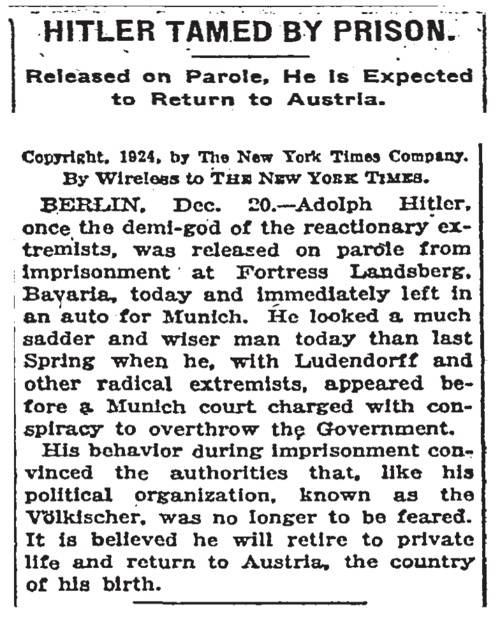
Worst. Punditry. Ever.

The New York Times, December 20, 1924 — 90 years ago today:


(via)

Saturday, March 2, 2013

The Holocaust was even worse than we thought

The New York Times explains:

[R]esearchers have cataloged some 42,500 Nazi ghettos and camps throughout Europe, spanning German-controlled areas from France to Russia and Germany itself, during Hitler’s reign of brutality from 1933 to 1945.

The figure is so staggering that even fellow Holocaust scholars had to make sure they had heard it correctly when the lead researchers previewed their findings at an academic forum in late January at the German Historical Institute in Washington. ...

The documented camps include not only “killing centers” but also thousands of forced labor camps, where prisoners manufactured war supplies; prisoner-of-war camps; sites euphemistically named “care” centers, where pregnant women were forced to have abortions or their babies were killed after birth; and brothels, where women were coerced into having sex with German military personnel.

Auschwitz and a handful of other concentration camps have come to symbolize the Nazi killing machine in the public consciousness. Likewise, the Nazi system for imprisoning Jewish families in hometown ghettos has become associated with a single site — the Warsaw Ghetto, famous for the 1943 uprising. But these sites, infamous though they are, represent only a minuscule fraction of the entire German network, the new research makes painfully clear.

The maps the researchers have created to identify the camps and ghettos turn wide sections of wartime Europe into black clusters of death, torture and slavery — centered in Germany and Poland, but reaching in all directions. ...

When the research began in 2000, Dr. Megargee said he expected to find perhaps 7,000 Nazi camps and ghettos, based on postwar estimates. But the numbers kept climbing — first to 11,500, then 20,000, then 30,000, and now 42,500.

The numbers astound: 30,000 slave labor camps; 1,150 Jewish ghettos; 980 concentration camps; 1,000 prisoner-of-war camps; 500 brothels filled with sex slaves; and thousands of other camps used for euthanizing the elderly and infirm, performing forced abortions, “Germanizing” prisoners or transporting victims to killing centers.

In Berlin alone, researchers have documented some 3,000 camps and so-called Jew houses, while Hamburg held 1,300 sites.

Dr. Dean, a co-researcher, said the findings left no doubt in his mind that many German citizens, despite the frequent claims of ignorance after the war, must have known about the widespread existence of the Nazi camps at the time.

“You literally could not go anywhere in Germany without running into forced labor camps, P.O.W. camps, concentration camps,” he said. “They were everywhere.”

Sunday, December 23, 2012

Growing class inequality in education

In a New York Times article with the headline "For Poor, Leap to College Often Ends in a Hard Fall," Jason DeParle writes:

Angelica Gonzales marched through high school in Goth armor — black boots, chains and cargo pants — but undermined her pose of alienation with a place on the honor roll. She nicknamed herself after a metal band and vowed to become the first in her family to earn a college degree.

Weekends and summers were devoted to a college-readiness program, where her best friends, Melissa O’Neal and Bianca Gonzalez, shared her drive to “get off the island” — escape the prospect of dead-end lives in luckless Galveston. Melissa, an eighth-grade valedictorian, seethed over her mother’s boyfriends and drinking, and Bianca’s bubbly innocence hid the trauma of her father’s death. They stuck together so much that a tutor called them the “triplets.”

Low-income strivers face uphill climbs, especially at Ball High School, where a third of the girls’ class failed to graduate on schedule. But by the time the triplets donned mortarboards in the class of 2008, their story seemed to validate the promise of education as the great equalizer.

Angelica, a daughter of a struggling Mexican immigrant, was headed to Emory University. Bianca enrolled in community college, and Melissa left for Texas State University, President Lyndon B. Johnson’s alma mater. . . .

Four years later, . . . [n]ot one of them has a four-year degree. Only one is still studying full time, and two have crushing debts. Angelica, who left Emory owing more than $60,000, is a clerk in a Galveston furniture store.

Each showed the ability to do college work, even excel at it. But the need to earn money brought one set of strains, campus alienation brought others, and ties to boyfriends not in school added complications. With little guidance from family or school officials, college became a leap that they braved without a safety net.

The story of their lost footing is also the story of something larger — the growing role that education plays in preserving class divisions. Poor students have long trailed affluent peers in school performance, but from grade-school tests to college completion, the gaps are growing. With school success and earning prospects ever more entwined, the consequences carry far: education, a force meant to erode class barriers, appears to be fortifying them.

“Everyone wants to think of education as an equalizer — the place where upward mobility gets started,” said Greg J. Duncan, an economist at the University of California, Irvine. “But on virtually every measure we have, the gaps between high- and low-income kids are widening. It’s very disheartening.”

The growing role of class in academic success has taken experts by surprise since it follows decades of equal opportunity efforts and counters racial trends, where differences have narrowed.
If the "experts" are so surprised, perhaps they should rethink their assumptions.

Tuesday, November 27, 2012

Warren Buffett's weird editorial on capital gains taxes

Normally, you'd expect a columnist who's claiming that a tax isn't going to have any deterrent effect to have to make an argument for why not. But when Warren Buffett writes an editorial for the New York Times, it seems to be good enough for him to say, in effect: Trust me, I'm rich!

Buffett wrote a similar NYT editorial last year.

Thomas Sowell has made the case for keeping capital gains taxes much lower than income taxes. Even the left-leaning Matthew Yglesias has supported that position, saying:

[T]his is definitely an issue where the conservative position is in line with what most experts think is the right course, and Democrats are outside the mainstream.
Maybe Sowell and Yglesias are wrong. But if they're wrong, there must be some reason why, and the reason isn't that Warren Buffett has more money than them.

Should we be so trusting of the super-rich in making claims about taxes? Or could it be that a multibillionaire like Buffett, who has a lifetime guarantee of  having more wealth than he could possibly spend, might be out of touch with the kinds of incentive effects that apply to most people?

Saturday, April 28, 2012

The killing of Osama bin Laden

The New York Times says:

President Obama is increasingly taking the unusual route of bragging about how he killed a man.
Well, that's one way to put it!

That's how I might expect a very far-left fringe candidate to describe our successful mission to kill the head of al Qaeda. The fact that this kind of approach is being used by mainstream Republicans like John McCain, as a proxy for Mitt Romney's presidential campaign, is surprising.

Tuesday, March 20, 2012

"Santorum Writings Voice Strikingly Consistent Views"

That's the New York Times' headline. The Times writes:

Over the last decade, Mr. Santorum has been a prolific writer of op-ed articles, letters to the editor and guest columns in some of the country’s largest and most influential newspapers. All the while he displayed many of the traits that define him as a presidential candidate today: a deep and unwavering Catholic faith, a suspicion of secularism and a conviction that the country was on a path toward cultural ruin.

A review of his columns and letters going back 10 years reveals a striking consistency in his conservative political views and spiritual guiding principles.
I guess his wife, Karen Santorum, knows him well.