(Full disclosure: I'm friends with Sarah Siskind, one of the writers and editors of this Reason video.)
Showing posts with label body. Show all posts
Showing posts with label body. Show all posts
Sunday, June 4, 2017
The war on breasts

Monday, October 26, 2015
"Too big for the industry"
This model, Agnes Hedengård, talks about being rejected for being "too big." Her BMI is 17.5, which is considered underweight.
Saturday, April 11, 2015
Friday, September 30, 2011
Could New Jersey Governor Chris Christie's weight help him in running for President?
Paul Campos argues that Christie's weight could help him, in addition to hurting him:
Few things are more powerfully gendered in mainstream American culture than body size: Fatness in general is considered bad—and to some extent feminizing—but it is a more complex characteristic in men, and especially powerful men, than it is among women. While it’s true that it is bad for a man to be fat, it is unquestionably good for a man—and most especially a socially powerful man—to be big. Our language encodes this judgment in countless ways: For leadership we look to the big man, the man of substance, the heavyweight contender, the man who can throw his weight around, and so on. In this sense, [John] Corzine’s ad mocking Christie [for "throwing his weight around" to get out of traffic tickets] was inadvertently reminding viewers of a powerfully positive characteristic of his opponent. Indeed, I would venture to guess that a short, slim man who wanted to run for president would face more difficulties in regard to the cosmetics of power than Christie.
In addition, Christie’s weight could help him in another way, especially in the GOP primaries. In the context of contemporary American politics, an unapologetically fat body, at least a fat male body (again, it should be obvious that putting 50 pounds on Michelle Bachmann or Sarah Palin would instantly destroy their presidential aspirations), could well function as a kind of symbolic flipping off of the endlessly intrusive nanny state, so despised by both libertarians and cultural conservatives. Of course, this puts someone like Christie in a bit of a practical bind, since in order to take advantage of this sentiment he has to stop being a “good” fat person—that is, he needs to become unapologetic about his body, rather than putting on the shame-ridden performance expected of fat people by the health police.
So is Christie too fat to be elected president, or to at least win the GOP nomination? In my view, the contemporary politics of fat are too complicated to draw that judgment.
Saturday, August 13, 2011
2 surprising pay gaps
1. Single men earn less money the heavier they are, while single women earn more money the heavier they are. (This is after controlling for several factors, including education, age, and whether they're raising young children.)
This might seem to counter the "perception that obese women are discriminated against in the job market far more than obese men."
But as economist Marina Adshade notes in her blog post, these facts might be due to the fact that heaviness is a more severe liability for women than for men in the dating market. Thus, heavy women have a stronger incentive to earn lots of money for themselves.
Clearly, being on the higher-income side of a pay "gap" doesn't necessarily show that you have an unfair advantage over the people on the lower-income side.
2. Lesbians earn more money than straight women.
The gap is about 40% before controlling for any of the factors that might contribute to the gap. And there are many such factors:
[L]esbian women are better-educated on average, are more likely to be white, live predominantly in cities, have fewer children, and are significantly more likely to be a professional. But even when you control for these differences, the wage premium is still on the order of 6%.Here's a very important insight from that second link, a post on a blog called Offsetting Behavior by economist Eric Crampton (I've changed Crampton's brackets to parentheses to be clear that I'm still quoting him):
[I]f correcting for the observables reduces the wage gap between lesbians and heterosexual women from around 40% (the paper cites average hourly wages of $18.70 for lesbians and $13.34 for cohabiting non-lesbian females) to around 5%, odds are pretty high that there are a bunch of unobservables also correlated with job performance that aren't captured in the wage regression.
More broadly: if you think it's implausible that employers love lesbians so much that they pay them extra for no good reason, then shouldn't you expect the same when looking at the male-female pay gap?
Tuesday, June 28, 2011
Talking to little girls without talking about looks
Some good advice and thoughts. "Not once did we discuss clothes or hair or bodies or who was pretty. It's surprising how hard it is to stay away from those topics with little girls, but I'm stubborn."
Tuesday, April 5, 2011
Is obesity caused by "food addiction"?
Medical News Today reports (via):
Some people really are addicted to foods in a similar way others might be dependent on certain substances, like addictive illegal or prescriptions drugs, or alcohol, researchers from Yale University revealed in Archives of General Psychiatry. Those with an addictive-like behavior seem to have more neural activity in specific parts of the brain in the same way substance-dependent people appear to have, the authors explained.Those researchers say:
It's a bit like saying that if you dangle a tasty chocolate milkshake in front of a pathological eater, what goes on in that person's brain is similar to what would happen if you placed a bottle of scotch in front of an alcoholic. . . .
The authors believe that no studies had so far looked into the neural correlates of addictive-like eating behavior.
One-third of American adults are now obese and obesity-related disease is the second leading cause of preventable death. Unfortunately, most obesity treatments do not result in lasting weight loss because most patients regain their lost weight within five years. Based on numerous parallels in neural functioning associated with substance dependence and obesity, theorists have proposed that addictive processes may be involved in the etiology of obesity.The article goes on to cite some scientific research, but it's all about the general phenomenon of food addiction. I'm not seeing any correlation or causation between the addiction and obesity.
Food and drug use both result in dopamine release in mesolimbic regions [of the brain] and the degree of release correlates with subjective reward from both food and drug use.
My question is: if food addiction is the real problem, aren't we all suffering from it?
Thursday, August 26, 2010
Media gimmicks I'd like to see banned
1. Beginning an article: "Unless you've been living under a rock . . ."
2. Depicting a weight-loss success story with a photo of someone holding up their old pants. Flattening out a pair of pants -- eliminating the front-to-back dimension and transferring it to the left-to-right dimension -- is going to exaggerate the width of any waistline.
Saturday, August 7, 2010
Men and women earn more money if they're tall and attractive — especially men.
"I thought looks mattered more in women," says Dr. Helen. "Apparently, not at work."
Here's a summary of the study to which she's referring:
A London Guildhall University survey of 11,000 33-year-olds found that unattractive men earned 15 percent less than those deemed attractive, while plain women earned 11 percent less than their prettier counterparts. In their report "Beauty, Productivity and Discrimination: Lawyers', Looks and Lucre," Hamermesh and Biddle found that the probability of a male attorney attaining early partnership directly correlates with how handsome he is.That's from this list of "7 Ways to Boost Your Pay." That title by CBS is rather misleading, since some of them aren't things you necessarily have any control over: women can't grow mustaches, and people can't change whether they're right-handed or left-handed.
One of the "7 Ways to Boost Your Pay" is "Walk taller," which is based on this research on height:
When it comes to height, every inch counts--in fact, in the workplace, each inch above average may be worth $789 more per year, according to a study in the Journal of Applied Psychology (Vol. 89, No. 3).As with attractiveness, though less surprisingly, height matters more for men than for women:
The findings suggest that someone who is 6 feet tall earns, on average, nearly $166,000 more during a 30-year career than someone who is 5 feet 5 inches--even when controlling for gender, age and weight.
The height-salary link was found by psychologist Timothy A. Judge, PhD, of the University of Florida, and researcher Daniel M. Cable, PhD, of the University of North Carolina. They analyzed data from four American and British longitudinal studies that followed about 8,500 participants from adolescence to adulthood and recorded personal characteristics, salaries and occupations. Judge and Cable also performed a meta-analysis of 45 previous studies on the relationship between height and workplace success.
Judge offers a possible explanation for the height bias: Tall people may have greater self-esteem and social confidence than shorter people. In turn, others may view tall people as more leader-like and authoritative.
"The process of literally 'looking down on others' may cause one to be more confident," Judge says. "Similarly, having others 'looking up to us' may instill in tall people more self-confidence."
As such, the biggest correlation between height and salary appeared in sales and management positions--careers in which customer perception has a major impact on success. If customers believe a tall salesperson is more commanding, for example, they may be more likely to follow the salesperson's wishes, Judge says.
Accordingly, height was most predictive of earnings in jobs that require social interaction, which include sales, management, service and technical careers. The height effect also mattered--though to a lesser degree--in other jobs such as crafts and blue-collar and clerical positions, researchers found.
The study also found that shorter men are slightly more likely to encounter height bias in the workplace than are shorter women. . . .Despite CBS's advice to "Walk taller," you don't have much control over how tall you are. You might be able to affect how tall you appear (which is presumably what matters in this context) by choosing your shoes. If you're under 18, you can eat a nutritious diet and not smoke. But your genes are the main factor.
Since men and women tend to differ in height, researchers controlled for gender by using the average height of 5 feet 9 inches for an American man and 5 feet 3 inches for a woman. They also controlled for age because people tend to lose 1 to 3 inches of their height during a lifetime.
When I was visiting family (including my three brothers) earlier this summer, we were talking about how height affect's one's life -- more in the context of dating/relationships than careers/money. I was asked how tall I'd like to be. I said 6'1" or 6'2". You get the main advantages of tallness without being so tall as to be potentially awkward or conspicuous, nor are you as likely to have people use "You're so tall!" or "How tall are you?" as a conversation-starter.
One of my favorite parts of the trip was when my 3 brothers and I had our heights measured (down to the quarter of an inch) by standing against my dad's kitchen wall and marking it with a pencil. As I thought (but it was nice to have it confirmed), I'm exactly 5'10". My brothers are 5'9 1/2", 5'9 1/4", and 5'3 1/2". (Respectively, we're 29, 27, 15, and 13 years old.) The 15-year-old will probably be taller than me the next time I see him. The 13-year-old kept changing the names next to the markings to make himself taller.
20/20 reported on an experiment that showed the profound effect of male height in dating:
Women will take just about any shortcoming in a man, except in the height department, according to Andrea McGinty, who founded the San Diego-based dating service It's Just Lunch.This was an insightful response to an AskMetafilter question about a 5'8" woman who was dating a shorter man and had misgivings about it. The woman who asked the question said she had "a hard time feeling physically attracted to someone shorter than me, largely because of how awkward I feel standing next to them in public . . . . Mostly I feel like a big hulking lump." The response:
McGinty helped ABCNEWS put together an experiment to test just how willing women are to date shorter men. We brought together several short men and asked them to stand next to taller men. We invited groups of women to look at the men and choose a date.
To see if the women would go for short guys who were successful, ABCNEWS' Lynn Sherr created extraordinary resumes for the shorter men. She told the women that the shorter men included a doctor, a best-selling author, a champion skier, a venture capitalist who'd made millions by the age of 25.
Nothing worked. The women always chose the tall men. Sherr asked whether there'd be anything she could say that would make the shortest of the men, who was 5 feet, irresistible. One of the women replied, "Maybe the only thing you could say is that the other four are murderers." Another backed her up, saying that had the taller men had a criminal record she might have been swayed to choose a shorter man. Another said she'd have considered the shorter men, if the taller men had been described as "child molesters."
This really stood out to me. As a fellow tall woman (I've actually got three inches on you!), I can relate to the self-consciousness about being tall, especially because "feminine" is so often coded as petite, small, and cute. I totally get how being taller than a dude can make you feel unsexy, because there's a [lot] of cultural programming that tells us how wonderful it is to be swept up in the embrace of a big, tall man, to be safe in his arms, blah blah blah. It can feel like a strange inversion of feminine and masculine, almost, to be taller than your honey. . . .
It might also be worth thinking about the fact that you're conflating "being attracted to a dude" and "feeling attractive while I'm with a dude." Those two things aren't the same, and a big part of my personal journey of accepting and lovin' my body was rejecting the idea that sexy was something I performed (that is, I felt sexy when other people looked at me like I was sexy), rather than something I felt.
Saturday, August 22, 2009
Is obesity a public-health problem, or are the upper class just imposing their eating disorders on the rest of us?
A complex, thought-provoking discussion by Megan McArdle and David Frum:
Thursday, May 14, 2009
The oldest known artistic depiction of a woman may also be the oldest known pornography.
It's this 35,000-year-old sculpture.
Paul Mellars, an anthropologist at the University of Cambridge, says:
"The figure is explicitly — and blatantly — that of a woman, with an exaggeration of sexual characteristics (large, projecting breasts, a greatly enlarged and explicit vulva, and bloated belly and thighs) that by twenty-first-century standards could be seen as bordering on the pornographic"....Here's a video segment about it.
So, what does this mean? It may have profound implications about the development of art and intelligence:
The oldest human art dates back much further, to between 75,000 and 95,000 years ago in Africa. But that art was abstract, and consisted of geometrical designs engraved on pieces of red iron oxide. This is the first known art to represent a woman, and possibly the first art to represent anything real at all....But let's get back to the sex...
The jump from abstract art to representative art ... might reflect a leap in the cognitive capacity of the human brain around this time. Some experts think that the development might have gone along with a leap in the complexity of human language.
"If there's one conclusion you want to draw from this, it's that an obsession with sex goes back at least 35,000 years," [said Mellars].... "But if humans hadn’t been largely obsessed with sex they wouldn’t have survived for the first 2 million years. None of this is at all surprising."
Friday, March 6, 2009
Michel Petrucciani (1962-1999)
I usually try to stick to just blogging music I'm pretty familiar with on Music Fridays. I admit that this week is an exception — I don't have any of Michel Petrucciani's albums, and I've mainly just listened to a few performances on YouTube. I have visited his grave in Paris, reverently located right next to that of another pianist — Chopin.
The New Republic's music critic David Hadju writes this idiosyncratic, vivid essay on Petrucciani, who died just over 10 years ago (January 1999) of a pulmonary infection resulting from osteogenesis imperfecta. That's a genetic condition that kept him around 3 feet tall and 50 pounds as an adult. He died in his 30s, which is another thing he has in common with Chopin.
From the article:
"He was in pain all the time," recalled his father, Tony Petrucciani, a part-time guitarist in the Grant Green mold. "He cried. I bought him a toy piano." The keyboard looked like a mouth to Michel, and he thought it was laughing at him, so he smashed it with a toy hammer, and his father got him an old full-size upright abandoned by British soldiers at a military base. From the age of four, Michel spent virtually all his free time, which was abundant, at the piano.I love this clip of him playing "Take the 'A' Train" with bassist Anthony Jackson and the acclaimed drummer Steve Gadd:
Petrucciani was twelve years old and looked like a toddler when his father started carrying him into jam sessions around the south of France. . . .
More from the article:
The first time I saw Michel Petrucciani, a friend of his was carrying him into Bradley's, the tiny piano-jazz club in Greenwich Village where I spent most of my nights and salary in the 1980s. . . . The bar crowd cleared a path from the door to the piano, and Petrucciani screamed, "Get out of my way, motherfuckers!" . . .Here he is playing "Caravan" alone:
"I've never been around anyone who loved to live like Petrucciani—and live life to the fullest," says Mary-Ann Topper, his manager during his breakthrough years in New York. "He said to me, 'Mary-Ann, I want to have at least five women at once, I want to make a million dollars in one night'—things that were probably impossible.
But had Michel ever thought that anything was impossible, he would have never done anything he did." As Petrucciani himself said, "I'm a brat. My philosophy is to have a really good time and never let anything stop me from doing what I want to do. It's like driving a car, waiting for an accident. That's no way to drive a car. If you have an accident, you have an accident—c'est la vie."
And here's "My Funny Valentine," with the great Jim Hall (the video is in 2 parts):

(Photo from Wikimedia Commons.)
UPDATE: More comments over here. One person says:
Wow. I love his take on "My Funny Valentine." So sublime.
His story makes a person appreciate life, in all of its imperfect forms.
And it makes you want to be a little easier on yourself, you know?
Friday, November 21, 2008
On women, men, and bodies
I wouldn't normally highlight a specific woman's body proportions, but Megan McArdle is someone who's been unusually explicit about hers. As she says in this Bloggingheads clip, she's 6'2" and 145 pounds, yet she can't shake the admittedly irrational belief — which she says "every other American woman" also holds — that her life would be better if only she lost 5 pounds:
She also says (as you can see in the video clip):
If I were an actress, I would have to lose 15 pounds, probably, to keep my jobs. And I'm really pretty skinny. . . Almost no one looks like me, and almost no one can look like this over the age of 19. I'm not saying that I'm amazingly gorgeous. In fact, I think that being that thin isn't really particularly attractive — to men. Women think it is.I remember seeing a study in one of my textbooks back in college. It found that men's views of the ideal female body type is, on average, about average. Women, of course, viewed the ideal female body type as much skinnier. You can find similar conclusions by Googling around (example: PDF). I wish I still had that textbook, though, because it not only stated the findings but also included realistic color illustrations of two women — one for men's ideal and one for women's. I wondered: if every woman in America could see these illustrations and absorb their significance, wouldn't we be living in a saner world, where the goal isn't always to keep losing more and more weight?
I don't mean to imply that women should only care what men think and not want to be attractive for themselves. It would be different if women were satisfied with a more realistic range of body types and men were the ones who wanted to see women get as skinny as possible. But since the opposite is the case — men are the less oppressive ones — I think it's fair to assume that something has gone wrong.
Where do women's misperceptions come from? The easy, politically correct answer is that "society" bombards women and girls with unrealistic images of supposedly ideal women. You know the drill: models in advertisements, Barbie's body proportions, etc.
First of all, speaking of unfair expectations, I think it's unfair to expect a doll to have proportions that would be realistic if they were blown up to the scale of a real adult. Isn't it possible that on a purely aesthetic levels, exaggerated proportions work better on a tiny scale?
More to the point, though, the "skinny models" explanation can't be true. Can it? Or at least, it's leaving a whole lot out.
Here's the problem: pick up a copy of Details magazine and look at the male models. Even though the articles are about macho topics like whisky, meat, and the military, the models are extremely svelte. I'm pretty skinny, but I'd have a very hard time if I were to try to conform to those body types.
At the other end of the spectrum, what about male action figures? People love to gripe about Barbie, but what about the dolls for boys? No one would argue that He-Man's muscles are a realistic, healthy standard for boys to aspire to.
We don't expect boys/men to be incapable of thinking through for themselves whether these are really the right standards. Yet it's considered the enlightened position to suggest that women are mere passive victims, hypnotized by whatever images the big bad "media" or "society" puts in front of them.
An aside: many liberals/feminists will rail against female genital mutilation — as well they should. But how many of them are upfront about the fact that it's primarily practiced by women? (One person who isn't upfront about this is Eve Ensler, who included a long piece in her famous play The Vagina Monologues about female genital mutilation, but oddly never mentioned who actually does it.)
Liberals/feminists will also rail against unrealistic female body ideals — as well they should. But could it be that the crux of the problem is women going after other women?
When I think about what kinds of body types straight guys really consider attractive, I think about two random exchanges I've had with some friends (both of these were situations where young guys were the only people in the room):
1. Four of us — old friends who had gone to college in different cities and were back home for winter break — were catching up with each others' lives. One of them was telling us about his new girlfriend. He said that she has a nice "medium" body, and that he's never been specifically focused on skinny girls. Two others said we felt the same way. The fourth guy disagreed, saying he's mainly just attracted to skinny girls.
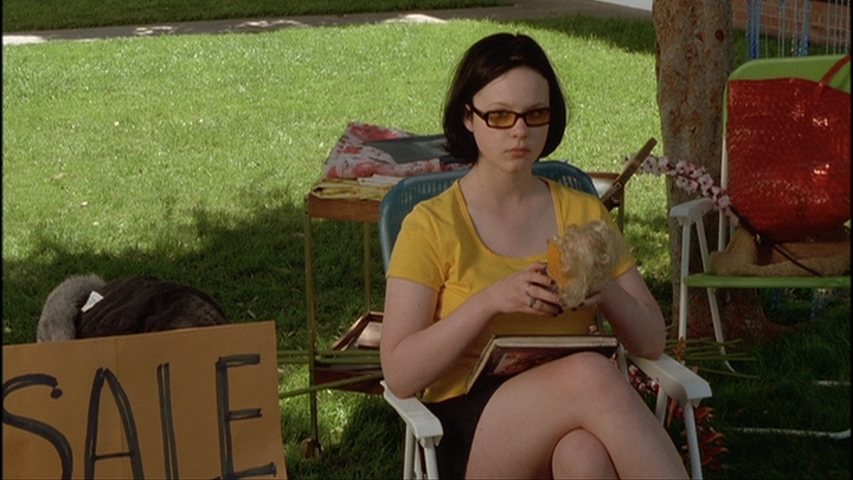
2. Three of us were watching the movie Ghost World. (Aside from me, these were different guys than the ones in the previous exchange.) Thora Birch isn't overweight by any means, but she's definitely curvier than the typical Hollywood actress in that movie. Two of us thought she was extremely attractive, but the other guy couldn't really see that.
That's the real world. Two-thirds of us (4 out of the 6 guys) didn't have a strong preference for especially skinny women.
Of course, this is completely anecdotal and unscientific, so I have no idea if my "two-thirds" conclusion is statistically accurate. But when I think about those conversations in light of the sociological studies, I have to conclude: most men are not fixated on skinniness as an essential criterion for female attractiveness. This isn't to deny that most men do find plenty of skinny women attractive, but just to say that it's not a requirement.
Of course there are some men who really do have an overwhelming interest in skinnier-than-average women. And that's just fine. There are also some men with an overwhelming interest in heavier-than-average women. That's fine too. But most men's tastes aren't so austere, in either direction.
Although, as I said, I make no moral judgment of men who are attracted to a relatively narrow range of body types, I do feel sorry for them, just as I feel sorry for women who insist on only dating men who are over 6 feet tall.
I don't object to the superficiality. Everyone cares about looks. Everyone is superficial. This isn't about trying to enforce some kind of rule that we have to be earnestly respectful toward "plus-size" women — which is doomed to be a joyless affectation if it's done out of a sense of duty. I just think that finding curvy women attractive is more fun for everyone concerned.
I'm writing this because it's on my mind, not to boost anyone's self-esteem. In fact, based on my experience, there's not much I can say to convince women that life isn't a contest where the goal is to be as skinny as possible. Whether women have that perception is not going to be affected by what I say. And it can't fairly be imputed to that imaginary scapegoat known as "society." The only one with the power to convince a woman she does have a beautiful body is the woman herself.
Monday, June 16, 2008
Why the silence about Tim Russert's weight problem?
Yesterday's Meet the Press was, of course, a tribute to Tim Russert. You can watch the whole show here.
As you can probably guess from my post about how shocked I was by Russert's death and how important the show was, I found it hard to watch at points. (I was talking to A____ yesterday, who told me: "I read your post on Tim Russert. Now I want to hug you and buy you a drink." Thanks! I'll take you up on that.)
If you watch starting just a few seconds before 46:00, you can see Tom Brokaw had a hard time getting through the show too.
The clip at the very end is just heart-breaking.
I thought the tribute was well-done overall, but I couldn't help but notice one omission.
When George Harrison or Peter Jennings died at a too-young-to-die age, every single reference to their death in the media was accompanied by "and he died because he was a smoker!"
Yet out of all the media coverage of Russert's death (and I've soaked up more than enough of it this past dreary weekend), I've seen only one reference to his weight problem:
Dr. Michael A. Newman, Mr. Russert’s internist, just told Andrea Mitchell that Mr. Russert had coronary artery disease, but no symptoms. He had done everything he was supposed to do to manage the disease, although his weight was a problem. The doctor said that such attacks can’t be anticipated, but a defibrillator can make a difference.
Now, I do think it's slightly crass to use someone's death as a springboard for lecturing the public about health, but I can accept that that's going to happen. There shouldn't be a rule that you're not allowed to mention a few of someone's faults as you're eulogizing them. And there's something to be said for the idea that if it saves a single life by prompting someone to quit smoking (for instance), it's worth it.
But what seems inexplicable is a double standard in which a famous person who's obviously very overweight can drop dead of a heart attack in his 50s, and no one in the media points out that his weight problem killed him.
If I had to come up with some principled basis for this, the one distinction would be: eating right is complicated. It's hard to know how to stay fit, and it's harder for some people than others. And it's not just eating, but also exercise, and some of it could be genetic, and so on.
Weight is also complicated by the fact that being underweight can be worse than the opposite. I would love to see Americans loosen up their attitudes about weight if it would reduce the incidence of anorexia and bulimia ... or if it would help people who might prefer to lose 10 or 20 pounds feel good about themselves the way they are.
So America's weight problem is complicated even though it's serious. Our smoking problem isn't just serious; it's simple. You shouldn't smoke at all, end of story. It's correct to say "The less smoking, the better," but it'd be idiotic to say "The less eating, the better" — or even "The more exercise, the better."
But let's face it. Smoking doesn't guarantee you'll die of cancer (or another smoking-related illness), just as obesity doesn't guarantee you'll die of a heart attack (or another obesity-related illness). They're both bad simply because they raise the risk of death.
It's not that smoking always leads to death; it's that it specifically caused George Harrison's death. And it's not that being severely overweight always leads to death; it's that it specifically caused Tim Russert's death.
So, I don't see the distinction.
According to Russert's doctor (from the same article linked above), he was very conscious of his heart disease and was trying to do something about:
Mr. Russert was managing his risk factors well, through diet and exercise. He had a stress test April 29, got to a high level of exercise and was pleased with himself. This very morning [the day he died], he was on his tread mill and was always excited about how he pushed himself.By all means, let's remember him and admire him as someone who was fighting against his problem. But let's not forget that it was a problem.
And another reason why it's worth bringing up: there are specific reasons to believe that Russert himself would have wanted us to talk about it.
What makes me think that? Well, a couple of instances:
1. I remember watching an episode of Meet the Press where the guest was Ralph Nader. Russert proactively brought up the fact that Nader had criticized Michael Moore for his weight problem. Nader — who, back in his pre-reprehensible days, was an impassioned advocate for consumer protection — put his criticism of Moore in the context of America's increasingly serious weight problem.
So, Russert himself was willing to have someone talk about the health consequences of someone's weight problem to his face. Granted, Nader didn't explicitly mention Russert's problem. But Russert was a smart guy — he knew what he was getting into by bringing up the subject.
2. On Russert's other show (The Tim Russert Show), he was showing clips of Johnny Carson, who had recently died. You could plainly see Carson smoking a cigarette in the clips. After each one, Russert would talk about how terrible it was: "He was addicted!" (He also mentioned that he, Russert, was never a smoker, and that his guest on the show, Mike Wallace, used to be a heavy smoker but had quit.)
So, Russert himself approved of the idea of using Carson's death as an opportunity to criticize his health practices.
As we've been hearing over and over since Friday, one of Russert's favorite things to do was exposing people's inconsistencies on important issues. Surely if Russert could see the coverage of his own death, he would point out — with his characteristic exuberance — the media's double standard.
Subscribe to:
Posts (Atom)