Obamacare’s supporters talked a lot about illnesses contributing to more than half of all bankruptcies, which implied there should have been a sharp decrease in 2014, when Obamacare’s major coverage provisions took effect. There wasn’t.
Obamacare’s supporters frequently cited America’s abysmal infant mortalityrate,
which implied that once Obamacare was in full swing, infant mortality
should decrease sharply. Itdidn’t.
Obamacare’s supporters claimed that tens of thousands of people were dying every
year because they didn’t have health insurance, which implied that by
2019, our overall mortality rate should be substantially lower than it
had been in 2009, with a noticeable kink around 2014. Instead, mortality
rates, which had been trending downward, leveled off around that time.
Obamacare’s supporters talked a lot about reducing health-care costs, or at least the rate at which they were growing. Sadly, no.
In 2011, Doug Elmendorf, head of the Congressional Budget Office, testified that by 2021, 24 million people would be buying their insurance on the Obamacare exchanges. … In
reality, the most recent data suggest it’s half that. …
That’s not to say Obamacare did nothing; the percentage of Americans who are uninsured has fallen from 16.7 percent in 2009 to 9.2 percent in 2019. … But even its most zealous boosters
should be willing to admit that the program the Supreme Court saved this
week is far from the revolutionary transformation its architects envisioned.
From movies, you’d think that when disaster strikes, people trample each other in their panic. But the greater risk is more often the opposite: People can’t quite believe. They ignore the fire alarm, defy the order to evacuate ahead of the hurricane, or pause to grab their luggage when exiting the crashed plane. Too often, they die.
One of 9/11’s most haunting details involves the South Tower, which was struck 17 minutes after the first. It seems likely that if people had started urgently evacuating right after the first plane hit, many of the 600 who died might have lived. But the standard evacuation plans called for emptying affected floors, not the entire 110-story building, and if a plane crashing into the North Tower wasn’t a normal kind of disaster, who could say how different it really was?
So the building’s director did the normal thing, waiting for the fire department or some other authority to order a broader evacuation.…
Calling the quest for normalcy a bias makes it sound bad, but most of the time this tendency is a good thing. The world is full of aberrations, most of them meaningless. If we aimed for maximal reaction to every anomaly we encountered, we’d break down from sheer nervous exhaustion.
But when things go disastrously wrong, our optimal response is at war with the part of our brain that insists things are fine. We try to reoccupy the old normal even if it’s become radioactive and salted with mines. We still resist the new normal — even when it’s staring us in the face.…
Nine months into our current disaster, I now see that our bitter divides over pandemic response were most fundamentally a contest between two ideas of what it meant to get “back to normal.”
One group wanted to feel as safe as they had before a virus invaded our shores; the other wanted to feel as unfettered. The disputes that followed weren’t just a fight to determine whose idea of normal would prevail. They were a battle against an unthinkable reality, which was that neither kind of normalcy was fully possible anymore.…
After a decent interval, we might have the time and perspective to sort out who was right and who was wrong, so we all can try to do better next time. Though I’m sure we’ll never agree on the whole truth of the pandemic, since no one person will ever know what that was.
Republican convention segments … strenuously implied that President Trump had taken the virus more seriously than Democrats … that he’d cut through bureaucratic red tape and PC nonsense to take bold action … that his resolve, plus a hefty dose of American greatness, have put the country in an enviable position, covid-wise.
Comparing Trump to the Pacific Rim, where the experience of SARS prepared countries for another viral outbreak, is perhaps not fair. Let’s compare him to Europe, where most governments made catastrophic errors.
Still, Trump managed to underperform.
Most European heads of government were slow to recognize the threat from covid; Trump was even slower, and only acted when the plummeting stock market left him no choice.
Many countries struggled to ramp up testing regimens; Trump placidly ignored bureaucratic infighting that left America functionally without testing capacity well into March, while the virus spread undetected and unhindered.
Most of those countries struggled to get their citizens to comply with social distancing measures; Trump actively encouraged Americans to defy them.
Most countries waited too long to tell citizens to mask up outside their homes; as late as Memorial Day, Trump ridiculed reporters for wearing masks.
Trump was not the only culprit here; plenty of mistakes were made by public health officials, and by Democratic mayors and governors. But a great Republican president would have worked to overcome those lower-level failings. Instead, our Republican president exacerbated the shortcomings at every juncture with denial, indecision and belligerence. Even his most touted “accomplishment,” the travel bans, were executed late and ineptly. [Link is to a Washington Post article from May 23.]
A truthful assessment of the U.S. performance against covid-19, even one that aimed for maximum charity toward Trump, would not tout “American greatness.” It would say, “Well, at least we’re not the absolute worst in the industrialized world.” At least four developed countries have lost a higher fraction of their population to covid-19: Sweden, Italy, Spain and Britain. The gap between worst-in-class Britain and the United States is modest but significant: The United States has lost about 1 in 1,900 citizens to covid, while the United Kingdom has lost about 1 in 1,600.
But the UK death rate peaked in April and has fallen to roughly 16 per day. The U.S. daily death rate also peaked in April — and then plateaued near 1,000.
That cumulative difference is steadily closing our gap with other countries we outperformed in the spring. U.S. deaths per 100,000 residents have already overtaken those of France and Switzerland, and unless something changes by Election Day, we will be, by far, the worst-afflicted country in the rich world. Economically as well as physically.
Trump’s machine can spin all sorts of explanations as to why that isn’t Trump’s fault, much as predecessors came up with all sorts of arguments why George W. Bush wasn’t to blame for the devastation of Hurricane Katrina or the financial crisis. Many of those arguments were even valid, but all of them were irrelevant come election time. When things go badly wrong on your watch, the public won’t risk more of the same.
Any American who has spent much time around visiting Europeans has probably had some version of this conversation: "Why do you use so much air conditioning?" they ask. "Your buildings are ridiculously cold. I have to wear a sweater inside in the summer! And it's bad for the environment. You shouldn't do that." . . .
For Europeans reading this, I may actually be able to clear up this baffling issue: Americans use air conditioning more because America is a lot hotter than Europe is. . . .
I've lived through heat waves in Northern Europe, which cause much the same hysteria that we see in Washington when two inches of snow is forecast. Because we have air conditioning, Americans do not have to panic when the mercury rises. Nor do we have incredible fatalities among the old and vulnerable when they happen. . . .
You could argue that if Americans had not migrated en masse from the temperate north to the blistering sunbelt, we would need less energy for climate control. You could argue that, but you'd be wrong. Americans still expend much more energy heating their homes than cooling them. . . . On average, the move from cold areas to warm ones has actually saved energy, not caused us to use more.
Let me make my position clear: In situations with a generic singular antecedent, "they" is not OK. It is preferable. The attempted abolition of singular "they" was a hypercolossal blunder by 18th- and 19th-century fusspots who thought grammar should follow the same sort of simple rules as a steam engine, that Latin and Greek grammars were a good model for English diction, and that in public-facing activity, men absorbed the women in their circle like a sort of social sponge. We should stop perpetuating their error. We should rip this rule from our grammar texts and obliterate it from our stylebooks. We should fling it down and dance upon it.
In the last five years, the odds of an American being killed in a terrorist attack have been about 1 in 20 million (that’s including both domestic attacks and overseas attacks).
I can right now think of several terrorist strategies which would kill a lot of people and be nearly impossible to defend against. I'm not going to offer terrorists any ideas, but here's one that's already been tried: the DC sniper. They were caught only because they were too poor to switch the cars they were shooting from; a slightly better bankrolled effort could have effectively gone on forever. And you can't really imagine how you'd re-engineer America to defend against such attacks.
So why don't they happen more? The most convincing answer I've gotten to that question is that fostering terror is only one of the aims of a terrorist attack. These attacks also function as recruiting, and as fundraising promotions for your terrorist organization. There are what you might [call] business considerations, in other words, and those business considerations dictate the kinds of attacks that terrorists want to carry out.
Thank God, randomly shooting one person every week or so does not satisfy the business plan. Terrorists want large, splashy attacks on specific sorts of targets that have high emotional resonance for both the victims and the people on your side who you hope to recruit, or tap for money. This helps explain why Al Qaeda was so obsessed with the Twin Towers, a place that--until they fell--most New Yorkers regarded as a rather ugly landmark containing some so-so office space. To a terrorist group looking for publicity, on the other hand, it had immense symbolic value: the tallest building in America's biggest city, with the hubristic name of "World Trade Center".
That's why we don't get high-frequency, low-intensity attacks on crowded spaces near some Texas town that no one in Abottabad has ever heard of. When attacks on those places happen, they tend to be the provenance of local lunatics for whom the nearby mall, or primary school, has some immense symbolic emotional importance.
And thankfully, there are not nearly as many lunatics as there are schools, or malls, or even marathons. That's why most of our public spaces are safe from mad bombers--and I'm glad to say, why they will remain so.
College improves your earning prospects. So does marriage. Education makes you more likely to live longer. So does marriage. Yet while many economist [sic] vocally support initiatives to move more people into college, very few of them vocally favor initiatives to get more people married. Why is that ... ? ...
[A]ll economists are, definitionally, very good at college. Not all economists are good at marriage. Saying that more people should go to college will make 0% of your colleagues feel bad. Saying that more people should get married and stay married will make a significant fraction of your colleagues feel bad. And in general, most people have an aversion to topics which are likely to trigger a personal grudge in a coworker.
The whole post is worth reading, but here's a sample:
A number of people have claimed that the government had to make these loans because they're "too risky" or "too big" for the private sector, forcing the government to act as a VC firm. That riskiness means that yes, a non-insubstantial number of the loans will fail.
But this doesn't really make any sense. The private sector doesn't have any trouble dealing with risky ventures; it simply prices the capital accordingly, demanding high interest rates, or a larger equity chunk, in exchange for money. . . .
[A]t the company level, there's no difference between an optimal market outcome, and an optimal social outcome (from the DOE's point of view); both investors and society benefit if more solar cells are sold. If the solar cells are unlikely to be sold to many people, than the loan guarantee is not a good idea — it will not foster much environmental benefit. If the solar cells are likely to be sold to many people, than the loan guarantee should not be needed; private investors should be easily found to back the manufacturing.
Megan McArdle asks the question, and she gives some answers from a financially savvy friend of hers and also from a Solyndra insider.
McArdle concludes:
I don't think this is going to end up being a story about corruption. I think it's going to end up being a story about bad decision making: at Solyndra, among its investors, and in the Obama administration. People took large bets with low expected values, because the alternative was admitting that the money they'd already spent was gone, and not coming back. They doubled down, just like some chump who lost his stake at the Vegas blackjack tables.
This does happen in the private market, of course. The difference is, when Argonaut Ventures takes a flyer on a longshot, they're not doing so with my money. The administration was supposed to have the economic dream team. Couldn't they have spared a moment to sit down with the folks at DOE and explain the concept of sunk costs?
Here are some highlights from that second link (by Megan McArdle):
The infrastructure stuff will be fine, if we choose good projects--America needs roads and airports and so forth. But as we discovered with the previous round, the better the project, the worse the stimulus. There are no terrific infrastructure projects sitting around, waiting to break ground next week . . . nay, not even if we streamline the regulatory red tape.
For that matter I'm not even sure that the president has the authority to streamline most of that red tape, and I'm highly skeptical that Congress is going to get busy undoing several decades worth of environmental and anti-corruption protections. So most of that $100 billion is not going to be spent next year--presumably, even the school rehab is going to have to wait until summer, when what we need is jobs right now. . . .
She also points out that Obama hasn't proposed any way to pay for the plan. She quotes from Obama's speech:
The agreement we passed in July will cut government spending by about $1 trillion over the next ten years. It also charges this Congress to come up with an additional $1.5 trillion in savings by Christmas. Tonight, I'm asking you to increase that amount so that it covers the full cost of the American Jobs Act. And a week from Monday, I'll be releasing a more ambitious deficit plan -- a plan that will not only cover the cost of this jobs bill, but stabilize our debt in the long run.
Then she quotes a Twitter post, summing up Obama's message to Congress:
"Here's the deal: I take credit for the new spending now; you take credit for making politically unpopular cuts later."
McArdle adds:
This is becoming a signature move for Obama. . . .
But it's hardly been a rousing success when Democrats tried to maneuver the Republicans into putting their sticky little fingerprints all over the unpopular parts of their plans while taking credit for the successes, which is what this boils down to. During the speech, Justin Wolfers tweeted to the effect that the GOP wouldn't dare vote against these hard-to-dislike provisions. I take it that this sentiment is common among liberals, who expressed approval that Obama was finally taking it to Republicans.
I'm less sure. For one thing, they've got a legitimate critique: it isn't paid for. Of course, if you want more stimulus, you don't want it to be paid for next year . . . but it isn't paid for at all. Select committees are turning into the Laffer Curve of the left: every time you want more money to pay for something, assign a committee to make unspecified cuts years in the future.
Republican complaints that the spending will happen and the pay-fors won't aren't unreasonable, and I suspect they'll get some traction with independents.
In the past 24 hours, I've seen this "quote" posted by many different people in my Facebook feed, apparently as a counterreaction to the celebration of the death of bin Laden:
"I mourn the loss of thousands of precious lives, but I will not rejoice in the death of one, not even an enemy. Returning hate for hate multiplies hate, adding deeper darkness to a night already devoid of stars. Darkness cannot drive out darkness: only light can do that. Hate cannot drive out hate: only love can do that." — Martin Luther King, Jr.
[I]t's a bit too a propos. What "thousands" would King have been talking about? In which enemy's death was he supposed to be rejoicing? . . .
In fairness, the rest of the quote was really said by King (repeatedly, as documented by Wikiquote). But that's no excuse for opportunistically fabricating the one sentence.
McArdle goes on:
What's fascinating is the speed of it. Someone made up a quote, attributed it to MLK jr, and disseminated it widely, all within 24 hours. Why? What do you get out of saying something pithy, and getting no credit for it?
Perhaps they only wanted to say this thing, and knew that no one would pay attention unless it came from someone else. Or, perhaps they are getting a gargantuan kick out of seeing people repeat their lie ad infinitum.
This New York Times article has gotten a lot of attention for raising that question (by focusing on Jonathan Haidt, who's concerned about the underrepresentation of conservatives even though he himself is a liberal).
Conservatives are usually reluctant to agree that women and minorities are still often victims of structural or personal bias--despite numerical underrepresentation and some fairly compelling studies showing that hiring is not race or gender blind. Yet when it comes to conservatives in academia, they suddenly sound like sociologists, discussing hostile work environment, the role of affinity networks in excluding out groups, unconscious bias, and the compelling evidence from statistical underrepresentation.
Meanwhile, liberals, who are usually quick to assume that underrepresentation represents some form of discrimination--structural or personal--suddenly become, as Haidt notes, fierce critics of the notion that numerical representation means anything. Moreover, they start generating explanations for the disparity that sound suspiciously like some old reactionary explaining that blacks don't really want to go into management because they're much happier without all the responsibility. Conservatives are too stupid to become academics; they aren't open new ideas; they're too aggressive and hierarchical; they don't care about ideas, just money. In other words, it's not our fault that they're not worthy.
Besides, liberals suddenly argue, we shouldn't look for every sub-population to mirror the composition of the population at large; just as Greeks gravitated towards diners in 1980s New York, and the small market business was dominated by Koreans, liberals are attracted to academia, and conservatives to, well, some other profession.
Part of what's going on here is that everyone wants to point out the hypocrisy of people who are on the other side from them. But hypocrisy often cuts both ways: if your opponents are taking positions that directly contradict each other, and both of them are the exact opposite of what you believe, then doesn't that imply that you're also taking contradictory positions?
Every once in a while you get stories like this one, about the underrepresentation of conservatives in academics, that treat ideological divides as being somehow equivalent to racial differences. This is a really, really bad analogy.
And it's not just the fact that you can choose your ideology, but not your race. Ideologies have a real effect on overall life outlook, which has a direct impact on job choices.
McArdle has an apt response:
I have no idea what distinction one is supposed to make between beliefs and something you "can't change". Could Paul Krugman become a devout Baptist and a supply sider tomorrow, if the financial incentives were right? I devoutly hope not. I presume that Paul Krugman . . . could no more change his beliefs than he could change his native language. It is easier (in most cases) to pretend different ideas than a different race--but we rightly think that it was horrific to force blacks to "pass" as a condition of being treated like a full human being.
But what about Krugman's other point that's supposed to show how ideology-based discrimination is nothing like race-based discrimination? "Ideologies have a real effect on overall life outlook, which has a direct impact on job choices." Oh. But wait a minute . . . how exactly does that show that there's no analogy between ideology and race/gender? Is Krugman trying to say that that gender and race have no correlation to job choices? I don't see why he'd assume that. As for gender, well, men and women are different in many ways; you'd have to be pretty naive to be shocked at the possibility that certain jobs are more appealing to men while others are more appealing to women. Race may be trickier, but should we really assume that race isn't correlated with job choices?
Krugman (a Nobel Prize-winning economist) seems to be doing some awfully sloppy thinking here, and McArdle is right about the shameless hypocrisy on both sides.
I also wonder if Krugman considered that the fact that ideology does have to do with different outlooks on life (as he says) makes ideological discrimination a particularlybad thing. If academics tend to dogmatically shut out certain outlooks and privilege others, so much the worse for academia.
IN THE COMMENTS: LemmusLemmus says, agreeing with that last paragraph:
One often hears the argument for affirmative action for African Americans in academia that it enriches discussion because African Americans contribute a different perspective on issues (which can be relevant at least in the social sciences and some humanities). And that's not true of conservatives? Ha!
ADDED: A commenter on Krugman's post sums up what I imagine is the real thinking behind the liberal reaction to this topic:
Besides, Paul, people who disagree with you are stupid, right?
Can't have stupid people teaching. They're too stupid!
Dan Drezner and Megan McArdle notice that the Republican Party's Pledge to America repeats the same incoherent set of positions we've been getting from the Democratic and Republican sides for decades:
1. We can't raise taxes.
2. We can't cut military or entitlement spending.
3. We have to reduce the deficit.
As Drezner says: "Good luck with that."
McArdle has a good rebuke to Tea Partiers who claim to be passionately opposed to the high deficit:
That's sort of like saying, "I want to be a size 6 and run marathons. I just don't want to do the part where I stop eating and go running."
In essence, what [the House Republicans] say [in the Pledge to America] is, “Deficits are a terrible thing. Let’s make them much bigger.” The document repeatedly condemns federal debt — 16 times, by my count. But the main substantive policy proposal is to make the Bush tax cuts permanent, which independent estimates say would add about $3.7 trillion to the debt over the next decade — about $700 billion more than the Obama administration’s tax proposals.
True, the document talks about the need to cut spending. But as far as I can see, there’s only one specific cut proposed — canceling the rest of the Troubled Asset Relief Program, which Republicans claim (implausibly) would save $16 billion. That’s less than half of 1 percent of the budget cost of those tax cuts. As for the rest, everything must be cut, in ways not specified — “except for common-sense exceptions for seniors, veterans, and our troops.” In other words, Social Security, Medicare and the defense budget are off-limits.
So what’s left? Howard Gleckman of the nonpartisan Tax Policy Center has done the math. As he points out, the only way to balance the budget by 2020, while simultaneously (a) making the Bush tax cuts permanent and (b) protecting all the programs Republicans say they won’t cut, is to completely abolish the rest of the federal government: “No more national parks, no more Small Business Administration loans, no more export subsidies, no more N.I.H. No more Medicaid . . . No more highway construction. No more homeland security. Oh, and no more Congress.”
HE dumps salt on almost everything, even saltine crackers. He devours burnt bacon and peanut butter sandwiches. He has a weakness for hot dogs, cheeseburgers, and fried chicken, washing them down with a glass of merlot. ...
Mayor Michael R. Bloomberg has become New York City’s nutritional nag, banning the use of trans fats, forcing chain restaurants to post calorie counts and exhorting diners to consume less salt. Now he is at it again, directing his wrath at sugary drinks in a new series of arresting advertisements that ask subway riders: “Are you pouring on the pounds?”
But an examination of what enters the mayoral mouth reveals that Mr. Bloomberg is an omnivore with his own glaring indulgences, many of them at odds with his own policies. And he struggles mightily to restrain his appetite. ...
[H]e is obsessed with his weight — so much so that the sight of an unflattering photo of himself can trigger weeks of intense dieting and crankiness, according to friends and aides. ...
Under his watch, the city has declared sodium an enemy, asking restaurants and food manufacturers to voluntarily cut the salt in their dishes by 20 percent or more, and encouraging diners to “shake the habit” by asking waiters for food without added salt.
But Mr. Bloomberg, 67, likes his popcorn so salty that it burns others’ lips. (At Gracie Mansion, the cooks deliver it to him with a salt shaker.) He sprinkles so much salt on his morning bagel “that it’s like a pretzel,” said the manager at Viand, a Greek diner near Mr. Bloomberg’s Upper East Side town house.
Not even pizza is spared a coat of sodium. When the mayor sat down to eat a slice at Denino’s Pizzeria Tavern on Staten Island recently, this reporter spotted him applying six dashes of salt to it.
A health tip sheet from the mayor’s office tells New Yorkers to “drink smart” by choosing water, even though Mr. Bloomberg has a three- to four-cup-a-day coffee habit.
“I can count on two hands the number of times I have seen him drink water,” said one dining companion ...
On the other hand, I find it a little disturbing that the Bloomberg piece is even considered a news story. It reminds me of how people love to point out that Al Gore and Thomas Friedman don't do the best job of minimizing their own carbon emissions. But how does that undermine their ideas about what's in store for the planet? Whether you agree or disagree with their views on climate change, their personal habits are a distraction from the real issues.
We have clashing expectations for politicians. It's politically poisonous for them to show any enthusiasm for arugula, endives, or dijon mustard, yet they're not supposed to eat too much fast food. The article is illustrated with a photo of Bloomberg eating a slice of cheese pizza (part of a whole "slideshow" of Bloomberg eating food), but people would be more critical if the mayor of NYC didn't go around eating pizza. If he had an impeccably healthy diet, people would criticize him for being a fanatical health nut trying to impose his personal regimen on the whole city.
The Bloomberg article is currently one of the "most blogged" and "most emailed" NYT articles. Of course, part of why so many people are talking about it is that it's just funny, and it lets bloggers use headings like: "Bloomberg to NYC: 'Stop Eating All My Salt.'" But are people truly concerned about Bloomberg's hypocrisy?
I suspect we're quietly gleeful at the chance to see our elected officials show that they're flawed, human, impetuous. It might not be far off from what happened to Bill Clinton, John Edwards, Mark Sanford, et al. For some reason, we're vaguely titillated by the idea of a politician who's unable to resist temptation.
George Will and Megan McArdle take issue with the Census Bureau's figure from 2008 that 46 million Americans are in need of health insurance. They also disagree with President Obama's statement in his speech to Congress last week that there are "more than 30 million American citizens who cannot get coverage." Will estimates that there are "perhaps 20 million persons who are protractedly uninsured." McArdle suggests that a better statistic would be "more than 15 million" Americans.
The debate over these statistics can be a red herring. There's a reason why conservatives and libertarians are taking a different stance on how to interpret the statistics than liberals. You can't interpret the data without expressing your ideology. If you're a liberal, you're likely to view the number of Americans without insurance as a crucial fact, maybe the most important fact in the whole health-care debate. If you're a conservative, you're likely to see that statistic as a smokescreen covering up the reality of the situation.
For instance, Will thinks the statistics are misleading because they gloss over the transitory nature of being insured. He says the 46 million figure is just
a "snapshot" of a nation in which more than 20 million working Americans change jobs every year. Many of them are briefly uninsured between jobs. If all the uninsured were assembled for a group photograph, and six months later the then-uninsured were assembled for another photograph, about half the people in the photos would be different.
But Will bizarrely implies that his observation only mitigates the problem. It's arguably worse than the statistics suggest, since a "snapshot" fails to convey the fact that people who are insured right now need to worry about whether they'll be insured in the future. Wright points out:
When just looking at a two-year period, far more people--nearly 1 in 3--find themselves uninsured.
It's understandable that opponents of health-care reform want to make the number of uninsured seem as insignificant as possible by quibbling over which ones we should really be counting. (Illegal immigrants? Legal immigrants? Poor people who aren't on Medicaid? Households making $75,000? $50,000?) It might be comforting, as Wright puts it, "to "think of the uninsured as a discrete population, one that can be marginalized." But the real problem is much broader: our health care is contingent on something as unreliable as employment, with only an incomplete safety net for Americans in need. Those of us who feel strongly that this is a grave problem aren't going to have our minds changed by the pseudo-statistical debate over how many uninsured Americans actually matter.
That seems to be the question everyone on the blogosphere is talking about, due tothis Washington Post article, which is based on 13 interviews with parents who killed their children in the same way: driving to the parent's destination, forgetting to drop the kid off somewhere, and leaving the kid in the hot car for a long time. (There should really be a warning on that article for the benefit of those who don't feel like running into a graphic description of a child slowly dying.)
More details:
"Death by hyperthermia" is the official designation. When it happens to young children, the facts are often the same: An otherwise loving and attentive parent one day gets busy, or distracted, or upset, or confused by a change in his or her daily routine, and just... forgets a child is in the car. It happens that way somewhere in the United States 15 to 25 times a year, parceled out through the spring, summer and early fall.
So, should this be a crime? The Pulitzer Prize-winning Washington Post writer, Gene Weingarten, says:
There may be no act of human failing that more fundamentally challenges our society's views about crime, punishment, justice and mercy. According to statistics compiled by a national childs' safety advocacy group, in about 40 percent of cases authorities examine the evidence, determine that the child's death was a terrible accident -- a mistake of memory that delivers a lifelong sentence of guilt far greater than any a judge or jury could mete out -- and file no charges. In the other 60 percent of the cases, parsing essentially identical facts and applying them to essentially identical laws, authorities decide that the negligence was so great and the injury so grievous that it must be called a felony, and it must be aggressively pursued.
There's a lot of talk about how these things aren't "intentional"; they're "accidents." One parent told Weingarten:
"I don't feel I need to forgive myself, because what I did was not intentional."
But that doesn't mean the act isn't illegal. Not all crimes are intentional. There are crimes based on "recklessness" or "negligence."
A lot of people have a strong emotional reaction that parents who do this shouldn't be prosecuted. Emotion can be a useful guide to what's right, but it's also important to step back and analyze it. Why do people have that reaction? Is it because the article starts out describing the agony of a particular father who did this, with a touching photo of the man holding his lost child's stuffed animal and looking overwhelmed with sadness?
Well, what if you were the parent ... and your babysitter did this to your child? Would you want the babysitter to be charged with a crime (assuming they're over 18)? It would hardly seem principled to have a rule that parents are legally allowed to do this to their children but babysitters aren't allowed to do it to other people's children.
To me, the decisive factor is the "lifelong sentence of guilt far greater than any a judge or jury could mete out." No matter what technical argument might be made about how prosecutors could legally charge the parent with a crime, that doesn't mean they have to do so. Living with the guilt is punishment enough; it seems like a waste of resources to make the parent also serve a prison sentence, even a light one.
Another problem, though: this is a well-crafted article that describes the parents as sympathetic and loving. But there are parents who neglect their children because they routinely get drunk or high. I haven't seen any evidence to show that any such parents have caused their children to die by leaving them in cars, but it's possible. Should prosecutors treat those parents differently from "normal" parents?
Many people are outraged at the parents: "How could you possibly forget your child in the car?!" I actually think it's disturbingly easy to imagine this. Can't you think of a time when you told yourself, "I have to do tasks A, B, C, and D in the next hour," then felt assured that you did everything you were supposed to, only to realize hours later that you never did task B? Well, imagine doing that, but task B is dropping your kid off at day care.
Megan McArdle has a good retort to the people who have that outraged reaction:
[T]he belief that you cannot possibly leave your kids in a car seat on a warm day is very dangerous to your kids. It is a virtual certainty that someone who read that article, and said to himself "That's BS--I could never leave my kid in a parked car"--will leave their kid in a parked car. It is the people who are afraid of it, who think that they could do the unthinkable, who are most likely to avoid that fate.
The Washington Post article quotes Ed Hickling, an Albany, NY psychologist, explaining why people have this reaction:
"We are vulnerable, but we don't want to be reminded of that. We want to believe that the world is understandable and controllable and unthreatening, that if we follow the rules, we'll be okay. So, when this kind of thing happens to other people, we need to put them in a different category from us. We don't want to resemble them, and the fact that we might is too terrifying to deal with. So, they have to be monsters."
Interestingly, the author admitted after publishing the piece that he had a blatant bias in writing the article. No, he didn't kill his child. But by his own admission (published in this Q&A published shortly after the article), he almost did. He would have left his infant in a locked car -- in the summer, in Miami -- but his daughter Molly happened to say something right before he was going to get out. Before then, he had no idea she was still there. He adds:
I did not tell my wife about that moment in the parking lot, not for years, not until half a year ago when I began working on this story and needed to explain why it was keeping me awake nights. And I didn't tell Molly about it until just a couple of months ago; oddly, I found that 25 years after the day no harm was done, I couldn't look her in the eye.
So, can this be stopped? Some people suggest car alarms. Well ...
there is the Chattanooga, Tenn., business executive who must live with this: His motion-detector car alarm went off, three separate times, out there in the broiling sun. But when he looked out, he couldn't see anyone tampering with the car. So he remotely deactivated the alarm and went calmly back to work.
The author (again, in the Q&A) has a suggestion that seems more useful:
[Make] sure that daycare centers ALWAYS call the parent if the child doesn't arrive one day.
I have very little confidence that people have actually figured out whether this thing is going to work. Now, that doesn't mean it's a bad idea -- maybe we should try out a gamble even if it might very well not work, because that'd be better than doing nothing.
But why don't we find a middle ground where we spend some of it -- say, 100 billion dollars -- then study what effects it's having and decide what to do next?
Full disclosure, I don't really know what I'm talking about. If there's some reason it has to be done this way, then please explain why in the comments. I'd be curious to hear why I'm wrong. [UPDATE: A commenter has taken me up on this.]
This piece shows how much money we spent on other major projects. For instance, the Marshall Plan to rebuild Europe after World War II cost the equivalent of $115 billion in today's dollars. In other words, we could start out spending a historically enormous amount of money, while still spending just a tiny fraction of the $800-billion figure.
I was thinking about this after watching Megan McArdle's hour-long rant against the stimulus:
I especially like how she takes down the idea of economists as experts. Key points:
(1) Economists have never tested their theories that supposedly support the stimulus, because it would be impossible to do so. Any historical parallels are too different from the current situation. So there are too many confounding variables to be able to draw a scientific conclusion.
(2) Even if McArdle is wrong about that, the way economists could prove her wrong would be to make specific predictions about what effect the stimulus will have, and stake their professional reputations on it. She says none of them will do that.
Ah, but they talk about this paper, which does make predictions. Isn't that a counterexample? Well, I don't think so. Are those economists really going to accept any personal consequences if their predictions turn out to be wrong? I assume they'd say either that unexpected contingencies got in the way, or the stimulus wasn't enacted in the exact way they would have liked. And sure enough, the paper savvily includes this paragraph, loaded with caveats:
It should be understood that all of the estimates presented in this memo are subject to significant margins of error. There is the obvious uncertainty that comes from modeling a hypothetical package rather than the final legislation passed by the Congress. But, there is the more fundamental uncertainty that comes with any estimate of the effects of a program. Our estimates of economic relationships and rules of thumb are derived from historical experience and so will not apply exactly in any given episode. Furthermore, the uncertainty is surely higher than normal now because the current recession is unusual both in its fundamental causes and its severity.
Translation: "Don't blame us if it doesn't turn out the way we said it would."
Of course, if the stimulus is enacted and has fantastic results, you can bet they'll say, "See, we told you it would work."
Karl Popper said people who claim to be scientific but don't make falsifiable predictions are engaging in pseudo-science. So, isn't economics a pseudo-science?
And if a pseudo-science is the main authority for people's belief that the stimulus is a good idea, then we should be a lot more cautious than we're being. A trillion dollars -- which, as Sen. Mitch McConnell correctly pointed out, is more than the amount you'd spend if you spent a million dollars a day from the supposed birth of Jesus to now -- just seems like way too much moneyto blow in one shot on a wild gamble.
I wouldn't normally highlight a specific woman's body proportions, but Megan McArdle is someone who's been unusually explicit about hers. As she says in this Bloggingheads clip, she's 6'2" and 145 pounds, yet she can't shake the admittedly irrational belief — which she says "every other American woman" also holds — that her life would be better if only she lost 5 pounds:
She also says (as you can see in the video clip):
If I were an actress, I would have to lose 15 pounds, probably, to keep my jobs. And I'm really pretty skinny. . . Almost no one looks like me, and almost no one can look like this over the age of 19. I'm not saying that I'm amazingly gorgeous. In fact, I think that being that thin isn't really particularly attractive — to men. Women think it is.
I remember seeing a study in one of my textbooks back in college. It found that men's views of the ideal female body type is, on average, about average. Women, of course, viewed the ideal female body type as much skinnier. You can find similar conclusions by Googling around (example: PDF). I wish I still had that textbook, though, because it not only stated the findings but also included realistic color illustrations of two women — one for men's ideal and one for women's. I wondered: if every woman in America could see these illustrations and absorb their significance, wouldn't we be living in a saner world, where the goal isn't always to keep losing more and more weight?
I don't mean to imply that women should only care what men think and not want to be attractive for themselves. It would be different if women were satisfied with a more realistic range of body types and men were the ones who wanted to see women get as skinny as possible. But since the opposite is the case — men are the less oppressive ones — I think it's fair to assume that something has gone wrong.
Where do women's misperceptions come from? The easy, politically correct answer is that "society" bombards women and girls with unrealistic images of supposedly ideal women. You know the drill: models in advertisements, Barbie's body proportions, etc.
First of all, speaking of unfair expectations, I think it's unfair to expect a doll to have proportions that would be realistic if they were blown up to the scale of a real adult. Isn't it possible that on a purely aesthetic levels, exaggerated proportions work better on a tiny scale?
More to the point, though, the "skinny models" explanation can't be true. Can it? Or at least, it's leaving a whole lot out.
Here's the problem: pick up a copy of Details magazine and look at the male models. Even though the articles are about macho topics like whisky, meat, and the military, the models are extremely svelte. I'm pretty skinny, but I'd have a very hard time if I were to try to conform to those body types.
At the other end of the spectrum, what about male action figures? People love to gripe about Barbie, but what about the dolls for boys? No one would argue that He-Man's muscles are a realistic, healthy standard for boys to aspire to.
We don't expect boys/men to be incapable of thinking through for themselves whether these are really the right standards. Yet it's considered the enlightened position to suggest that women are mere passive victims, hypnotized by whatever images the big bad "media" or "society" puts in front of them.
An aside: many liberals/feminists will rail against female genital mutilation — as well they should. But how many of them are upfront about the fact that it's primarily practiced by women? (One person who isn't upfront about this is Eve Ensler, who included a long piece in her famous play The Vagina Monologues about female genital mutilation, but oddly never mentioned who actually does it.)
Liberals/feminists will also rail against unrealistic female body ideals — as well they should. But could it be that the crux of the problem is women going after other women?
When I think about what kinds of body types straight guys really consider attractive, I think about two random exchanges I've had with some friends (both of these were situations where young guys were the only people in the room):
1. Four of us — old friends who had gone to college in different cities and were back home for winter break — were catching up with each others' lives. One of them was telling us about his new girlfriend. He said that she has a nice "medium" body, and that he's never been specifically focused on skinny girls. Two others said we felt the same way. The fourth guy disagreed, saying he's mainly just attracted to skinny girls.
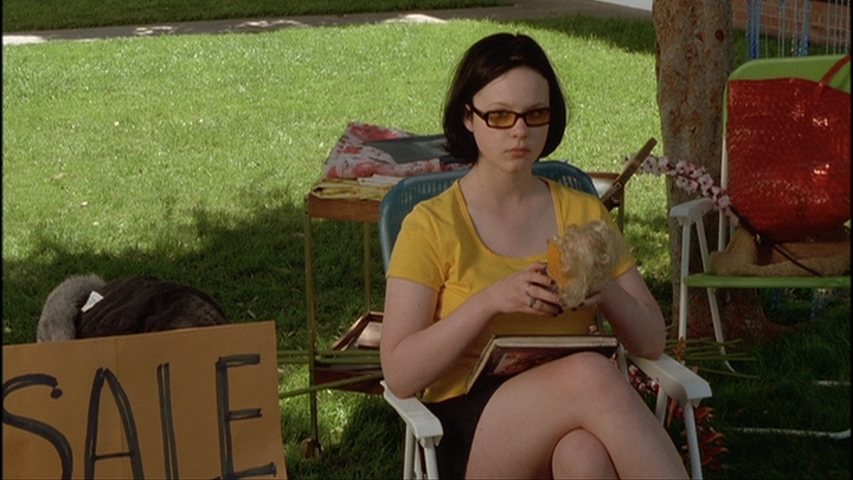
2. Three of us were watching the movie Ghost World. (Aside from me, these were different guys than the ones in the previous exchange.) Thora Birch isn't overweight by any means, but she's definitely curvier than the typical Hollywood actress in that movie. Two of us thought she was extremely attractive, but the other guy couldn't really see that.
That's the real world. Two-thirds of us (4 out of the 6 guys) didn't have a strong preference for especially skinny women.
Of course, this is completely anecdotal and unscientific, so I have no idea if my "two-thirds" conclusion is statistically accurate. But when I think about those conversations in light of the sociological studies, I have to conclude: most men are not fixated on skinniness as an essential criterion for female attractiveness. This isn't to deny that most men do find plenty of skinny women attractive, but just to say that it's not a requirement.
Of course there are some men who really do have an overwhelming interest in skinnier-than-average women. And that's just fine. There are also some men with an overwhelming interest in heavier-than-average women. That's fine too. But most men's tastes aren't so austere, in either direction.
Although, as I said, I make no moral judgment of men who are attracted to a relatively narrow range of body types, I do feel sorry for them, just as I feel sorry for women who insist on only dating men who are over 6 feet tall.
I don't object to the superficiality. Everyone cares about looks. Everyone is superficial. This isn't about trying to enforce some kind of rule that we have to be earnestly respectful toward "plus-size" women — which is doomed to be a joyless affectation if it's done out of a sense of duty. I just think that finding curvy women attractive is more fun for everyone concerned.
I'm writing this because it's on my mind, not to boost anyone's self-esteem. In fact, based on my experience, there's not much I can say to convince women that life isn't a contest where the goal is to be as skinny as possible. Whether women have that perception is not going to be affected by what I say. And it can't fairly be imputed to that imaginary scapegoat known as "society." The only one with the power to convince a woman she does have a beautiful body is the woman herself.