Some good advice and thoughts. "Not once did we discuss clothes or hair or bodies or who was pretty. It's surprising how hard it is to stay away from those topics with little girls, but I'm stubborn."
There's a whole body of First Amendment law on "commercial speech." This is a weird grey area: the First Amendment isn't irrelevant, but it doesn't confer the full protections you think of when you hear the phrase "freedom of speech." That's why the law can prohibit false advertising and require companies to say certain things, e.g. to put nutrition labels on food.
But isn't "commercial speech" vs. "noncommercial speech" a false dichotomy? Isn't most speech commercial?
It's important to get language that isn't commercially mediated, and increasingly, we don't have that. . . .
I sometimes think: is reading a book itself a value? . . . It doesn't matter what book, as long as you're reading a book? And I go either way on that. . . . It's not valuable because it's a book. It would be better to spend time watching a good movie. . . .
Most language that we encounter is trying to sell us something. And that's really unfortunate, and it degrades the language, and it degrades encounters with language.
I agree with all that.
At one point, she starts to say that fiction writers are "presumably" an exception — but she immediately catches herself and points out that they're also working for money.
Once the 2-minute segment is over, the embedded video switches to a black background with the word "PREMIUM" in a gold rectangle. The screen urges us:
If you click on that link, you'll see a list of "PREMIUM EVENTS." To the right, there's an explanation in fine print:
FORA.tv Premium Events offer pay-per-view programming from the world's top conferences, universities, and public forums. Now, you can enjoy many of the benefits of these exclusive gatherings without the costs and hassles of travel, and at a fraction of the ticket price. We offer flexible access plans to suit your interests including annual and monthly subscriptions, and full event and single program passes. . . . We invite you to watch Previews of our premium programming to take in a big idea and sample the panel, presentation, or debate.
So, when Lorrie Moore said, "Most language we encounter is trying to sell us something," those words were part of a teaser for a website that's trying to sell us more words (including more of her own words). On that same webpage is a list of titles in gold type (with the color gold signaling, "This is worth spending money on").
One of the more attention-getting titles is "Hollywood, War Crimes and the Search for Love," which is accompanied by a photo of a blond-haired woman wearing sunglasses, a revealing shirt, a jeans skirt, hot-pink stockings, and high heels that are mostly blue but have pink heels to match the stockings. She's writing on a pad of paper while lying on her stomach, legs crossed, in classic lying-on-the-bed-writing-in-a-diary pose. It isn't immediately apparent what any of that has to do with war crimes, but that doesn't matter because the image got us to stop and look.
Each of these visual elements was meticulously selected in order to persuade people (male and female) to spend money in exchange for language.
Speech is always going to be commodified — we're never going to solve that problem. As consumers/readers, the best we can do is to keep this in mind: when you're reading a text that seems strikingly authoritative or persuasive, remember that the words are so powerful because the person who wrote them was trying to make a living. If we're skeptical of the statements we see on food packages in the supermarket, we should be just as skeptical of statements we read in a book. It's all "commercial."
A London Guildhall University survey of 11,000 33-year-olds found that unattractive men earned 15 percent less than those deemed attractive, while plain women earned 11 percent less than their prettier counterparts. In their report "Beauty, Productivity and Discrimination: Lawyers', Looks and Lucre," Hamermesh and Biddle found that the probability of a male attorney attaining early partnership directly correlates with how handsome he is.
One of the "7 Ways to Boost Your Pay" is "Walk taller," which is based on this research on height:
When it comes to height, every inch counts--in fact, in the workplace, each inch above average may be worth $789 more per year, according to a study in the Journal of Applied Psychology (Vol. 89, No. 3).
The findings suggest that someone who is 6 feet tall earns, on average, nearly $166,000 more during a 30-year career than someone who is 5 feet 5 inches--even when controlling for gender, age and weight.
The height-salary link was found by psychologist Timothy A. Judge, PhD, of the University of Florida, and researcher Daniel M. Cable, PhD, of the University of North Carolina. They analyzed data from four American and British longitudinal studies that followed about 8,500 participants from adolescence to adulthood and recorded personal characteristics, salaries and occupations. Judge and Cable also performed a meta-analysis of 45 previous studies on the relationship between height and workplace success.
Judge offers a possible explanation for the height bias: Tall people may have greater self-esteem and social confidence than shorter people. In turn, others may view tall people as more leader-like and authoritative.
"The process of literally 'looking down on others' may cause one to be more confident," Judge says. "Similarly, having others 'looking up to us' may instill in tall people more self-confidence."
As such, the biggest correlation between height and salary appeared in sales and management positions--careers in which customer perception has a major impact on success. If customers believe a tall salesperson is more commanding, for example, they may be more likely to follow the salesperson's wishes, Judge says.
Accordingly, height was most predictive of earnings in jobs that require social interaction, which include sales, management, service and technical careers. The height effect also mattered--though to a lesser degree--in other jobs such as crafts and blue-collar and clerical positions, researchers found.
As with attractiveness, though less surprisingly, height matters more for men than for women:
The study also found that shorter men are slightly more likely to encounter height bias in the workplace than are shorter women. . . .
Since men and women tend to differ in height, researchers controlled for gender by using the average height of 5 feet 9 inches for an American man and 5 feet 3 inches for a woman. They also controlled for age because people tend to lose 1 to 3 inches of their height during a lifetime.
Despite CBS's advice to "Walk taller," you don't have much control over how tall you are. You might be able to affect how tall you appear (which is presumably what matters in this context) by choosing your shoes. If you're under 18, you can eat a nutritious diet and not smoke. But your genes are the main factor.
When I was visiting family (including my three brothers) earlier this summer, we were talking about how height affect's one's life -- more in the context of dating/relationships than careers/money. I was asked how tall I'd like to be. I said 6'1" or 6'2". You get the main advantages of tallness without being so tall as to be potentially awkward or conspicuous, nor are you as likely to have people use "You're so tall!" or "How tall are you?" as a conversation-starter.
One of my favorite parts of the trip was when my 3 brothers and I had our heights measured (down to the quarter of an inch) by standing against my dad's kitchen wall and marking it with a pencil. As I thought (but it was nice to have it confirmed), I'm exactly 5'10". My brothers are 5'9 1/2", 5'9 1/4", and 5'3 1/2". (Respectively, we're 29, 27, 15, and 13 years old.) The 15-year-old will probably be taller than me the next time I see him. The 13-year-old kept changing the names next to the markings to make himself taller.
20/20 reported on an experiment that showed the profound effect of male height in dating:
Women will take just about any shortcoming in a man, except in the height department, according to Andrea McGinty, who founded the San Diego-based dating service It's Just Lunch.
McGinty helped ABCNEWS put together an experiment to test just how willing women are to date shorter men. We brought together several short men and asked them to stand next to taller men. We invited groups of women to look at the men and choose a date.
To see if the women would go for short guys who were successful, ABCNEWS' Lynn Sherr created extraordinary resumes for the shorter men. She told the women that the shorter men included a doctor, a best-selling author, a champion skier, a venture capitalist who'd made millions by the age of 25.
Nothing worked. The women always chose the tall men. Sherr asked whether there'd be anything she could say that would make the shortest of the men, who was 5 feet, irresistible. One of the women replied, "Maybe the only thing you could say is that the other four are murderers." Another backed her up, saying that had the taller men had a criminal record she might have been swayed to choose a shorter man. Another said she'd have considered the shorter men, if the taller men had been described as "child molesters."
This was an insightful response to an AskMetafilter question about a 5'8" woman who was dating a shorter man and had misgivings about it. The woman who asked the question said she had "a hard time feeling physically attracted to someone shorter than me, largely because of how awkward I feel standing next to them in public . . . . Mostly I feel like a big hulking lump." The response:
This really stood out to me. As a fellow tall woman (I've actually got three inches on you!), I can relate to the self-consciousness about being tall, especially because "feminine" is so often coded as petite, small, and cute. I totally get how being taller than a dude can make you feel unsexy, because there's a [lot] of cultural programming that tells us how wonderful it is to be swept up in the embrace of a big, tall man, to be safe in his arms, blah blah blah. It can feel like a strange inversion of feminine and masculine, almost, to be taller than your honey. . . .
It might also be worth thinking about the fact that you're conflating "being attracted to a dude" and "feeling attractive while I'm with a dude." Those two things aren't the same, and a big part of my personal journey of accepting and lovin' my body was rejecting the idea that sexy was something I performed (that is, I felt sexy when other people looked at me like I was sexy), rather than something I felt.
It's interesting to look at some of the lower-ranked heads of state and try to detect the hallmarks of unattractiveness. Many of them look like the photos were taken with a fisheye lens or distorted with a Photoshop tool.
Not surprisingly, the photos of some of the higher-ranked heads of state seem chosen to be flattering. But I've always found that photo of President Obama strangely unflattering.
(Photo of Maldivian President Mohamed Nasheed from Wikimedia Commons, by Mauroof Khaleel. Photo of Ukrainian Prime Minister Yulia Tymoshenko from the European Parliament's Flickr site, by Pietro Naj-Oleari.)
Every once in a while, they'll give you a glimpse of some random stranger's mind.
Here are some of the ones where, for one reason or other, the idea of someone sitting around trying to find whatever they're looking for with these words strikes me as vaguely touching:
i want to break a gender norm
uncaring husbands overwork wives
ways to lessen hatred towards gender
people who break rules, violate norms, or fail to meet the expectations of others
jazz is dead
extremely skinny
statistics on use of word nigger
attractive round faces
father and daughter talk
how to write a thank you letter to a previous employer for firing you
i want to stop thinking the worst outcome will happen
I wouldn't normally highlight a specific woman's body proportions, but Megan McArdle is someone who's been unusually explicit about hers. As she says in this Bloggingheads clip, she's 6'2" and 145 pounds, yet she can't shake the admittedly irrational belief — which she says "every other American woman" also holds — that her life would be better if only she lost 5 pounds:
She also says (as you can see in the video clip):
If I were an actress, I would have to lose 15 pounds, probably, to keep my jobs. And I'm really pretty skinny. . . Almost no one looks like me, and almost no one can look like this over the age of 19. I'm not saying that I'm amazingly gorgeous. In fact, I think that being that thin isn't really particularly attractive — to men. Women think it is.
I remember seeing a study in one of my textbooks back in college. It found that men's views of the ideal female body type is, on average, about average. Women, of course, viewed the ideal female body type as much skinnier. You can find similar conclusions by Googling around (example: PDF). I wish I still had that textbook, though, because it not only stated the findings but also included realistic color illustrations of two women — one for men's ideal and one for women's. I wondered: if every woman in America could see these illustrations and absorb their significance, wouldn't we be living in a saner world, where the goal isn't always to keep losing more and more weight?
I don't mean to imply that women should only care what men think and not want to be attractive for themselves. It would be different if women were satisfied with a more realistic range of body types and men were the ones who wanted to see women get as skinny as possible. But since the opposite is the case — men are the less oppressive ones — I think it's fair to assume that something has gone wrong.
Where do women's misperceptions come from? The easy, politically correct answer is that "society" bombards women and girls with unrealistic images of supposedly ideal women. You know the drill: models in advertisements, Barbie's body proportions, etc.
First of all, speaking of unfair expectations, I think it's unfair to expect a doll to have proportions that would be realistic if they were blown up to the scale of a real adult. Isn't it possible that on a purely aesthetic levels, exaggerated proportions work better on a tiny scale?
More to the point, though, the "skinny models" explanation can't be true. Can it? Or at least, it's leaving a whole lot out.
Here's the problem: pick up a copy of Details magazine and look at the male models. Even though the articles are about macho topics like whisky, meat, and the military, the models are extremely svelte. I'm pretty skinny, but I'd have a very hard time if I were to try to conform to those body types.
At the other end of the spectrum, what about male action figures? People love to gripe about Barbie, but what about the dolls for boys? No one would argue that He-Man's muscles are a realistic, healthy standard for boys to aspire to.
We don't expect boys/men to be incapable of thinking through for themselves whether these are really the right standards. Yet it's considered the enlightened position to suggest that women are mere passive victims, hypnotized by whatever images the big bad "media" or "society" puts in front of them.
An aside: many liberals/feminists will rail against female genital mutilation — as well they should. But how many of them are upfront about the fact that it's primarily practiced by women? (One person who isn't upfront about this is Eve Ensler, who included a long piece in her famous play The Vagina Monologues about female genital mutilation, but oddly never mentioned who actually does it.)
Liberals/feminists will also rail against unrealistic female body ideals — as well they should. But could it be that the crux of the problem is women going after other women?
When I think about what kinds of body types straight guys really consider attractive, I think about two random exchanges I've had with some friends (both of these were situations where young guys were the only people in the room):
1. Four of us — old friends who had gone to college in different cities and were back home for winter break — were catching up with each others' lives. One of them was telling us about his new girlfriend. He said that she has a nice "medium" body, and that he's never been specifically focused on skinny girls. Two others said we felt the same way. The fourth guy disagreed, saying he's mainly just attracted to skinny girls.
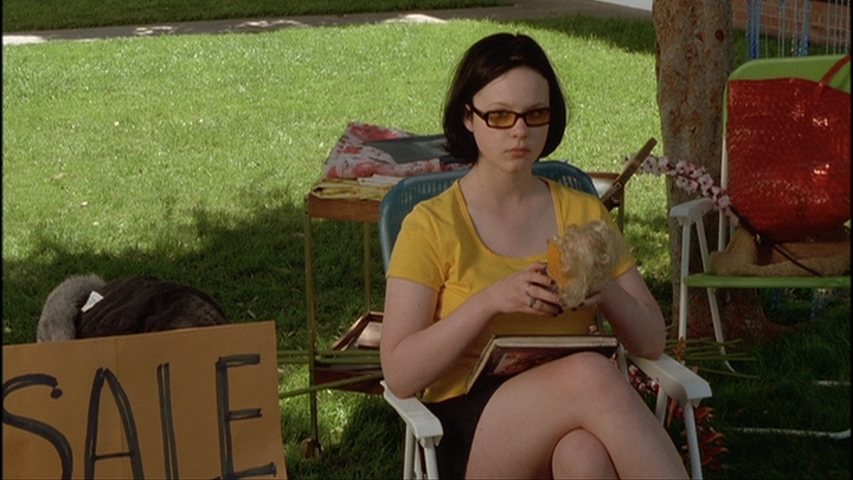
2. Three of us were watching the movie Ghost World. (Aside from me, these were different guys than the ones in the previous exchange.) Thora Birch isn't overweight by any means, but she's definitely curvier than the typical Hollywood actress in that movie. Two of us thought she was extremely attractive, but the other guy couldn't really see that.
That's the real world. Two-thirds of us (4 out of the 6 guys) didn't have a strong preference for especially skinny women.
Of course, this is completely anecdotal and unscientific, so I have no idea if my "two-thirds" conclusion is statistically accurate. But when I think about those conversations in light of the sociological studies, I have to conclude: most men are not fixated on skinniness as an essential criterion for female attractiveness. This isn't to deny that most men do find plenty of skinny women attractive, but just to say that it's not a requirement.
Of course there are some men who really do have an overwhelming interest in skinnier-than-average women. And that's just fine. There are also some men with an overwhelming interest in heavier-than-average women. That's fine too. But most men's tastes aren't so austere, in either direction.
Although, as I said, I make no moral judgment of men who are attracted to a relatively narrow range of body types, I do feel sorry for them, just as I feel sorry for women who insist on only dating men who are over 6 feet tall.
I don't object to the superficiality. Everyone cares about looks. Everyone is superficial. This isn't about trying to enforce some kind of rule that we have to be earnestly respectful toward "plus-size" women — which is doomed to be a joyless affectation if it's done out of a sense of duty. I just think that finding curvy women attractive is more fun for everyone concerned.
I'm writing this because it's on my mind, not to boost anyone's self-esteem. In fact, based on my experience, there's not much I can say to convince women that life isn't a contest where the goal is to be as skinny as possible. Whether women have that perception is not going to be affected by what I say. And it can't fairly be imputed to that imaginary scapegoat known as "society." The only one with the power to convince a woman she does have a beautiful body is the woman herself.
They've never had sex-change operations, but they've played the part. And they're all virgins to this day, apparently because there would have been no socially accepted way for them to have a sex life.
One of these women says the masquerade would no longer be necessary because of the gender equality that now exists in rural Albania:
"Back then, it was better to be a man because before a woman and an animal were considered the same thing.... Now, Albanian women have equal rights with men, and are even more powerful. I think today it would be fun to be a woman."
Think about that: rural Albania. An incredibly remote, conservative area of the world. If even they have been transformed by gender equality, can we really doubt that feminism has basically won the argument, if not eliminated every last vestige of misogyny?
Of course, due to the pessimistic attitude of many so-called progressives, it will instead be spun the opposite way: America isn't even as good as Albania!
And you know, even the idea that women used to be worse off than men in Albania might not be so obvious. After all, why was there a big problem with absent male heads of household? Because so many men were dying -- in war, feuds, and who knows what else.
But doesn't the tendency of men to die through acts of violence count as yet another disadvantage of being a man (for my list)? Or should we not take that into account because ... that's just what men do?
A lot of the criticisms are based on the fact that some of the comments made about her have been superficial and trivial: her speaking voice, her display of cleavage.
I admit that when I see references to her legs or the fact that she wears pant suits, my reaction is: hey, that's sexist and unfair. So I'm not saying I approve of all this. (As I said before, though, it doesn't bother me for people to talk about her voice or cleavage.)
But it doesn't make sense to go from saying that the media's criticisms of her have been superficial ... to saying that Hillary in particular was hurtby sexism.
A presidential race is a zero-sum game. That means that anything that hurts one candidate has to help the other candidate. Therefore, if something "hurts" all the candidates, it really hurts none of them. If you're saying she was hurt by sexism, that's implying not just that there were unfair criticisms of her, but that they were criticisms of a sort that male candidates don't have to withstand.
Well, I agree that there have been some unfair criticisms of her. But to imply that male candidates aren't treated just as unfairly, or that the discussion of them isn't just as superficial? I mean, maybe you could believe that ... if you had never observedhow any other presidential candidate has ever been treated.
I have some news for Clinton supporters who think that superficial criticisms of her are evidence of sexism:
PRESIDENTIAL RACES ARE UNFAIR
Media Focus on Candidates' Personal Quirks
Trivialities, Superficialities Discussed More Than Policy Issues
Barack Obama is criticized for not wearing an American flag pin on his lapel. His exotic name is a major topic of discussion among serious commentators.
Mitt Romney is criticized for being too polished and robotic, and his own staffers worry that his hair is "too perfect."
Bill Richardson receives little media attention despite having a more impressive resume than Clinton, Edwards, or Obama, and you have to wonder if the fact that he's not as conventionally attractive as those three candidates has something to do with it.
Before he officially enters the race, the media focuses on Fred Thompson more than any of his Republican rivals even though he doesn't have especially interesting ideas or accomplishments. The discussion in the media largely focuses on his perceived "sex appeal" and masculinity.
Dennis Kucinich is mocked as an elf-like creature whose wife is too attractive for him. While he might be too far left to have a real chance at becoming president, you have to wonder if he'd receive more favorable coverage if he had equally liberal positions but were a suave 6'4" man with a baritone voice.
John Kerry is criticized more for his stodgy demeanor than his policy stances — which the media don't report on because they're too busy mocking his rhetorically clumsy but substantively defensible statement that "I voted for it [one particular Iraq appropriations bill] before I voted against it [a related but significantly different bill]." It becomes common to talk about his horse face.
After Howard Dean loses the Iowa caucus in 2004, the media never report on him without mentioning that he let out an ill-considered yelp (which is always referred to as "the Dean scream") in an understandable effort to rally his supporters after a shocking defeat.
Dick Gephardt is routinely derided for lacking a "rock star" quality even though he's actually one of the most passionate speakers among the 2004 candidates.
Presidential races are superficial and unfair. That's true whether the candidate is a Democratic or a Republican. It's true whether the candidate is a man or a woman. And it's unlikely to change in the near future.
I was glad to see this, since I read this distillation of the book the other day, and it's the kind of thing I want my president to be reading.
I hope to do a post about Zakaria's geopolitical thesis soon, but first I have to point out that Obama looks so cool! He looks like his own Secret Service agent.
"Ah, yes, Obama's appeal is superficial. McCain might have less charisma, but he's the more serious candidate."
I wonder what percentage of the people who have that response supported Ronald Reagan, who would not have ended up being President if he hadn't started out as a dashing Hollywood actor.
I actually think McCain is decidedly less serious than Obama when it comes to domestic and foreign policy. But that's a whole other blog post.
There's a tendency to assume that if a candidate gets high marks in some superficial area, then surely this must be offset by deficiencies in more substantive areas. As Matthew Yglesias has observed, people seem to subconsciously adhere to the "Law of Conservation of Virtues." The supermodel must be dumb. The smartest kid in the class must wear dorky glasses and have no social skills. The candidate who gives inspiring speeches must be weak on policy.
Once you put it like that, it becomes transparently irrational: of course Obama's charisma is independent of his strengths and weaknesses on the merits.
But I would go further. The coolness factor matters. Coolness, likability, charisma, and even sex appeal are legitimate reasons to vote for someone for president.
A candidate who's more personally appealing will be more likely to hold onto popularity as president, which will tend to make them more effective at enacting their agenda. If the president is more appealing for admittedly superficial reasons, that should apply abroad too, and we should want the world to have a positive attitude toward us (all other things being equal). [UPDATE: Here's some statistical and anecdotal evidence that Obamamania is sweeping Europe. And he's "becoming an international phenomenon."] Whether the president is liked by a lot of people matters, and someone who's suave and attractive has an advantage when it comes to being well-liked.
We're not supposed to admit that this does matter. We're supposed to believe that "what the voters really care about are the issues." And so while the pundits are willing to analyze relatively clear-cut demographic factors (race, gender, age), you rarely hear them talk about the more nebulous quality of attractiveness, even when it's obviously important.
When Tommy Thompson (my former governor) ran for the Republican nomination, the few commentators who bothered to even talk about him would struggle to articulate what exactly was the problem with his foundering campaign. Based on sheer substance and experience, he could have been a very strong candidate. But all you had to do is watch him for 10 seconds in one of the debates, and you'd see -- and hear -- why he couldn't make it.
You know, Obama can be a rather cool character. Midway through the debate, I found myself practicing an impersonation of him. Not his speech, but his clasped hands on the table, his head turned sideways, chin up, lips pursed in a grin, his eyes looking down onto the hapless soul who imagines she could unsettle him in the slightest degree.
It's become a cliche to lament that the media is obsessed with trivialities in the presidential race and should focus on the issues instead. But if they would talk more about the actual importance of appearance, this would have the twofold advantage of being more honest and more enticing to readers/viewers. If you can get more people to pay attention to a presidential election, that's a good thing for democracy.
I know there's a huge gender angle to this -- I plan to do a whole other post about Hillary Clinton in this context. [UPDATE: Here it is.] But, of course, most candidates are men, and most commentators are men, and men tend to be hesitant to talk about the attractiveness of other men. And female commentators have obvious reasons for not publicly gushing over attractive men.
But face it: the results of the democratic process over the years are clear. JFK, Reagan, Bill Clinton, George W. Bush -- each had his own distinctive sex appeal. Can anyone say with a straight face that these men were chosen for the job purely based on their resumes and policy positions?
Nixon, Carter, and George H.W. Bush were, of course, weaker in this regard. I wasn't in existence during the Nixon or Carter administrations, and I had pretty minimal political consciousness for the Bush administration, but I have to imagine that these presidents' relative unattractiveness -- not just in the physical sense, but also demeanor, particularly in Bush Sr.'s case -- played to their weaknesses. Notice that Carter and Bush were both defeated by more charismatic challengers.
My theory of this general election is that if you have one candidate who's 47, 6'1", and has a full head of dark hair, and another candidate who's 72, 5'7", and bald with thin white hair, it's predictable who will win. I wish this didn't matter at all and everyone just made perfectly rational decisions based on substantive issues. And we won't know if this factor ends up being decisive. But I think we'll know that it mattered.
Before I got into the journaling that led to this blog, I thought about doing a blog-as-commonplace-book. Like the idea of a typed-up diary, though, I realized that a blog version of the underlining and marginalia in my books would be too cramped and fussy. But I still want the blog to have some of the marginalia concept. So…
And, well, it's changed how I think about people! One thought that especially made an impression on me: Explaining human behavior as the result of natural selection doesn't mean justifying the behavior. This seems so obvious to me now that it almost doesn't even seem worth pointing out, but I don't know if I had realized it before reading this book. And this is what really got me:
we're all puppets, and our best hope for even partial liberation is to try to decipher the logic of the puppeteer.
He goes further:
Just because natural selection created us doesn't mean we have to slavishly follow its peculiar agenda. (If anything, we might be tempted to spite it for all the ridiculous baggage it's saddled us with.)
People tend to assume that if want to effect social change, you need to somehow show that nature is on your side. Thus, if you're for gay rights, you need to argue that homosexuality is inborn, not a choice.
But the problem is that we don't know that. To my knowledge, we haven't solved the mystery of homosexuality. It doesn't seem to fit very well with natural selection: why haven't gays died out as a result of their distaste for procreation? Wright (a liberal and a supporter of gay rights) raises that question and admits the answer is unclear.*
The reason we respect gays isn't that they have a well-defined place in the natural order of things. We simply respect them because they're not doing anything wrong.
I wish everyone could agree to stop equating "nature" with good, and instead adopt the view that, "Look, of course the world is a terrible place. There are huge problems intrinsic to the world itself. Some of them might be fundamental defects in human nature" — in this case, aversion to homosexuality, distrust of outside-the-mainstream behavior, etc. — "and we should try to solve them using human ingenuity. Those solutions might just as well come from rebelling against nature or tradition rather than returning to nature or tradition."
But it's hard to make this kind of argument and win over many people. One problem is religion: if you believe that God is good and is the creator of the natural order, then the natural order must be good. Maybe that's why we're going to keep getting sidetracked by "issues" that shouldn't be issues, like "Is homosexuality a choice?"
Speaking of human tendencies that are natural but evil, I also want to highlight what Wright says about rape on pages 52-53 — and, relatedly, what he says about tall men — but that will have to wait till later.
There is one point I don't see Wright addressing. He notes that male animals typically have bright colors or other features designed to attract women. This is because females are "choosier" than males when it comes to sex,*** so their preferences are more influential than males' on which traits get passed down to future generations.
But this is the opposite of what we observe in humans. Women are the ones who wear visible makeup, not men. Women have much more leeway to wear clothes with bright colors and ornate patterns. [UPDATE: This might have been too simplistic if we're talking about human beings in general rather than merely our own culture and era. See the comments. Also, this intro to one of Wright's diavlogs suggests that he himself may be an exception to the rule.] Throughout the book he explains how human traits and behavior parallel those observed in animals, but then there's this one discrepancy that seems to contradict how you'd expect the sexes to behave based on natural selection.
If men are the ones who want to have as much sex as possible (because that will maximize how many of their genes get passed on), then what's the point in women getting all dolled up?
If anyone knows the explanation for this, or has a guess, please let me know in the comments. I can't be the first person to notice this. (I tried Googling for it, but that didn't work.) Maybe it's just one of those "I'm not going to point this out because it would contradict the whole theory of this book" things. That's a big problem with books.
So, apparently this is going to be a blog with footnotes. I didn't plan that — it just happened. I'll try to cut down on them in the future.
- - -
* He wrote the book in 1994, so it's possible that more recent research provides the answer. But something like this 2007 study offering various highly speculative theories suggests that not a lot of progress has been made since then. For example, one theory -- mentioned by both Wright and the linked study -- is that gays contribute to the survival of their own genes by caring for their family members. As Wright points out, it follows from this theory that we should be able to observe gay people being extraordinarily devoted to their nephews and nieces, far more so than heterosexuals. There doesn't seem to be any evidence that that's the case. (384-6)
** This is a huge theme of the book, and he certainly thinks it applies to humans as well as other animals.