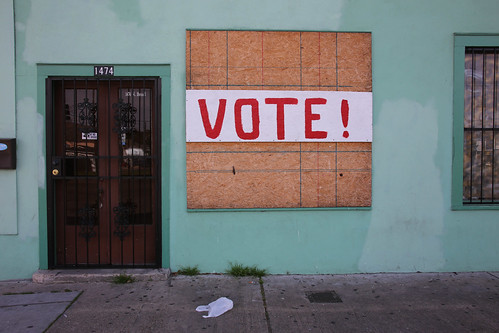
Showing posts with label voting. Show all posts

Tuesday, November 3, 2020

Why I voted for Biden — and against Trump

Back in the olden days of February 2020, after the first Democratic primary contests and before any Americans had died of the coronavirus, I wrote a post in response to someone on Facebook who asked who we’d vote for if the nominees were Trump and Bernie Sanders.

I explained why I’d vote for the Democrat even though he wasn’t my first choice in the primaries. What I wrote still applies now that the nominee is Joe Biden.

And that was before Trump’s inept, disingenuous, and reckless response to the pandemic, which has only strengthened my support for Biden.

So here’s an adaptation of what I said in February but with Biden’s name:

I don’t need to decide whether Biden will be a better president than Trump, in order to choose Biden over Trump. There’s something larger at stake, which is the need to send a message to the world and to history: “Whoops! We screwed up in 2016. We need a different tone and direction.”

If Trump is a two-term president, he’ll appear to have a halo 😇 in retrospect. People assume that Obama and Reagan were great presidents, whether or not they really were. One-term presidents who lose their reelection bids are generally seen as failures and footnotes to history, whether or not that’s deserved.

Making Trump a one-term president will have positive ripple effects that could last for decades, far beyond the next administration. It will change the thinking of future presidential candidates. It will change how the Trump administration is presented in history books.

In contrast, making Trump a two-term president will legitimize the idea that the president should sink to the lowest common denominator in his rhetoric, and try to close off America from other countries through his policies.

We need to make Trump a one-term president. We already know what we need to know about President Trump, and we have only one more chance to act on that knowledge. We don’t yet know what President Biden would be like, but if he turns out to be bad, we’ll be able to deal with that problem in other elections.

I don’t need to love Biden in order to vote for him. As others have said: voting isn’t a valentine, it’s a chess move.


(Photo of Biden by Gage Skidemore, via Wikipedia.)

Wednesday, October 28, 2020

I voted

Tonight, I voted for the candidate who was raising the alarm about how unprepared we were to respond to a pandemic in October 2019, and against the candidate who's still trying to downplay the pandemic in October 2020.


I waited more than 3 hours and stood in line for 8 blocks. Even knowing that my vote in New York wouldn't affect the outcome of the presidential election, that was worth it.

Wednesday, June 3, 2020

Why your focus in online posting or voting doesn't need to reflect your priorities

One of the mistakes people make in approaching a site like Facebook is to tell someone: "You're posting more about X than Y, so you obviously care more about X than Y."

A good response would be: "No, I care about making Facebook feeds better, and I see that Y is getting 10 times as much attention as X, so I'm posting more about X to improve the overall balance."

That could be rational even if I care twice as much about Y as I do about X. That's thinking more about the site as a whole than how to signal what I care about.

You can also apply this idea to voting.

For instance, let's say reducing cruelty to animals ranks #20 on my list of political goals. But maybe I think almost no other voters are going to consider that issue at all when they cast their votes. In order to correct the overall neglect of that issue, I could rationally make the question of which candidate will be best for animals the #1 factor in how I cast my vote. That makes it sound like I think animal issues are more important than any other issues, but what it really means is that I'm thinking about the whole democratic process instead of, again, how to signal what I care about.

Vote!

(Photo by Paul Sableman.)

Saturday, February 22, 2020

Can Bernie Sanders defeat Donald Trump in November?

2 things about Bernie Sanders:

He does much better with male voters than female voters.

He does much better with younger voters than older voters.


2 things about presidential elections:

Women vote more than men.

Older voters turn out more than younger voters.


Think about it.


(Photo of Bernie Sanders by Tasos Katopodis/Getty Images via NPR.)

Sunday, November 13, 2016

How should Democrats respond to Gary Johnson and Jill Stein supporters?

People say Hillary Clinton is such a good listener, and she may well be. But did she ever listen to Gary Johnson or Jill Stein or their supporters? I'm sure she'd agree that she had to work hard for every single vote. She wasn't entitled to anyone's vote. The fact that people like me voted for Gary Johnson (after voting for Gore, Kerry, and Obama) is meaningful. Instead of lashing out at us for how we cast our votes, listen to us and try to absorb what we were saying when we looked at "Clinton" and "Trump" on the ballot and said: "Neither, thanks."

Think about this: a candidate as bumbling as Johnson, who was ignored by the mainstream media except when there was a story that allowed the media to ridicule him for supposedly not knowing about the world, did far better than any other Libertarian candidate in history. That should send a message.

If you're a Democratic candidate or working for one, try to do better next time. You may think you tried as hard as possible this time. But the Democratic party didn't bother to oppose the worst excesses of the Obama administration — the Libya war, the drone war which could inspire more terrorists, the erosion of Americans' privacy, the expansive theories of executive power . . . Stop and think about the efficiency of markets and the appropriate limits of government power, instead of seeing every problem as one to be solved by government.

Thursday, November 10, 2016

The popular vote doesn't matter

It doesn't matter that Hillary Clinton won the popular vote, just as it didn't matter that Al Gore won the popular vote.

In both cases, I would have preferred the Democrat over the Republican. But I lost, and I can only accept the results of the election — just as so many people were urging Donald Trump to do if he lost. The same people would have been outraged if Trump had refused to accept the results after winning the popular vote but losing the Electoral College.

If you want to switch from the Electoral College to a popular-vote system, put your money where your mouth is. Do the hard work of lobbying for a constitutional amendment. This would take a long time, and you'd have no assurance that it would end up favoring candidates you happen to like. But it would be more effective than ad hoc complaints about the results of a particular election.

There is no such thing as "winning" the popular vote, because you can only "win" under existing rules. If we play chess and you capture my king, you win the whole game — end of story. If I capture more of your pieces in total, I don't "win" the plurality of pieces; I don't win anything. If I had wanted to be able to claim that as a win, I would have needed to reach an agreement with you before starting the game that our goal would be capturing as many pieces as possible — in which case, it's anyone's guess who would have won.

If we had switched to a popular-vote system right before this presidential race started, Trump and Clinton could have changed their get-out-the-vote strategies; Trump could have appealed to large numbers of conservatives and independents in places like California and New York; and Clinton could have appealed to liberals and independents in places like Austin and New Orleans. The candidates might have taken different positions on the issues, or emphasized different issues. And the unpredictability goes beyond that: we don't even know who would have been nominated if primary voters had been trying to choose a candidate who'd receive a plurality of individual votes. For that matter, we don't know if Trump and Clinton would have run for president, or if additional candidates like Elizabeth Warren or Joe Biden would have resisted the outpouring of pleas for them to run.

Any discussion of a candidate receiving a "win" or "victory" in the 2016 popular vote exists only in the realm of hypothetical alternative history, and has no bearing on the rightful winner in the real world. The only thing the candidates were trying to do was to win the Electoral College, so that's the only fair basis for judging their results.

Wednesday, March 16, 2016

8 Thoughts on Tuesday, March 15

1. Marco Rubio's loss of his home state by almost 20 points to Donald Trump wasn't just fatal to the Rubio campaign; it also dealt a devastating blow to the idea of Mitt Romney as an influential Republican elder statesman.

2. Tonight was also not a great night for the idea that betting odds are a better predictor than polls. For most of the time (since mid-October, which is the earliest time that website goes back to), betting odds have said Rubio is the most likely Republican nominee. (Full disclosure: Those links go to Election Betting Odds, which was co-created by my friend Maxim Lott.)

3. John Kasich is saying he might go to the Republican convention with more delegates than anyone else. And now, I'm afraid all the remaining Republican candidates might be mentally ill.

4. Losing Ohio could help Trump.

5. Alex Knepper explains why we should expect Trump to stay in the lead:

Presumably the only way to stop Trump at this point would be to look toward a Cruz-Kasich ticket, but the upcoming primaries are mostly friendly territory for Trump — Cruz will win Utah and Kasich might have a shot in Wisconsin, but Trump will likely sweep the Mid-Atlantic states on 4/19 and 4/26 — New York, Pennsylvania, Maryland, and so forth. Even without Ohio, Trump still has a perfectly viable path to a majority, and nobody else does.
6. I find it interesting that Trump made a point, in his victory speech, to congratulate Rubio on running a "tough" campaign, called him "smart," and said he'll have a great future. I don't think Trump said a word about Jeb Bush when he dropped out on the night of South Carolina.

7. Did anyone predict, before the voting started, that the Republican race would come down to Donald Trump, Ted Cruz, and John Kasich? Anyone at all, in the whole world?

8. Since Hillary Clinton seems to have won all 5 primaries and Trump won everything except Kasich's home state, we can now see that this Reason piece was right: "letting Trump speak is not merely the morally correct, philosophically consistent course of action: It's the tactically sound one as well." That article had prescient words the day before the primaries:
When the left stops Trump from speaking, Trump wins. He gets to tell his people that the forces of far-left activism and political correctness are trying to silence him. Implicitly, he is suggesting to his followers that when he becomes president, the tides will turn: see his promise to make it easier to sue newspapers for criticizing him. Trump supporters adore this shtick. Stop giving them ammunition.
As Bill Scher said on Twitter in response to the primary results:
Speculation: The visual of Bernie supporters disrupting Trump rallies offered a dismal picture of a Sanders-Trump general, fueling [Clinton] . . .

Takeaway: spend more time knocking doors for your candidate than protesting the other party's candidate

Tuesday, February 2, 2016

Flipping coins to decide the Democratic Iowa caucuses

My friend Ben Wikler, the Washington Director of Moveon.org (which is supporting Bernie Sanders), describes how one of the Iowa caucus precincts was decided:

[T]he first vote was roughly evenly split between Bernie and Hillary. (Nobody for O'Malley.) There are five delegates at stake, divided between the candidates in proportionate to their votes in the room. So it'll be two and two, with one delegate at stake.

The four undecideds go into a corner to hear pitches from supporters of either side. The rest of the crowd mills around; a few go to the bathroom; one or two don't come back.

Three people make up their mind for Bernie; one for Hillary. Back to seats.

Final vote. 61 for Bernie. For Hillary it's 59... 60... 61. Tie!

Recount. Slower this time. Still 61-61. Whoa.

So how do you break a tie? At this precinct, the answer is apparently: COIN FLIP.

Bernie's people call it: heads. Up goes the coin. Back down. Everyone clusters around to look.

Tails.

Cheers go up on the Hillary side, frustration on Bernie side, and boom, that's it: three delegates for Hillary, two for Bernie, a bajillion fail points awarded to the people who left in the middle of the caucus, and we're off the Bernie victory party.

Ben caught it on video (if this video doesn't show up properly, click here):

Iowa Caucus precinct awards delegate to Clinton based on coin ...

Watch it happen: #IowaCaucus delegate awarded to Clinton based on coin flip in tied precinct. w/ MoveOn.org's Benjamin O'Keefe

Posted by Ben Wikler on Monday, February 1, 2016


Here's another video of the same coin flip, shown on C-SPAN. You can hear Ben Wikler say, "What?!" at about 0:25, and a couple seconds later he shows up just to the right of the woman who's explaining the procedure.


This also happened five other times. Hillary Clinton won all six coin tosses.

Megan McArdle comments:
Hillary Clinton is a terrible candidate. . . . That doesn’t mean she won’t eventually end up being president, but if she does, it will be despite her lackluster political skills, rather than because of them. The woman has had almost incumbent levels of support from her party, which paved the way for an easy coronation . . . and saw her come to a statistical tie with a self-avowed socialist.

Think about this: she started up 30 percent over Bernie Sanders, and ended up winning six precincts by a coin toss. Clinton seems to have a stronger base of support among Iowa coins than she does among Iowa caucus voters.

Pocket Change We Can Believe In!

A Facebook friend pointed out that the real problem seems to be that Sanders supporters are terrible at calling coin flips. Why, I can see the attack ad now . . .
(Narrator, speaking slowly with a tone of voice expressive of deep concern, over grainy black-and-white footage of slow-motion coin flips in Iowa auditoriums:) "The Bernie Sanders campaign . . . has consistently called coin flips wrong. How can we expect Bernie Sanders . . . to do what's right for America?"

Wednesday, September 2, 2015

Have moderate Republicans been losing the presidency because conservative voters stayed home in protest?

Ramesh Ponnuru says no:

Conservatives sometimes argue that Republicans lost the last two presidential elections because they nominated moderates who did not inspire conservatives to vote. On NRO today, Bernard Goldberg places blame on those conservatives who stayed home. He writes that “millions of the ideologically pure — who normally would vote Republican — did in fact sit home, if not handing the elections to Barack Obama, at least making it a lot easier for him to win.”

The premise of both arguments–Republicans shouldn’t have nominated moderates because they can’t turn out conservatives, and conservatives shouldn’t have sat out the elections–does not appear to be correct, based on the exit polls. There was no drop-off in conservative turnout in either 2008 or 2012. Conservatives were 34 percent of the electorate in 2004, 34 percent in 2008, and 35 percent in 2012. They voted Republican at a normal rate in 2012 too: Romney got 82 percent of them, a bit lower than George W. Bush’s 84 percent in 2004 but higher than his 81 percent in 2000. (McCain did a bit worse in 2008, with 78 percent.) Goldberg’s argument could end up being true about 2016, but it has not been true in the last two elections.

Saturday, March 21, 2015

Why not force everyone to vote?

Peggy Noonan says:

"It would be transformative if everybody voted," [Obama] told an audience in Cleveland. Yes, it would. It would mean a lot of people who aren’t interested in public policy and choose not to follow it would suddenly be deciding it.

The way it is now, if you aren’t interested—and you have the right not to be interested—you don’t have to vote. If you are interested, you pay attention, develop political views, and vote. Making those who don’t care about voting vote will only dilute the votes of those who are serious and have done their democratic homework.

Most of us are moved by the sight of citizens lined up at the polls on Election Day. We should urge everyone to care enough to stand in that line. But we should not harass or bother those who, with modesty and even generosity, say they are happy to leave the privilege of the ballot to those who are engaged.
Mandatory voting would also increase the sense that your vote doesn't make a difference, since your vote would become an even smaller proportion of the total. More people would vote, but most of them would be more lackluster about their votes — including those who would have voted voluntarily anyway.

Friday, November 16, 2012

Judge Richard Posner's bad reason to keep the electoral college

Judge Posner gives "five reasons for retaining the Electoral College despite its lack of democratic pedigree." He says they're all "practical reasons, not liberal or conservative reasons." I disagree with all of them, but especially this one:

3) Swing States

The winner-take-all method of awarding electoral votes induces the candidates—as we saw in last week’s election—to focus their campaign efforts on the toss-up states; that follows directly from the candidates’ lack of inducement to campaign in states they are sure to win. Voters in toss-up states are more likely to pay close attention to the campaign—to really listen to the competing candidates—knowing that they are going to decide the election. They are likely to be the most thoughtful voters, on average (and for the further reason that they will have received the most information and attention from the candidates), and the most thoughtful voters should be the ones to decide the election.
Sure, they pay the most attention now — because the current system makes their vote matter a lot more than those of voters in most states. Maybe the voters in those other states would start paying more attention if they knew their vote was as important as everyone else's!

And how does Posner get to decide which voters are more "thoughtful" than others? There are a couple huge problems with this. The most fundamental problem is that this isn't Posner's decision to make. In fact, it isn't anyone's decision to make: no one should have the authority to decide which states' voters get to be counted as more thoughtful than other states'. Everyone who's eligible to vote should have the chance to make a thoughtful decision and to have their vote count equally.

It's also naive to think that what distinguishes swing-state voters is that they're just really smart at deciding on a candidate. In fact, there is no category of voters that can be counted on to make objective, well-informed decisions. Everyone is influenced by their self-interest. People in some states care about ethanol in ways that people in non-decisive states don't, and this has a huge effect on federal policy.

Posner's "reason" for the electoral college actually restates the main problem with the electoral college: it privileges some voters' opinions far above other voters'. The fact that the electoral college is empowering to voters in some states is not a good thing; it's a bad thing, because the more you empower the voters in those states, the more you disempower voters in other states. There should only be such an imbalance in the democratic process if there's an extraordinarily strong justification. Considering how arbitrary state boundaries are, the possibility of vague differences among voters in different states is not a sufficient justification.

Sunday, September 25, 2011

Women will get the rights to vote and run for office in Saudi Arabia.

Women in one of the most repressive countries in the world will have rights that women in the United States were denied less than 100 years ago. That's an extraordinary rate of global progress. (via)

ADDED: I originally wrote that this would happen "soon," but I've omitted that word since it won't happen till after the upcoming municipal elections, and the next ones happen 4 years from now. (Municipal elections are the only elections in Saudi Arabia.)

Women can't legally drive in Saudi Arabia, which obviously limits their freedom to vote. In many cases, a man's decision about whether to drive a woman to the polls will determine whether she can actually exercise the right. No one would claim that Saudi Arabia is anywhere close to a paragon of feminist enlightenment, but even a reform that might be considered weak on its own can lead to more progress down the road.

Wednesday, October 6, 2010

Young voters and political party

Ann Althouse (my mom) quotes this report on a CBSNews/New York Times poll:

[O]nly half the 18-29 year olds are registered to vote and just 55 percent of them say they will definitely vote in 2010. Moreover, a mere 15 percent of young people say they are paying “a lot of attention” to the election. By comparison, 84 percent of voters over 64 say they will definitely vote, and 50 percent say they are paying a lot of attention to the election.
She makes a good point:
One is tempted to think that if only more young people would vote, the Democrats would have it made. But the young people who say they favor Democrats also aren't paying attention. They have to get interested before they'll be motivated to vote, and we don't know what they'd think after they paid attention. . . .

When you're young, usually you want to get along. You want to be liked. But do you care about politics? Do you really know who to vote for? Apparently not, or you'd vote.
See also "the taste of political and economic ideas." People often seem to be expressing coherent political ideas, when they're really displaying their taste or personality. Very often, the subtext of political discussions is: "I belong in our group, and I want to get along." If you're in a liberal milieu,* and you're talking with someone who states a lot of liberal opinions, you can't assume this person has engaged in any serious thinking about "the issues." It could be that they're skilled at adopting other people's words as their own, and they place a high priority on fitting in and getting along. When I was a teenager, I used to draw anarchy symbols on notebooks — why? Because friends of mine did this, and it was a way to signal: "I'm the type of person we approve of in our group." To conclude that I would have voted for anarchist politicians (if I had been old enough to vote) would have been a big mistake.

* Of course, the same thing applies if you cross out "liberal" and replace it with a different ideology. I'm using liberal by default because I've spent my life in liberal milieus. Or should that be milieux?

Saturday, November 1, 2008

Why I'm voting for Obama

A few weeks ago, I did a series of posts called "How Obama lost me." The basic premise: I was a big fan of his during the primaries, but during the general election I came to realize that he's not a particularly better candidate than any generic Democrat would have been.

Some people who read that series seemed to think it was important for me to also explain why I was still voting for him or why I was so supportive of him in the first place. I disagree — I don't think it's very important for me to explain why I'm voting for him. There's no shortage of newspaper and magazine endorsements of Obama, and there must be thousands of blog posts extolling his virtues. But if one more blogger's reasons for voting for Obama don't matter much in the grand scheme of things, then I might as well give them.

First, let's get McCain's negatives out of the way. Here's what I said at the conclusion of my "How Obama lost me" series:

Every candidate has a slew of flaws, and I think McCain's are worse. There are the staggering self-reinvention and flip-flops, which dwarf anything I've seen from Obama. There's his refusal to admit that invading Iraq turned out to be a bad idea. There's his painfully shallow understanding of economics. There's his "How dare you question my integrity or righteousness — I was a POW!" attitude, which makes Bush look humble by comparison.

And yes, there's his age. Of course I think people in their 70s can handle serious jobs. I have no problem with, say, an 80- or 90-year-old judge, as long as they're able. But being president is a uniquely stressful and demanding job, so I do have a problem with an 80-year-old president (which is what McCain will be if he has a full, successful presidency). The idea that this is somehow offensive or taboo is ludicrous. The stakes are just too high to worry about offending people.
Now onto Obama's positives. Since this is pretty well-tilled soil, I'll mostly rely on snippets from other people's endorsements that happen to reflect my thinking:

The Economist (which has endorsed Democrats and Republicans for president):
Merely by becoming president, he would dispel many of the myths built up about America: it would be far harder for the spreaders of hate in the Islamic world to denounce the Great Satan if it were led by a black man whose middle name is Hussein; and far harder for autocrats around the world to claim that American democracy is a sham. . . .

A man who started with no money and few supporters has out-thought, out-organised and outfought the two mightiest machines in American politics—the Clintons and the conservative right. . . .

In terms of painting a brighter future for America and the world, Mr Obama has produced the more compelling and detailed portrait. He has campaigned with more style, intelligence and discipline than his opponent. Whether he can fulfil his immense potential remains to be seen. But Mr Obama deserves the presidency.
The Chicago Tribune (which has endorsed Republicans since Abraham Lincoln and had never endorsed a Democrat until now):
We have known Obama since he entered politics a dozen years ago. We have watched him, worked with him, argued with him as he rose from an effective state senator to an inspiring U.S. senator to the Democratic Party's nominee for president. We have tremendous confidence in his intellectual rigor, his moral compass and his ability to make sound, thoughtful, careful decisions. He is ready. . . .

We know first-hand that Obama seeks out and listens carefully and respectfully to people who disagree with him. He builds consensus. He was most effective in the Illinois legislature when he worked with Republicans on welfare, ethics and criminal justice reform.
The Washington Post (which seems to mostly endorse Democrats for president, but also supported the Iraq war):
Mr. Obama is a man of supple intelligence, with a nuanced grasp of complex issues and evident skill at conciliation and consensus-building. At home, we believe, he would respond to the economic crisis with a healthy respect for markets tempered by justified dismay over rising inequality and an understanding of the need for focused regulation. Abroad, the best evidence suggests that he would seek to maintain U.S. leadership and engagement, continue the fight against terrorists, and wage vigorous diplomacy on behalf of U.S. values and interests. . . .

On most [foreign] policies, such as the need to go after al-Qaeda, check Iran's nuclear ambitions and fight HIV/AIDS abroad, he differs little from Mr. Bush or Mr. McCain. But he promises defter diplomacy and greater commitment to allies. His team overstates the likelihood that either of those can produce dramatically better results, but both are certainly worth trying. . . .

Mr. Obama's temperament is unlike anything we've seen on the national stage in many years. He is deliberate but not indecisive; eloquent but a master of substance and detail; preternaturally confident but eager to hear opposing points of view.
The New Republic (which always endorses Democrats for president, but endorsed McCain in the 2000 primaries and supported the Iraq war):
Obama will work to achieve an ambitious agenda but will revise his opinion when the evidence dictates a different course. He is a sincere liberal but without the temperament of an ideologue. His health care and environmental plans are broadly progressive but make concessions to the free market and do not fit the platonic ideals of the left. He doesn't intend to create a single-payer system (alas) and expresses openness to nuclear power. His recent education rhetoric has incorporated the best of the reform movement.

In the middle of this recession, the national mood will run raw. Major policy changes, now inevitable, will exacerbate the anger. . . . Fortunately, Obama has a fetish for data and the company of social scientists, as Noam Scheiber has shown in his reporting. And, just as important, he has the soothing demeanor that might calm tempers and the gift for language that could make necessary, but not necessarily popular, policies more palatable.
Individual Slate editors (each paragraph is an excerpt from a different editor's explanation of why they're voting for him):
I'm a liberal person and I usually vote for Democrats, and while I'm not proud of being a totally predictable voter in this election, I don't mind admitting it. Any further justification would be post facto reasoning for a decision I made by default a long time ago.

As for the accusation that he doesn't have enough experience: No one has enough experience. Nothing prepares you for the presidency. Nothing can. But Obama has the temperament and the humility to surround himself with smart people and let them do their jobs.

It's important not to ratify failure, and the current Republican administration is a failure.

I'm choosing Obama for one main reason: He's the smarter candidate. I don't just mean he's got smarter policies, though he does. I mean he seems to have the higher IQ. His books and speeches suggest deep intellectual curiosity—a calm, analytical, rational mind of the sort we haven't seen in the White House in years.

Obama seemed an implausible candidate when he first announced because he was so short on experience. But . . . Obama's disciplined and level-headed campaign style and his commonsensical grasp of domestic and foreign policy proved his mettle. It doesn't hurt that along the way he gave at least one speech that my grandchildren will study in school. Obama ain't the messiah, but I think he'll be a good president and maybe a great one.

I admire Obama's quality of balance: between attention to details and grasp of ideas; or to put that somewhat differently, between politics and ideals. Beyond that quality of balance, he has demonstrated in action an impressive ability to keep his balance through two challenging, stressful campaigns, for nomination and election.

I like his obvious inner calm. It suggests that his decisions will come from somewhere other than expediency, anger, or fear.

For his charisma, his cautiousness, and his cool. In a time of high stakes, we need someone who can sort out the best course of action without bridling in anger. A candidate who actually nods when his opponent makes a powerful counterargument—as Obama did several times during the last debate—is a rare bird.
Fareed Zakaria:
Let's be honest: neither candidate has past experience that is relevant to being president, except that they have now both run large, multiyear, multimillion-dollar, 50-state campaigns. By common consent, McCain's has been chaotic and ineffective, while Obama has run a superb operation, and done so with little of the drama and discord that usually plague political machines. . . .

I admit to a personal interest. I have a 9-year-old son named Omar. I firmly believe that he will be able to do absolutely anything he wants in this country when he grows up. But I admit that I will feel more confident about his future if a man named Barack Obama became president of the United States.
Well, I don't have much more to add to all that. A few more points, though:

You might notice that some of these excerpts cite superficial qualities like his "style," "cool," and "charisma." But wait — shouldn't we be focusing exclusively on "the issues" instead of superficialities? I don't think so. The superficialities matter too.

Does anyone really cast their vote based on reading the candidates' bullet-pointed position statements on "the issues," subjecting them to rigorous intellectual and empirical scrutiny, and finally tallying up the strengths and weaknesses of each candidates' policies to see which one is stronger overall on "the issues"? Kudos to you if that's how you make your decision, but I don't think people are that rational.

I wish I could figure out how to solve the credit crisis, but I just don't know enough. None of us really knows enough to cast a fully informed vote. So we have to focus on what we are capable of perceiving. It's easier to perceive character, habits, and personality than to predict the consequences of whatever legislation the president might end up signing by extrapolating from the promises on the candidates' websites.

So, what traits do I care about? Intelligence. Open-mindedness. Cautiousness vs. recklessness. Humility vs. arrogance. Pragmatism vs. dogmatism. Is there any serious doubt that Obama trumps McCain on all of these traits?

The president isn't just the top bureaucrat or policy wonk. Our president is the equivalent of Britain's Queen and Prime Minister smooshed into one person. The president needs to encapsulate the spirit of the nation and speak for all of us.

Don't you feel like we don't quite have a leader right now? Don't you feel like our country is missing its voice? It's not a very good feeling, is it?

Thursday, October 9, 2008

"Who is your mom going to vote for?"

I've been asked that a few times.

My mom, who lives in Wisconsin, has been undecided for this whole presidential race.

If you're at all familiar with her blog, Althouse, you know she's been paying attention to the race every day and subjecting it to her famous "cruel neutrality." There's another blog that's been entirely devoted to keeping track of this since March: Monitoring the Cruel Neutrality. (For a little while there was even a blog keeping track of the blog that kept track of the cruel neutrality -- Monitoring Monitoring the Cruel Neutrality -- but that was ridiculous.)

Anyway, when she woke up yesterday morning, she decided to clarify her thoughts on who won the second presidential debate and how it might affect her vote.

And when she thought about that, she decided to give up her vow of cruel neutrality.

Oh, she still doesn't know who she's going to vote for. And she's still going to observe the race with neutrality.

But it won't be cruel neutrality anymore. It will be "slouchy neutrality," and it won't be based on a vow.

So, who won the debate for her?

She wasn't very impressed with McCain's performance.

And she wasn't very impressed with Obama's performance.

"But you see the trend, and the destination is almost inevitable."

Monday, June 2, 2008

Unknown people in the Florida and Michigan primaries and the death penalty debate

Josh Marshall makes a key observation about the controversy over what to do with the delegates from the Florida and Michigan Democratic primaries, from which I want to draw a very attenuated connection to my recent posts about the death penalty:

The Clinton campaign argues that if the delegates from these non-sanctioned primaries are not seated hundreds of thousand of voters in Florida and Michigan will be disenfranchised.

The other side argues that it is wrong to change the rules under which the nomination process after the fact in order to advantage one candidate over another. The latter is an argument I agree with -- but there's no question it lacks the emotive impact of the disenfranchisement argument.

What doesn't get mentioned, however, is this: it was widely reported and understood in both Florida and Michigan that the results of these primaries would not be counted. And based on that knowledge, large numbers of voters in both states simply didn't participate.

If the DNC were now to turn around and decide to make these contests count after all, these non-participating voters would be disenfranchised
no less than the people who did turn out would be if the DNC sticks to the rules and doesn't seat any of the delegates. The simple fact is that large numbers of people, acting on accurate knowledge and in good faith, decided that there wasn't a real primary being held in their state on the day in question and on that basis decided not to participate.
He backs it up with statistics from another blog post appropriately titled "Do Florida And Michigan Primaries Really Reflect The Will Of The People? Nope." But we don't need statistics to see that a rational, informed person would have stayed home on primary day since they'd believe their vote wouldn't count. This has nothing to do with whether you agree about the decision not to count the Florida and Michigan delegates; it's just about the fact that people who were told that that would be the case.

Here's the key point. The people who voted are specific and known. We know their exact number, and everyone knows for sure whether they're in that group or not. The people who didn't vote but would have if there had been normal primaries are speculative and statistical. We can only think about them by extrapolating from untaken paths. No one person can definitively claim, "I would have voted, so I was disenfranchised." (I'm sure there are specific people who would make this claim, but there's no way to know if they're telling the truth.)

Now, it would clearly be irrational for our only concern to be whether we're disenfranchising the people in Florida and Michigan who actually did vote, right? We also need to be concerned with the people who choose not vote because they were under the impression that there wasn't a real primary going on in their state. If a different policy -- a policy of counting the states' delegates and announcing this beforehand -- would have caused more people to vote, then we need to think about the alternate universe in which that was the policy and those people really did vote.

The fact that you could find out the names of the people who ended up voting as things happened, while you couldn't say for sure which of the non-voters would have voted if things had been different, does not give any legitimate reason for differentiating between the two groups. They're all citizens -- we shouldn't want to disenfranchise any of them.

OK, so let's follow this reasoning where it leads us ...
[A] great deal of recent work has emphasized the possibility that heuristics and biases can be found in the moral arena, making it possible that deeply felt moral intuitions are a result of errors and confusions. ... Statistical lives and harms are pervasively neglected in policy, in part for cognitive reasons.
In other words, we tend to care about the harm that's done to specific, knowable people, while we give short shrift to the harm done to "statistical" people -- people about whom we can't say "We know their names," but only "We can calculate that this number of people probably would have done this in an alternate world."

The above block quote wasn't talking about elections, though. It was from the paper by Cass Sunstein and Adrian Vermeule that I've been blogging in some of my posts on the death penalty. Here's what they say about the difference between "statistical" (speculative, not specifically known) people and "salient" (specifically known people -- people whose names we know) as it affects the death penalty debate:
Those subject to capital punishment are real human beings, with their own backgrounds and narratives. Some of them have been subject to multiple forms of unfairness, in the legal process and elsewhere. At least some were wrongly convicted. By contrast, those whose lives are or might be saved by virtue of capital punishment are mere “statistical people.” They are both nameless and faceless, and their deaths are far less likely to be considered in moral deliberations. It is for this reason, perhaps, that the advocates of capital punishment often focus on the heinousness of the (salient) offender, while the abolitionists focus on his or her humanity. We suspect that the discussion would take a different form if the victims of a regime lacking capital punishment were salient too, and the example of police behavior in hostage situations supports the suspicion. ... But it does raise the possibility that moral intuitions, for many people, are a product of the salience of one set of deaths and the invisibility or speculative nature of another.
I think instead of calling these people "statistical" or "speculative" -- either of which makes it sound like they're just some figment of an academic's imagination -- we should call them "unknown" people. We don't know exactly who they are -- but that's just a byproduct of our inability to physically observe what-would-have-happened-if-things had-been-done-differently. They're unknown, but they're just as "real" as the people whose names we happen to know.

Granted, that's a lot more clearly true in the case of the primaries than with the death penalty, because the question of who was disenfranchised in Florida and Michigan is certainly less mysterious than whose lives have been saved (if any) by the death penalty. There's a reasonable chance that this blog post will be read by someone in Florida or Michigan who didn't vote in the primaries but will say, "Hey, I see Jac's point: I would have voted if I had thought it would count." But there's no way this blog post is being read by someone who can say, "I see his point: I would have died if it hadn't been for the death penalty's deterrent effect on murder." (As for whether there really is a deterrent effect, I've blogged about that extensively: 1, 2, 3, 4.)

But there's a big difference between your ability to know something on the one hand, and how real something is on the other hand. It seems to me that everyone is as "real" as everyone else, whether or not we happen to know their names so that we can point to them and say: "Ah, these were the exact people who were affected."

In practice, that's not how humans make decisions. We value the people we can actually see over the people we can only hypothesize. But that just shows that humans are imperfect decision-makers.

Bonus law observation: couldn't you use this point to argue for more lenient standing or ripeness requirements for having a justiciable claim against the government?

(Photo by Steve Ford Elliott)