One of the mistakes people make in approaching a site like Facebook is to tell someone: "You're posting more about X than Y, so you obviously care more about X than Y."
A good response would be: "No, I care about making Facebook feeds better, and I see that Y is getting 10 times as much attention as X, so I'm posting more about X to improve the overall balance."
That could be rational even if I care twice as much about Y as I do about X. That's thinking more about the site as a whole than how to signal what I care about.
You can also apply this idea to voting.
For instance, let's say reducing cruelty to animals ranks #20 on my list of political goals. But maybe I think almost no other voters are going to consider that issue at all when they cast their votes. In order to correct the overall neglect of that issue, I could rationally make the question of which candidate will be best for animals the #1 factor in how I cast my vote. That makes it sound like I think animal issues are more important than any other issues, but what it really means is that I'm thinking about the whole democratic process instead of, again, how to signal what I care about.
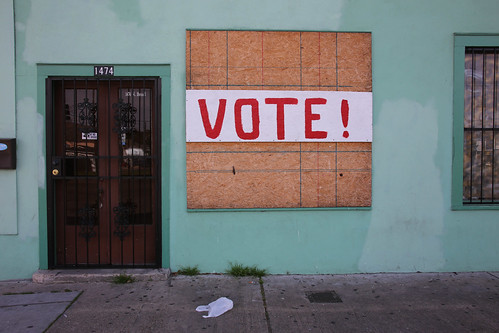
(Photo by Paul Sableman.)
Showing posts with label facebook. Show all posts
Showing posts with label facebook. Show all posts
Wednesday, June 3, 2020
Why your focus in online posting or voting doesn't need to reflect your priorities

Tuesday, May 14, 2019
An idea to address censorship by Google and Facebook without excessive government intrusion
This letter to the Wall Street Journal (by Emeritus Adjunct Prof. Stephen M. Maurer) suggests a way for government to do something about Google's censorship (which could also be applied to Facebook's censorship), in a way that would seem to get around the typical line of "they're a private company, they can censor whoever they want and government can't do anything about it":
Google’s suppression of [conservative think tank] Claremont Institute ads for speech that Google’s own employees couldn’t identify is terrifying. The problem is what to do about it. Asking government to look over Google’s shoulder would likely be worse.
There is an easier way. Before inviting regulators to intervene, Congress should first ask how a search engine that suppresses such organizations can exist at all. Why haven’t consumers demanded better? The answer, as [Claremont Institute President Ryan P. Williams] explains, is that nobody—apparently including Google itself—has any clear idea of when and how censorship occurs.
But that suggests a simple fix: Require platforms to generate an automated record each time their employees suppress speech, along with the in-house rule(s) they purportedly relied on. Then make the data widely available to regulators, congressmen, scholars and (especially) any competitor who promises to do better.
The cynics will say that Google will go on censoring regardless. Perhaps, but Silicon Valley monopolies are surprisingly sensitive to competition that might unseat them.
Saturday, May 11, 2019
A response to those who say: "Facebook is a private company, so it's free to censor"
If a private company is legally allowed to do all the censorship it wants, that’s why we should use more of our free speech to critique that company’s censorship. That is not a reason to stay silent about a corporation censoring people on a massive, global scale. If government can’t do anything about that problem, then it’s up to us.
Saturday, March 23, 2019
Your time
Your
time is limited and valuable. In every waking moment, you get to decide
what the very best use of your time is right now out of all possible
options. You should always want to do that rather than anything else.
And the best use of your time is never arguing with people about whether
they have the appropriate "reactions" to your Facebook posts.
Wednesday, April 11, 2018
Takeaway from Mark Zuckerberg's Senate hearing
Facebook needs to make sure no one says anything that makes anyone else feel bad — while giving everyone unprecedented, airtight privacy protections!
Good luck with that.
Tuesday, December 9, 2014
What Facebook does with your face
Sterling Crispin’s “Data Masks” are haunting portraits that don’t actually depict any one person. Instead, they use raw data to show how technology perceives humanity. Reverse-engineered from surveillance face-recognition algorithms and then fed through Facebook’s face-detection software, the Data Masks “confront viewers with the realization that they’re being seen and watched basically all the time,” Crispin says.(Quoted from "This Is What Your Face Looks Like to Facebook" by Kyle Chayka.)
“Facebook actually makes masks out of everyone’s faces,” the artist explains. The social network analyzes every face that appears in photos on its servers and renders them into three-dimensional models. “It’s happening whether you get tagged in the photo or not” . . .
As the U.S. government builds biometric databases like its Next-Generation Identification face-recognition system, it’s more important than ever to know how our identities are captured and processed by the technology we adopt. Crispin’s work is a reminder.
Sunday, January 23, 2011
How Facebook could get me to pay for a premium account
Offer an option to filter out all sports-related status updates from my news feed.
Tuesday, December 14, 2010
Our Facebook world
1. A map of the world made up entirely of glowing lines that symbolize Facebook friend connections. (More explanation here.)
2. A sign of the times: one friend writes to another on Facebook:
What did you change your profile picture to raise awareness for?
Monday, November 1, 2010
Causation and correlation
Normally I don't link to conversations on Facebook, but Robert Wiblin's Facebook wall is open to the public to see his insightful musings. (If you use Facebook, I recommend friending him.) For instance, he says:
Correlation is not causation, but correlates with it.My response:
Causation is not correlation, but causes it.Then, someone asks whether all causation is "statistical." I give a whole book as an answer: Probabilistic Causality by Ellery Eells (1953-2006). As you might have guessed from the title, the author's answer is yes. Eells pointed out (to those of us who took his course on probabilistic causality at the University of Wisconsin - Madison) that, in addition to the ubiquitous refrain that correlation does not prove causation, there's also the less well-known fact that causation does not prove correlation. (For instance, if A causes both B and C, and C prevents B more strongly than A causes B, A won't be correlated with B.) That observation, along with Eells's whole theory, was the inspiration for my response to Wiblin.
Someone else links to this perfect XKCD comic:

Monday, September 20, 2010
Mexico's drug violence and journalistic self-censorship
A typically appalling account of Mexico's drug wars by the New York Times quotes a chilling front-page editorial in the Mexican city of Ciudad Juarez, which has been so ravaged by the violence that there's been an exodus from the city. It's a common gimmick for an editorial to pretend to address someone ("An Open Letter to ____"), but this is the first time I've seen one that literally addresses a group of people — the drug lords — as a genuine form of communication:
“We want you to explain to us what you want from us . . . . What are we supposed to publish or not publish, so we know what to abide by. You are at this time the de facto authorities in this city because the legal authorities have not been able to stop our colleagues from falling.”I noticed the article because one of my friends recommended it on Facebook, which showed up in my feed as: "[Friend's Name] likes 'Mexico Paper, a Drug War Victim, Calls for a Voice.'" My friend remarked on the vacuous cheeriness with which Facebook's jargon has pervaded our content sharing:
When you "recommend" a NYTimes article, Facebook treats it as a "like." "Like" is not the right term for my regard for this article.
Tuesday, May 25, 2010
Do the media understand how bad Facebook's latest privacy problems are?
Let's look at two MSM publications -- the New York Times and the Economist -- and see how they've underreported some of the latest privacy issues with Facebook.
First, the New York Times uncritically ran this interview with a Facebook executive named Elliot Schrage, who answers questions from Times readers -- all of them about privacy. Of course the Times isn't endorsing what he's saying just by publishing the interview. But they didn't need to publish it in that form; they could have used the interview as the basis for an article that provided fact checks and counterpoints from other sources. In particular, all of these answers by Schrage are disingenuous:
[NYT reader:] I love Facebook, but I am increasingly frustrated by the convoluted nature of the privacy settings. It’s clearly within Facebook’s ability to make the privacy settings clear and easy to use — why hasn’t this been a focus? . . .I used to defend Facebook's privacy settings; I thought they were actually pretty admirable in allowing users to fine-tune exactly which kinds of people would be able to see which kinds of content. (For a given category of information, such as your job history, you could allow it to be seen by a hand-picked group of your friends, or all your friends, or also "friends of friends," or "everyone.") I knew there were a few components with no option to keep them from the public -- including your name, your profile photo, and things you're a "fan" of -- but I considered these pretty trivial. So I would have been fairly sympathetic to Schrage's answers. I knew about Facebook's indefensible privacy violation called Beacon, but Facebook discontinued that program, so I was optimistic that they had learned their lesson.
[Schrage:] Unfortunately, there are two opposing forces here — simplicity and granularity. By definition, if you make content sharing simpler, you lose granularity and vice versa. To date, we’ve been criticized for making things too complicated when we provide granular controls and for not providing enough control when we make things simple. We do our best to balance these interests but recognize we can do even better and we will . . . .
[NYT reader:] Why not simply set everything up for opt-in rather than opt-out? Facebook seems to assume that users generally want all the details of their private lives made public. . . .
[Schrage:] Everything is opt-in on Facebook. Participating in the service is a choice. We want people to continue to choose Facebook every day. Adding information — uploading photos or posting status updates or “like” a Page — are also all opt-in. Please don’t share if you’re not comfortable.
[NYT reader:] Why must I link to a page for my school, job, or interests and make them public, or delete the information entirely? . . .
[Schrage:] It turns out that less than 20 percent of users had filled out the text fields of this information. By contrast, more than 70 percent of users have ‘liked’ Pages to be connected to these kinds of ideas, experiences and organizations. That is the primary reason we offered the transition — because it reflects the way people are using our service already. While we see tremendous benefit to connecting to interests, we recognize that certain people may still want to share information about themselves through static text. That’s why we continue to provide a number of places for doing this, including the Bio section of the profile. In these places, just as when you share a piece of content like a photo or status update, we give you complete control over the privacy of the information and exactly who can see it.
I changed my mind about this when I tried to sign on to Facebook a few weeks ago. I described my experience in a comment on the NYT interview with Schrage; here's what I said (with some slight tweaking to my original comment):
Schrage's answer to the last question ("Why must I link to a page for my school, job, or interests and make them public, or delete the information entirely?") is unsatisfactory. He doesn't explain why Facebook is apparently forcing users to either delete their profile info or make it public.To be clear, there isn't an option to list my past and present jobs under "work," or my education history under "education," without connecting each employer and school to a public page. Schrage makes it sound like you're free to keep this information private. You're not.
See, I was recently prompted by Facebook to connect info in my profile -- my job and education history, as well as favorite music, books, movies, and TV shows -- to "pages." (This is also known as being a "fan" of these things.) Your pages are always visible to everyone; Facebook's normal privacy settings don't apply to pages. So I unclicked the boxes because I didn't want to link all that info to pages, thus causing it to become public.
Facebook gave me a warning saying that if "none" of my info was linked to pages, it would all be deleted. I thought this warning meant that I just needed to link some info to pages in order to prevent all my info from being deleted. So I became a "fan" of some of my favorite music and books -- that is, I opted to link a few of these items in my profile to their pages. When I went to my profile info, my job and education history (among other things) were gone! I immediately realized that I had misinterpreted Facebook's notice: they didn't just mean that all your info will be deleted if you don't link at least some of it to pages; they meant that any particular item will be deleted if that item isn't linked to pages. That seems obvious in retrospect, but the whole thing didn't make sense to me when I initially read it (Facebook has so many interface tweaks -- I don't have time to keep track of the rationales for each one), so I wasn't in a good position to interpret their warning correctly.
There was no way to undo this. So now, I apparently need to retype all of my work and education history, and also a bunch of my favorite music, movies, etc. that I didn't happen to link to pages. But even if I could easily restore the info, that still wouldn't be acceptable, because that would be giving up privacy I don't want to give up.
Facebook is using this new requirement of linking your info to pages as a ploy to get people to give up the privacy of their info. Surely, many people are not aware that pages don't have privacy "granularity"; again, pages are always public. In fact, this very interview is an example of Facebook's lack of transparency about this, since Schrage's "granularity" remark is inconsistent with how pages work and how they're taking over the site.
I can't believe that Facebook thinks this is best-described as "opt-in," or that it "reflects the way people are using [Facebook] already."
What about Schrage's rationale that only 20% of users had filled out these forms, while 70% of users had become a fan of pages? For one thing, I simply don't believe that only 20% of active users fill our their profile. But even if it's true that there was a real need to encourage more users to fill out this information and that the best way to accomplish this was by forcing you to connect your profile info to pages, that still wouldn't explain why they couldn't have added privacy settings to pages. This wouldn't require a delicate balancing act of "simplicity" against "granularity" (as Schrage puts it) -- they could have just applied the same granular privacy settings that always applied to these categories. Surely the Facebook executives in charge of this decision knew what they were doing; they didn't just lose track of the fact that pages are always public.
This is one of the things Senators Chuck Schumer, Al Franken, and two others complained about last month in a letter to Facebook CEO Mark Zuckerberg. As you can see at the link, the problem I'm focusing on in this blog post is just one of several. (The senators mentioned that the FTC will be looking into these issues.)
Now let's look at what the Economist says:
Facebook faces criticism for making more information about its users available by default. . . .I'm glad to see the Economist taking a generally critical stance on Facebook's privacy issues, but their commentary is too bland and generalized. They're right that default settings matter because many users won't bother to change them. But I don't feel that it's a major problem if many people sign up for a site and never bother to change the privacy settings from the default. Presumably, anyone who's very protective of their privacy will make sure to tweak those settings to their liking.
Facebook claims that most of its users are comfortable with the changes it has introduced, including one that lets it share detailed customer data with some external sites. It has blamed the furore on media hysteria; only a few privacy activists have publicly committed “Facebook suicide” by closing their accounts . . . .
[Facebook] has some of the most extensive privacy controls on the web, but these have now become so complex—and are tweaked so often—that even privacy experts find them bamboozling. The company also has a powerful incentive to push people into revealing more information. Facebook generates most of its revenue from targeted advertisements based on users’ demography and interests, so the more data users share publicly the more money it can mint from ads. It may well be betting that users are now so hooked that they are unlikely to revolt against a gradual loosening of privacy safeguards.
The worst thing is Facebook’s underlying prejudice against privacy. Sign up and it assumes you want to share as much data as possible; if not, you have to change the settings, which can be a fiddly business. The presumption should be exactly the opposite: the default should be tight privacy controls, which users may then loosen if they choose.
The problem isn't just about default settings. It's about first establishing privacy settings, giving people the sense that they are in total control of those settings, and then weakening the privacy protections without clearly letting users know about the change.
Now, one of the most common defenses of Facebook seems to be:
How can you complain about a free service? If you don't like Facebook's privacy levels, the solution is simple: don't use Facebook.Of course, this is missing the point. The problem isn't simply that people are giving up some of their privacy when they use Facebook. For instance, I would have no sympathy with someone who signs up for Flickr, publicly posts photos of people they know, then complains that they don't want strangers viewing these photos. Flickr's privacy settings are transparent and flexible, which is why you don't see uproars about Flickr even though people regularly waive their privacy by using the site. I have my name, photo, and a few personal facts posted on this blog, and it doesn't bother me -- because I always specifically chose to reveal this information. The problem with Facebook is that it deprives users of the freedom to decide whether they're comfortable with the extent to which they're giving up privacy by using the site, because so many of the privacy features have either been changed without notice or made so convoluted that it's a whole research project to figure them out.
Here's another comment on the NYT interview with Schrage that sums up the whole situation well. I'm not generally a fan of so much ALL CAPS, but it's rather appropriate here:
Listen up, because this is the big, fundamental difference between you Facebook executives and we the people who are screaming about privacy. You may THINK you know why I come to Facebook and you have assumed TOO MUCH. I come to share and interact with specific people that I already know. DID YOU HEAR THAT? SPECIFIC PEOPLE THAT I ALREADY KNOW. I do not want ANY information revealed to strangers by default. I am not alone in this. Your assumption that I come to connect with strangers is completely erroneous. Did you hear that Facebook? I will repeat - YOUR ASSUMPTION THAT I'VE COME TO FACEBOOK TO CONNECT WITH COMPLETE STRANGERS IS COMPLETELY ERRONEOUS. Are you getting it now? Is there any way I can make this more plain? It's about control - give me control over my personal details. Some people may want them known - fine, give them the control to reveal all and give me the control to reveal nothing. But do not just assume that you know what I want. Your assumption is what's best for YOU. It's not what's best for me. Do you get it now?Although I would love to feel like I could send a message to Facebook by deleting my account, I admit that the site is just too useful to me for that to be worth it. But I did post this status update on Facebook:
Facebook deleted all my education and work history (and other info) without asking me. As a small protest against Facebook's new interface that prompts you to either make this info public or have it deleted, I'm going to leave it off my profile. Anyone who's interested in knowing my education or work history will have to find out the old-fashioned way.I know that's not much. But I don't feel that even a whole movement of people deleting their accounts would make a dent. They'd inevitably be swamped by the millions of people who are signing up with Facebook all the time. It's more useful if those of us who care about privacy stay on Facebook so we can monitor the changes, stay part of the discussion, and speak up when things like this happen.
This piece by Mark Zuckerberg, in which he says that Facebook will fix the privacy settings in response to all the criticism, is encouraging. We'll have to wait and see what actually happens -- we certainly can't trust Zuckerberg's vague promises to make things better -- but maybe, this time, they'll get it right.
Wednesday, January 27, 2010
The MSM's reaction to the iPad is out of step with my Facebook feed.
Nicholas Carr sums up the mainstream media's response to Steve Jobs's unveiling of the iPad today:
The rapturous reaction to Apple’s tablet -- the buildup to Jobs’s announcement blurred the line between media feeding-frenzy and orgiastic pagan ritual -- shows that our attitude to the tablet form has finally changed. Tablets suddenly look attractive.Carr doesn't back this up with any examples, but let's assume he knows what he's talking about. If so, then the mainstream media is much more excited than my Facebook friends who reacted to the announcement. Here's a representative sampling of status updates:
The iPad? More like the iDon'tWannaBuyThisPad.
iDon't see the need for iPad.
but i already have a small macbook, and an iphone. dumb.
iFail.
Tuesday, September 22, 2009
For the annals of "unconvincing Facebook alerts"
There's a Facebook application called iLike, where you can make a list of your favorite music and get alerted when one of your favorites is going to play a concert in your town. This message from iLike just arrived in my inbox:
"George Harrison posted a concert near you!"
Friday, April 24, 2009
"This LP is basically not very good."
This review of Chris Cornell's new album, Scream, is actually more useful than the average review by a professional music critic. (Via ChordStrike.)
In that spirit, I wrote a review of St. Vincent's yet-to-be-released album Actor (which I was anticipating last Music Friday). Here it is, in full, originally appearing as a status update on Facebook:
John Althouse Cohen thinks the new St. Vincent album is pretty good but not as good as Marry Me. Better-produced, though.You might read reviews of the album in Pitchfork or Rolling Stone, where the critics are trying to (1) satisfy people's word-count expectations and (2) show off their (a) facility with metaphor, (b) aptitude for lyrical analysis, and (c) knowledge of musical influences (probably mentioning Kate Bush and Joni Mitchell), but my Facebook status update tells you everything you need to know.
If you're a fan of St. Vincent based on Marry Me, it's worth getting Actor, but expect a bit of "sophomore slump." If you don't have either of her albums, get Marry Me first, and only get Actor if you really like Marry Me. Any ink spilled, or bandwidth hogged, dissecting this album in any further detail will be superfluous.
Friday, March 20, 2009
Punk epistemology: "All I know is that I don't know nothing"
Facebook friend status update, referring to the old punk band Operation Ivy:
_______ is on an Op Ivy bender.
That makes me want to listen to some "Knowledge" -- an Operation Ivy song covered here by Green Day (whose first live show ever using the name Green Day was also Operation Ivy's last show, according to Wikipedia):
Cf. Socrates in Plato's Apology:
For this fear of death is indeed the pretence of wisdom, and not real wisdom, being the appearance of knowing the unknown; since no one knows whether death, which they in their fear apprehend to be the greatest evil, may not be the greatest good. Is there not here conceit of knowledge, which is a disgraceful sort of ignorance?
And this is the point in which, as I think, I am superior to men in general, and in which I might perhaps fancy myself wiser than other men -- that whereas I know but little of the world below, I do not suppose that I know.
Back to the modern day ... don't forget about Operation Ivy's bassist, Matt Freeman, who went on to be the bassist for Rancid. The greatest punk bassist in the world (parental advisory: explicit lyrics):
Tuesday, March 10, 2009
What I do and don't understand about Twitter
For a while, I didn't see the point of Twitter at all:
It seems like basically a blog service but with a word limit that's so restrictive that it's awkward to do links.Since I wrote that, I've slowly started to see the point. It's sort of like IM but better: everyone's content gets merged together, so you can experience it as an ongoing stream rather than a discrete, private conversation. OK, that's nice.
Or like IM without the spontaneity.
Or like Facebook's status updates without Facebook.
So, it's like a severely limited version of a bunch of other social media, with nothing extra to compensate? What's the point?
But that's leaving something out: who is engaging in those conversations? Ideally, you'd be connected with huge numbers of friends on Twitter. Well, I know very few people who regularly use Twitter. Meanwhile, I'm on Facebook and have about 250 friends, which is not an unusually high number for Facebook. I'd be surprised if even 50 of them are on Twitter.
Why does that matter? Because Facebook already has a feature that's much like Twitter: you can write a "status" message at the top of your profile that will also temporarily show up on your friends' Facebook homepage. I think the Facebook status even has a more generous space limit than Twitter.
So here's the problem: let's assume I want to let people know what I'm doing -- say, making carrot-ginger soup (real example). Why would I post this to Twitter instead of Facebook? Even on the liberal assumption that 50 of my friends are on Twitter, that's just a tiny fraction of 250. So I can do the same thing on either site, but a lot more people will see it if I use Facebook.
A Slate article from yesterday gave an elaborate explanation of why Twitter isn't going to "kill Facebook." According to the article, Twitter has an edge because it gives users real-time content, right when it's posted, while Facebook manipulates the timing of its content. (The article then dismisses its own point by noting that Facebook is apparently going to overhaul the interface to be more like Twitter.) That may be good fodder for a Slate writer who needs to make a clever point in an article, but is that what's really going to determine whether Twitter "kills" Facebook (or Facebook "kills" Twitter)? I have to think most people choosing between the sites are going to care about the same thing I care about: how many people I'd want to be in contact with are using these sites?
Aside from all that, I have been warming up to Twitter. I see it as an alternative to Facebook for older people. Twitter might not make sense as an alternative to Facebook if you're in your 20s, but if you're over 40 or so, it allows you to partake in the joys of social media without having to figure out: "What's this Facebook thing all about?"
So I'll keep my account around, simply to stay in touch with interesting people who happen to be middle-aged. But it still seems pathetic next to Facebook.
Maybe that's why the mainstream media are so obsessed with Twitter. They're informed enough to know that social-networking websites are a big enough craze to be worth reporting on. And it's clear what the most important such site is right now: Facebook. But either they don't get Facebook or it's too complicated to try to explain how it works in the limited space of media soundbites.* Twitter, by contrast, is entirely based on simplicity and brevity, so it's easy to convey it to a mass audience and seem like you're tuned into what the kids are up to these days.
* Of course, if that's the reason, then you have to wonder: if the mainstream media aren't adept at explaining something as trivial as Facebook, can we trust them to report on complicated issues that are actually serious?
UPDATE: Follow-up post.
Tuesday, February 10, 2009
25 random things about me
It's the craze that's sweeping Facebook:
In the past few weeks, a chain letter called "25 Random Things About Me" has wormed its way through Facebook at an alarming speed. The exhibitionistic format has remained surprisingly intact: In addition to rattling off 25 facts about themselves, "Random Things" authors are supposed to tag 25 of their Facebook friends, prompting them to write their own note and tag 25 more people, and so forth and so on.
[UPDATE: The evolutionary basis of "25 things."]
Here's mine, cross-posted from Facebook:
1. My first word was "happy." My first phrase was "Beach Boys." My first sentence was "I want it."
2. I haven't eaten meat since I was in elementary school.
3. I was baptized on Wall Street.
4. My favorite band is the Beatles. I used to say my favorites Beatles song was "You Never Give Me Your Money," but I can't decide anymore.
5. In the summer between 7th and 8th grades, I got an electric guitar and practiced about 8 hours a day.
6. The most famous people I've met are Al Franken, Christopher Hitchens, and Lorrie Moore, the last of whom is an old friend of the family.
7. I have a weird set of movies I watch over and over, while I haven't seen a lot of the most famous ones. I've never seen Forrest Gump, Titanic, etc. Movies I've seen a ridiculous number of times: My Dinner with Andre, Back to the Future trilogy, Annie Hall, Duck Soup.
8. I'm a pessimist and a skeptic, but I try not to be a cynic. I think the world is probably doomed, but I have confidence that a lot of individuals will make a good-faith effort to try to make things better along the way to our demise.
9. I spent a month in Rome but have never seen the Sistine Chapel's ceiling.
10. Since the beginning of 2007, I always wanted Obama as president and Biden as VP. I couldn't believe I hit the nail on the head.
11. I have a vivid memory of touching Courtney Love's bare shoulder when she was crowd surfing at a Hole concert, one of the emblematic moments of my teenage years.
12. When I was a law review editor I spent about half an hour on the phone with an author debating every single contraction in the piece, about 60 in all. He loved contractions, and I didn't want any of them, so we compromised and changed about half of them to full words.
13. People tell me I'm very "tech-savvy," but I'm actually technophobic. I waited as long as possible to switch to a cell phone and digital camera, and I still don't have any kind of iPhone/Blackberry/etc. because I prefer writing things down in notebooks.
14. I wish I'd been European instead of American; I think I'd fit in better in Europe.
15. When I was in middle school, I didn't cut my hair for a long time and I looked like this.
16. When I was 2, I played a game we called "do counter," which was getting up on the kitchen counter and recognizing spices. I knew each one by smell, or as I called it back then, "hmell."
17. This article accurately describes me.
18. The first time I acted in a play, there was a part at the end where the other actor ran up to me (per the script), but I accidentally struck her forehead with my teeth, causing her to bleed onstage. We were both fine, but I felt really bad. People in the audience didn't realize anything had gone wrong; they thought it was fake blood.
19. I cook myself dinner almost every night.
20. I used to sketch people's faces all the time, and I wish I still had the time or inclination to do so. One of my favorites is a drawing I did in 7th grade of Justice Scalia.
21. I can't whistle. But I'm really good at snapping.
22. I can't give you an answer about whether I'm a liberal or not. I often agree with them, but I also think they get too much stuff wrong.
23. I have a crush on Regina Spektor and Tracyanne Campbell, the singer from Camera Obscura.
24. I'm tired of being in my 20s; I can't wait till I'm in my 30s.
25. I started a blog last April. You should bookmark this link and read it on a regular basis.
Obviously, that last one was done for Facebook and is a moot point for you who are reading it here.
Saturday, June 14, 2008
Thank you, Tim Russert (1950-2008)
I make a point not to get particularly emotional about celebrity deaths. It seems kind of mawkish when there are so many ordinary people in the world suffering, dying, or struggling to get by.
But I can't think of any time in my life when I've felt so awful about the death of a single individual I've never met.
Does anyone else even come close? There was Kurt Cobain, of course. That was more objectively shocking — but I was so young when he died that I couldn't fully absorb it, and I only really got into his music in the aftermath of the suicide. There was George Harrison — the Beatles are my favorite band, and I especially look up to him as a guitarist — but he was well past his prime, and we had had plenty of time to resign ourselves to the fact that he was going to die soon.
No, the death of Tim Russert is different from all the others I've lived through. At 58, he was so clearly in the middle of his prime, with no good reason why he shouldn't have gone on for at least another decade as the skeptical voice of a nation.
Seeing the news was so shocking I didn't know how to take it in. Since I got the news from my mom, who I've often watched Meet the Press with, I emailed her. I can't think of anything to say except:
I can't believe Tim Russert is dead!!!She responds:
I know! I'm so shocked, and I feel a great sense of personal loss. It really mattered to hear Russert present the news.I post a status message on Facebook (the little messages about your friends that say, "John is doing such-and-such"):
John can't remember ever feeling more shocked at the news of a famous person's death than now.I check Facebook's feed of status messages from my friends, and the next 4 in a row are all about Russert. Samples:
_____ is so saddened by the death of Tim Russert. [43m ago]And so on. [Added later: This was back when you had to start each Facebook post with your name.]
_____ says rest in peace Tim. You were a hell of a journalist. [12m ago]
I still can't believe it. But yes, it's true . . .
I had the show's opening faux-Beethoven theme music stuck in my head for the rest of the day. Bum bum bum BAHHH da-da DUM dum . . .
I keep telling myself I'm never going to start my Sunday hearing that music with his voice intoning: "Our issues this Sunday..." He died while recording one of those opening sequences.
The show's intro was a little manufactured and overblown, as the show itself could be at times when it would focus more on horse-race politics than on policy issues.
But I still had to watch. Every Sunday. He made the news seem so much more serious, even momentous, than anyone else did.
Above all, he forced our leaders to explain themselves — to answer the tough questions that everyone was raising about them.
And he did this with everyone, never seeming to discriminate based on party or ideology. I remember when John Edwards had a disastrous performance on Meet the Press in the 2004 race — many commentators saw it as a major obstacle to him in trying to win the Democratic nomination. And I remember seeing him interview John McCain back in 2006, when he was just a "probable presidential candidate" (transcript). Without being unfair, and even though he gave McCain ample time to defend himself, Russert left no doubt that McCain had shifted far to the right of his maverick/centrist past in preparation for the Republican primaries. At the end of the interview, McCain acknowledged his discomfort: "I haven’t had so much fun since my last interrogation."
Russert has been criticized for valuing "gotcha" journalism over serious discussion of the issues, but that's confusing his trademark with his overall method. Yes, his trademark move was to put two quotes up on the screen, both from the guest, and then ask the guest to explain the discrepancy. Well, this alone was a valuable service, and actually went beyond what the New York Times does in a typical news story.
But that was just one of the tools in his tool chest — it wasn't the only one. He also regularly confronted guests with opinions from other people — politicians, pundits, experts — that seemed to debunk the guest's position. That may sound basic, but it's surprisingly rare. It certainly takes more initiative than almost any American TV journalist has. Well, we expect TV news to be shallower than the text version ... but even the newspapers often couldn't match Russert.
Even when the newspaper reporter makes sure to include quotes representing both sides of an issue, there's no substitute for what Russert mastered: sitting down with the people from the highest echelons of power and holding them accountable in real time, for all to see. I'm sorry, maybe I'm naive, but I think that's really important.
I remember having drinks with B____, who's a big follower of politics but, surprisingly, had never seen the show. I told him about how great it is and that he had to watch it. So the next day, we watched the current episode — the guest was John Kerry, who was the Democratic presidential nominee at that point. I realize that most people's idea of a good time isn't hanging out with your friends watching an interview with John Kerry. But B____ instantly got it: "Wow." It wasn't a particularly dramatic or newsworthy interview. But to watch just the first few minutes of it was to suddenly see Kerry's thinking on foreign policy laid bare in a way you hadn't seen in months and months of campaign coverage.
Last week's episode — the last of Russert's life — featured a group of pundits analyzing the end of the Democratic primaries and the beginning of the general election. That seems so small and arbitrary for the swan song of a great man. Anyway, he told this anecdote:
I remember reading those polls . . . in South Carolina where Senator Clinton was ahead amongst African-American voters. Then came some of the comments that Bill Clinton made. I went to Cleveland, Ohio, to do the debate with Clinton and Obama, and a big, black security guard came up to me and said, "You see Bill Clinton, you tell him thanks for making us 90-10 for Obama," and I just, "Whoa, I don't—not in the business of transmitting messages, sir, but I appreciate your comment."(During that last line, he tilted up his palms in a "taken aback" gesture.) I think this trivial little moment says something about him — not just that he had a knack for a vivid anecdote, but also that he talked to us the way people talk to each other in real life. "So this big black guy comes up to me and . . ." — that's not the way people are supposed to talk on television. He knew he didn't make the warmest impression on TV — he was just trying to be accurate and real.
Not many journalists in the United States are willing to look a presidential candidate in the eyes and tell them they've made "a direct contradiction." Russert was.
He didn't follow other people's standards — he set the standard. And it's hard for me to imagine anyone taking his place. I'm sure the show will keep going, and I'm sure they'll have very competent guest hosts (as they sometimes have in the past) such as Andrea Mitchell or David Gregory until they figure out a permanent replacement. But it won't be the same.
Russert's single moment that may be remembered above all the rest involves a bizarre fluke at the end of an interview with Colin Powell. It was back when Powell was still Secretary of State but after our intelligence leading up to the Iraq war had been discredited.
Just as Russert is prefacing his question with a description of Powell's crucial pre-war presentation 0f WMD evidence — around when he starts talking about how "you placed your enormous personal credibility before the United Nations . . ." — the camera jerks away so that it's showing a palm tree instead of Powell. You can hear muttering in the background between Powell and an unseen woman.
At this point, most interviewers would try to smooth over the awkwardness as calmly as possible. But Russert doesn't smooth anything over — he heightens the tension by letting an awkward silence go by.
Then he sternly tells Powell:
"I think that was one of your staff, Mr. Secretary. I don't think that's appropriate."
Russert continues with his line of questioning and seems all the more insistent for being a little flustered. After the interview, Russert forcefully tells us:
And that was an unedited interview with the secretary of state taped earlier this morning from Jordan. We appreciate Secretary Powell's willingness to overrule his press aide's attempt to abruptly cut off our discussion as I began to ask my final question.Evidently, the staffer thought that NBC would go along with their wishes and edit out the awkward stuff so that it appeared to be a nice, normal interview. Indeed, though you can't make out a complete sentence, you can faintly hear the staffer say something about "editing." Well, anyone who thought they could get away with an airbrushed interview with Russert didn't understand what he was all about.
Thank you, Tim Russert, for informing us and standing up to the powerful. We need people like you to have a functioning democracy.
A commenter on The New Republic's website offered a nice vignette:
I have a recent and extremely pleasant memory of Mr. Russert. I was watching the election returns after, I think Super Tuesday, and he was on with a couple other guys. The close nature of the Democratic race had become stunningly apparent. Mr. Russert was beside himself with glee. He was obviously, genuinely excited about being a witness at Democracy. He was no longer an anchor or pundit; he was instead savoring the fruits of our Constitution -- our elections -- and thus his face, with its stupid grin and wild, child's eyes, was the face of a patriot. I hope Tim Russert is now on a bar stool in Heaven, next to guys with their sleeves rolled up and their shirt collars unbuttoned, running an infinite tab and laying odds with new friends and old on who wins Virginia -- Obama or McCain.Crying over the loss of a television personality seems ridiculous. But I can't help but feel sad about something that had become so ordinary to me, that had such a settled place in my life.
You were my Sunday mornings. They're not going to be the same without you.
Subscribe to:
Posts (Atom)


