Showing posts with label September 11. Show all posts

Friday, September 11, 2015

How two comedy greats went back to work after September 11, 2001

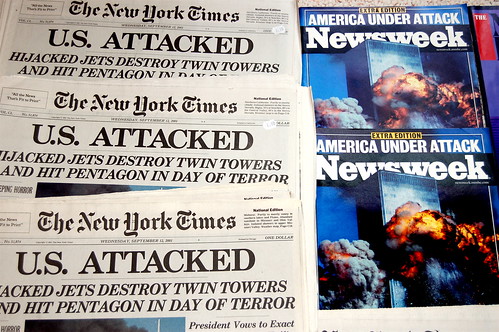
September 11th news


David Letterman on September 17, 2001:


Welcome to the Late Show. This is our first show on the air since New York and Washington were attacked. And I need to ask your patience and indulgence here. . . . If we are going to continue to do shows, I just need to hear myself talk for a couple of minutes, and so, that's what I'm going to do here. It's terribly sad here in New York City. We've lost 5,000 fellow New Yorkers. And you can feel it. You can see it. . . . And watching all of this, I wasn't sure that I should be doing a television show. . . .

In the 20 years that we've been here in New York City, we've worked closely with the police officers and firefighters. And fortunately, most of us don't really have to think too much about what these men and women do on a daily basis. And the phrase "New York's finest" and "New York's bravest" — you know, did it mean anything to us personally, first-hand? Well, maybe, hopefully, but probably not. But boy, it means something now, doesn't it? They put themselves in harm's way to protect people like us. . . . And my hope for myself and everybody else . . . is that we never, ever take these people for granted. . . .

The reason we were attacked, the reason these people are . . . missing and dead, and they weren’t doing anything wrong, they were living their lives, they were going to work, they were traveling, they were doing what they normally do . . . as I understand it, and my understanding of this is vague at best — another smaller group of people stole some airplanes and crashed them into buildings. And we’re told that they were zealots, fueled by religious fervor. Religious fervor. And if you live to be a thousand years old, will that make any sense to you? Will that make any goddamned sense?

I’ll tell you about a thing that happened last night. There’s a town in Montana by the name of Choteau. It’s about a hundred miles south of the Canadian border. And I know a little something about this town. It’s 1,600 people. And it’s an ag-business community, which means farming and ranching. And Montana’s been in the middle of a drought for, I don’t know, three years? And if you’ve got no rain, you can’t grow anything. And if you can’t grow anything, you can’t farm. And if you can’t grow anything, you can’t ranch, because the cattle don’t have anything to eat. And that’s the way life is in a small town, 1,600 people. Last night at the high school auditorium in Choteau, Montana, . . . they had . . . a rally . . . to raise money for New York City. And if that doesn’t tell you everything you need to know about the . . . the spirit of the United States, then I can’t help you. I’m sorry.

Rolling Stone notes that Letterman got married 8 years later in Choteau, Montana.

Notice how Letterman started out: "If we are going to continue to do shows . . ." That seems like a silly thing to say now. But back then, he was invoking a serious concern: it didn't seem to make sense for anyone to do a comedy show anymore. Everything seemed to have turned completely serious all of a sudden, and it was hard to imagine ever getting out of it. That's probably how people often feel in response to the death of a loved one — but that happens privately, not to the whole country at once.

It's interesting to compare how Letterman and Stewart dealt with the situation. In many ways, they were similar: they both highlighted inspiring Americans and lambasted the terrorists' way of life. But their emotional quality was different. Letterman was clearly rattled, but he also had a steadily controlled determination. Jon Stewart seemed absolutely raw and barely able to get through a sentence. He was speaking three days later than Letterman, but he seemed like he was speaking the day after the attacks. They were both great in their own ways.

This was Jon Stewart on September 20, 2001:


I'm sorry to do this to you. It's another entertainment show beginning with an overwrought speech of a shaken host, and television is nothing if not redundant. . . . They said to get back to work. And there were no jobs available for "a man in the fetal position under his desk crying" — which I gladly would have taken. So I come back here. . . .

We sit in the back and we throw spitballs, but never forgetting the fact that it is a luxury in this country that allows us to do that — that is, a country that allows for open satire. And I know that sounds like it goes without saying, but that's really what this whole situation is about. It's the difference between closed and open. It's the difference between free and burdened. And we don't take that for granted here. . . .

I wanted to tell you why I grieve, but why I don't despair. . . . One of my first memories is of Martin Luther King being shot. I was five. . . . That was a tremendous test of this country’s fabric. And this country’s had many tests before that and after that. And the reason I don’t despair is because — this attack happened. It’s not a dream. But the aftermath of it, the recovery, is a dream realized. And that is Martin Luther King’s dream. Whatever barriers we’ve put up are gone, even if it’s just momentary. And we’re judging people by not the color of their skin, but the content of their character.

And you know, all this talk about: “These guys are criminal masterminds. They got together, and their extraordinary guile, and their wit and their skill.” . . . It’s a lie! Any fool can blow something up. Any fool can destroy. But to see . . . these firefighters, these policemen, and people from all over the country, literally, with buckets, rebuilding. That’s extraordinary. And that's why we’ve already won. It’s light, it's democracy. . . . They can’t shut that down. They live in chaos, and chaos, it can’t sustain itself. It never could. It’s too easy, and it’s too unsatisfying.

The view from my apartment was the World Trade Center. And now it’s gone. They attacked it! This symbol of American ingenuity and strength and labor and imagination and commerce, and it is gone! But you know what the view is now? The Statue of Liberty. The view from the south of Manhattan is now the Statue of Liberty. You can’t beat that.

So we’re going to take a break . . . and we’re going to get back to this. And it's going to be fun and funny, and it’s going to be the same as it was.

Now the World Trade Center is back. And we've recently said goodbye to David Letterman and Jon Stewart. They quietly played a role in helping America work through its feelings after the unthinkable happened.


(Photo by my mom, Ann Althouse.)

Sunday, September 11, 2011

Two first-hand accounts of the attacks of September 11, 2001, by the same person

Penelope Trunk wrote this on September 12, 2001 (on her blog and for Time magazine):

At the Wall St. train stop people were covered with papers. A plane crash. That's what everyone said. Then a boom. Everyone ran. I ran to my office and called my brother in the Midwest.

I wanted to be closer. At the corner of Church and Broadway, I angled my way through a large, packed crowd to get the best view. We talked about people jumping. The police stood behind the yellow tape. Minutes later, there was a boom. I thought it was a bomb, so I crouched, but people ran, so I ran. I couldn't see anything. I don't know how far I ran. Couldn't see where I was running. Didn't know if I was in a street or next to a building. Didn't know what street I was on. No one could talk because the dust filled our throats. After about ten steps I tripped over a pile of people and then people tripped on me.

I laid there. The only sound was the falling of dust and debris. No one moved under me. The weight of people on top of me got heavier. I couldn't breathe. I knew we were all going to die in that pile. I pulled myself out of the pile. My slip-ons slipped off. I stood up and saw nothing. Not even an inch in front of me. I put my hands out and felt for something. I bumped into the brick side of a building. I bumped into milk crates. I stopped. I had no idea what to do, and I knew everyone around me was suffocating. I thought about my mom and dad, they would be so sad to hear that I died. I thought about my husband. Just married and I will not get to live my life with him. I thought about my brothers. They would cry. I told myself to just keep trying to find a way to air, but I didn't believe I would live.

I bumped into something that I could feel the top of, so I lifted myself up. I worried I was going into the back of a dump truck, and I was scared I'd be trapped. I didn't know if there was fire, or a bomb. I didn't know how to protect myself — find air. Go up? — so I didn't know for sure that a dump truck would be bad. I think it was scaffolding. I think I jumped over piles of bodies by climbing scaffolding.

I pulled myself into a building. What building? I don't know. And I took a breath. I took two breaths. I was sure the building would be bombed. I looked for stairs. I kept thinking I needed clean air. I found a bathroom. I didn't realize I wanted water until it was there. Four men inside. Two fighting over the faucet. I shared the toilet with another man. We drank almost the whole bowl.

Once the four of us were calmed by water and air, we ventured outside the bathroom. We walked up stairs. Slowly. We checked doors behind us, left them all open. We got up only one floor. We waited. I cried. They shared one can of apple juice.

The intercom in the building announced stay where you are. I was so relieved to know people knew we were there. The intercom announced again and I thought another bomb would go off and I'd die. I cried. The guy with the apple juice put his arm around me. I wondered why no one else cried. The intercom announced to go down the stairs. I picked up a wastebasket: I planned to fill it with water. Planned to use it to shelter myself from the next bomb. (I still had no idea the building collapsed.)

In the lobby of the building someone gave me a Nantucket Nectar and told me to vomit. I walked outside the building with the drink in my wastebasket. There was no one around. White everywhere. The four of us had nowhere to go. I couldn't remember where I was. I walked toward the water. Police directed everyone north. I asked a woman next to me, "Where are we going?" She said, "I don't know." She had no dust. She looked so steady. I followed her. This was the beginning of her long protection.

She said, "You can walk home with me. You need a shower." I coughed. She asked why I was carrying a wastebasket. I said, "In case there's another bomb." She held onto my arm as we made our way next to the river. In Chinatown, she bought me shoes. At the Bowery we finally found a payphone that didn't have a line of people. So she called her husband and I sat down next to my wastebasket. It was the first time I sat down, and I started crying.

We resumed walking. Sometimes we ran. I made sure to keep up and I didn't tell Teresa that I was worried that I would faint. I drank Nantucket Nectar every time I got dizzy.

At 59th St. a plane went overhead and I screamed. In front of Bloomingdales. There was no one there from Wall St. I knew I looked crazy. I screamed anyway. I reminded everyone there were no planes allowed to fly. Someone said, "It's the army." I came out from under my wastebasket and kept walking. Theresa's apartment was 71st on the Upper West Side. Where everyone looked fine.

In the shower, dripping debris down my body, I remembered one more moment under the rubble. When I couldn't breathe. When I couldn't see. In the middle of the dead quiet was a voice. He said, "Is there anyone here? Can someone hold my hand?" I reached out to the voice, and held his hand. It was shaking and the skin was old. I squeezed and then I let go.
10 years later, here's her very different description of the same events:
I was there when the first tower fell. I was so close to it that I could not even see what had happened. I didn’t run. I ducked for cover. I got trampled. By the time I could stand up, everything was completely dark.

I remember the moment I realized I should close my mouth and stop breathing. Time got so slow. I remember thinking that if I had stopped breathing sooner, I would have had a few extra breaths right now. I remember thinking don't swallow, because there was too much stuff in my mouth.

I thought to myself that I had no idea what to do to save my life. I was in the dark and couldn’t breathe. I thought I’ll only be alive for maybe a minute longer, so I only have to keep trying to figure out how to save my life for one more minute. I told myself I can’t give up until I pass out. I remember that I hoped for a fast death.

Then something switched in me. I was okay dying. I felt okay with whatever level of pain I had before I died. I thought of my two brothers. I wanted them to be okay. To be fine. And I hoped someone would help them deal with my death. I thought of my husband, and I was so disappointed to not see our life unfold together.

That evening, after I had been to the hospital, after I had both eyes patched up, my husband finally told me both towers fell. That evening, I still thought the time that I was in the dark was maybe ten minutes. Now I realize that the time when I could not breathe was probably less than a minute. I had accepted the pain and my death after only 30 seconds.
Today, she posts to Twitter:
My mom called me this morning. She was crying. She said she remembers thinking I was dead. She never cries.

When we mourn the loss on September 11, what do we affirm?

Leon Wieseltier said, at a 9/11 memorial a few days ago hosted by The New Republic:

We mourn only the loss of what we have loved and what we have valued, and in this way mourning darkly refreshes our knowledge of the causes of our loves and the reasons for our values. . . .

Here is what we affirmed by our mourning on September 11, 2001, and by the introspection of its aftermath:

that we wish to be known, to ourselves and to the world, by the liberty that we offer, axiomatically, as a matter of right, to the individuals and the groups with whom we live;

that the ordinary lives of ordinary people on an ordinary day of work and play can truthfully exemplify that liberty, and fully represent what we stand for;

that we will defend ourselves, resolutely and even ferociously, because self-defense is also an ethical responsibility, and that our debates about the proper use of our power in our own defense should not be construed as an infirmity in our will;

that the multiplicity of cultures and traditions that we contain peaceably in our society is one of our highest accomplishments, because we are not afraid of difference, and because we do not confuse openness with emptiness, or unity with conformity;

that a country as vast and as various as ours may still be experienced as a community;

that none of our worldviews, with God or without God, should ever become the worldview of the state, and that no sanctity ever attaches to violence;

that the materialism and the self-absorption of the way we live has not extinguished our awareness of a larger purpose, even if sometimes they have obscured it;

that we believe in progress, at home and abroad, in social progress, in moral progress, even when it is fitful and contested and difficult;

that just as we have enemies in the world we have friends, and that our friends are the individuals and the movements and the societies that aspire, often in circumstances of great adversity, to democracy and to decency.

Saturday, September 11, 2010

President Obama on the September 11 attacks

"We are one nation — one people — bound not only by grief but by a set of common ideals. . . . [T]he sense of responsibility we felt for one another that day was not a fleeting passion, but a lasting virtue. This is a difficult time for our country. It's often in such moments that some try to stoke bitterness, to divide us based on our differences, to blind us to what we have in common. But on this day, we are reminded that at our best, we do not give in to this temptation. . . . So let us grieve for those we've lost, honor those who have sacrificed, and do our best to live up to the shared values that we have — on this day and every day that follows."


My post on September 11, 2008: "Do you see what's happening?"

Friday, September 12, 2008

I'm not here. This isn't happening. I'm not here...

I usually do a music post on Fridays, but it seems a bit gaudy after the September 11 post.

So here's a song for you: "How to Disappear Completely." (Lyrics.)

Radiohead couldn't have been writing this about the attacks, because the song came out in 2000. But with its eerie pall and relentless trudge, it sounds like it was written about that day.


Thursday, September 11, 2008

When the fire was lit - TNR on 9/11

I'm glad to see that The New Republic has dredged up some of its old pieces conveying "the immediate reaction" to the September 11 attacks.

Here are two articles that I still remember making an impression on me:

1. Fault Lines, by Peter Beinart (Oct. 1, 2001)

Sample:

[P]erhaps the most pitiful thing about [Robert] Fisk and The Nation's efforts to rationalize bin Laden's hatred of the United States is that they don't even correspond to what bin Laden himself says. . . . In bin Laden's mind, America's greatest offense — by far — is its military presence in his home country of Saudi Arabia. . . . And that's a harder line for Western leftists to peddle. Because bin Laden isn't upset at the United States for bolstering Riyadh's oppressive policies — after all, the Saudi government's views on individual freedom and the status of women roughly mirror his own. Bin Laden is upset simply because non-Muslims live in the Holy Land around Mecca and Medina. His first priority is banishing Christians and Jews from Saudi Arabia. And his second priority is banishing Christians and Jews from every other Muslim country. As he told ABC News in 1998, "Allah ordered us in this religion to purify Muslim land of all non-believers, and especially the Arabian Peninsula." . . .

If Fisk and The Nation really want to argue that America brought the World Trade Center attack on itself, they shouldn't delude themselves. They are not defending the Palestinians' right to a state or the Iraqis' right to medicine. They are defending a Muslim's right not to live with a non-Muslim.

2. How to Fight, by Eliot Cohen (Sept. 24, 2001)

Sample:
We will pay a price in convenience and even, perhaps, in the full scope of our personal liberties. We will spend more time waiting in line at airports, find access to government offices more difficult, and quite likely submit to more intrusive monitoring by police and counterintelligence than we have known since the early years of the cold war. We may come to understand, at least in our big cities, the experience of Israelis today or of Londoners several years ago, when IRA bombs meant not being able to go into a cinema without having one's belongings carefully searched. Welcome to the world of omnipresent video cameras, retinal scanners, and perhaps even national identity cards.
Cohen concludes this essay by quoting Winston Churchill's response to the attacks on Pearl Harbor:
Silly people—and there were many, not only in enemy countries—might discount the force of the United States. Some said they were soft, others that they would never be united. They would fool around at a distance. They would never come to grips. They would never stand blood-letting. Their democracy and system of recurrent elections would paralyze their war effort. They would be just a vague blur on the horizon to friend or foe. Now we should see the weakness of this numerous but remote, wealthy and talkative people. But I had studied the American Civil War, fought out to the last desperate inch. American blood flowed in my veins. I thought of a remark which Edward Grey had made to me more than thirty years before—that the United States is like "a gigantic boiler. Once the fire is lighted under it there is no limit to the power it can generate."
In the last sentence of the article, Cohen adds his own sentiment to Churchill's:
The fire has been lit.

"Do you see what's happening?"

There's only been one day in my life when I could get a phone call, hear "Do you see what's happening?" as the first sentence from the person calling me, and, without having any context aside from being in America, know exactly what it was about.

I'm sure there have been other events in United States history when that would have also been understood — the assassination of JFK or MLK. But those were before my time.

And those were deaths of single individuals. As sad as it is for a sitting president to die, it's bound to happen sometimes. People die, and we need to have a way of dealing with it. But we should never have needed to deal with our greatest city being torn down.

Commentators on the right and left (William Safire, Matthew Yglesias) have compared the deaths in those attacks to car accident statistics. More people die in car accidents each month in the United States than died in the attacks.

Well, I think that's wrong on a lot of levels:

1. It's easy to focus on the deaths you know about; it's harder, but equally important, to focus on the hidden deaths that you can't see or that haven't even happened. The terrorists didn't go to all that effort "just" to kill 3,000 people. The fact that such a relatively small number died while so many more escaped is amazing. Tens of thousands of people escaped the World Trade Center. The terrorists foolishly attacked shortly before 9 a.m., when many people hadn't gotten to work yet. One of the four planes didn't even strike its target. They were trying, and are still trying, to do a lot more damage than they did on September 11.

It's common to use "3,000 deaths" as a shorthand for "the extreme consequences that can result from terrorism." But this number is (understandably) used for its emotional resonance, not because of any genuine numerical exactitude. The September 11 attacks have already happened; we can't change that. We need to be worrying about the number of people killed in the next terrorist attack, and there's no telling what that number will be. It could be 3, or 300, or 30,000, or 300,000.


2. Yes, only a tiny proportion of deaths are due to terrorism, but it doesn't follow that terrorism should be a negligible concern. As impolitic as it may be to point this out in our "culture of life," some deaths are more worth accepting than others.

We've spent a century getting used to cars. Over time, we've collectively decided that having the widespread benefit of cars is worth the tradeoff of resulting deaths — which are a tiny percentage of the beneficiaries even though the absolute numbers are huge.

Cars can kill people; they can also make life more comfortable. They can even save lives if, say, you need to be rushed to the hospital for life-saving treatment, or you need to leave town to escape a natural disaster. Most people basically accept this calculus, and those who don't like it have a lot of power to minimize the role of cars in their lives by not driving, being extra careful when crossing the street, and so on.

You can't say the same thing about terrorism. We haven't gradually gotten used to its presence in our life and systematically worked on minimizing the damage in a way that's broadly acceptable to most people.

I also find it really odd when people argue, in effect, that "we don't take car accidents seriously, so we shouldn't other deaths seriously either." The fact is, we do take car accidents very seriously, as well we should. We've taken all sorts of measures to try to reduce the harm they cause: speed limits, drunk-driving laws, airbags, etc. If one of the premises of your argument is that cars aren't a very morally serious issue, then you simply have a false premise.

Above all, there is no real cost-benefit tradeoff with terrorism because there's no benefit! Terrorists don't offer us a mix of good and bad that we look at and say, "Well, we'll accept that, on balance."

Al Qaeda-style terrorists offer an obsession with death and a dehumanizing ideology, and that's it.


3. The death toll alone doesn't capture the enormity of the destruction caused by terrorism.

Again, people use "3,000 deaths" as a synonym for "the harm caused by the attacks" -- understandably so, as it would seem crass to focus on some of the other harms. But if reality is a little crass, then so be it.

There was enormous economic loss. For some estimates, look at this list and scroll down to the dollar figures. (New York magazine link.) One that stands out: the cost to NYC in the month after the attacks was over $100 billion. That's a million dollars, multiplied by 1,000, multiplied by 100, for just one city, in one month.

There were the toxic environmental effects in Manhattan.

There was a deep psychic wound left on our country's soul.

And there were people who didn't just die, but had to live their last moments hanging out of skyscraper windows and deciding to plummet to their deaths.

That's what I try to remember every year this day. But it's so unfathomable that I can't imagine it.

I don't know how you factor that into a cost-benefit analysis. I don't know how you balance that against the costs of annoying airline security measures, or library records being given an extra look beyond just checking for late fees.

Maybe you can't. You just keep trying to do whatever you can, whatever tiny amount that might be, to stop this from ever happening again.


WTC World Trade Center September 11 memorial in NYC


(Photo of September 11 memorial by Denise Gould. I got this photo from pingnews, which got it from the U.S. Department of Defense photo collection.)