Showing posts with label Letterman. Show all posts

Friday, September 11, 2015

How two comedy greats went back to work after September 11, 2001

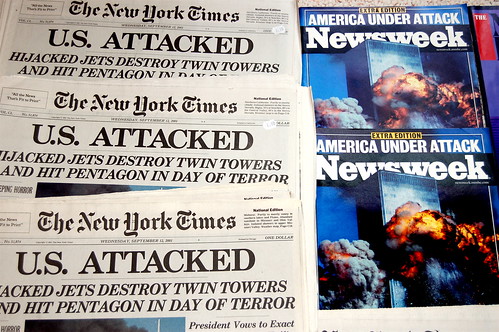
September 11th news


David Letterman on September 17, 2001:


Welcome to the Late Show. This is our first show on the air since New York and Washington were attacked. And I need to ask your patience and indulgence here. . . . If we are going to continue to do shows, I just need to hear myself talk for a couple of minutes, and so, that's what I'm going to do here. It's terribly sad here in New York City. We've lost 5,000 fellow New Yorkers. And you can feel it. You can see it. . . . And watching all of this, I wasn't sure that I should be doing a television show. . . .

In the 20 years that we've been here in New York City, we've worked closely with the police officers and firefighters. And fortunately, most of us don't really have to think too much about what these men and women do on a daily basis. And the phrase "New York's finest" and "New York's bravest" — you know, did it mean anything to us personally, first-hand? Well, maybe, hopefully, but probably not. But boy, it means something now, doesn't it? They put themselves in harm's way to protect people like us. . . . And my hope for myself and everybody else . . . is that we never, ever take these people for granted. . . .

The reason we were attacked, the reason these people are . . . missing and dead, and they weren’t doing anything wrong, they were living their lives, they were going to work, they were traveling, they were doing what they normally do . . . as I understand it, and my understanding of this is vague at best — another smaller group of people stole some airplanes and crashed them into buildings. And we’re told that they were zealots, fueled by religious fervor. Religious fervor. And if you live to be a thousand years old, will that make any sense to you? Will that make any goddamned sense?

I’ll tell you about a thing that happened last night. There’s a town in Montana by the name of Choteau. It’s about a hundred miles south of the Canadian border. And I know a little something about this town. It’s 1,600 people. And it’s an ag-business community, which means farming and ranching. And Montana’s been in the middle of a drought for, I don’t know, three years? And if you’ve got no rain, you can’t grow anything. And if you can’t grow anything, you can’t farm. And if you can’t grow anything, you can’t ranch, because the cattle don’t have anything to eat. And that’s the way life is in a small town, 1,600 people. Last night at the high school auditorium in Choteau, Montana, . . . they had . . . a rally . . . to raise money for New York City. And if that doesn’t tell you everything you need to know about the . . . the spirit of the United States, then I can’t help you. I’m sorry.

Rolling Stone notes that Letterman got married 8 years later in Choteau, Montana.

Notice how Letterman started out: "If we are going to continue to do shows . . ." That seems like a silly thing to say now. But back then, he was invoking a serious concern: it didn't seem to make sense for anyone to do a comedy show anymore. Everything seemed to have turned completely serious all of a sudden, and it was hard to imagine ever getting out of it. That's probably how people often feel in response to the death of a loved one — but that happens privately, not to the whole country at once.

It's interesting to compare how Letterman and Stewart dealt with the situation. In many ways, they were similar: they both highlighted inspiring Americans and lambasted the terrorists' way of life. But their emotional quality was different. Letterman was clearly rattled, but he also had a steadily controlled determination. Jon Stewart seemed absolutely raw and barely able to get through a sentence. He was speaking three days later than Letterman, but he seemed like he was speaking the day after the attacks. They were both great in their own ways.

This was Jon Stewart on September 20, 2001:


I'm sorry to do this to you. It's another entertainment show beginning with an overwrought speech of a shaken host, and television is nothing if not redundant. . . . They said to get back to work. And there were no jobs available for "a man in the fetal position under his desk crying" — which I gladly would have taken. So I come back here. . . .

We sit in the back and we throw spitballs, but never forgetting the fact that it is a luxury in this country that allows us to do that — that is, a country that allows for open satire. And I know that sounds like it goes without saying, but that's really what this whole situation is about. It's the difference between closed and open. It's the difference between free and burdened. And we don't take that for granted here. . . .

I wanted to tell you why I grieve, but why I don't despair. . . . One of my first memories is of Martin Luther King being shot. I was five. . . . That was a tremendous test of this country’s fabric. And this country’s had many tests before that and after that. And the reason I don’t despair is because — this attack happened. It’s not a dream. But the aftermath of it, the recovery, is a dream realized. And that is Martin Luther King’s dream. Whatever barriers we’ve put up are gone, even if it’s just momentary. And we’re judging people by not the color of their skin, but the content of their character.

And you know, all this talk about: “These guys are criminal masterminds. They got together, and their extraordinary guile, and their wit and their skill.” . . . It’s a lie! Any fool can blow something up. Any fool can destroy. But to see . . . these firefighters, these policemen, and people from all over the country, literally, with buckets, rebuilding. That’s extraordinary. And that's why we’ve already won. It’s light, it's democracy. . . . They can’t shut that down. They live in chaos, and chaos, it can’t sustain itself. It never could. It’s too easy, and it’s too unsatisfying.

The view from my apartment was the World Trade Center. And now it’s gone. They attacked it! This symbol of American ingenuity and strength and labor and imagination and commerce, and it is gone! But you know what the view is now? The Statue of Liberty. The view from the south of Manhattan is now the Statue of Liberty. You can’t beat that.

So we’re going to take a break . . . and we’re going to get back to this. And it's going to be fun and funny, and it’s going to be the same as it was.

Now the World Trade Center is back. And we've recently said goodbye to David Letterman and Jon Stewart. They quietly played a role in helping America work through its feelings after the unthinkable happened.


(Photo by my mom, Ann Althouse.)

Sunday, May 31, 2015

What do David Letterman and Kurt Cobain have to do with Hillary Clinton?

Matt Lewis explains:

A girl I went to high school with spent a semester in Australia. She must have blossomed there, for when she returned home, she magically had an Australian accent. Predictably, we would have none of it. Kids might be cruel, but they also have great bullshit detectors. Nobody likes a phony — not even in Middletown, Maryland. The accent receded; the mockery endured.

This, I suspect, has always been the case. But at least since the invention of Holden Caulfield, phoniness has been the unpardonable sin. Meanwhile, authenticity has become our greatest virtue. . . .

We just spent a week celebrating the career of David Letterman, a man whose entire raison d’ĂȘtre consisted of being the first post-modern late-night comedian — a guy whose humor hinged on being in on the joke and ironic (not like all the phonies on TV at the time!).

This, of course, brings us to Hillary Clinton, and her fake Southern accent. There might have been a Southern accent where Tom Petty came from, but there wasn’t one in Illinois or New York (you know, the places where Clinton grew up and represented in the U.S. Senate?) . . .

The revolt against the phoniness of American life goes back to at least the 60s, which is why it’s odd that Hillary Clinton is so transparently engaging in “show business.” But for Generation X, in particular, the ethos of authenticity practically defines our generation. It’s why Kurt Cobain in a cardigan was cooler than KISS in makeup. It’s why single camera sitcoms with laugh tracks (once wildly popular) now feel so damned cringeworthy. It’s even why John McCain, with all his flaws, seemed much cooler than George W. Bush in 2000. . . .

[T]he GOP (should they nominate someone like, say, Marco Rubio) has a chance to actually “out-cool” Hillary.


(That video is from 2007.)

Thursday, May 21, 2015

Adam Sandler on David Letterman

"'Cause you're the king of comedy, our best friend on TV."


Wednesday, May 20, 2015

Norm MacDonald drops his usual deadpan and says an emotional goodbye to David Letterman.

Norm MacDonald closed his standup on the Late Show last week by saying this (via):

Mr. Letterman is not for the mawkish, and he has no truck for the sentimental. If something is true, it is not sentimental. And I say in truth, I love you.

Tuesday, May 19, 2015

Conan O'Brien explains why David Letterman matters.

Conan O'Brien writes:

[I]n 1980 the comedy world was a very different place. Yes, we had Saturday Night Live, but the original cast had departed and, strange as it sounds now, I felt as if that show had spent its explosive force. My early teen hero Steve Martin was done performing electrifying stand-up and was making movies—still hilarious but now an established show business franchise. Johnny Carson was only two thirds through his reign and at the time it felt as if he would always be with us—charming, poised, and stylish. Johnny was comforting and enduring—the guy you watched with your father.

And then it happened. It was a sunny morning during my senior year in high school. I was late for a 10 a.m. class, and I ran out the door of my parents’ home in Brookline, Massachusetts to jog the quarter mile to Brookline High. Just before the screen door slammed behind me, my sister Kate shouted from inside the house for me to come back. I dashed back inside and into the den, where Kate was sitting on the couch. “You have to see this guy,” Kate said, gesturing to the garish, wood paneled Zenith television from that era that looked more like a casket than a TV. I looked at the screen and immediately everything was wrong.

The guy didn’t look right. His hair resembled an ill-fitting vintage leather motorcycle helmet. His front teeth had a massive gap that looked almost painted-on as a joke. He was wearing the requisite broadcaster’s tie, but khaki pants and Adidas sneakers. His set looked wrong, as if he had thrown it together minutes before the show—strange photos of dogs decorated the wall behind him. And then there was his manner. His smile was not ingratiating, but mischievous and ever so slightly malevolent. He was not comfortable in his own skin at a time when everyone on television, by definition, was comfortable in their own skin. And on top of it all, he was doing a comedy show in the morning. What the hell? Who does a comedy show in the morning? What’s wrong with this guy? Who let this happen?

Like every comedian of my era, I watched Dave’s subversive, untamed morning show with delightful incredulity. The show didn’t last long, but quickly morphed into his late night program—and then Dave was really off to the races. Throughout college, everyone my age watched Dave and discussed his show the next day. The late night talk show had existed at that point for 30 years in more or less one form, but Dave and his writers completely re-invented the format.

Dave’s show was that rare phenomenon: a big, fat show business hit that seemingly despised show business. Dave didn’t belong, and he had no interest in belonging. He amused himself, skewered clueless celebrity guests, and did strange, ironic comedic bits that no one had seen on television before. Everything about that show was surreal and off-kilter. Where late night television had once provided comfort, this man reveled in awkwardness. Cher called him an asshole. Andy Kaufman ran screaming from the set. Chris Elliot lived under the stairs. Throughout one episode the entire show rotated a complete 360 degrees, for no reason whatsoever. By 1985, when I graduated from college and was ready to try my hand as a comedy writer, Late Night with David Letterman had been the Holy Grail for several miraculous years.

With time came those insipid Late Night wars and the ensuing media obsession over ratings and guests. Personally, I never cared about any of it. I never saw late night comedy as a cockfight—someone makes me laugh or they don’t, and whoever won Tuesday night is irrelevant. Similarly, when Dave became tabloid fodder because of his personal life, the whole story felt pointless and dreary.

So let’s keep it simple: Not one single writer/performer in the last 35 years has had Dave’s seismic impact on comedy. Every day, I read that a new comic has ‘changed the game,’ and admittedly there is an absurd abundance of talent and creativity out there right now. But in today’s world of 30 late night programs, it’s tempting now to take Dave for granted. Do not. Dave was a true revolution—and I believe his innovations are up there with the light bulb and the Twix bar. Like all revolutions, it was such a seismic shift that it was disorienting and a bit messy at first, and it has taken us time to realize the sheer magnitude of the shift.

And so, as Dave departs, I can’t help but remember that strange vision on my television way back in 1980. Immediately, everything was wrong, wrong in every way—and because it was so wrong the world since has been a better place.


(Photo by US Department of Defense Mass Communication Specialist, 1st Class, Chad J. McNeeley, cropped by Wikimedia Commons.)

Saturday, May 16, 2015

Eddie Vedder will be David Letterman's second-to-last musical guest.

I'll bet I know what song he's going to sing . . .


(Correction: I originally said he'd be the last guest — he'll be the second-to-last musical guest. Also, no guests have been announced for the last show, so there might be surprise guests.)


UPDATE: I was wrong: