"No question about it, I am ready to get hurt again!"
(That's from the Office episode called "Chair Model.")
Showing posts with label TV. Show all posts
Showing posts with label TV. Show all posts
Wednesday, January 20, 2021
Me looking forward to a new administration:

Tuesday, June 30, 2020
Carl Reiner has died at 98
Carl Reiner, who as performer, writer and director earned a place in comedy history several times over, died Monday night at home in Beverly Hills. He was 98.…
Mr. Reiner first attracted national attention in 1950 as Sid Caesar’s multitalented second banana on the television variety show “Your Show of Shows,” for which he was also a writer. A decade later he created “The Dick Van Dyke Show,” one of the most celebrated situation comedies in television history, and teamed with Mel Brooks on the hugely successful “2000 Year Old Man” records.
His novel “Enter Laughing” became both a hit Broadway play and the first of many movies he would direct; among the others were four of Steve Martin’s early starring vehicles....
In his performances with Mr. Brooks and before that with Mr. Caesar, Mr. Reiner specialized in portraying the voice of sanity, a calm presence in a chaotic universe. But despite his claim to the contrary, he was never “just the straight man.”
“He was a comedian himself, and he truly understood and still understands comedy,” Mr. Caesar said of Mr. Reiner in his book “Caesar’s Hours” (2003), written with Eddy Friedfeld. “Most people still don’t realize the importance of a straight man in comedy, or how difficult that role is. Carl had to make his timing my timing.” ...
He is survived by his sons, Rob, known for directing “When Harry Met Sally,” “A Few Good Men,” “This Is Spinal Tap” and numerous other films and for his role as Archie Bunker’s son-in-law on the groundbreaking sitcom “All in the Family” ...
Mr. Reiner’s first major box-office success as a director was “Oh, God!” (1977), starring George Burns as a very down-to-earth deity. Two years later he teamed with Steve Martin, then at the height of his fame as a comedian, for what proved to be a mutually rewarding collaboration.
Mr. Reiner first directed Mr. Martin in “The Jerk” (1979), a film largely inspired by Mr. Martin’s manic stand-up act. The critical response was lukewarm, but the movie was a box-office smash and now often shows up on lists of the best American comedies.
“The Jerk,” “Dead Men Don’t Wear Plaid” (1982), “The Man With Two Brains” (1983) and “All of Me” (1984) defined Mr. Martin’s onscreen persona as a lovable goofball and made him a movie star. They also established Mr. Reiner as an imaginative director — especially “Dead Men Don’t Wear Plaid,” a black-and-white spoof of film noir set in the 1940s, in which he integrated vintage clips featuring actors like Humphrey Bogart and Barbara Stanwyck into the action....
Mr. Reiner wrote a number of books in addition to “Enter Laughing,” including novels, children’s books and several memoirs, among them “My Anecdotal Life” (2003), “I Remember Me” (2013) and “Too Busy to Die” (2017).
In 2017 he was prominently featured in “If You’re Not in the Obit, Eat Breakfast,” a documentary about people who remained active into their 90s....
Toward the end of “I Remember Me,” Mr. Reiner said a friend of his had recently asked if he had thought about retiring. Noting that his role on “Hot in Cleveland” gave him “the opportunity to kiss Betty White — thrice — and on the lips,” he offered a succinct response:
“Retire? I may be old, but I am not crazy!”
Here's a scene with Steve Martin and Bernadette Peters in The Jerk, a great comedy:
Jerry Seinfeld on Carl Reiner:
His comedy energy was one of pure joyfulness. It’s an unusual quality in our world and I have always tried to emulate him that way.
Saturday, June 27, 2020
What does it mean for "white actors" not to "voice non-white characters" on The Simpsons?
“‘The Simpsons’ will no longer have white actors voice non-white characters,” according to a statement by the producers, who don't seem to have elaborated on that in public. (Several news articles all quote the same sentence and nothing more.)
David Bernstein at the Volokh Conspiracy responds:
This raises so many questions. Is Hank Azaria–who is Sephardic and thus Hispanic under federal law–white? Is it still okay for Dan Castellaneta, a Gentile, to voice Krusty, a Jewish clown, or does he have to give the part to Azaria? And what's up with a grown woman voicing Bart?
Monday, May 11, 2020
Jerry Stiller, who played Frank Costanza on Seinfeld, has died at 92
Jerry Stiller, a classically trained actor who became a comedy star twice — in the 1960s in partnership with his wife, Anne Meara, and in the 1990s with a memorable recurring role on “Seinfeld” — has died. He was 92.
His death was announced on Monday on Twitter by his son, the actor Ben Stiller, who did not specify the cause.…
He appeared on Broadway in Terrence McNally’s frantic farce “The Ritz” in 1975 and David Rabe’s dark drama “Hurlyburly” in 1984. Off Broadway, he was in “The Threepenny Opera”; in Central Park, he played Shakespearean clowns for Joseph Papp; onscreen, he was seen as, among other things, a police detective in “The Taking of Pelham One, Two, Three” (1974) and Divine’s husband in John Waters’s “Hairspray” (1988). But he was best known as a comedian.
The team of Stiller and Meara was for many years a familiar presence in nightclubs, on television variety and talk shows, and in radio and television commercials, most memorably for Blue Nun wine and Amalgamated Bank.
Years after the act broke up, Mr. Stiller captured a new generation of fans as Frank Costanza, the short-tempered and not entirely sane father of Jason Alexander’s George, on the NBC series “Seinfeld,” one of the most successful television comedies of all time.
Mr. Stiller was in fewer than 30 of the 180 episodes of “Seinfeld,” whose nine seasons began in 1989, and he did not make his first appearance until the fifth season. (Another actor appeared as Frank in one episode of Season 4, although his scenes were later reshot with Mr. Stiller for the syndicated reruns.) But he was an essential part of the show’s enduring appeal. He was nominated for an Emmy in 1997.
Frank Costanza was a classic sitcom eccentric whose many dubious accomplishments included marketing a brassiere for men and creating Festivus, a winter holiday “for the rest of us” celebrated with tests of strength and other bizarre rituals.
His most noteworthy characteristic was his explosive, often irrational anger, and most of the episodes on which he was featured found him, sooner or later, yelling, usually at either his son; his wife, Estelle, played by Estelle Harris; or both.
When I ranked my 20 favorite Seinfeld episodes, my #3 choice was an episode with Jerry Stiller: "The Opposite."
Jerry Stiller tells the amazing story of how he invented his character of Frank Costanza by showing up on his first day and doing the opposite of what he had been told to do:
More from the obit:
Gerald Isaac Stiller was born in Brooklyn on June 8, 1927, the first of four children born to William Stiller, the son of immigrants from Galicia, and Bella (Citron) Stiller, who was born in Poland. His father drove a taxi and later a bus. His mother was a homemaker.
After serving in the Army during and immediately after World War II, he studied theater at Syracuse University under the G.I. Bill, learning about Greek tragedy and Shakespearean drama from the celebrated teacher Sawyer Falk. He began working in summer stock almost immediately after graduating in 1950, and was appearing Off Broadway a few years later.
Mr. Stiller remained active throughout his 80s. He was typically manic in a series of commercials for Capital One Bank, seen on television and heard on radio in 2012.…
In 2016, he reprised the role of the agent Maury Ballstein in “Zoolander 2,” the sequel to the hit 2001 comedy about a male model, starring and directed by his son.
“I’ve never thought of stopping,” Mr. Stiller told The Daily News of New York in 2012. “The only time you ever stop working is when they don’t call you.”
Some of his most dramatic acting on Seinfeld was in the episode where he was asked to cook for a Jewish social function:
The end of his New York Times obituary is very meta:
Mr. Stiller and Ms. Meara’s swan song as a team was a series of web-only video clips produced by their son and posted from November 2010 until March 2011. Each clip lasts about two minutes and consists of the two of them discussing a single topic. One topic is obituaries.
In that clip, Mr. Stiller says he is “shocked” that The New York Times might have already prepared their obituaries and wonders whether the newspaper is “up to date” on his having worked with Veronica Lake in a production of “Peter Pan” (about six decades earlier). And Ms. Meara reveals that years ago Mr. Stiller had persuaded The Times to publish her father’s obituary by falsely claiming that he had written material for their comedy act.
Mr. Stiller’s agitated response: “What you just said is going to get us in trouble with The New York Times! I may never get an obit!”
Sunday, July 14, 2019
Conan O'Brien improvises a whole episode when his only guest cancels at the last minute
"So much TV today is pre-programmed, worked out ahead of time . . . but that's not this show tonight! . . . We're figuring it out as we go. . ."
Friday, July 5, 2019
My 20 favorite Seinfeld episodes
The pilot of Seinfeld first aired 30 years ago today, July 5, 1989.
Here are my 20 favorite Seinfeld episodes (with the season number in parentheses):
1. The Pez Dispenser (3)
2. The Fix-Up (3)
3. The Opposite (5)
4. The Red Dot (3)
5. The Soup (6)
6. The Soup Nazi (7)
7. The Outing (4)
8. The Junior Mint (4)
9. The Deal (2)
10. The Invitations (7)
11. The Big Salad (6)
12. The Limo (3)
13. The Contest (4)
14. The Bizarro Jerry (8)
15. The Cartoon (9)
16. The Hamptons (5)
17. The Library (3)
18. The Stall (5)
19. Male Unbonding (1)
20. The Reverse Peephole (9)
And the winner is … season 3, with 5 of the 20 episodes, including the top 2.

(Image from "The Pez Dispenser.")
Friday, March 25, 2016
Garry Shandling (1949 - 2016)
Garry Shandling, the comedian, died yesterday at age 66.
The New York Times says:
Mr. Shandling’s Larry Sanders was the host of a fictional show within the show, interviewing real celebrities playing themselves in segments that were virtually indistinguishable from real talk shows like “The Tonight Show.” (Mr. Shandling had frequently substituted for Johnny Carson as the “Tonight Show” host.)
But the show was mostly concerned with what happened when the cameras were off, especially the interplay among Larry, his bumbling announcer and sidekick (Jeffrey Tambor) and his mercurial producer (Rip Torn).
“The Larry Sanders Show,” often cited as a groundbreaking precursor of shows like “Curb Your Enthusiasm” and “30 Rock,” was the second show by Mr. Shandling to take an unorthodox approach. The first, “It’s Garry Shandling’s Show,” seen on Showtime from 1986 to 1990, freely admitted that it was a show, with Mr. Shandling often breaking the fourth wall by speaking directly to the audience. . . .
Playing a talk-show host who was, as Jacques Steinberg wrote in The New York Times, “a too-close-for-comfort amalgam of Johnny Carson, David Letterman, Jay Leno and Jack Paar,” Mr. Shandling offered a jaundiced insider view of the television business. . . .
Mr. Shandling’s profile was never again as high as it was during the “Larry Sanders” years, but the show’s influence has been lasting. “30 Rock” borrowed its unblinking warts-and-all look at how television is made; “Curb Your Enthusiasm” embraced its use of real celebrities to play versions of themselves that were perhaps only slight exaggerations.
Its influence was also felt in less obvious ways. David Chase, the creator of “The Sopranos,” once said that “The Larry Sanders Show” “inspired me to want to do something really good for television.” . . .
Just a few months ago Mr. Shandling was a guest on Jerry Seinfeld’s popular web series “Comedians in Cars Getting Coffee,” in an episode eerily titled “It’s Great That Garry Shandling Is Still Alive.” Eighteen years earlier, Mr. Seinfeld had praised Mr. Shandling’s comedic instincts.
“Comedians all wait around to hear things that they can use,” Mr. Seinfeld said in 1998. “With Garry, it’s like being in a boat with a guy who’s constantly reeling in fish.”
In 2007, nine years after “The Larry Sanders Show” went off the air, Mr. Shandling spoke to The Times about his post-“Sanders” life.
“It’s very similar to — what is it? — the seven stages of grieving,” he said. “First there’s the shock. Now I’m going to head for something funny here. Then there’s denial, acceptance and” — he paused — “masturbation.”
Here's Shandling and Seinfeld talking on that recent episode of Seinfeld's show:
Shandling: I was sitting there watching CNN anyway, and they broke in and said Robin Williams had killed himself. And I sat there and I was frozen. . . . Then Wolf Blitzer says: "63 is so young!" And then I looked up with a little hope, because I'm about the same age as Robin. And then I realized: "63 is so young" is a phrase you never hear relative to anything but death. "63 is so young to be playing in the NFL"? There's nothing!
Seinfeld: You have to die in your 60s for them to say: "Boy, he was young!"
Saturday, November 21, 2015
Happy 50th birthday to the great Björk!
I highly recommend her 3rd and 4th albums, Homogenic and Vespertine.
"You shouldn't let poets lie to you."
(Transcript and explanation.)
Friday, October 2, 2015
Johnny Carson explains how shyness made him want to perform
Johnny Carson: I grew up in the Midwest . . . I guess what you'd call a normal upbringing. . . . My folks were supportive of what I wanted to do.
Interviewer: Did you always know what you wanted to do?
Carson: Oh yeah, oh sure.
Interviewer: From the very beginning? How old?
Carson: I must have been about 12 or 13 years old, and I knew I wanted to entertain.
Interviewer: You liked the attention?
Carson: Oh, sure.
Interviewer: But why? Why you? I mean, why at age 12 or 13?
Carson: Because I was in a play or something and I got up, and people laughed . . . so it makes you the center of attention.
Interviewer: Yes, but why did you want the attention?
Carson: Why did I want the attention? Because I was shy. Because I was shy. Now, that sounds like ambivalence, right?
Interviewer: No, not at all.
Carson: On stage, you see, when you're on stage in front of an audience, you are kind of in control. When you're off of the stage, or you're in a situation when you're with a lot of people, you are not in control. And I felt awkward. So I went into show business thinking . . . I could overcome that shyness.
Wednesday, September 16, 2015
The early Republican debate tonight
I'm not live-blogging this debate. I'll blog the main debate, starting at 8:10 pm. I just have one thing to say about the early debate:
The moderator notes that Rick Santorum is the only one of the four candidates on the stage of the early debate who supports increasing the federal minimum wage, and Santorum passionately defends his position on that issue, calling for more "income support" for "American workers."
Santorum reminds me of Liz Lemon's terrible boyfriend, Dennis Duffy (the beeper salesman). There's an episode of 30 Rock where he's asked what his politics are, and he answers, in his smarmy, sleazy tone: "Social conservative, fiscal liberal."
Tuesday, September 15, 2015
Justice Breyer on the Late Show with Stephen Colbert
Colbert: You go to work every day, and manage to get your job done with a group of nine people, half of whom will disagree with you vehemently on a host of different issues. How come you guys manage to keep doing your job and the rest of the government can't?
Breyer: When we're sitting around that table — that's a good question. I don't know about — leave the rest of the government out of it. But I'll say: when we're sitting around that table, the nine of us discussing — I've been there over 20 years, 21 — I have never heard a voice raised in anger. I have never heard one member of our Court say something insulting about another — not even as a joke. Of course we disagree. We disagree about half the time. We're unanimous about half the time. And we're 5-4 — and it's not always the same four — maybe 20% or so. And we feel it possibly quite strongly. But the discussion is professional. It is serious. And it is not personal. And we are good friends, despite the fact that we agree some of the time and disagree others of the time.
Colbert: You know, you're yelling at me now.
Friday, September 11, 2015
How two comedy greats went back to work after September 11, 2001
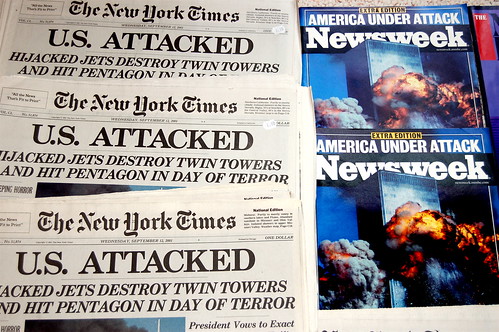
David Letterman on September 17, 2001:
Welcome to the Late Show. This is our first show on the air since New York and Washington were attacked. And I need to ask your patience and indulgence here. . . . If we are going to continue to do shows, I just need to hear myself talk for a couple of minutes, and so, that's what I'm going to do here. It's terribly sad here in New York City. We've lost 5,000 fellow New Yorkers. And you can feel it. You can see it. . . . And watching all of this, I wasn't sure that I should be doing a television show. . . .
In the 20 years that we've been here in New York City, we've worked closely with the police officers and firefighters. And fortunately, most of us don't really have to think too much about what these men and women do on a daily basis. And the phrase "New York's finest" and "New York's bravest" — you know, did it mean anything to us personally, first-hand? Well, maybe, hopefully, but probably not. But boy, it means something now, doesn't it? They put themselves in harm's way to protect people like us. . . . And my hope for myself and everybody else . . . is that we never, ever take these people for granted. . . .
The reason we were attacked, the reason these people are . . . missing and dead, and they weren’t doing anything wrong, they were living their lives, they were going to work, they were traveling, they were doing what they normally do . . . as I understand it, and my understanding of this is vague at best — another smaller group of people stole some airplanes and crashed them into buildings. And we’re told that they were zealots, fueled by religious fervor. Religious fervor. And if you live to be a thousand years old, will that make any sense to you? Will that make any goddamned sense?
I’ll tell you about a thing that happened last night. There’s a town in Montana by the name of Choteau. It’s about a hundred miles south of the Canadian border. And I know a little something about this town. It’s 1,600 people. And it’s an ag-business community, which means farming and ranching. And Montana’s been in the middle of a drought for, I don’t know, three years? And if you’ve got no rain, you can’t grow anything. And if you can’t grow anything, you can’t farm. And if you can’t grow anything, you can’t ranch, because the cattle don’t have anything to eat. And that’s the way life is in a small town, 1,600 people. Last night at the high school auditorium in Choteau, Montana, . . . they had . . . a rally . . . to raise money for New York City. And if that doesn’t tell you everything you need to know about the . . . the spirit of the United States, then I can’t help you. I’m sorry.
Rolling Stone notes that Letterman got married 8 years later in Choteau, Montana.
Notice how Letterman started out: "If we are going to continue to do shows . . ." That seems like a silly thing to say now. But back then, he was invoking a serious concern: it didn't seem to make sense for anyone to do a comedy show anymore. Everything seemed to have turned completely serious all of a sudden, and it was hard to imagine ever getting out of it. That's probably how people often feel in response to the death of a loved one — but that happens privately, not to the whole country at once.
It's interesting to compare how Letterman and Stewart dealt with the situation. In many ways, they were similar: they both highlighted inspiring Americans and lambasted the terrorists' way of life. But their emotional quality was different. Letterman was clearly rattled, but he also had a steadily controlled determination. Jon Stewart seemed absolutely raw and barely able to get through a sentence. He was speaking three days later than Letterman, but he seemed like he was speaking the day after the attacks. They were both great in their own ways.
This was Jon Stewart on September 20, 2001:
I'm sorry to do this to you. It's another entertainment show beginning with an overwrought speech of a shaken host, and television is nothing if not redundant. . . . They said to get back to work. And there were no jobs available for "a man in the fetal position under his desk crying" — which I gladly would have taken. So I come back here. . . .
We sit in the back and we throw spitballs, but never forgetting the fact that it is a luxury in this country that allows us to do that — that is, a country that allows for open satire. And I know that sounds like it goes without saying, but that's really what this whole situation is about. It's the difference between closed and open. It's the difference between free and burdened. And we don't take that for granted here. . . .
I wanted to tell you why I grieve, but why I don't despair. . . . One of my first memories is of Martin Luther King being shot. I was five. . . . That was a tremendous test of this country’s fabric. And this country’s had many tests before that and after that. And the reason I don’t despair is because — this attack happened. It’s not a dream. But the aftermath of it, the recovery, is a dream realized. And that is Martin Luther King’s dream. Whatever barriers we’ve put up are gone, even if it’s just momentary. And we’re judging people by not the color of their skin, but the content of their character.
And you know, all this talk about: “These guys are criminal masterminds. They got together, and their extraordinary guile, and their wit and their skill.” . . . It’s a lie! Any fool can blow something up. Any fool can destroy. But to see . . . these firefighters, these policemen, and people from all over the country, literally, with buckets, rebuilding. That’s extraordinary. And that's why we’ve already won. It’s light, it's democracy. . . . They can’t shut that down. They live in chaos, and chaos, it can’t sustain itself. It never could. It’s too easy, and it’s too unsatisfying.
The view from my apartment was the World Trade Center. And now it’s gone. They attacked it! This symbol of American ingenuity and strength and labor and imagination and commerce, and it is gone! But you know what the view is now? The Statue of Liberty. The view from the south of Manhattan is now the Statue of Liberty. You can’t beat that.
So we’re going to take a break . . . and we’re going to get back to this. And it's going to be fun and funny, and it’s going to be the same as it was.
Now the World Trade Center is back. And we've recently said goodbye to David Letterman and Jon Stewart. They quietly played a role in helping America work through its feelings after the unthinkable happened.
(Photo by my mom, Ann Althouse.)
Friday, July 24, 2015
"You don't know my name, do you?"
A translator's struggle to export Seinfeld to Germany.
The hardest joke to translate, out of 180 episodes, was the one where Jerry doesn't know the name of the woman he's dating, but only knows it "rhymes with a female body part."
Nazi jokes were also dicey:
Seinfeld’s Jewish references posed a unique challenge: as Sebastian explained, "The Germans have a certain you-know-what with the Jewish." Her editor was worried about some of Seinfeld’s Jewish jokes. "We better not say it like that," she remembered her editor saying, "because the Germans may be offended." She added later, recalling the incident to me, "They should be offended, in my understanding. They did it!"
Sebastian appreciated Seinfeld’s direct approach to Jewish history. She wanted to use jokes in direct translation, but the editor wouldn’t let her. She lost several battles. It was a fine line: Der Suppen-Nazi? Sure. . . . An entire episode based on George being mistaken for a neo-Nazi was problematic. So were references to the TV miniseries Holocaust and the film Schindler’s List. Take Elaine’s voiceover narration in "The Subway" episode when her train gets stuck: "We are in a cage. . . . Oh, I can't breathe, I feel faint. Take it easy, it'll start moving soon. Think about the people in the concentration camps, what they went through."
Occasionally, Sebastian triumphed in her conflicts with editors — the practicalities of the show demanded an authentic translation. In an early episode, one of Jerry’s comedy routines addresses the fact that Nazis in World War II movies had "like two separate ‘heils.' They had like the regular ‘heil,’ and then when they were around the offices, they had like this casual ‘heil.’" There was no way to avoid a faithful translation . . .
Sunday, June 7, 2015
On Jon Stewart and Stephen Colbert's political comedy
". . . tendency to affirm its audience’s pre-conceived notions about morality and politics in order to win their views and wallets . . ."
". . . convinces those in the center that they’re on the vanguard, which severely delimits their view of the range of political possibilities . . ."
This, coming from . . . the New Republic.
Sunday, May 31, 2015
What do David Letterman and Kurt Cobain have to do with Hillary Clinton?
A girl I went to high school with spent a semester in Australia. She must have blossomed there, for when she returned home, she magically had an Australian accent. Predictably, we would have none of it. Kids might be cruel, but they also have great bullshit detectors. Nobody likes a phony — not even in Middletown, Maryland. The accent receded; the mockery endured.
This, I suspect, has always been the case. But at least since the invention of Holden Caulfield, phoniness has been the unpardonable sin. Meanwhile, authenticity has become our greatest virtue. . . .
We just spent a week celebrating the career of David Letterman, a man whose entire raison d’être consisted of being the first post-modern late-night comedian — a guy whose humor hinged on being in on the joke and ironic (not like all the phonies on TV at the time!).
This, of course, brings us to Hillary Clinton, and her fake Southern accent. There might have been a Southern accent where Tom Petty came from, but there wasn’t one in Illinois or New York (you know, the places where Clinton grew up and represented in the U.S. Senate?) . . .
The revolt against the phoniness of American life goes back to at least the 60s, which is why it’s odd that Hillary Clinton is so transparently engaging in “show business.” But for Generation X, in particular, the ethos of authenticity practically defines our generation. It’s why Kurt Cobain in a cardigan was cooler than KISS in makeup. It’s why single camera sitcoms with laugh tracks (once wildly popular) now feel so damned cringeworthy. It’s even why John McCain, with all his flaws, seemed much cooler than George W. Bush in 2000. . . .
[T]he GOP (should they nominate someone like, say, Marco Rubio) has a chance to actually “out-cool” Hillary.
(That video is from 2007.)
Thursday, May 21, 2015
Wednesday, May 20, 2015
Norm MacDonald drops his usual deadpan and says an emotional goodbye to David Letterman.
Norm MacDonald closed his standup on the Late Show last week by saying this (via):
Mr. Letterman is not for the mawkish, and he has no truck for the sentimental. If something is true, it is not sentimental. And I say in truth, I love you.
Tuesday, May 19, 2015
Conan O'Brien explains why David Letterman matters.
[I]n 1980 the comedy world was a very different place. Yes, we had Saturday Night Live, but the original cast had departed and, strange as it sounds now, I felt as if that show had spent its explosive force. My early teen hero Steve Martin was done performing electrifying stand-up and was making movies—still hilarious but now an established show business franchise. Johnny Carson was only two thirds through his reign and at the time it felt as if he would always be with us—charming, poised, and stylish. Johnny was comforting and enduring—the guy you watched with your father.
And then it happened. It was a sunny morning during my senior year in high school. I was late for a 10 a.m. class, and I ran out the door of my parents’ home in Brookline, Massachusetts to jog the quarter mile to Brookline High. Just before the screen door slammed behind me, my sister Kate shouted from inside the house for me to come back. I dashed back inside and into the den, where Kate was sitting on the couch. “You have to see this guy,” Kate said, gesturing to the garish, wood paneled Zenith television from that era that looked more like a casket than a TV. I looked at the screen and immediately everything was wrong.
The guy didn’t look right. His hair resembled an ill-fitting vintage leather motorcycle helmet. His front teeth had a massive gap that looked almost painted-on as a joke. He was wearing the requisite broadcaster’s tie, but khaki pants and Adidas sneakers. His set looked wrong, as if he had thrown it together minutes before the show—strange photos of dogs decorated the wall behind him. And then there was his manner. His smile was not ingratiating, but mischievous and ever so slightly malevolent. He was not comfortable in his own skin at a time when everyone on television, by definition, was comfortable in their own skin. And on top of it all, he was doing a comedy show in the morning. What the hell? Who does a comedy show in the morning? What’s wrong with this guy? Who let this happen?
Like every comedian of my era, I watched Dave’s subversive, untamed morning show with delightful incredulity. The show didn’t last long, but quickly morphed into his late night program—and then Dave was really off to the races. Throughout college, everyone my age watched Dave and discussed his show the next day. The late night talk show had existed at that point for 30 years in more or less one form, but Dave and his writers completely re-invented the format.
Dave’s show was that rare phenomenon: a big, fat show business hit that seemingly despised show business. Dave didn’t belong, and he had no interest in belonging. He amused himself, skewered clueless celebrity guests, and did strange, ironic comedic bits that no one had seen on television before. Everything about that show was surreal and off-kilter. Where late night television had once provided comfort, this man reveled in awkwardness. Cher called him an asshole. Andy Kaufman ran screaming from the set. Chris Elliot lived under the stairs. Throughout one episode the entire show rotated a complete 360 degrees, for no reason whatsoever. By 1985, when I graduated from college and was ready to try my hand as a comedy writer, Late Night with David Letterman had been the Holy Grail for several miraculous years.
With time came those insipid Late Night wars and the ensuing media obsession over ratings and guests. Personally, I never cared about any of it. I never saw late night comedy as a cockfight—someone makes me laugh or they don’t, and whoever won Tuesday night is irrelevant. Similarly, when Dave became tabloid fodder because of his personal life, the whole story felt pointless and dreary.
So let’s keep it simple: Not one single writer/performer in the last 35 years has had Dave’s seismic impact on comedy. Every day, I read that a new comic has ‘changed the game,’ and admittedly there is an absurd abundance of talent and creativity out there right now. But in today’s world of 30 late night programs, it’s tempting now to take Dave for granted. Do not. Dave was a true revolution—and I believe his innovations are up there with the light bulb and the Twix bar. Like all revolutions, it was such a seismic shift that it was disorienting and a bit messy at first, and it has taken us time to realize the sheer magnitude of the shift.
And so, as Dave departs, I can’t help but remember that strange vision on my television way back in 1980. Immediately, everything was wrong, wrong in every way—and because it was so wrong the world since has been a better place.

(Photo by US Department of Defense Mass Communication Specialist, 1st Class, Chad J. McNeeley, cropped by Wikimedia Commons.)
Saturday, May 16, 2015
Eddie Vedder will be David Letterman's second-to-last musical guest.
I'll bet I know what song he's going to sing . . .
(Correction: I originally said he'd be the last guest — he'll be the second-to-last musical guest. Also, no guests have been announced for the last show, so there might be surprise guests.)
UPDATE: I was wrong:
Thursday, May 14, 2015
Harry Shearer is fired from The Simpsons
"Not excellent."
I wonder how many people in the world are practicing their Mr. Burns, Smithers, Principal Skinner, and Flanders voices today.
Subscribe to:
Posts (Atom)


