Showing posts with label science. Show all posts

Monday, April 20, 2020

How the coronavirus (covid-19) is "unique"

A physician who's fully recovered from covid-19 talks about his experience:

The mornings are better, but it sort of teases folks — myself included — into thinking that it's going away. And then, boom! It comes right back. For me, that went on for eight days in a row.

The nights are so bad, because as a physician, I know what can happen. And so I would sit awake, counting the minutes until morning almost, wondering if my breathing was going to get worse and I'd end up on a ventilator. That was the horror of it.…

We don't have a proven treatment and I think that's essential to understand. It points out how spoiled we've become in the world of medicine. We have so many treatments for so many disorders that we just assume that when something pops up, we can handle this.

But the reason we can handle it for other diseases is that we've had time to do randomized trials that we haven't had time to do with COVID.…

I'm a little bit ashamed of myself, because I could have put myself into harm's way in terms of sudden death. That can happen when you use those two particular drugs [hydroxychloroquine and azithromycin] together … and I was not being monitored properly.

The take-home point is I totally get why someone who's that sick would want something, because doing nothing is very, very difficult.

On the other hand, we really do need randomized controlled trials to tell us the truth of what the drug regimen does or does not do, and what its safety profile is. Until we have that, we're really trying to fly an airplane in fog without instruments.…

The infection is not like the flu that hits you all at once. These symptoms sort of gradually creep up on folks, and then it crescendos.…

Read the whole interview here.

Wednesday, April 10, 2019

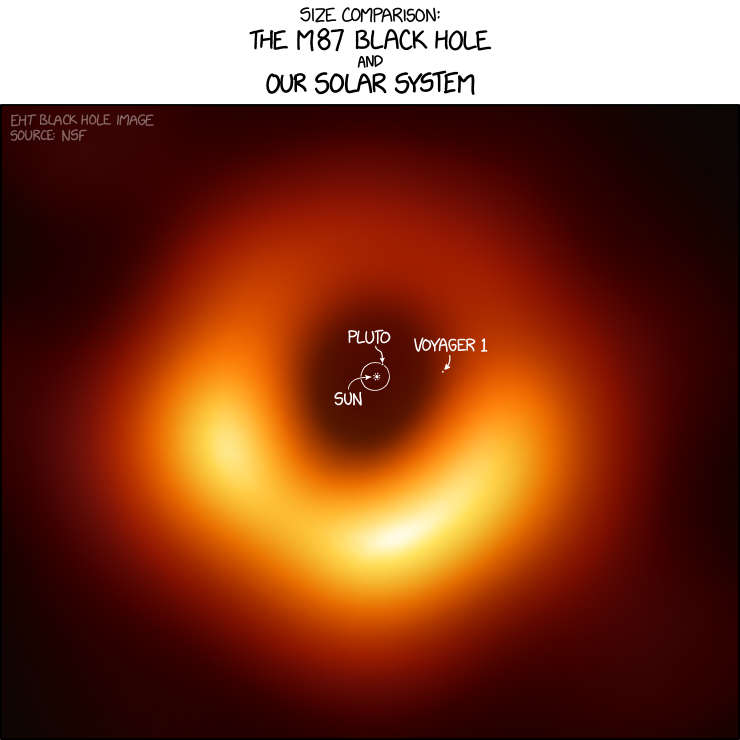
Black hole seen

We can now see a black hole for the first time. Science magazine explains:

Astronomers today revealed that they have taken a picture of a gargantuan black hole at the heart of the nearby galaxy Messier 87. The result is a powerful confirmation of Albert Einstein’s general theory of relativity, which was used to predict black holes more than a century ago. It is also a feat for the team of more than 200 scientists who toiled for years to produce the image by combining signals from eight separate radio observatories spanning the globe. . . .

Black holes have gravitational fields so strong that even light cannot escape, so they are defined by a black, featureless sphere called an event horizon. But the holes can nevertheless be seen because they acquire a disk of gas and whip it up to high temperatures so that it glows brightly at different wavelengths.

By seeing the shape of this ring, bent into an asymmetric crescent by the black hole’s gravity, a new era of astrophysics will begin. The precise size and shape of the ring will help researchers test Einstein’s gravitational equations to see if they stand up to the test or if some other theory of gravity may be needed.
For scale: black hole, sun:


(Image by XKCD.)

Saturday, November 21, 2015

Happy 50th birthday to the great Björk!

I highly recommend her 3rd and 4th albums, Homogenic and Vespertine.


"You shouldn't let poets lie to you."


(Transcript and explanation.)

Friday, May 15, 2015

Anti-circumcision activists are anti-science

A Slate article from a couple years ago explains how they're like anti-vaxers:

Like most fringe groups, the anti-circumcision faction is almost comically bizarre, peddling fabricated facts, self-pity, and paranoia. The intactivists also obsess about sex to an alarming degree. Still, some of their tactics are shrewd. The first rule of anti-circumcision activism, for instance, is to never, ever say circumcision: The movement prefers propaganda-style terms like male genital cutting and genital mutilation, the latter meant to invoke the odious practice of female genital mutilation. (Intactivists like to claim the two are equivalent, an utter falsity that is demeaning to victims of FGM.)

Anti-circumcision activists then deploy a two-pronged attack on some of humanity’s most persistent weaknesses: sexual insecurity and resentment of one’s parents. Your parents, you are told by the intactivists, mutilated you when you were a defenseless child, violating your human rights and your bodily integrity. Without your consent, they destroyed the most vital component of your penis, seriously reducing your sexual pleasure and permanently hobbling you with a maimed member. Anti-circumcision activists craft an almost cultic devotion to the mythical powers of the foreskin, claiming it is responsible for the majority of pleasure derived from any sexual encounter. Your foreskin, intactivists suggest, could have provided you with a life of satisfaction and joy. Without it, you are consigned to a pleasureless, colorless, possibly sexless existence.

Intactivists gain validity and a measure of mainstream acceptance through their sheer tenacity. Their most successful strategy is pure ubiquity, causing a casual observer to assume their strange fixations are widely accepted. Just check the comment section of any article pertaining to circumcision. When Slate’s Troy Patterson wrote a piece thoughtfully weighing circumcision’s pros and cons, he was attacked for supporting a “barbaric practice” of “mutilation” that “ought to be illegal.” A lighthearted Dear Prudence column suffered the same fate. Intactivists pummeled the Amazon rankings of a book about the history of AIDS that mentioned circumcision as a proven preventive measure. Check any Internet message board and you’ll find the same ideas peddled as unimpeachable fact: Circumcision is amputation, a brutally cruel and despicable form of abuse. It damages penises and violates human rights. And it irrevocably, undeniably ruins male sexuality for life.

The problem with these arguments is that they’re either entirely made up or thoroughly disproven. None of intactivists’ cornerstone beliefs are based in reality or science; rather, they’re founded in lore, devilishly clever sophistry dressed up as logic. The facts about circumcision may be hard to find on an Internet cluttered with casuistry—but they are there. And they prove that even as intactivists dominate the Internet, the real-world, fact-based consensus on circumcision is tipping in the opposite direction.

Take, for example, the key rallying cry of intactivists: That circumcision seriously reduces penis sensitivity and thus sexual pleasure. Study after study after study has proven this notion untrue. Some men circumcised as adults actually report an increase in sensitivity, while many report no appreciable difference; virtually none noted any notable decrease. Men circumcised as adults also almost universally report no adverse effect in overall sexual satisfaction following the procedure. (That fits with what my colleague Emily Bazelon found when she asked readers for their circumcision stories a few years ago.) And genital sensitivity in response to erotic stimulation is identical in circumcised and uncircumcised men. Don’t trust individual studies? A systematic review of all available data on circumcision came to the same conclusion. Intactivists, then, aren’t disputing a few flimsy studies: They’re contradicting an entire field of research.

So much for circumcision’s supposedly crippling effect on sexual pleasure. But what about its effect on health? Intactivists like to call circumcision “medically unnecessary.” In reality, however, circumcision is an extremely effective preventive measure against global disease. Circumcision lowers the risk of HIV acquisition in heterosexual men by about 60 to 70 percent. And circumcision reduces HIV risk over a man’s lifetime, unlike condoms, which must be used during each sexual encounter. It’s no wonder that the World Health Organization has pushed circumcision as a key tool in the fight against HIV.

But that’s not circumcision’s only benefit. The procedure also protects men against a variety of other STDs, significantly reducing their odds of contracting herpes and syphilis. Moreover, circumcision is highly effective in preventing transmission of HPV in men, which in turn reduces their risk of penile cancer. And circumcised men are far less likely to contract genital warts* or develop urinary tract infections. Fewer circumcisions mean more STDs and infections—and billions more in health care spending.

As both a personal and public health matter, circumcision is clearly in men’s best interest. But intactivists, predictably, aren’t having any of it. Like anti-vaccine conspiracy theorists, anti-circumcision activists reject all science that doesn’t fit their angry, victimized orthodoxy.

* I added this link to replace a dead link in the original article.

Friday, May 8, 2015

Measles leads to other diseases through "immune amnesia"

New Scientist reports:

Measles is often painted as a trivial disease by the anti-vaccination movement. It is not – it kills or causes brain damage in two or three out of every 1000 cases, even in wealthy countries. Here's another reason it isn't trivial: having measles destroys your immunity to other diseases – and some of those are far more deadly. The upshot? Getting your child vaccinated will protect them from much more than just measles. . . .

The measles virus is known to kill the white blood cells that have a "memory" of past infections and so give you immunity to them. It had been thought that those cells quickly bounce back, because new ones appear a week or two after someone gets over measles. However, recent work in monkeys that have recovered from measles shows that these new memory cells only remember measles itself; the monkeys lose cells that recognise other infections. If humans get similar "immune amnesia" after measles, childhood deaths from infectious diseases should rise and fall depending on how many had measles recently, and how long the effect lasts. . . .

The prospect of a child losing its hard-won immunity to a host of threatening diseases might be the nudge some parents need to recognise that the measles vaccine is essential.

Tuesday, February 3, 2015

What happens when each domino is 1.5 times as big as the one that knocked into it?

Keep watching till the end to hear how big they would have gotten if there were 29 of them.

Monday, February 2, 2015

"There are moments when there is nothing more urgent than the defense of what has already been accomplished."

In an insightful article called "Crimes Against Humanities," about the need to prevent "science" from "invading the liberal arts," Leon Wieseltier responds to Steven Pinker's essay, "Science Is Not Your Enemy," in the New Republic (this is from last year, back when they were New Republic editors):

The question of the place of science in knowledge, and in society, and in life, is not a scientific question. Science confers no special authority, it confers no authority at all, for the attempt to answer a nonscientific question. It is not for science to say whether science belongs in morality and politics and art. Those are philosophical matters, and science is not philosophy, even if philosophy has since its beginnings been receptive to science. Nor does science confer any license to extend its categories and its methods beyond its own realms, whose contours are of course a matter of debate. The credibility of physicists and biologists and economists on the subject of the meaning of life . . . cannot be owed to their work in physics and biology and economics, however distinguished it is. The extrapolation of larger ideas about life from the procedures and the conclusions of various sciences is quite common, but it is not in itself justified; and its justification cannot be made on internally scientific grounds, at least if the intellectual situation is not to be rigged. Science does come with a worldview, but there remains the question of whether it can suffice for the entirety of a human worldview. . . .

Rejecting the various definitions of scientism—“it is not an imperialistic drive to occupy the humanities,” it is not “reductionism,” it is not “naïve”—Pinker proposes his own characterization of scientism, which he defends as an attempt “to export to the rest of intellectual life” the two ideals that in his view are the hallmarks of science. The first of those ideals is that “the world is intelligible.” The second of those ideals is that “the acquisition of knowledge is hard.” Intelligibility and difficulty, the exclusive teachings of science? This is either ignorant or tendentious. Plato believed in the intelligibility of the world, and so did Dante, and so did Maimonides and Aquinas and Al-Farabi, and so did Poussin and Bach and Goethe and Austen and Tolstoy and Proust. They all share Pinker’s denial of the opacity of the world, of its impermeability to the mind. They all join in his desire to “explain a complex happening in terms of deeper principles.” They all concur with him that “in making sense of our world, there should be few occasions in which we are forced to concede ‘It just is’ or ‘It’s magic’ or ‘Because I said so.’”

If Pinker believes that scientific clarity is the only clarity there is, he should make the argument for such a belief. He should also acknowledge its narrowness (though within the realm of science it is very wide), and its straitening effect upon the investigation of human affairs. Instead he simply conflates scientific knowledge with knowledge as such. In his view, anybody who has studied any phenomena that are studied by science has been a scientist. It does not matter that they approached the phenomena with different methods and different vocabularies. If they were interested in the mind, then they were early versions of brain scientists. If they investigated human nature, then they were social psychologists or behavioral economists. . . . If they contributed to knowledge, then they must have been scientists, because what other type of knowledge is there? . . .

[I]t was the imperative to keep up, to be “progressive,” which led to “the disaster of postmodernism” and other unfortunate hermeneutical fashions of recent decades. More importantly, the humanities do not advance the way the sciences advance. . . . The history of science is a history of errors corrected and discarded. But the vexations of philosophy and the obsessions of literature are not retired in this way. In these fields, the forward-looking cast backward glances. The history of old art and thought fuels the production of young art and thought. Scientists no longer consult Aristotle’s scientific writings, but philosophers still consult Aristotle’s philosophical writings. The present has the power of life and death over the past. It can choose to erase vast regions of it. Tradition is what the present calls those regions of the past that it retains, that it cherishes and needs. Contrary to the progressivist caricature, tradition is not the domination of the present by the past. It is the domination of the past by the present. . . .

There are moments when there is nothing more urgent than the defense of what has already been accomplished. . . . Sometimes wisdom is conventional. The denigration of conventional wisdom is itself a convention. . . .

The technological revolution will certainly transform and benefit the humanities, as it has transformed and benefited many disciplines and vocations. But it may also mutilate and damage the humanities, as it has mutilated and damaged many disciplines and vocations. My point is only that shilling for the revolution is not what we need now. The responsibility of the intellectual toward the technologies is no longer (if it ever was) mere enthusiasm. The magnitude of the changes wrought by the new machines calls for the revival of a critical temper. Too much is at stake to make do with that cool vanguard feeling. But Pinker is . . . waxing on like everybody else about how “this is an extraordinary time” because “powerful tools have been developed” and so on. . . . With his dawn-is-breaking scientistic cheerleading, Pinker shows no trace of the skepticism whose absence he deplores in others. His sunny scientizing blurs distinctions and buries problems. If there was one thing for which the humanities, the old humanities, the wearyingly traditional humanities, could be counted on, it was to introduce us also to the darkness and prepare us also for the worst.
(Here's Pinker's response, followed by another response from Wieseltier.)

Sunday, January 18, 2015

Call it the scientific ignorance of the American voter — but don't call it the stupidity . . .

"Over 80 percent of Americans support 'mandatory labels on foods containing DNA.'"

But why? And who cares? Ilya Somin explains why this is a big deal:

"A recent survey by the Oklahoma State University Department of Agricultural Economics finds that over 80 percent of Americans support “mandatory labels on foods containing DNA,” about the same number as support mandatory labeling of GMO foods “produced with genetic engineering.” Oklahoma State economist Jayson Lusk has some additional details on the survey. If the government does impose mandatory labeling on foods containing DNA, perhaps the label might look something like this:
WARNING: This product contains deoxyribonucleic acid (DNA). The Surgeon General has determined that DNA is linked to a variety of diseases in both animals and humans. In some configurations, it is a risk factor for cancer and heart disease. Pregnant women are at very high risk of passing on DNA to their children.
The Oklahoma State survey result is probably an example of the intersection between scientific ignorance and political ignorance, both of which are widespread. The most obvious explanation for the data is that most of these people don’t really understand what DNA is, and don’t realize that it is contained in almost all food. . . .

Polls repeatedly show that much of the public is often ignorant of both basic scientific facts. . . . A 2012 National Science Foundation survey even found that about 25% of Americans don’t know that the Earth revolves around the sun rather than vice versa. . . .

It would be a mistake to assume that widespread political and scientific ignorance are the result of “the stupidity of the American voter,” as Obamacare architect Jonathan Gruber put it. Political ignorance is not primarily the result of stupidity. For most people, it is a rational reaction to the enormous size and complexity of government and the reality that the chance that their vote will have an impact on electoral outcomes is extremely low. The same is true of much scientific ignorance. For many people, there is little benefit to understanding much about genetics or DNA. Most Americans can even go about their daily business perfectly well without knowing that the Earth revolves around the sun. Even the smartest people are inevitably ignorant of the vast majority of information out there. We all have to focus our time and energy on learning that information which is most likely to be instrumentally useful, or at least provide entertainment value. For large numbers of people, much basic political and scientific information doesn’t make the cut.

Unfortunately, this is a case where individually rational behavior leads to potentially dangerous collective outcomes. While it doesn’t much matter whether any individual voter is ignorant about science or public policy, when a majority (or even a large minority) of the electorate is ignorant in these ways, it can lead to the adoption of dangerous and counterproductive government policies. In this case, excessive and unnecessary warning labels on food products could confuse consumers, and divert their limited attention from real dangers.

Saturday, May 5, 2012

"Who's in charge — you or your brain?"

That question is debated in this Guardian piece. It's a flawed question, since your brain is part of you.

It reminds me of this excellent article: "'Is it evolutionary, or is it . . .?'" The point of the article is that that's probably not a good way to start a question, since you can agree with an evolutionary explanation of human behavior while also agreeing with other explanations of the same behavior. (Previously.)

The "brain" article ends with this passage by neuroscientist David Eagleman, which I strongly agree with:

It is not contradictory to recognise that we are sealed off from most of reality, and that we can discover more of it by a process of careful experimentation. That is the endeavour of science. For example, you cannot see, hear or touch radio waves, but you can build machines to translate the waves into the biologically delimited language in which you can understand them. You can build such machines only because science reaches beyond what we know to discover new realms.

Neuroscience is uncovering a bracing view of what's happening below the radar of our conscious awareness, but that makes your life no more "helpless, ignorant, and zombie-like" than whatever your life is now. If you were to read a cardiology book to learn how your heart pumps, would you feel less alive and more despondently mechanical? I wouldn't. Understanding the details of our own biological processes does not diminish the awe, it enhances it. Like flowers, brains are more beautiful when you can glimpse the vast, intricate, exotic mechanisms behind them.
One problem is that reductionism is very tempting. Reductionism means feeling unsatisfied with making an observation based on evidence — "Hey look, here's something" — and feeling the need to rule out the possibility of other types of observations by adding: "And it's the only thing." Reductionism can make people feel contrarian and scientific, without actually being scientific. There can be multiple layers of explanation that are all accurate and not mutually exclusive; different kinds of description can peacefully coexist.

Friday, October 14, 2011

The statistical point that neuroscience papers get wrong half the time

Ben Goldacre explains.

The explanation does take a few dense paragraphs; Goldacre admits his own writing is going to cause some "pain" for readers, and I had to read it twice before I got it. But it's worth it for anyone interested in brain studies.

UPDATE: I posted the article to Metafilter, where a commenter named "valkyryn" takes another shot at explaining it:

Say we've got two samples, A and B. For our sample size and subject matter, if we expose it to chemical X, any detected results need to be above 20 Units (U) to be statistically significant.

We expose A to X, and we get a result of 30U. That's statistically significant.

We expose B to X, and we get a result of 15U. That isn't statistically significant.

But note that the result for A is less than 20U from the result for B. This means that while we did have a statistically significant finding for A, the difference between A and B is not statistically significant.

This significantly diminishes the value of our findings, as the math only supports a relatively unambitious claim. We want to say that A and B are different, but the math won't let us, as the difference in reaction between A and B is too small. We're left with a relatively uninteresting finding, namely that something seems to happen with A and X, but we aren't sure how much that matters.

Careers tend not to be made out of this kind of finding, and the author is implying that because scientists have an interest in careers, they're making more ambitious claims than their studies actually permit.
IN THE COMMENTS: LemmusLemmus illustrates the problem with this graph:


LemmusLemmus explains:
The result for condition A is significantly different from zero (i.e., it "is significant"), while the result for condition B is not (the confidence interval for A does not include zero, but the confidence interval for B does). However, the two confidence intervals overlap, which means that the results for conditions A and B are not significantly different from each other.

Monday, October 3, 2011

Do you "love your iPhone"?

"Literally"?

Or, is an article that says modern technology is disconnecting us from human interaction, and claims to back this up with a brain imaging study, too good for the New York Times to check?

Saturday, October 1, 2011

How bad is it to cherry-pick scientific studies that support your position?

Very bad, explains Ben Goldacre. He calls out Aric Sigman, a popular science writer who admitted to cherry-picking only the studies that supported his pre-existing views about day care (that it's harmful to young children).

At the end of his post, which is worth reading in its entirety, Goldacre concludes:

A deliberately incomplete view of the literature, as I hope I’ve explained, isn’t a neutral or marginal failure. It is exactly as bad as a deliberately flawed experiment, and to present it to readers without warning is bizarre.
I have a feeling that last sentence was carefully edited, and that he originally wrote a different word than "bizarre."

Tuesday, September 6, 2011

Christopher Hitchens and Thomas Sowell on "simple" theories of terrorism and crime

Christopher Hitchens writes, in an article headlined "Simply Evil":

The proper task of the "public intellectual" might be conceived as the responsibility to introduce complexity into the argument: the reminder that things are very infrequently as simple as they can be made to seem. But what I learned in a highly indelible manner from the events and arguments of September 2001 was this: Never, ever ignore the obvious either. To the government and most of the people of the United States, it seemed that the country on 9/11 had been attacked in a particularly odious way (air piracy used to maximize civilian casualties) by a particularly odious group (a secretive and homicidal gang: part multinational corporation, part crime family) that was sworn to a medieval cult of death, a racist hatred of Jews, a religious frenzy against Hindus, Christians, Shia Muslims, and "unbelievers," and the restoration of a long-vanished and despotic empire.

To me, this remains the main point about al-Qaida and its surrogates. I do not believe, by stipulating it as the main point, that I try to oversimplify matters. I feel no need to show off or to think of something novel to say. Moreover, many of the attempts to introduce "complexity" into the picture strike me as half-baked obfuscations or distractions. These range from the irredeemably paranoid and contemptible efforts to pin responsibility for the attacks onto the Bush administration or the Jews, to the sometimes wearisome but not necessarily untrue insistence that Islamic peoples have suffered oppression. (Even when formally true, the latter must simply not be used as nonsequitur special pleading for the use of random violence by self-appointed Muslims.)

Underlying these and other attempts to change the subject there was, and still is, a perverse desire to say that the 9/11 atrocities were in some way deserved, or made historically more explicable, by the many crimes of past American foreign policy. Either that, or—to recall the contemporary comments of the "Reverends" Jerry Falwell and Pat Robertson—a punishment from heaven for American sinfulness. . . . That this was an assault upon our society, whatever its ostensible capitalist and militarist "targets," was again thought too obvious a point for a clever person to make. It became increasingly obvious, though, with every successive nihilistic attack on London, Madrid, Istanbul, Baghdad, and Bali. . . .

10 years ago in Manhattan and Washington and Shanksville, Pa., there was a direct confrontation with the totalitarian idea, expressed in its most vicious and unvarnished form. Let this and other struggles temper and strengthen us for future battles where it will be necessary to repudiate the big lie.
This reminds me of a great passage — one of many — in Thomas Sowell's 2009 book Intellectuals and Society. (By the way, I appreciate that this book has an index that's more complex than the usual list of obvious nouns like names and places. This index actually has an entry for "Simplistic Arguments," which allowed me to easily find the passage I was thinking of.) Sowell writes:
[T]he assumption that certain arguments are unworthy because they are "simplistic" — not as a conclusion from counter-evidence or counter-arguments, but in lieu of counter-evidence or counter-arguments . . . is a very effective debating tactic, however questionable it may be logically. With one word, it preempts the intellectual high ground without offering anything substantive. It is insinuated, rather than demonstrated, that a more complex explanation is more logically consistent or more empirically valid.
That one argument may be simpler than another says nothing about which argument reaches conclusions that turn out to be validated by empirical evidence more often. Certainly the explanation of many physical phenomena — the sun setting over the horizon, for example — by the argument that the earth is round is simpler than the more complex explanations of the same phenomena by members of the Flat Earth Society. Evasions of the obvious can become very complex. (81)
Later in the book, he applies this observation to fighting crime:
Even the most blatant facts can be sidestepped by saying that the causes of crime are too "complex" to be covered by a "simplistic" explanation. This verbal tactic simply expands the question to unanswerable dimensions, as a prelude to dismissing any explanation not consonant with the prevailing vision as "simplistic" because it cannot fully answer the expanded question. But no one has to master the complexities of Newton's law of gravity to know that stepping off the roof of a skyscraper will have consequences. Similarly, no one has to unravel the complexities of the innumerable known and unknown reasons why people commit crimes to know that putting criminals behind bars has a better track record of reducing the crime rate than any of the complex theories or lofty policies favored by the intelligentsia. (195)

Monday, August 29, 2011

If Mitt Romney doesn't "know" global warming is mostly caused by humans, is he "against science"?

Paul Krugman's latest column is headlined:

Republicans Against Science
Krugman writes:
Jon Huntsman Jr., a former Utah governor and ambassador to China, isn’t a serious contender for the Republican presidential nomination. And that’s too bad, because Mr. Hunstman has been willing to say the unsayable about the G.O.P. — namely, that it is becoming the “anti-science party.” This is an enormously important development. And it should terrify us. . . .

In the past, Mr. Romney, a former governor of Massachusetts, has strongly endorsed the notion that man-made climate change is a real concern. But, last week, he softened that to a statement that he thinks the world is getting hotter, but “I don’t know that” and “I don’t know if it’s mostly caused by humans.” Moral courage!
So, Mitt Romney says he doesn't know. Is this uncertainty "terrify[ing]"?

The full Romney quote is: "Do I think the world's getting hotter? Yeah, I don't know that but I think that it is." So his basic conclusion is: "I think that it is," but he qualifies this with "I don't know." Isn't this appropriate for a layperson who's deferring to scientific consensus?

I've been reading Richard Feynman's book The Meaning of it All: Thoughts of a Citizen Scientist. Here's what Feynman said about uncertainty:
It is necessary and true that all of the things we say in science, all of the conclusions, are uncertain, because they are only conclusions. They are guesses as to what is going to happen, and you cannot know what will happen, because you have not made the most complete experiments. . . .

Scientists, therefore, are used to dealing with doubt and uncertainty. All scientific knowledge is uncertain. This experience with doubt and uncertainty is important. I believe that it is of very great value, and one that extends beyond the sciences. I believe that to solve any problem that has never been solved before, you have to leave the door to the unknown ajar. You have to permit the possibility that you do not have it exactly right. Otherwise, if you have made up your mind already, you might not solve it.

So what we call scientific knowledge today is a body of statements of varying degrees of certainty. Some of them are most unsure; some of them are nearly sure; but none is absolutely certain. Scientists are used to this. We know that it is consistent to be able to live and not know. Some people say, "How can you live without knowing?" I do not know what they mean. I always live without knowing.
Remember, Feynman said this about all scientific conclusions, including ones about much simpler questions than how much the billions of people in the world are contributing to climate change. And he was describing the level of doubt that even scientists should have about their own fields of expertise, let alone the appropriate attitude of a layperson. Feynman said this isn't some weird defect in science, but it's essential to science. If Krugman is terrified at the idea of not "knowing," maybe he's the one who's against science.

Sunday, February 20, 2011

What's more scientific: science classes or Wikipedia entries about science?

Katja Grace, in her excellent blog called Meteuphoric, says:

This is how science classes mostly went in high school. We would learn about a topic that had been discovered scientifically, for instance that if you add together two particular solutions of ions, some of the ions will precipitate out as a solid salt. Then we would do an experiment, wherein we would add the requisite solutions and get something entirely wrong in its color, smell, quantity, or presence. Then we would write a report with our hypothesis, the contradictory results, and a long discussion about all the mistakes that could be to blame for this unexpected result, and conclude that the real answer was probably still what we hypothesized (since we read that in a book).
(In a follow-up post, she gives some specific suggestions for how we could teach kids to think scientifically.)

Freeman Dyson writes in the New York Review of Books (via):
Jimmy Wales hoped when he started Wikipedia that the combination of enthusiastic volunteer writers with open source information technology would cause a revolution in human access to knowledge. The rate of growth of Wikipedia exceeded his wildest dreams. Within ten years it has become the biggest storehouse of information on the planet and the noisiest battleground of conflicting opinions. It illustrates Shannon’s law of reliable communication. Shannon’s law says that accurate transmission of information is possible in a communication system with a high level of noise. Even in the noisiest system, errors can be reliably corrected and accurate information transmitted, provided that the transmission is sufficiently redundant. That is, in a nutshell, how Wikipedia works.

The information flood has also brought enormous benefits to science. The public has a distorted view of science, because children are taught in school that science is a collection of firmly established truths. In fact, science is not a collection of truths. It is a continuing exploration of mysteries. Wherever we go exploring in the world around us, we find mysteries. Our planet is covered by continents and oceans whose origin we cannot explain. Our atmosphere is constantly stirred by poorly understood disturbances that we call weather and climate. The visible matter in the universe is outweighed by a much larger quantity of dark invisible matter that we do not understand at all. The origin of life is a total mystery, and so is the existence of human consciousness. We have no clear idea how the electrical discharges occurring in nerve cells in our brains are connected with our feelings and desires and actions.

Even physics, the most exact and most firmly established branch of science, is still full of mysteries. We do not know how much of Shannon’s theory of information will remain valid when quantum devices replace classical electric circuits as the carriers of information. Quantum devices may be made of single atoms or microscopic magnetic circuits. All that we know for sure is that they can theoretically do certain jobs that are beyond the reach of classical devices. Quantum computing is still an unexplored mystery on the frontier of information theory. Science is the sum total of a great multitude of mysteries. It is an unending argument between a great multitude of voices. It resembles Wikipedia much more than it resembles the Encyclopaedia Britannica.

Friday, January 7, 2011

"It's a chemical world."

"Learn to live with it."

A friend of mine posts that link to Facebook and asks:

Can we ditch "all-natural" while we're at it?

Thursday, December 9, 2010

"A democratic society needs Republican scientists."

So says this Slate article, which complains that only 6% of American scientists are Republicans. (55% are Democrats.)

The author, Daniel Sarewitz, argues:

For 20 years, evidence about global warming has been directly and explicitly linked to a set of policy responses demanding international governance regimes, large-scale social engineering, and the redistribution of wealth. These are the sort of things that most Democrats welcome, and most Republicans hate. No wonder the Republicans are suspicious of the science.

Think about it: The results of climate science, delivered by scientists who are overwhelmingly Democratic, are used over a period of decades to advance a political agenda that happens to align precisely with the ideological preferences of Democrats. Coincidence—or causation? . . .

How would a more politically diverse scientific community improve this situation? First, it could foster greater confidence among Republican politicians about the legitimacy of mainstream science. Second, it would cultivate more informed, creative, and challenging debates about the policy implications of scientific knowledge. This could help keep difficult problems like climate change from getting prematurely straitjacketed by ideology.
Sarewitz concludes that the United States "needs Republican scientists," but by his own account, we already have them: 6% of scientists. That's a lot of people. Why doesn't Sarewitz make any attempt to look at some of these scientists' work and explain how they've made a distinctive contribution that non-Republican (Democratic, independent, or apolitical) scientists wouldn't have made?

Friday, October 29, 2010

What public-service advertising is and isn't considered acceptable in America?

1. NYC's anti-soda ads are considered acceptable.

As that article suggests, the debate behind the scenes boiled down to "fear" ("'I think what people fear is getting fat'") vs. "science" ("'As we get into this exacting science, the idea of a sugary drink becoming fat is absurd'"). Guess which value won out?

2. But this German ad promoting condom use would probably not be considered acceptable in America.

The German text in the ad uses a double entendre to explain the visual joke: "Prevents short-sightedness."

I almost want to put a "NSFW" disclaimer because some people might consider the ad too graphic. But that's part of the problem.

Sunday, October 3, 2010

The Simpson embiggens the English language.

Language Log calls out the Economist for using the Simpsons neologism "embiggened":

If a future turn of events in Africa was seen as requiring the island’s military role to be embiggened and its facilities rendered much more secure, it might be convenient if the islanders had no legal right to remain where they were.
The Economist writer seems to have had no inkling that there was anything humorous about the word. As Euguene Volokh points out, the rest of the sentence isn't especially funny. In fact, it's quite dour. So is the rest of the article (a series of dispatches from an isolated island in the middle of the Atlantic Ocean called Ascension).

Language Log points us to the Wikipedia entry on the Simpsons episode that originally used "embiggen" (I've omitted the numerous footnotes and links here):
The show runners asked the writers if they could come up with two words which sounded like real words . . . . The Springfield town motto is "A noble spirit embiggens the smallest man." Schoolteacher Edna Krabappel comments that she never heard the word embiggens until she moved to Springfield. Miss Hoover, another teacher, replies, "I don’t know why; it’s a perfectly cromulent word." Later in the episode, while talking about Homer’s audition for the role of town crier, Principal Skinner states, "He's embiggened that role with his cromulent performance."

Embiggen—in the context it is used in the episode—is a verb that was coined by Dan Greaney in 1996. [That is, a Simpsons writer coined it for the episode.] The verb previously occurred in an 1884 edition of the British journal Notes and Queries: A Medium of Intercommunication for Literary Men, General Readers, Etc. by C. A. Ward, in the sentence "but the people magnified them, to make great or embiggen, if we may invent an English parallel as ugly. After all, use is nearly everything." The literal meaning of embiggen is to make something larger. . . . [E]mbiggen can be found in string theory. The first occurrence of the word was in the journal High Energy Physics in the article "Gauge/gravity duality and meta-stable dynamical supersymmetry breaking", which was published on January 23, 2007. For example, the article says: "For large P, the three-form fluxes are dilute, and the gradient of the Myers potential encouraging an anti-D3 to embiggen is very mild." Later this usage was noted in the journal Nature, which explained that in this context, it means to grow or expand.

Cromulent is an adjective that was coined by David S. Cohen. [Actually, he was forced to change his name and is now David X. Cohen.] Since it was coined it has appeared in the Webster’s New Millennium Dictionary of English. The meaning of cromulent is inferred only from its usage, which indicates that it is a positive attribute. Webster's Dictionary defines it as meaning fine or acceptable.
Language Log says Dan Greaney might join "the very select club of people who invented words that make it into major dictionaries."

In a blog post entitled "Beyond embiggens and cromulent," a linguist named Heidi Harley gave an amusingly analytical list of Simpsons jokes that play with language.

She followed this up every year for the next few years: 2006, 2007, 2008, 2009.

Caution: Reading these posts can use up hours of your time. I just read the first 5 in the first list, and I'm delighted by all of them. I like this one so much I have Moe's remark in my list of "favorite quotes" on Facebook:
The Simpsons' house has been broken into on Christmas eve, and all their Christmas presents and decorations stolen. Homer is telling his woes to Moe. Moe says, "You know what I blame this on the breakdown of? Society!"