Showing posts with label classical. Show all posts

Friday, October 22, 2021

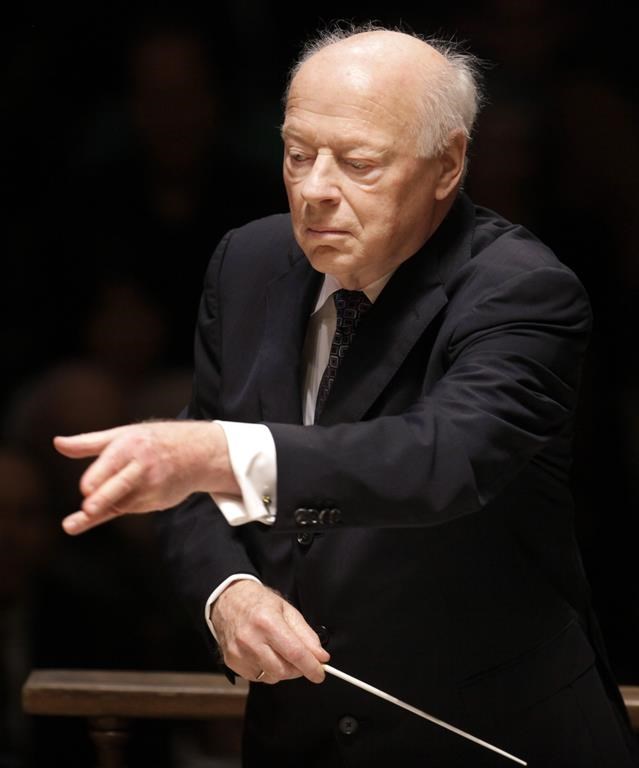
Conductor Bernard Haitink dies at 92

The New York Times reports:
Bernard Haitink, an unaffected maestro who led Amsterdam’s Royal Concertgebouw Orchestra for 27 years and was known for presenting powerful readings of the symphonies of Mahler, Bruckner and Beethoven conducting orchestras on both sides of the Atlantic, died on Thursday at his home in London. He was 92.

Here's Beethoven's 7th Symphony conducted by Haitink — the famously moving second movement starts at 13:18:


The Times obit gives a sense of Haitink's personality:

Mr. Haitink let the music emerge from the orchestra, often transcendently, without imposing a heavy-handed interpretation that a star conductor might.

His self-effacing nature was noticed early on.

He was “not one of the glamour boys on the podium,” Harold C. Schonberg, the chief classical music critic for The New York Times, wrote in January 1975 after Mr. Haitink’s debut with the New York Philharmonic, conducting Bruckner’s Symphony No. 7.

“He does not dance, he does not patronize the best tailor on the Continent,” Mr. Schonberg continued. “But he is a dedicated musician, always on top of the music, getting exactly what he wants from his players.”

Reviewing his performance of the same symphony with the Philharmonic in 2011, the critic Steve Smith wrote in The Times: “Some conductors strive for mysticism in late Bruckner; Mr. Haitink, with his unerring sense of shape, transition and flow, lets the music speak for itself, with results that can approach the supernatural and often did here.”

Haitink conjures the towering greatness of Brahms's 4th Symphony:


More from the Times:

His reputation for being unassuming trailed him throughout his career. In 1967, Time magazine described him as “a short, quiet man who likes to take long bird-watching rambles in the woods,” and pointed out that “in a profession where flamboyance and arrogance are often the hallmarks of talent, the diffident Haitink is an anomaly.” A New York Times article in 1976 carried the headline “Why Doesn’t Bernard Haitink Act Like a Superstar?”

Mr. Haitink’s colleagues lauded his modesty, integrity and musicianship when he was awarded the prestigious Gramophone Lifetime Achievement Award in 2015. The pianist Murray Perahia, who recorded the complete Beethoven piano concertos with Mr. Haitink and the Concertgebouw, praised him as being “dedicated to a real collaboration: neither dictating an interpretation, nor slavishly following — but a natural give and take.”

Haitink brings Debussy's cinematic La Mer to life:


The Times on how wartime in Haitink's childhood affected him as a conductor:

Bernard Johan Herman Haitink was born on March 4, 1929, into a well-off family in Amsterdam. His father, Willem Haitink, was a civil servant, and his mother, Anna Clara Verschaffelt, worked for the French cultural organization Alliance Française. Neither were musicians. The family lived under Nazi occupation during World War II, and Willem was imprisoned for three months in a concentration camp.

Mr. Haitink referred to his youth as his “lazy days.”

“I wasn’t stupid,” he explained, “but I just wasn’t there. Half the time we were taught under our desks because of air raids. But even when things became normal, I wasn’t interested. Maybe this is why now, when I am over 70, that people always ask me why I work so hard.”

Shostakovich's merciless 4th Symphony:


The New York Times obit ends with this:

In 2011, in [an] interview with The Guardian, Mr. Haitink mused on the strange life of a conductor. “I have been doing this job for 50 years,” he said. “And, you know, it is a profession and it is not a profession. It’s very obscure sometimes. What makes a good conductor? What is this thing about charisma? I’m still wondering after all these years.”

And here's the last symphony by one of Haitink's signature composers: Bruckner's 9th.

Wednesday, December 16, 2020

250 years of Beethoven

Ludwig van Beethoven was born 250 years ago today, on December 16, 1770. He died at age 56 in 1827.

When I made a list of "the top 10 greatest classical composers," I ranked Beethoven #1. Click here for my thoughts on Beethoven and a few videos.


(Portrait by Ferdinand Schimon via Wikipedia.)

Wednesday, January 6, 2016

Pierre Boulez (1925 - 2016)

Boulez, the composer and conductor, died yesterday at age 90. From the New York Times obituary:

"Mr. Boulez belonged to an extraordinary generation of European composers who emerged in the postwar years while still in their 20s. They wanted to change music radically, and they did. Mr. Boulez was at the forefront of their crusade.

As a young composer — and throughout his life as an insistently private man — he matched intelligence with great force of mind: He knew what had to be done, according to his reading of history, and he did it, in defiance of all the norms of French musical culture at the time. His “Marteau Sans Maître” (“Hammer Without a Master”) was one of this pioneering group’s first major achievements, and it remains a landmark of modern music.

But his influence was equally great on the podium. In time he began giving ever more attention to conducting, where his keen ear and rhythmic incisiveness could produce a startling clarity. (There are countless stories of him detecting faulty intonation, say, from the third oboe in a complex piece.)

He reached his peak as a conductor in the 1960s, when he began to appear with some of the world’s great orchestras, including the Concertgebouw in Amsterdam, the Berlin Philharmonic and the Cleveland Orchestra. By the early ’70s he had succeeded Leonard Bernstein as music director of the New York Philharmonic, an appointment that startled the music world and led to a fitful tenure.

His conducting style was unique. He never used the baton, preferring to manipulate the orchestra by means of his two hands simultaneously, the left indicating phrasing or, in much contemporary music, counterrhythm.

His characteristic sound — unemotional on the surface but with undercurrents of intemperateness, at once brilliant in color and rhythmically disciplined — depended on his famously acute ear and suited his core repertoire: Stravinsky (several of whose works he introduced to Europe), Debussy, Webern, Bartok and Messiaen. . . .

A defining moment came when he heard a broadcast of Stravinsky’s “Song of the Nightingale” conducted by Ernest Ansermet; it was a work to which he often returned throughout his conducting career. Rejecting the wishes of his father, who wanted him to study engineering, he went to Paris in 1942 and enrolled at the Conservatoire.

In 1944-45, he took a harmony class taught by Olivier Messiaen, whose impact on him was decisive. Messiaen’s teaching went far beyond traditional harmony to embrace new music that was outlawed both by the stagnant Conservatoire of that period and by the German occupying forces: the music of Schoenberg, Stravinsky, Bartok and Webern.

Messiaen also introduced his students to medieval music and the music of Asia and Africa. Mr. Boulez felt his course was set; but he also knew he needed to go further into the 12-tone method that Schoenberg had introduced a generation before. . . .

In 1960, he conducted the orchestra in the first performance of his “Pli Selon Pli,” an hourlong setting of poems by Stéphane Mallarmé for soprano, with an orchestra rich in percussion.

That lustrous score allowed the conductor certain flexibilities in assembling its fragments. A musical work should be a labyrinth, with no fixed route, Mr. Boulez often said. It might also never have a fixed ending. From then on, he began starting more works than he ever brought to completion, while at the same time submitting older pieces to rounds of revision.

As a conductor, he showed much less hesitation. Where his first concerts had been devoted entirely to 20th-century works, he began, in the early 1960s, to explore earlier repertoires — Haydn, Bach, Schubert, Mozart, Beethoven — with the Concertgebouw and the Southwest German Radio Symphony Orchestra. He made his debut with an American orchestra, the Cleveland Orchestra, in March 1965. The program, a typical one for him, comprised Rameau, his own music (“Figures-Doubles-Prismes”), Debussy and Stravinsky (“The Song of the Nightingale”). . . .

His appointment to the New York Philharmonic in 1971 presented great challenges. As music director, he had to enlarge his repertoire rapidly. Until then, he had conducted very little Romantic music other than Berlioz’s; now Schubert, Brahms, Dvorak and Borodin joined his programs, not always convincingly. Though he refused to compromise on Tchaikovsky, he was becoming much more like a regular conductor.

Part of his individuality was lost in the colossal task of maintaining important positions on both sides of the Atlantic, his post with the BBC Symphony demanding much of his time as well. . . .

Both his programming and his handling of an older repertoire met with some resistance from audiences, critics and, it was said, even some of his musicians. Harold C. Schonberg of The New York Times called Mr. Boulez “a brainy orchestral technician” whose “scientific approach” lacked heart. Reviewing a 1972 concert that included Edgard Varèse’s 1927 composition “Arcana,” Donal Henahan of The Times reported that “perhaps a quarter of the downstairs audience” at Philharmonic Hall “fled as if from the Black Death” before the piece was performed." . . .

“He never ceased to think about subjects in relation to one another; he made painting, poetry, architecture, cinema and music communicate with each other, always in the service of a more humane society,” the office of President François Hollande said in a statement."

Boulez as a composer:


Boulez as a conductor:


Friday, November 21, 2014

Thursday, February 28, 2013

Oboist William Bennett dies of on-stage stroke

The San Francisco Chronicle reports:

William Bennett, the longtime San Francisco Symphony oboist who suffered a cerebral hemorrhage on Saturday night while performing Richard Strauss' Oboe Concerto with the orchestra in Davies Symphony Hall, died Thursday morning in a San Francisco hospital. He was 56.

Mr. Bennett, known to friends and fans alike as Bill, was an artist of extraordinary skill and imagination, whose musical contributions were a consistent highlight of any performance in which he took part. He had a distinctive tone that was both full-bodied and lyrical, and a ferocious technical ability that allowed him to make easy work of even the most challenging assignments.

Most striking, though, were the liveliness and unpredictability of his artistic choices. Whenever Mr. Bennett stepped into the spotlight, even momentarily, a listener could be sure that he would impart some original or unexpected twist to a familiar musical passage.

That artistic profile was in keeping with Mr. Bennett's personality. He was a buoyant and spirited man, quick with a chuckle or a joke, yet with a deep vein of seriousness about music. He was also an able cartoonist, whose sketches and caricatures during Symphony tours kept his colleagues amused.

"I am heartbroken by the tragic death of Bill Bennett, which has left a terrible, sad emptiness in the hearts of the whole San Francisco Symphony family," Music Director Michael Tilson Thomas said in a statement. "Bill was a great artist, an original thinker, and a wonderful man. I am saddened to have lost such a true friend." ...

[T]he Strauss concerto held a special place for him. In a 1992 interview with The Chronicle before the premiere of [John] Harbison's concerto[, which was commissioned for him], Mr. Bennett said he hoped the new piece would "be a piece that young players would hear and say, 'That's a reason for learning this instrument,' the way the Strauss concerto was for me."
I couldn't find any video of Bennett playing Strauss's Oboe Concerto, but here he is playing the second movement of Tchaikovsky's Fourth Symphony (he's the one featured in the first minute):


And here's the second movement of Strauss's Oboe Concerto performed by one of the most acclaimed oboists, Heinz Holliger (I don't know the conductor or orchestra):


The sad news about William Bennet calls to mind Giuseppe Sinopoli, who died of a heart attack while in the middle of conducting Verdi's Aidi in Berlin in 2001.

Wednesday, December 12, 2012

Charles Rosen (1927-2012)

Charles Rosen, the classical pianist and writer, died of cancer on Sunday at age 85 in Manhattan, which is also where he was born. His books The Classical Style and The Romantic Generation are full of uncommon insights on Haydn, Mozart, Beethoven, Schubert, Schumann, Mendelssohn, Chopin, and Liszt.

The New York Times reports:

Mr. Rosen the polymath was possessed of a lightning-fast, seemingly limitless discursiveness that has been described variously as enchanting and intimidating.

A conversation with him, associates have said, typically ranged over a series of enthusiasms that besides music could include philosophy; art history; architecture; travel (Mr. Rosen had homes on the Upper West Side of Manhattan and in Paris, where he had first lived as a Fulbright fellow in the early 1950s); European literature, usually read in the original (he had a Ph.D. in French from Princeton); poetry (he held the Charles Eliot Norton professorship of poetry, an annual lectureship at Harvard, from 1980 to 1981); food (he was an accomplished cook); wine and the glassware it was served in; cognac and the wooden casks it was aged in; and the television shows “Absolutely Fabulous,” “Taxi” and “Cheers.”

It was said of Mr. Rosen that when he practiced the piano, a discipline to which he hewed daily well into old age, he might choose to read something — not a musical score but an actual work of literature — at the same time.
In an article on freedom in art, he wrote:
Of all the constraints imposed on us that restrict our freedom—constraints of morality and decorum, constraints of class and finance—one of the earliest that is forced upon us is the constraint of a language that we are forced to learn so that others can talk to us and tell us things we do not wish to know.

We do not learn language by reading a dictionary, and we do not think or speak in terms of dictionary definitions. Meaning is always more fluid. Nevertheless, we are hemmed in, even trapped, by common usage. Senses we wish to evade entrap us. The greatest escape route is not only humor, but poetry, or art in general. Art does not, of course, liberate us completely from meaning, but it gives a certain measure of freedom, provides elbow room. Schiller claimed in the Letters on Aesthetic Education that art makes you free; he understood that the conventions of language and of society are in principle arbitrary—that is, imposed by will. They prevent the natural development of the individual. The clash between the imposition of meaning and freedom has given rise to controversy in ways that Schiller could not have predicted. . . .

The ambiguity of spoken or written language is far less than the ambiguity of musical meaning, a disconcerting ambiguity powerfully described by Denis Diderot in his Lettre sur les sourds et muets:
In music, the pleasure of sensation depends on a particular disposition not only of the ear but of the entire nervous system…. In addition, music has a greater need to find in us these favorable dispositions of the organs than painting or poetry. Its hieroglyph is so light and so fleeting, it is so easy to lose it or to misinterpret it, that the most beautiful movement of a symphony would have little effect if the infallible and subtle pleasure of sensation pure and simple were not infinitely above that of an often ambiguous expression…. How does it happen then that of the three arts that imitate Nature, the one whose expression is the most arbitrary and the least precise speaks the most powerfully to the soul?
I have quoted this elsewhere (in The Classical Style as an epigraph), but it is important to see how clearly the nature of musical discourse was understood by the second half of the eighteenth century. Felix Mendelssohn found the meaning of music more precise, not less, than language, but that is because music means what it is, not what it says. . . .

The triumph of Beethoven’s musical image of freedom [in his Ninth Symphony] depended on more than just the contemporary popularity and relish for the idea. It needed an adequate musical language for its expression with subtle and complex articulations. These articulations had thickened within a few years after his death, making way for a powerful and rich chromaticism. . . .

We are always haunted by the past, even when we try to destroy it. . . . Our freedom is hemmed in on every side. We must be grateful for what remains.

Friday, May 18, 2012

Dietrich Fischer-Dieskau (1925-2012)

The New York Times obituary describes Fischer-Dieskau's experience as a German in World War II:

[I]n 1943, he was drafted into the Wehrmacht and assigned to care for army horses on the Russian front. He kept a diary there, calling it his “attempt at preserving an inner life in chaotic surroundings.” . . .

“Lots of cold, lots of slush, and even more storms,” read [one entry]. “Every day horses die for lack of food.”

It was in Russia that he heard that his mother had been forced to send his brother to an institution outside Berlin. “Soon,” he wrote later, “the Nazis did to him what they always did with cases like his: they starved him to death as quickly as possible.”

And then his mother’s apartment in Lichterfelde was bombed. Granted home leave to help her, he found that all that remained of their possessions could be moved to a friend’s apartment in a handcart. But as early as his second day home, he and his mother began seeking out “theater, concerts, a lot of other music — defying the irrational world.”

Instead of returning to the disastrous campaign in Russia, he was diverted to Italy along with thousands of other German soldiers. There, on May 5, 1945, just three days before the Allies accepted the German surrender, he was captured and imprisoned. It turned out to be musical opportunity: soon the Americans were sending him around to entertain other P.O.W.’s from the back of a truck. The problem was, they were so pleased with this arrangement that they kept him until June 1947. He was among the last Germans to be repatriated.
Here's Fischer-Dieskau singing "Gute Nacht," from Schubert's Winterreise (with Murray Perahia on piano):


Many of the comments on that YouTube video were posted today, echoing the song title:
Gute Nacht, meine freund ;(


(The third movement from A German Requiem by Brahms.)

Friday, January 27, 2012

2 cellos cross over into rock, and 2 electric guitars cross over into classical

"Welcome to the Jungle" by Guns 'n' Roses (2Cellos):


"Summer" from Vivaldi's Four Seasons (David Evangelista and Manuel Iradian):

Saturday, February 12, 2011

"Music is a form whose meaning depends upon its violation."

Jonah Lehrer analyzes "the neuroscience of music."

But there's something I don't understand about his whole explanation. It's all about how music sets up "expectations" and then violates them, or delays the satisfaction of them:

While music can often seem (at least to the outsider) like a labyrinth of intricate patterns – it’s art at its most mathematical – it turns out that the most important part of every song or symphony is when the patterns break down, when the sound becomes unpredictable. If the music is too obvious, it is annoyingly boring, like an alarm clock. (Numerous studies, after all, have demonstrated that dopamine neurons quickly adapt to predictable rewards. If we know what’s going to happen next, then we don’t get excited.) This is why composers introduce the tonic note in the beginning of the song and then studiously avoid it until the end. [I don't know of any music that fits that description! — JAC] The longer we are denied the pattern we expect, the greater the emotional release when the pattern returns, safe and sound. That is when we get the chills. . . .

The uncertainty makes the feeling – it is what triggers that surge of dopamine in the caudate, as we struggle to figure out what will happen next. And so our neurons search for the undulating order, trying to make sense of this flurry of pitches. We can predict some of the notes, but we can’t predict them all, and that is what keeps us listening, waiting expectantly for our reward, for the errant pattern to be completed.
Here's what I don't get: I've listened to the first movement of Beethoven's Fifth Symphony so many times that I know in advance what the whole thing is going to sound like, note for note. There isn't a single moment in the piece that I find genuinely surprising. I don't expect anything else from it other than exactly what it gives me. (Even if you're not a Beethoven fan like me, one so often hears the movement played that you could easily become well-acquainted with it without trying.) If enjoying music is all about challenging our expectations, shouldn't this movement fall flat for me? But I find it one of the most effective and emotional pieces of music in the world.

This video even gives you visual cues about what's going to happen in that movement before it happens (by Stephen Malinowski, who has over 100 of these). I don't find that this detracts from the musical experience at all:

Saturday, January 22, 2011

The top 10 greatest classical composers (complete list)

Here are the links to my whole top 10 list of the greatest composers (inspired by Anthony Tommasini's New York Times series):

10, 9 (with rules for the list)

8, 7

6, 5

4, 3

2, 1

Honorable mentions


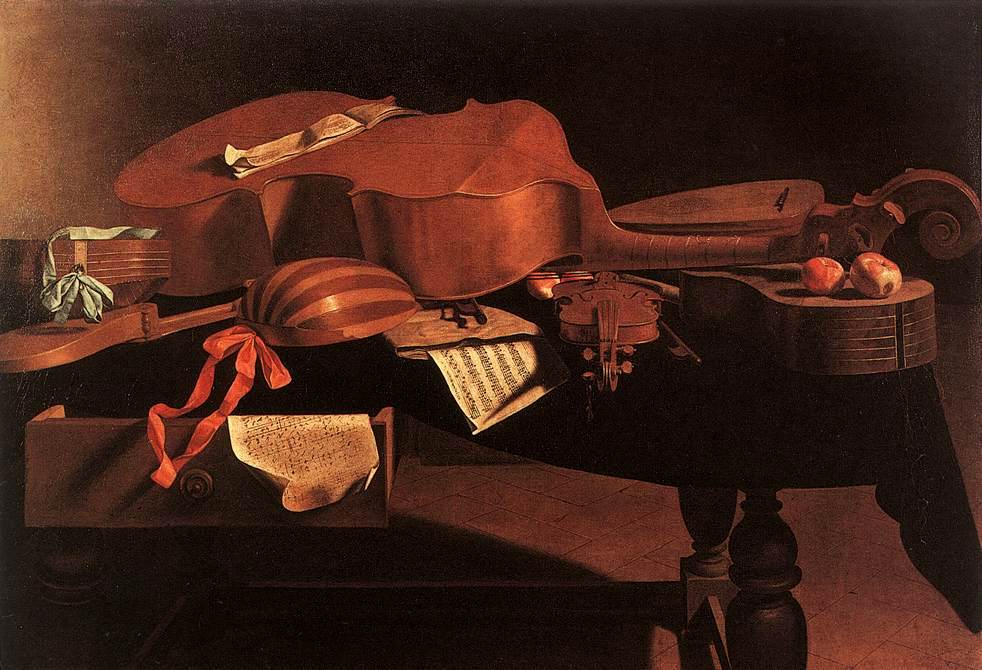
"Musical Instruments," painting by Evaristo Baschenis (1617-1677), via Wikimedia Commons.

The top 10 greatest classical composers — honorable mentions

Now that I've posted my top 10 list of the greatest classical composers, let's look at some people I left off whom others might have included.

Mendelssohn could have easily been in the top 10. His Octet (for the equivalent of two string quartets) is some of the best music I've ever heard by anyone. The achievement would be hard to fathom if he had written it at any age. He was 16 when he wrote it. Here it is played by Janine Jansen on violin and others (click through to YouTube for all the musicians).


Many top 10 lists would also include Schumann. I like his manic Toccata (played here by Do-Hyun Kim).


I noticed a lot of support for Tchaikovsky once the NYT series started. The Nutcracker Suite always puts me in a good mood. Here's the "Waltz of the Flowers" from that suite, which is supposed to be played by orchestra but is redone here by the Los Angeles Guitar Quartet:


Going back in time to the Baroque, there's Handel. Here's the obvious choice (for more Handel, check out his Keyboard Suites, like this one):


Scarlatti's harpsichord sonatas (often played on piano, as in this performance of K. 141 by Martha Argerich) are strikingly individualistic and out of sync with the late Baroque.


How about the 20th century? Bartok would be a leading contender. Here's his audacious String Quartet #4, played by Quatuor Ebène:


I love Shostakovich, who wrote under constant fear of his own Soviet government. Here's his 1st Symphony, which he wrote as a conservatory assignment when he was 19 years old (conducted by Paavo Järvi). This is relatively cheerful for Shostakovich (for something more characteristically bleak, try his 8th String Quartet):


Another Soviet composer is Prokofiev, who wrote some hard-edged, dissonant music, but also popular fare like Peter & the Wolf and Romeo & Juliet. I especially like his piano music, such as the 5th Piano Sonata (played by Boris Berman):


You could include Schoenberg on the list, but would that be mostly a gesture of recognition that he did something new? That's important, but I care more about: "If I could only listen to 10 composers for the rest of my life, who would they be?" I wouldn't put Schoenberg on that list. But if you had to listen to choose just 10 classical compositions to have on a desert island, you might want this haunting early piece, Verklärte Nacht (Transfigured Night) (played here by the NEC Contemporary Ensemble Concert, directed by John Heiss):


There are some giants I still haven't mentioned: Verdi, Wagner, Mahler. I like opera, but I'm not enough of a fan of it to put Verdi or Wagner in the top 10. I've never found the historical significance of Wagner to be viscerally exciting, as opposed to an academic observation (in contrast with Beethoven or Debussy). And I've never understood the passion for Mahler. I prefer the similar but more introverted and enigmatic Bruckner. Here's part of Bruckner's 9th Symphony (unfinished), conducted by Bernard Haitink:


What about Vivaldi, with his hundreds of masterful Baroque concertos? Here's "Summer" from The Four Seasons, which has no resemblance to summer unless we're talking about a thunderstorm (Mari Silje Samuelsen on violin):


The top 10 format might be skewed against Ravel, since most people would put Debussy ahead of him, and the one impressionist seems like enough for a short list. Here's his Piano Trio (the first two movements), played by Henry Kramer (piano), Arianna Warsaw-Fan Rauch (violin), and Meta Weiss (cello):


Then there's Sibelius. Here's the first movement of his overlooked 6th Symphony, conducted by Esa-Pekka Salonen:


We could keep going like this and end up with a top 50 list of excellent composers. There just isn't room for every worthy composer on a top 10 or 20 list. A top 10 list gets attention because it's restrictive; disappointment is built into the concept.

If you're looking for a fuller guide to classical composers than I could give here, I recommend Jan Swafford's Vintage Guide to Classical Music. He has long essays on the music and lives of the great composers, and shorter blurbs on lesser-but-notable composers. I particularly recommend this over Phil G. Goulding's Classical Music, which ranks "the 50 greatest composers" in order (unlike Swafford's book). Goulding's format is entertaining and eye-catching, but he makes some bizarre choices: he doesn't include Schoenberg or any American composers (no Copland or Ives), yet he includes relatively forgettable composers like Rameau and Donizetti. In contrast, Swafford's choices about which composers to emphasize (including some less obvious choices like Palestrina and Hindemith) and which ones to discuss briefly (Corelli, Scriabin, Poulenc) are close to perfect.

Friday, January 21, 2011

The top 10 greatest classical composers (2, 1)

(The complete list.)

[UPDATE: The New York Times author, Anthony Tommasini, just finished his top 10 list.]

2. Mozart

What's so great about Mozart? Why is it that he's routinely ranked one of the top 2 or 3 composers, and no one would dare leave him off the top 10? Like Bach, he didn't invent a new style; he fit comfortably into an existing one. But has there been any other composer, before or since, whom notes seem to flow out of with such beauty and grace?

Here's Sharon Kam playing the Clarinet Concerto, Mozart's last instrumental composition:


His piano sonatas are not Mozart at his very greatest, but they have an understated wonderfulness. This is Vladimir Horowitz playing the first movement of K. 330:


In the last movement of the "Jupiter" Symphony (#41) (conducted here by Jeffrey Tate), Mozart develops several different melodic themes, ending with a Baroque-inspired outburst of polyphony where all the themes seem to meld together. Sheer genius.


As with everyone on this list, there's so much more to him than I can do justice to here. He was the king of the piano concerto. There are his masses, his chamber music . . . All this would be enough to cement his ranking even if he hadn't been one of the greatest opera composers. He did all that in his cruelly short 35 years of life.


1. Beethoven

Tommasini, the NYT author, says there's a consensus among "thinking musicians" (which surely means "people who agree with me") that Bach was the single greatest composer, but to me Beethoven far surpasses any of the others. He's traditionally classified along with Haydn and Mozart as belonging to the "Classical" (capital C) era, but it's hard to fathom what an advance he was over Haydn, his partial contemporary. (Beethoven started writing in the 1700s, and Haydn was productive until his death at age 77 in 1809.)

Beethoven internalized all the existing concepts in Western music up to the beginning of the 19th century, stretched them almost beyond recognition, and probably gave more inspiration to the next 200 years of classical music than anyone else. Later composers could emulate him (Mendelssohn, Schumann), or stand on his shoulders to progress further (Wagner, Brahms), or react against him (Chopin, Debussy), but no one could ignore him.

His stylistic and emotional range was amazing. He could be wild and visionary, as in the Grosse Fuge . . .


. . . tragic, in the second movement of the 7th Symphony . . .


. . . or joyous and replenishing, in the first movement of the "Pastoral" (6th) Symphony.


I think of the whole history of classical music as a mountain. You start at the bottom of one side, which is medieval chant. You climb up the mountain, go down the other side, and when you reach the ground again, you're at late 20th century minimalism.

Higher up the mountain doesn't necessarily mean "better." It has more to do with how structured the music is. When you go from Baroque up to Classical, the arc of a piece becomes more dramatic. (As the musicologist Donald Francis Tovey said, you can randomly drop into a Classical piece you've never heard and have some clue about whether you're hearing the beginning, middle, or end of the movement; this doesn't work with Baroque.)

In the Romantic era, you start going downhill, with plenty of that old Classical form, but also a looser, more improvisational sensibility.

The 20th century goes steeply downhill, challenging all expectations of structure, harmony, melody, and rhythm.

At the top of the mountain — fusing the best aspects of Baroque, Classical, and Romantic (with a dash of prophetic modernism) in magnificent, awe-inspiring structures — is Beethoven.

Thursday, January 20, 2011

The top 10 greatest classical composers (4, 3 . . .)

(The complete list.)

4. Bach

Bach composed during the late Baroque, so he didn't forge a new style the way Haydn or Debussy or Schoenberg did. And the Baroque style itself is more limited than the music that would follow him. Yet he's so widely called one of the top 3 composers of all time that I feel slightly apologetic at ranking him "only" #4. Evidently, greatness is not just about originality. Bach transcended the limitations of his era and brought an intellectual depth previously unknown to Western music.

I think of him as generally mild-mannered and contemplative, but he was also capable of overwhelmingly intense emotion. Here's "Herr, Unser Herrscher" ("Lord, Our Master") from the St. John Passion, conducted by Jos van Veldhoven:


Bach's Cello Suites allow the cellist to explore melody alone, in a way no other composer has equalled. Here's Hidemi Suzuki playing No. 5 in C minor:


If you wanted to choose one little piece by anyone that perfectly distills the idea of pure, simple music for music's sake, it would be hard to do better than the 1st Prelude of the Well-Tempered Clavier (played here by Lang Lang):


3. Brahms

Schoenberg famously wrote, in an essay called "Brahms the Progressive," that Brahms had been misunderstood as one of the more conservative composers of the Romantic era, and that in fact he foreshadowed the atonalism of the 20th century. Fortunately, we don't need to take a stance on this musicological issue to become immersed in the autumnal world of Brahms, where every note seems to be aching or yearning or striving for something. Brahms, who died in 1897, often sounds to me like he's saying a long farewell to pre-Modern classical music itself.

The first movement of the Piano Trio #1 (Op. 8) has one of the most beautiful melodies I've ever heard (played here by Alexi Kenney, Oliver Herbert, Roman Rabinovich):


Here's the first movement of A German Requiem, where the non-religious Brahms put his individual spin on a traditionally Christian genre. Here's the whole thing, conducted by Jeffrey Thomas. The first 2 movements are spell-binding.


Here's Brahms's 4th Symphony (his last), conducted by Klaus Mäkelä. Does music get any better than the first movement of this symphony?

Wednesday, January 19, 2011

The top 10 greatest classical composers (6, 5 . . .)

(The complete list.)

6. Haydn

Haydn is known as "the father of the symphony." He might not have actually invented the symphony, but he made it great. The same is true of the string quartet.

Most 19th century composers paid little attention to Haydn, but it's hard to imagine Mozart or Beethoven without him.

He claimed he wasn't a very happy person, but who else has ever produced so many compositions (over 1,000) that sound so much like sunshine? Here's the first movement of his 104th Symphony, conducted by Achim Holub:


His comical approach of toying with your expectations was especially strong in his finales; for instance, here's the last movement of the 96th Symphony, with Jan Caeyers conducting Le Concert Olympique:


5. Debussy

You could easily pigeonhole him as a composer of pleasantly "impressionistic" music on the borderline of Romantic and Modern. I prefer to think of him as the most revolutionary composer of the 20th century. If you had to pick just one composition that gave the Modern era permission to disregard everything that came before, you might pick Debussy's Prelude to the Afternoon of a Faun (Prélude à L'Après-Midi d'un Faune). It flows along gently instead of hammering you over the head the way other revolutionary pieces (like the "Eroica" Symphony or the Rite of Spring) do. Here's François-Xavier Roth conducting the London Symphony Orchestra:


A more overtly Modern work is the 12 Etudes. Here's #9, For Repeated Notes (Pour les Notes Repétées), played by Christina McMaster:

Tuesday, January 18, 2011

The top 10 greatest classical composers (8, 7 . . .)

(The complete list.)

8. Chopin

The quintessential lone pianist exploring his soul through the instrument. The most intimate and introverted of the greats.

Some of the most characteristically Chopinesque pieces are his 58 Mazurkas. (A mazurka is a traditional Polish folk dance that might have been fairly obscure if not for Chopin.) Here are 7 of them, played by Evgeny Kissin (for a list of the specific pieces, click through to YouTube):


Here are Chopin's 24 Preludes, played by Yuja Wang:


7. Schubert

Impossible to neatly label or summarize. Is he Classical or Romantic or what? Who cares? His body of work is fascinatingly varied and staggeringly huge, yet he died at only 31 — a terrible loss to music.

He's known for his over 600 songs (in the traditional sense of "short pieces that are sung"). But I'm more interested in classical music without vocals, so here are a few of my favorites:

Schubert's 5th Symphony is like the best Mozart symphony Mozart never wrote. He was only 19 when he wrote this (conducted by Andrés Orozco-Estrada):


His String Quintet (for the unusual lineup of string quartet plus an extra cello, instead of an extra viola) is at the highest level of any chamber music by anyone. It was his last instrumental composition, written just two months before he died. This performance by the Afiara Quartet plus Joel Krosnick starts at 8:20, after Krosnick's introduction:


I had lent a few CDs to a friend who was getting into classical music, and he brought up the last movement of the "Trout" Quintet (which also has an unusual lineup: piano, violin, viola, cello, and double-bass). I've talked before about how it's the rare piece of music that gives me a strong feeling of: "Aha, this is it!" My friend essentially told me he felt that way about the "Trout" finale. So do I, and here it is (played by Julian Rachlin, Mischa Maisky, Mihaela Ursuleasa, Nobuko Imai, and Stacey Watton):


The "Unfinished" Symphony has a profound sense of completeness:

Monday, January 17, 2011

Who are the top 10 greatest classical composers? (10, 9 . . .)

That question has prompted over a thousand readers of the New York Times to give their opinions (here and here and here and here). [Update: Commenters on my mom's blog are also opining.] The Times writer Anthony Tommasini still hasn't given his list yet; he's running a series of pieces where he agonizes over who should be in the top 10 (also at those links).

I'm going to follow Tommasini's rules:

I am focusing on Western classical music. . . . [G]iants like George Gershwin, Duke Ellington and Stephen Sondheim are outside my purview here. And on the assumption that we are too close to living composers to assess their place and their impact, I am eliminating them from consideration.

Finally, I am focusing on the eras since the late Baroque. You could make a good case for Josquin or Monteverdi, but I won’t. The traditions and styles were so different back then as to have been almost another art form.
Now, here's my list. I'll add 2 a day from now to Friday.

[UPDATE: Here's the complete list.]

10. Dvorak

A Czech composer who did better than any American at capturing the essence of our country. Here's the first movement of his famous "American" String Quartet (#12):


His Cello Concerto is the best composition of its kind, and one of the most emotional, invigorating orchestral works I've ever heard. Here it is played by Yo Yo Ma:


9. Stravinsky

Debussy started the ignition of the 20th century, but Stravinsky drove down more of its roads. He would layer one key on top of another, or one rhythm on top of another; this shouldn't work in theory, but he made it work.

To sample a few of his many styles, listen to the playful, childlike Petrushka (conducted by Andrés Orozco-Estrada) . . .


. . . then the ferocious and radical Rite of Spring (Le Sacre du Printemps), conducted by Simon Rattle . . .


. . . then the majestically neoclassical Symphony in C (first movement, conducted by Georg Solti).

Sunday, March 7, 2010

Why politics and policy are less important than music and art

I'm reading Confessions of a Philosopher, a 1997 book by Bryan Magee. It's the best long-form account I've read of how philosophical issues impose themselves on one's life. (I deliberately speak of the issues as animate things acting upon a passive person — this is a main theme of the book.)

In a chapter called "Mid-Life Crisis," Magee describes his anguished struggle with the problem of the absurd (which I recently blogged about at the end of this post). He says:

I used to look at people going about their normal lives with everyday cheerfulness and think: "How can they? And how can they suppose that any of what they're doing matters? They're like passengers on the Titanic, except that these people know already that they're headed for total and irremediable shipwreck. . . . Above all, I was baffled by the fact that the middle-aged, who were so close to death, tended to be even more cheerful than the young. . . .

Under the influence of these thoughts my values went through sea changes. Everything that was limited to this life and this world came to appear insignificant. Only what might possibly point beyond them, or have its basis outside them — beauty, art, sex, morality, integrity, metaphysical understanding — could even possibly be worth anything. . . . Success and fame were worse than nothing, because anyone pursuing them was actively throwing his life away. (253)
This leads him to contrast following politics (apparently as a hobby or an occupation) with experiencing art (again, apparently as an audience member or performer, amateur or professional). I was pleased to see his description, because it articulates why I've been feeling increasingly uninterested in politics:
Even on their own terms the politics and business of the world were absurdly evanescent. One week politicians, people who worked in the City, and people whose job it was to report their doings would all be kept out of their beds by a financial crisis which, six months later, would be little talked of. By that time perhaps there would be . . . a corruption scandal in local government, which would then be followed by a flurry of public concern over crimes of violence, which in its turn would be pushed out of people's minds by their fury over some proposed new tax; and so it would go on. Each of these things would seem important for a time, then each would pass away and scarcely matter again except to historians. In fact, the truth is that most of them made little or no difference even to the daily lives of most of the population living through them. People immersed in this stream of ever-changing events were filling their minds with . . . ephemera and trivia, what people in electronics mean by "noise." (254)
I should note that he was a Member of Parliament for about 10 years, so he's not simply apathetic about politics by nature.

Not only do I agree with that passage as a description of current-day American politics (even though it was written in the UK in the '90s), but I find it especially silly that people get so worked up about one tax or one appropriations bill without seeming to care much about what taxes are like on the whole, or how much the country spends on different kinds of things overall. The specific bills that happen to be pending in Congress can only be validly assessed against this backdrop of broader understanding. But the media rarely gives us this information for fear of seeming to lack "objectivity" (whatever that is). And those who aren't concerned about being objective are usually too unreliable to be taken seriously. A subtle, balanced analysis of the tax structure is never going to achieve the level of interest generated by a report on the latest dumb comment by Sarah Palin (for the left) or President Obama (for the right). Magee goes on:
It is not as if were no alternatives. Time spent listening to great music, or seeing great plays, or thinking about issues of lasting importance, was not in this category. In those cases the object of one's activities retained its interest and importance for the rest of one's life. If I spent an evening listening to Mahler's Third Symphony, that symphony was still going to matter to me in six months' time, or ten years, or thirty: it was part of my life, for always. In fact such things more often than not increased in interest and value with the passage of time. If I spent two or three months saturating myself in, let us say, recordings of Mozart's piano concertos, and then did not return to them like that for another four years or so, I would find when I came back to them that I engaged with them on a deeper level than before. And the same was true of most great art. . . .

There were times when I felt, after all, that I was living to the full in face of death. Many men of action who are also writers have described the bliss induced in them by the sound of bullets smacking past their ears, and said that it intensified their awareness of being alive to an intoxicating level. The things that came closest to doing this for me when I fully realized I was facing death were my love affairs and friendships, philosophy and the arts. Never have I reacted to these things more intensely than I did in my late thirties and early forties. It was as if Shakespeare and Mozart were addressing me personally. . . . Had it not been for my need to earn a living I would have immersed myself in them entirely. (254-5)
Although I was more than satisfied by this explanation, some would respond, "But what about political art?" His answer to this is, again, exactly how I feel:
Those that treated political, social or historical levels of explanation as fundamental now seemed to me to be treating externals and surfaces as if they were foundations, and to be superficial and point-missing. In the world as it was at that time the most conspicuous example of this was Marxism, though there were others too. Marxism had a complete explanation of the arts in terms of political power, economic interests and social classes, and this seemed to me a grotesque attempt to explain the greater in terms of the less. Not only was there a lot of Marxist criticism around at that time, there were innumerable Marx-influenced stage productions which had the effect of superficializing the works they dealt with for precisely this reason, that they treated social and political externals as fundamental, while remaining oblivious to what actually was fundamental. Arguing with people who produced or supported this kind of thing was a dislocating experience, because it seemed self-evident to them that the metaphysical, personal and interpersonal dimensions of things were of secondary importance compared with the social and political. Indeed, they often denied that there was any metaphysical dimension at all, either to reality or to works of art. (255)
Some people will respond: "But art should say something about society. It shouldn't be just meaningless fluff to make you feel good. It should disturb people and wake them up to social injustices." (Yes, I've heard all of this said.) Of course I agree that art can say important things about society and that this can be a fine thing to do. It's not that I totally dismiss this function, and I don't think Magee does. But these aren't the most important functions of art, nor are they requirements of great art.

And as for anyone who considers art "meaningless" if it doesn't contain a social critique, or if isn't "appreciated in the social context in which it was made," I feel sorry for them for what they're missing . . .


(That's Mozart's Piano Concerto No. 20, conducted and performed by Mitsuko Uchida.)
Thursday, July 9, 2009

What we did on our trip to NYC

Danielle and I went on a little vacation in New York last week, which is why I wasn't blogging. What were the most noteworthy things we did in the city? Here's our list.

1. Live music — classical
a. New York City Opera performing a variety of crowd pleasers on Pier 17 (free)
b. Escher Quartet playing Brahms, Bartok, and Haydn at Barge Music in Brooklyn (free chamber music every Sunday at 3 pm)

2. Live music — jazz
a. Anat Cohen paying homage to Benny Goodman at the Village Vanguard [UPDATE: Here's what it was like.]
b. random free jazz shows around town

Washington Square Park

(Part of a jazz group playing in Washington Square Park.)

3. Parks
a. The High Line (opened just last month, running along 10th Ave. from about 12th St. to 20th St.)
b. Washington Square Park
c. Socrates Sculpture Park (Astoria, Queens)

4. Cafes with good food
a. Cafe Brama (East Village)
b. Dumbo General Store (Brooklyn) [UPDATE: Both of those cafes have now gone out of business]

Brooklyn - Dumbo General Store

(Dumbo General Store.)

5. Bars
a. Lillie's (just opened last year on 17th St.)
b. 5 Ninth (West Village)
c. Lolita (Lower East Side)

Cafe Brama in the East Village, NYC

(Danielle at Cafe Brama.)

6. Movie: Away We Go at Clearview Cinema in Chelsea [UPDATE: Here's what we thought of it.]

7. Bookstores
a. Strand* (the beloved institution on Broadway at 12th St.)
b. Three Lives (West Village)
c. The Powerhouse Arena in the Dumbo neighborhood of Brooklyn (emphasis on photography)
d. Rocketship on Smith St. in Brooklyn (alternative comics)

* I originally wrote "The Strand" but changed it following some discussion in the comments.

Brooklyn, Dumbo General Store

(Me at the Dumbo General Store.)

8. Chelsea galleries
a. DJT Gallery
b. Basil Wolverton exhibit at the Gladstone Gallery (more images here) (till Aug. 14) [UPDATE: I respond to the New York Times' response to the exhibit.]

9. Bronx Zoo

Socrates Sculpture Park in Astoria

(Socrates Sculpture Park. All photos in this post are by me, except the one of me, which is by Danielle Pouliot.)

UPDATE: See the comments over here for more NYC ideas. People are going wild over Wolverton!

Friday, May 29, 2009

Music Friday: 4 more covers

Continuing with the theme from last week, here are 4 more covers, each one followed by the original.

5. The Project (info) covers...


...Tchaikovsky.


6. Ben Gibbard (of Postal Service and Death Cab for Cutie fame) covers...


...Michael Jackson.


7. Hanne Hukkelberg (blogged previously) covers...


...the Kinks.


8. M. Ward (featuring Zooey Deschanel) covers...


...Buddy Holly.

Thursday, April 9, 2009

Cured, all right

We just watched the great Stanley Kubrick movie A Clockwork Orange last night, and today I read in Will Saletan's blog Human Nature that a new drug might "cure the urge to steal."

Saletan quotes a report by the University of Minnesota School of Medicine:

An 8-week, double-blind, placebo-controlled trial was conducted to evaluate the safety and efficacy of oral naltrexone for kleptomania. Twenty-five individuals with DSM-IV kleptomania were randomized to naltrexone (dosing ranging from 50 mg/day to 150 mg/day) or placebo. . . .

Subjects assigned to naltrexone had significantly greater reductions in . . . stealing urges (p = .032), and stealing behavior (p < .001) compared with subjects on placebo. Subjects assigned to naltrexone also had greater improvement in overall kleptomania severity. . . . Naltrexone demonstrated statistically significant reductions in stealing urges and behavior in kleptomania.
Saletan adds:
Naltrexone is better known as a drug for alcohol or drug addiction. Many of us, while accepting these addictions as diseases, continue to regard theft as a matter of personal responsibility. Should we rethink that distinction? If the same drug relieves both conditions, should we take kleptomania more seriously as an illness?