Thursday, February 21, 2019

Is free speech on campus in a "crisis," and if so, who's most affected?
The Wall Street Journal has a weekly feature called Future View, where college students answer a question. This week, the question is whether there's a "campus free-speech crisis."
Here's a response by Sam Wolfe, a comparative literature student at Stanford University:
Ask a liberal student about the “campus free-speech crisis,” and watch him roll his eyes. He’ll tell you it’s a figment of the conservative imagination—a handful of racist speakers have been protested or shut down, but the overwhelming majority proceed without incident. Speak your mind, he’ll insist. No one will punish you for it.And you know who’s especially hurt by this? Liberals. They don’t get exposed to as many different points of view. The more conservative students receive greater opportunities — opportunities to consider more ideas, because they know what they hear/read plus what’s in their heads! After graduation, who’s going to be better-equipped to go out in the world and interact with intellectually diverse groups of people?
Ask a conservative student, however, and you’ll hear her stories: how she couldn’t speak up in her classes, scared to admit that the shibboleths of the left aren’t her own; how she had to self-censor in her dorm and in her academic papers; how she couldn’t imagine revealing her true positions on abortion, affirmative action or gun control.
They’re both right. Rarely do colleges formally punish students for expressing conservative opinions. But when one’s peers and professors are overwhelmingly left-wing, students reasonably fear that they could be ostracized for sharing their beliefs.
Occasional protests against controversial guest speakers are the least important manifestation of the problem. Instead, worry about the intellectually curious student who is afraid to question the prevailing views. If not in college, when?
Tuesday, February 19, 2019
Bernie Sanders
I voted for Bernie Sanders in the New York primary in 2016.
I do not intend to do so in 2020.
My vote for Sanders in 2016 was a protest against the lack of adequate competition. That doesn’t seem like it will be a problem this time.
Sen. Sanders says this while announcing on Vermont Public Radio that he's running for president:
"It turns out that many of the ideas that I talked about – that health care is a right, not a privilege, and that we've got to move toward a Medicare-for-all, single-payer system: very, very popular. The idea that we have got to raise the minimum wage to $15 an hour," he told Vermont Public Radio. "When I talked about making public colleges and universities tuition-free and lowering student debt, that was another issue that people said was too radical. Well, that's also happening around the country. . . ."Here are some highlights from Bernie Sanders in my live-blogging of the 2016 primary debates (I was writing this live, with no pause or rewind button, and I tried to make the quotes reasonably accurate but they weren't necessarily verbatim):
Asked by Vermont Public Radio how he will pitch his candidacy in such a diverse and progressive field, Sanders argued, "We have got to look at candidates not by the color of their skin, not by their sexual orientation or gender, and not by their age. I think we have got to try to move us toward a nondiscriminatory society that looks at people based on their abilities, based on what they stand for."
Oct. 13, 2015:
9:06 — [Anderson Cooper] asks Sanders if he's a capitalist. "Do I consider myself a part of the casino-capitalist process? . . . No, I don't."Nov. 14, 2015:
9:39 — Sanders is asked how he could be Commander in Chief after he applied for "conscientious objector" status during the Vietnam War. "When I was a young man — I'm not a young man today — I strongly opposed the Vietnam War. . . . I am not a pacifist." [VIDEO.]
9:42 — Sanders is asked how high he'd raise taxes. He doesn't have an "exact number," but it will be lower than the highest rate under President Eisenhower — "I'm not that much of a socialist compared to Eisenhower!" [VIDEO.]Feb. 4, 2016:
9:53 — Sanders is asked how much "job loss" he'd find an "acceptable" consequence of raising the minimum wage. Sanders vaguely acknowledges that any policy will have some negative consequences, but he'll "apologize to nobody" for supporting an increase to $15 an hour. For some reason, he suggests that this will especially help to reduce unemployment among black youths.
10:32 — Sanders calls to "end minimum sentencing" and legalize marijuana at the federal level, so states can be free to legalize it.
10:54 — Sanders's closing statement is evocative of Larry David's impersonation of him: "We need a political revolution! . . . Turn off the TV! . . . Please become a part of the revolution!"
9:42 — Sanders goes on a diatribe against Wall Street. "Kid gets caught with marijuana — that kid gets sent to jail. A Wall Street executive destroys the entire economy — $5 billion settlement, no criminal record."Feb. 11, 2016:
9:49 — Sanders: "The business model of Wall Street is fraud."
9:14 — Sanders calls out [Hillary Clinton] for "going around the country" saying he's going to "dismantle" Medicare, Medicaid, etc. "We're not going to dismantle anything."March 6, 2016:
9:29 — Sanders says: "A Sanders victory would be some historical accomplishment as well."
10:43 — They're asked to name one American leader and one foreign leader who'd influence their foreign policy. Sanders says FDR for the American leader, and Winston Churchill for the foreign leader.
9:07 — A member of the audience begins his question by pointing out that opportunities often go disproportionately to "older Caucasian men and women." Sanders interrupts him with a self-effacing joke: "You're not talking about me, are ya?!" On a more serious note, Sanders says: "Most candidates wouldn't put this on their resume, but . . . I was arrested by the Chicago police for trying to desegregate the Chicago school system." [VIDEO.]
Saturday, February 16, 2019
Online comments and the Constitution
When I see online comments fantasizing about what grotesque punishments the commenters would like to see imposed on certain criminals, which is a kind of virtue signaling (“Look at me — I hate evil so much that I want terrible things to happen to evildoers, because I’m such a good person!”) . . . when I see that kind of comment, I’m proud to live in a country that has a constitutional rule against “cruel and unusual punishment.”
When I see comments assuming someone is guilty of a crime before they’ve been convicted of anything, based only on a headline that refers to the government’s allegations, I’m glad the Constitution requires “due process.”
Those and other short phrases in the Constitution, written centuries ago, are in effect regardless of what the majority thinks or feels, and that’s a great thing about America. We do live in a democracy, but there must be limits on the majority’s power, to keep democracy from becoming tyranny.
Tuesday, February 12, 2019
What was wrong with Ilhan Omar's tweets about Israel and AIPAC?
Some are saying, "Well, Rep. Ilhan Omar was right: AIPAC really is an influential pro-Israel lobbying organization, and it does use money to exert its influence! So what's the problem with her two tweets [now deleted] that were denounced by House Speaker Nancy Pelosi and other congressional Democrats?"
This Reason piece explains what that's missing. Yes, you can look at Omar's two tweets that have gotten the most attention and say each one on its own has some truth to it. But that's overlooking the larger context of her statements. She was responding to a Haaretz article about House Minority Leader Kevin McCarthy's criticism of Omar's statement from years ago that "Israel has hypnotized the world," and the world must "awaken" to "see the evil doings of Israel."
To her credit, Omar has apologized for those statements (though her recent response to Pelosi was called a "nonapology" by my mom, Ann Althouse). But it's still troubling when a member of Congress uses old anti-Semitic tropes about Jews as an elite group secretly controlling the world with all their money. You don't get to keep pulling out invidious stereotypes about a historically marginalized group and then plead innocent because hey, there is some truth to your statements. That's setting the bar too low for our national leaders. To insist on reading each individual tweet by Omar in isolation from everything else she's expressed about the topic would be applying a skewed standard that we shouldn't apply to any powerful government official.
As David Bernstein says in the Reason post:
Let's be generous, and assume she meant AIPAC to begin with. Two freshman Democrats who have attracted a great deal of attention are widely perceived to have engaged in anti-Semitic rhetoric while criticizing Israel. The leader of the House GOP, just off demoting a member of his caucus for racist comments, threatens similar action against the two Democrats. . . . Suggesting in the absence of 'Israel lobby' money, the House Republican leader wouldn't call out anti-Semitism by House Democrats suggests that you believe that the lobby, i.e., Jews, are pulling the strings in a classic Jewish-conspiracy kind of way, such that even the most mundane and obvious of political maneuvers are really just tribute to a Jewish cabal.
Monday, February 11, 2019
Amy Klobuchar: On, Wisconsin!
"Amy Klobuchar trolls Hillary Clinton with Wisconsin jab," reports the Washington Times:
“We’re going to be in Iowa and in Wisconsin,” the Minnesota Democrat told reporters after she announced her 2020 presidential bid in Minneapolis.Over and over during the 2016 race, I said we shouldn't call my home state of Wisconsin a "blue state." I kept saying it's a purple state, a swing state, a state that could go either way.
“I think we’re starting in Wisconsin because as you remember there wasn’t a lot of campaigning in Wisconsin in 2016,” she added. “With me, that changes.”
Mrs. Clinton infamously neglected to campaign in Wisconsin after she won the 2016 Democratic Party nomination. She wound up . . . becoming the first Democrat to lose the state since 1984.
Mrs. Clinton addressed the loss in her campaign memoir “What Happened.”
“If there’s one place where we were caught by surprise, it was Wisconsin. Polls showed us comfortably ahead, right up until the end,” she wrote. “I would have torn up my schedule . . . and camped out there.”
People told me I was wrong because Democrats had won Wisconsin in the past several presidential elections.
I told them to look at the margins of those elections in Wisconsin:
Al Gore won Wisconsin . . . by 0.22%, making it the third-closest state in 2000.
John Kerry won Wisconsin . . . by 0.38%, making it the closest of all 50 states in 2004.
Barack Obama won Wisconsin by more than 10% in 2008, but that was an unusually large margin for anyone to win Wisconsin (the biggest since 1964). Why did that happen? In November 2008, the economy seemed to be in free fall at the end of an 8-year Republican administration. An outlier under extraordinary circumstances like 2008 is a less reliable predictor than close elections like 2000 and 2004.
I also said to look at Wisconsin's governors. The governor back in 2016 was a staunchly conservative Republican, Scott Walker, who succeeded a Democrat, who succeeded two Republican governors in a row (including Tommy Thompson, a pioneer of welfare reform in the '90s who went on to serve in President George W. Bush's cabinet).
I grew up in the very left-wing state capital, Madison, but the rest of Wisconsin is not Madison. It was a terrible mistake for Democrats to overlook Wisconsin or make assumptions about the state.
Kamala Harris on marijuana
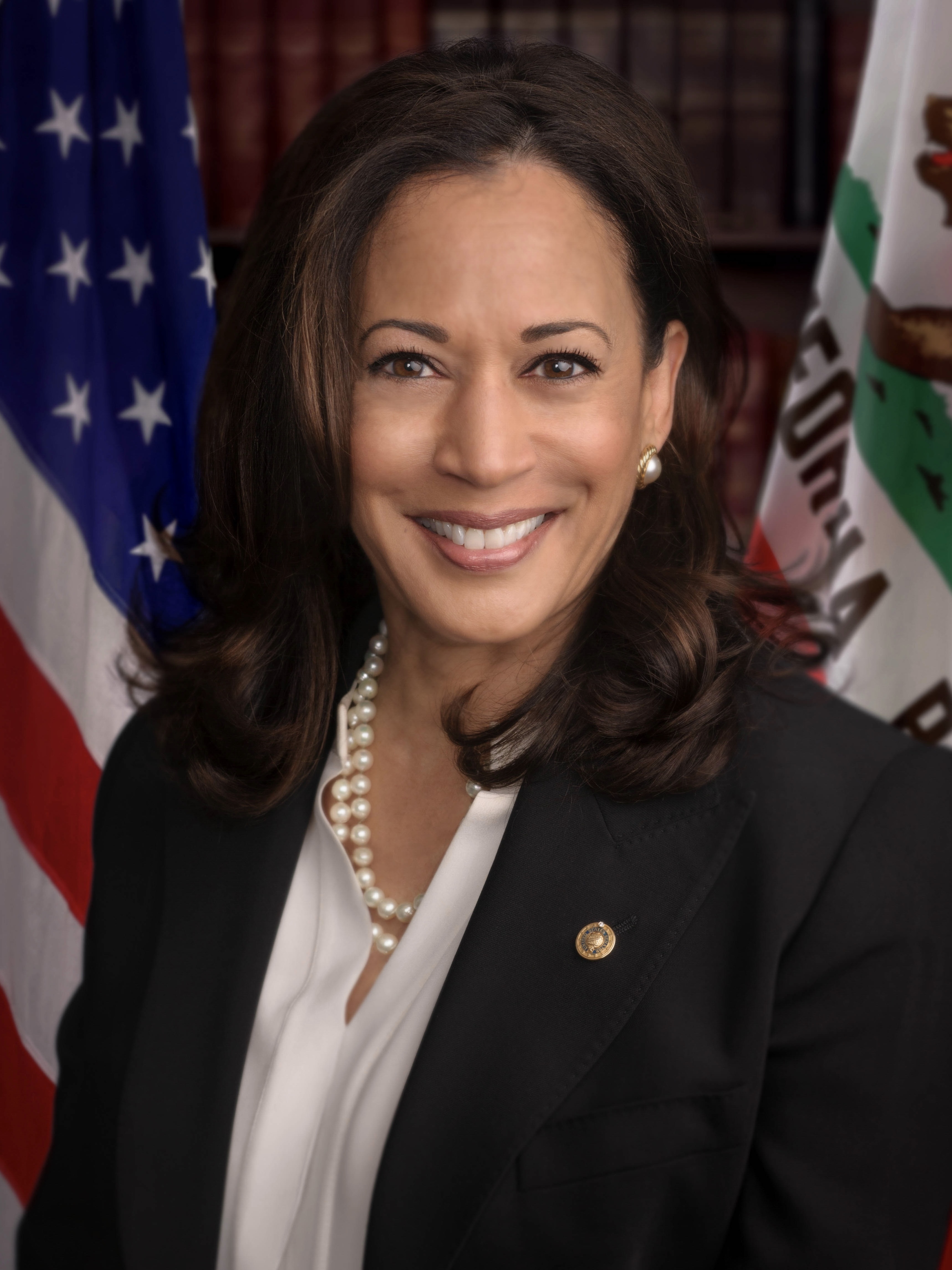
A presidential candidate admitting to marijuana use is nothing new. That happened in the 2004, 2008, and 2016 races.
But in the past, candidates have often been quick to add that it was a mistake (for instance, click the "2008" link on Obama).
I've never seen any presidential candidate other than Kamala Harris make this kind of argument for legalizing marijuana:
I think that it gives a lot of people joy, and we need more joy.
(Official Senate photo from the public domain.)
Thursday, February 7, 2019
Mixed messages
Our message to men: Admit your toxic masculinity, and start having a conversation about how men can improve themselves!
Our message to white people: Admit your racism and privilege, and start having an honest conversation about race — however difficult and uncomfortable that might be!
Our message to people with mental illness: We need to remove the stigma so you can talk openly about your mental health!
Our message to a white man who publicly admits to the time he was so racist and mentally unwell that he wanted to kill a black man just for being a black man, then realized the error of his ways and made an effort to improve himself: Stop talking about that! You're not allowed to say that in public!
Sunday, February 3, 2019
A strange sentence in the New York Times about Democrats apologizing
"2020 Democrats Agree: They’re Very, Very Sorry," reports the New York Times:
The most recent high-profile mea culpa came Thursday when Senator Elizabeth Warren of Massachusetts apologized for her controversial decision to take a DNA test to prove her decades-old claim of Native American ancestry.And the Times doesn't mention Tulsi Gabbard apologizing for her vile statements about "homosexual extremists."
Former Vice President Joseph R. Biden Jr. recently lamented his role in crafting the tough-on-crime drug legislation of the 1980s and 1990s.
Senator Kamala Harris of California said she regretted some of the positions her office took while she was a state prosecutor.
Senator Kirsten Gillibrand of New York said her past hard-line stances on immigration “certainly weren’t empathetic and they were not kind.”
Senator Bernie Sanders of Vermont apologized after reports of gender discrimination and sexual harassment in his 2016 presidential campaign.
But I don't understand what the New York Times reporters (Astead W. Herndon and Sydney Ember) are talking about in this sentence:
As recently as 2006, national Democrats including former President Barack Obama expressed wariness about immigrants’ ability to assimilate into American culture and did not openly embrace gay marriage — two talking points that would probably be deeply damaging for any 2020 candidate."Why "[a]s recently as 2006"? That wasn't a presidential election year. And did Democrats stop doing those things before 2008? President Obama and Vice President Biden didn't "openly embrace gay marriage" until 2012.
Maybe the writers were thinking of what Obama wrote in his 2006 book The Audacity of Hope (pp. 263-64, 266, 268):
[T]here's no denying that many blacks share the same anxieties as many whites about the wave of illegal immigration flooding our Southern border — a sense that what's happening now is fundamentally different from what has gone on before. Not all these fears are irrational. . . . If this huge influx of mostly low-skill workers provides some benefits to the economy as a whole . . . it also threatens to depress further the wages of blue-collar Americans and puts strains on an already overburdened safety net. . . .
For most Americans, though, concerns over illegal immigration go deeper than worries about economic displacement and are more subtle than simple racism. In the past, immigration occurred on America's terms; the welcome mat could be extended selectively, on the basis of the immigrant's skills. . . . The laborer, whether Chinese or Russian or Greek, found himself a stranger in a strange land, severed from his home country, subject to often harsh constrains, forced to adapt to rules not of his own making.
Today, it seems those terms no longer apply. Immigrants are entering as a result of a porous border rather than any systematic government policy. . . . Native-born Americans suspect that it is they, and not the immigrant, who are being forced to adapt. . . .
I'm not entirely immune to such nativist sentiments. When I see Mexican flags waved at proimmigration demonstrations, I sometimes feel a flush of patriotic resentment. When I’m forced to use a translator to communicate with the guy fixing my car, I feel a certain frustration. . . .
We have a right and duty to protect our borders. We can insist to those already here that with citizenship come obligations — to a common language, common loyalties, a common purpose, a common destiny.
Buddy Holly died 60 years ago today.
I did this blog post 10 years ago as a tribute to Buddy Holly — and the many people he's influenced.
Sunday, January 27, 2019
Why I'm still talking about Covington
A week after the media meltdown over Covington, it's not surprising that some people are starting to say eh, this is old news; people have apologized, so why not give it a rest?
You could give various responses about the larger significance of the debacle, that some people haven't adequately recanted, etc.
But I want to add something, which is that this feels personal because it could so easily happen to any of us. The encounter was so mundane that you have to wonder what other non-events will be used to try to destroy you or me. It happened to be video-recorded not because it mattered, but because that's just so easy with 2019 technology.
I didn't have to worry about that when I was 16, but I can't help thinking: what would it have been like if this had happened to me when I was 16? Are some people not having that thought because they see him as the Other, and consequently lack empathy for him?
I also think about what will happen if I ever have a kid. Would my 16-year-old always stay on the right side of the face police? Or might he occasionally be awkward at that age? What if he had some kind of a mental or physical disability that caused him to have facial expressions or body movements that people took the wrong way? (I say "he" because so much of the vituperation that's been directed at the Covington kids has been explicitly based on their gender.)
In the past few days, I've been under the weather (getting better now, so don't worry about me), and sometimes as I've stood around in a public place, I've stopped to think: hey, I might have had an inappropriate facial expression just now, because of a combination of feeling a little out of it and feeling physically uncomfortable. If someone were video-recording me, could they find one still that made it look like I was "disrespecting" the wrong person?
When I see a post saying the kid's "smirk" (always that same exact word choice) is proof that there's something bigoted or wicked about him, I wonder if the person saying that has gone through life always making an appropriate facial expression for every social situation. Would you even want to be someone who always makes what others consider just the right expression? That sounds like someone who's very safe and inoffensive and well-scripted, not someone spontaneous and flawed and quirky.
I grew up in a far-left college town, and I've known so many young people who were free spirits, who were nonconformists, who were determined to be themselves no matter what anyone else said, who had a passion for noisy music and experimental art, who listened to the color of their dreams . . . And back then, it didn't seem incongruous that they were mostly on the left. Today, I see so many people on the left sternly admonishing a 16-year-old for having the wrong smile in the wrong place at the wrong time. That's a prissy attitude which seems like the antithesis of so many lefties I've known. How can you be a young person who identifies as left/liberal and take that attitude? I've always had my differences with the left, but for most of my life I at least would have admitted that hey, a lot of them are cool people, interesting people, people who are worth talking to, especially if you don't share their politics. And that has no resemblance to some of the self-appointed arbiters of propriety we've been seeing on social media.
I want to say to some of these people joining virtual lynch mobs based on the latest viral video: Is that really who you are? Or are you too afraid to say what you really think? Or have you forgotten what you really think because you're more focused on . . . looking just right?
Saturday, January 26, 2019
"Respect your elders"?
Amid all the talk about how the Covington story was falsely reported and how the mob against those kids summed up everything wrong with social media, one point seems to have gotten lost: no matter what version of the facts we believed, it was always absurd to say, in response to seeing a Native American in his 60s, that the teenagers needed to "respect their elders." That phrase can be used to mean many different things, but I'd suggest that it's so problematic it should be replaced by clearer statements that don't rely on cliches.
We should not respect anyone based on what demographic group they belong to, whether it's age, ethnicity, or anything else. Each individual either does or doesn't deserve respect based on what they've specifically said or done. Just think how many of the people who said "respect your elders" after watching that video have the utmost disrespect for Donald Trump, who, as the 72-year-old leader of our country, is as much an "elder" as anyone. Of course, "respecting your elders" is an effective approach in many social situations. But the word "respect" can refer to either outward behavior or internal thoughts/feelings. If it means the latter, then no one believes you must genuinely respect all of your "elders" (whoever they are). Some of your "elders" are fundamentally at odds with each other, so to respect one of them would be to disrespect another. It's even been argued that teaching kids to "respect their elders" could lead them to accept being abused by adults.
There are valid arguments in favor of "respect your elders": that we should honor those who've come before us, who've struggled in ways we haven't, who've worked hard to make the world better, and who've gained wisdom over the years. As a general attitude toward older generations, that's fine — but that's not what people meant when they said "respect your elders" about the Native American man at that event. They seemed to mean that he as an individual must be respected at all times, but we can't know that from clicking on a short video someone recorded with their phone.
Ironically, it isn't respectful to leap to a positive judgment about someone based on their ethnicity. Is seeing a Native American of a certain age and immediately saying, "Respect your elders!" really that different from meeting someone who's Asian and quickly praising them for "speaking good English," or routinely mentioning that "some of my best friends are black" during any conversation about race? Those kinds of statements might sound positive on the surface, but it's well-known that they're insidiously patronizing. They treat people as ethnic placeholders instead of as fully formed individuals with unique strengths and weaknesses.
Tuesday, January 22, 2019
Why are adults freaking out about a smiling kid?
In the novel 1984, George Orwell wrote about a dystopian future where “to wear an improper expression on your face (to look incredulous when a victory was announced, for instance) was itself a punishable offense.” It was called a "facecrime."
Julie Irwin Zimmerman writes in the Atlantic:
I watched with indignation Saturday morning as stories began appearing about a confrontation near the Lincoln Memorial between students from Covington Catholic High School and American Indians from the Indigenous Peoples March. The story felt personal to me; I live a few miles from the high school, and my son attends a nearby all-boys Catholic high school. I texted him right away, ready with a lesson on what the students had done wrong.Reason magazine has details based on about two hours of videos:
“They were menacing a man much older than them,” I told him, “and chanting ‘Build the wall!’ And this smirking kid blocked his path and wouldn’t let him leave.” The short video, the subject of at least two-thirds of my Twitter feed on Saturday, made me cringe, and the smirking kid in particular got to me. . . .
“Where were they chanting about building the wall?” my son asked. His friends had begun weighing in, and their take was decidedly more sympathetic than mine. He wasn’t sure what to think, as he was hearing starkly different accounts from people he trusted. I doubled down, quoting from the profile of Nathan Phillips that The Washington Post had quickly published online, in which he said he’d been trying to defuse a tense situation. I was all-in on the outrage. How could the students parade around in those hats, harassing a man old enough to be their grandfather—a Vietnam veteran, no less?
One student did not get out of Phillips['] way as he marched, and gave the man a hard stare and a smile that many have described as creepy. This moment received the most media coverage: The teen has been called the product of a "hate factory" and likened to a school shooter, segregation-era racist, and member of the Ku Klux Klan. I have no idea what he was thinking, but portraying this as an example of obvious, racially-motivated hate is a stretch. Maybe he simply had no idea why this man was drumming in his face, and couldn't quite figure out the best response? It bears repeating that Phillips approached him, not the other way around.Rep. Thomas Massie wrote:
And that's all there is to it. Phillips walked away after several minutes, the Black Hebrew Israelites continued to insult the crowd, and nothing else happened. . . .
Far from engaging in racially motivated harassment, the group of mostly white, MAGA-hat-wearing male teenagers remained relatively calm and restrained despite being subjected to incessant racist, homophobic, and bigoted verbal abuse by members of the bizarre religious sect Black Hebrew Israelites, who were lurking nearby. . . .
Phillips enters the picture around the 1:12 mark, but if you skip to that part, you miss an hour of the Black Hebrew Israelites hurling obscenities at the students. They call them crackers, faggots, and pedophiles. At the 1:20 mark (which comes after the Phillips incident) they call one of the few black students the n-word and tell him that his friends are going to murder him and steal his organs. At the 1:25 mark, they complain that "you give faggots rights," which prompted booing from the students. Throughout the video they threaten the kids with violence, and attempt to goad them into attacking first. The students resisted these taunts admirably: They laughed at the hecklers, and they perform a few of their school's sports cheers.
Would you have remained that composed at that age under those circumstances? . . . Even when taunted by homophobic bigots . . . they insulted no one.The Atlantic writer now realizes that her son was right to question the outrage. She says:
In the context of everything that was going on (which the media hasn’t shown) the parents and mentors of these boys should be proud, not ashamed, of their kids’ behavior. It is my honor to represent them.
Take away Twitter and Facebook and explain why total strangers cared so much about people they didn’t know in a confrontation they didn’t witness. Why are we all so primed for outrage, and what if the thousands of words and countless hours spent on this had been directed toward something consequential? If the Covington Catholic incident was a test, it’s one I failed. . . .An update to that Reason article quotes the student's public statement about the event, which says: "I would caution everyone passing judgement based on a few seconds of video to watch the longer video clips that are on the internet, as they show a much different story than is being portrayed by people with agendas."
Will we learn from it, or will we continue to roam social media, looking for the next outrage fix? Next time a story like this surfaces, I’ll try to sit it out until more facts have emerged.
A couple months ago, I wrote this in response to a different viral video that left out crucial context:
I generally don’t watch this kind of online video that supposedly shows everyday discrimination. Video isn’t reliable. Video is a thin slice of a much larger thing. Video leaves out so much. Video can leave out context that would completely change your view of what you’re seeing. Getting outraged by video alone, without knowing the full story, isn’t the best use of my time.Yet many adults have been harassing this kid online. I can't believe some of the things people are willing to say in public! Some journalists have been deleting their earlier reactions to the incident:
Recode editor and New York Times contributing op-ed writer Kara Swisher, for instance, deleted one tweet saying she was thinking of “finding every one of these shitty kids and giving them a very large piece of my mind,” and other tweets throwing slurs like “Nazi” and “nationalist.” . . .But Reza Aslan still hasn't deleted this tweet, along with a photo of the kid:
The New Republic’s Jeet Heer deleted a tweet arguing the MAGA hat-wearing teens were “racist.”
CNN’s Bakari Sellers deleted a tweet suggesting the kids should be “punched in the face.”
Honest question. Have you ever seen a more punchable face than this kid’s?Aslan is a prominent commentator on religion who's written a book about Jesus, but his tweet is the opposite of "Turn the other cheek." Instead, he's trying to incite people to hit a kid who had a nonviolent response to hate.
Some have defended the outrage against the kids by pointing out their "Make America Great Again" hats. But it shouldn't be a national news story that some teenagers have political views that are different from yours. No matter how strongly you disagree with their politics, attacking kids for being politically active is cowardly. I'm against Trump and I support a legal right to abortion, but I'm not going to express my political views at the expense of a random kid who I don't know.
It seems like most of the people who are doubling down on the initial outrage have been focusing on the young person's smile. How is it OK to make a national news story out of not liking someone's smile? Mocking someone's smile is as bad as telling someone they have to smile more, and we're all supposed to think the latter is blatantly offensive, right?
As an extreme example, a Facebook post by Slate calls the kid's facial expression "the smirk of evil." Think about it: adults going online to type out that a random kid — not a famous person and not someone who's even being accused of a crime (as far as I know) — is "evil." And his full name, image, and school have been made public. I don't know how adults can sleep at night after going to work and trashing a kid who isn't even alleged to have done anything seriously wrong.
I've used the word "smile," not "smirk," but many people are calling it a "smirk." Why that word choice? Ann Althouse (my mom) writes:
When is a smile a "smirk"? The dictionary says, when it's affected or simpering or silly and conceited looking.Just think how different the reaction would have been if the media had framed the story differently — if they had focused on other people hurling homophobic and racist slurs, instead of focusing on the kid's smile.
But I'd like a deeper psychological explanation of what is supposed to be in the mind of the smirker and how observers of smiles decide they have a window into that mind. My hypothesis is: People see what they want to see. That means: When people tell you what they think they see about the inside of another person's head, they are opening a window for us to peer into their head.
And, of course, that means that if we talk about what we think we see in the mind of the observer of another person, we too reveal ourselves. We express misunderstandings and expose ourselves to being misunderstood.
The day after the incident, Slate ran a piece saying the "new footage doesn’t exonerate the kids in the red caps." But "exonerate" them from what? Standing around and smiling?
The onslaught against these kids has been a Kafka-esque farce. They were summarily pronounced guilty (not in the legal sense, of course, but in the media) . . . without the charges even being specified.
We need to resist this kind of online bullying. If it's allowed to be done against people who are on the other side of you politically, it will happen to people on your side too.
Tuesday, January 15, 2019
90
Martin Luther King, Jr. would have turned 90 today.
Anne Frank would have turned 90 later this year.
Did you ever think of them as being the same age?
Monday, January 14, 2019
Happy 50th birthday to Dave Grohl!
He stuck around.
I love this statement by Dave Grohl in his acceptance speech for Nirvana's induction to the Rock 'n' Roll Hall of Fame in 2014 (starting at 5:00 in the video):
I have to thank my beautiful wife, Jordyn, and my two daughters, that I hope grow up to inspire people just like every musician I grew up inspired by. Because I think that’s the deal, is that you look up to your heroes, and you shouldn’t be intimidated by them; you should be inspired by them. Don’t look up at the poster on your wall and think, “Fuck, I could never do that!” Look at the poster on the wall and think, “Fuck, I’m gonna do that!”
Saturday, December 15, 2018
"Donald Trump Jr. Says His Father Is a Regifter"
President Donald Trump's eldest son says his father is a "regifter" who "may or may not" have once given him the same gift he presented to his dad the year before.
Donald Trump Jr. says in an interview with the entertainment program "Extra" that because he is his father's namesake, he "got regifted all the things that were monogrammed for him at times."
And he says that one Christmas he called his dad out on the regifting, explaining that he was the one who'd had the item monogrammed.
In addition to being a re-gifter, the president is also reported to be a double-dipper, low talker, and master of his domain.
Monday, November 19, 2018
One of the worst kinds of online comments
One of the worst kinds of online comments is: “Oh, look who’s suddenly the big EXPERT in this field!” As if your only options are either being a distinguished scholar or staying silent on any issue that involves some technical knowledge!
Tuesday, November 6, 2018
The difference between the internet and real life
Percent of Facebook photos of someone smoking anything that show them smoking cigars: at least 99%
Percent of people you see in real life smoking anything who are smoking cigars: less than 1%
Sunday, October 7, 2018
2 bad analogies about Supreme Court nominees . . .
. . . who face allegations of wrongdoing:
(1) "If I need surgery, I only care about the surgeon's medical skill. I don't care about anything else good or bad that the surgeon might have done. Therefore, we shouldn't care how a Supreme Court nominee has acted in life outside their job performance."
The problem with that: Government is different from a medical specialty like surgery, which has a clear scope and mission that's narrowly defined and uncontroversial. Government can potentially get involved in almost any area of our lives, and questions of what government should and shouldn’t concern itself with are hotly debated. So when we're talking about one of the most powerful government officials, it makes sense to look more broadly at the person's whole character, morals, judgment, etc.
(2) "If you were considering hiring a babysitter or nanny for your kids, and had heard that one candidate sexually assaulted a 15-year-old at age 17, and there were many other candidates who you had no reason to suspect of sexual assault, you'd probably pass over that person — even if it was just a rumor and you couldn't say it was more likely than not to be true. Choosing a Supreme Court Justice is a more important decision than choosing a babysitter or nanny, and therefore shouldn't have a higher standard of proof."
Problems with that: Hiring someone to help out in your own home is a private decision which you're free to make on a whim. It isn't an extended process that plays out in front of the whole country and could permanently mar a judge’s reputation. Also, choosing a nanny or babysitter isn't an elaborate governmental process that was carefully crafted to provide for separation of powers and checks and balances, in which a nominee is chosen by a president who's typically been elected after making campaign promises/statements about what kind of judges they'll choose, and another branch of government makes the final decision but is expected to give some degree of deference to the president's choice.
Friday, September 21, 2018
Nirvana's In Utero turns 25.
25 years ago today, on September 21, 1993, Nirvana released its third and last studio album, In Utero, the defiantly raw and noisy follow-up to Nevermind.
And if you really want to feel old, think about this: In Utero is an older album today than the Beatles' White Album was on the day In Utero was released!
There’s a “soulful” tribute to the album called Heart-Shaped Tracks (Spotify link). Based on the free samples, my favorite is the cover of “Radio Friendly Unit Shifter,” which feels true to the spirit of the song while fitting comfortably in the R ’n’ B genre.
“Serve the Servants” kicks off the album perfectly with a chaotically discordant chord (the ‘90s equivalent to the beginning of “A Hard Day’s Night”?). The first line is a droll take on the band’s success: “Teenage angst has paid off well/Now I’m bored and old.” At the end of each chorus, Kurt Cobain seemingly mocks himself for overdramatizing how he was affected by his parents’ divorce in interviews: “That legendary divorce is such a bore!” The song is unusual in that the singing in the chorus is lower and more relaxed than in the verse; the other way around is far more common.
(Here's a live performance where Kurt Cobain played a wonderfully off-kilter, anti-virtuosic guitar solo.)
“Heart-Shaped Box,” the first single from the album, was perhaps the only song on In Utero that an unsuspecting listener at the time might have expected as a follow-up to the poppier Nevermind. This was one of three songs that was remixed by Scott Litt to have clearer vocals than in Steve Albini’s original mix; Krist Novoselic explained that songs like this and “All Apologies” were “gateways” to the rest of the album, which would cause more people to discover the album’s “aggressive wild sound — a true alternative record.”
“Dumb” is the “Polly” of In Utero; the songs have a similar chord progression, but “Dumb” is more fully satisfying, with atmospheric cello adding depth to the soft side of the band. The cellist on this song and “All Apologies” was Kera Schaley, the only musician to play on a Nirvana studio album without being in the band.
“Milk It” is an aggressively un-commercial song with shockingly dissonant guitar playing. One line is heart-breaking knowing what happened the next year: “Look on the bright side is suicide.”
“Pennyroyal Tea” was going to be released as the third single from the album in April 1994 (following “All Apologies”), but the single was canceled because of Kurt Cobain’s suicide that month. He looked forward to the afterlife in an oddly non-rhyming couplet: “Give me a Leonard Cohen afterworld/So I can sigh eternally.” He said: “The song is about a person who's beyond depressed; they’re in their death bed, pretty much.” Asked about the Leonard Cohen line, Cobain explained: “That was my therapy, when I was depressed and sick. I'd . . . listen to Leonard Cohen, which would actually make it worse.”
“Radio Friendly Unit Shifter” is one of my favorite Nirvana songs, with manically oscillating guitar noise over relentlessly thumping drums. Most of the song is not quite “radio friendly,” but it gets most melodic in the bridge, with Kurt Cobain offering uncharacteristically straightforward advice: “Hate, hate your enemies/Save, save your friends/Find, find your place/Speak, speak the truth.”
“All Apologies” brings the album to a bittersweet close, culminating in a meditative chant over droning guitars. Kurt Cobain had this song around since 1990, before Nevermind. When Dave Grohl heard a demo of it in the early days, he thought: “This guy has such a beautiful sense of melody — I can’t believe he’s screaming all the time.”
("All Apologies" unplugged.)
Subscribe to:
Posts (Atom)


