Sunday, March 6, 2011

Scheduling life

I've been reading The 4-Hour Workweek by Timothy Ferriss, which is worth reading if you read it critically enough to sort out the great advice from the terrible advice. I like this suggestion from the book (which he originally made in a blog post):

Work is not all of life. Your co-workers shouldn't be your only friends. Schedule life and defend it just as you would an important business meeting. (326-27)
Ferriss isn't recommending that you put a high priority on socializing in general. In fact, the above advice only makes sense if you first take stock of which socializing is truly valuable, by asking yourself these questions:
• Positive friends versus time-consuming friends: Who is helping versus hurting you, and how do you increase your time with the former while decreasing or eliminating your time with the latter?

• Who is causing me stress disproportionate to the time I spend with them? What will happen if I simply stop interacting with these people? (81)
At first, he suggests explicitly confronting the negative friends about how you're not getting enough out of the relationship, but he realizes many readers won't be up for this. So instead, he recommends "just politely refus[ing] to interact with them":
Be in the middle of something when the calls comes, and have a prior commitment when the invitation to hang out comes. Once you see the benefits of decreased time with these people, it will be easier to stop communication altogether. (82)
I'm reminded of a scene from a Seinfeld episode, "The Boyfriend," where Jerry's annoyed that his new friend (Keith Hernandez) hasn't called him:
Elaine: You know, maybe he's been busy. Maybe he's been out of town.

Jerry: Oh, they don't have phones out of town? I love how people say they're too busy. 'Too busy!' Pick up a phone! It takes two minutes! How can you be too busy?


Everyone's "too busy" for what they don't really want to do. We make time for the things value the most.

Saturday, March 5, 2011

Are stories inherently left-wing?

That's the position taken by Tyler Cowen (who, for the record, is an emphatically moderate libertarian), in response to a liberal reader who wanted to find the definitive left-wing novel as a counterweight to Ayn Rand's Atlas Shrugged:

I would say that the story per se is usually left-wing, in both good and bad ways. It elevates the seen over the unseen, can easily portray a struggle for justice, focuses on the anecdote, and encourages us to judge social institutions by the intentions of the people who work in them, rather than looking at their deeper and longer-term outcomes. Precisely because the story is itself so left-wing, there won't be a definitive example of the left-wing novel. Story-telling encourages context-dependent thinking, although not necessarily in an accurate manner. One notable feature of Atlas Shrugged is how frequently the story-telling stops for a long speech or an extended dialogue, in order to explain some first principles to the reader.
But a commenter on Facebook disagrees:
I don't think the story is a bad form for conservative thinking, even if in practice most novelists have been left-wing. The basic themes of identity, conflicts between good and evil, and personal struggles over adversity, temptation, etc all fit with both the novel and conservative thinking. But the novel is not at all suited to social science thinking, which . . . looks for systemic patterns. Social scientists dismiss as outliers events novelists would see as deeply significant.
Also: "Art is right wing."

Wednesday, March 2, 2011

"What I Killed Today"

A blog about exactly that. (via)

I like this entry:

This is the first time this has ever happened but there was one euthanasia last Wednesday and *I can't remember what the circumstances were*. It's driving me mad as the entire purpose of this blog was to remember every animal. I know it was a dog. I know it was either old or sick but the week became such a blur that I just can't place it. I'm sorry, anonymous dog.

Sunday, February 27, 2011

How to reverse global warming

Just have a small nuclear war.

Thursday, February 24, 2011

Football and brain damage

I don't generally pay attention to sports news, but this has been a big story this week:

Before he shot himself fatally in the chest Thursday, the former Chicago Bears defensive back Dave Duerson sent family members text messages requesting that his brain tissue be examined for the same damage recently found in other retired players. . . .

As a longtime force in the N.F.L. players union, Duerson, 50, was keenly aware of chronic traumatic encephalopathy, the degenerative brain disease linked to depression, dementia and occasionally suicide among more than a dozen deceased players. He had expressed concern in recent months that he might have had the condition, said one person close to him who spoke on condition of anonymity. . . .

Now, at Duerson’s request, his brain may contribute to knowledge of how — and how many — football players are at risk for C.T.E. Thirteen of the 14 deceased N.F.L. players who have been examined for the disease by the Boston University researchers have been found to have it, although that rate is skewed by the fact that many died in part through acts linked to the disease itself, like suicide, drug abuse or mental breakdown.

There also is a question as to whether the disease derives from a career in pro football or simply from many years of playing football at any level. Last year, C.T.E. was found in the brain of Owen Thomas, a University of Pennsylvania football captain who killed himself in April.
A year ago, Penelope Trunk wrote:
It’s unbelievable to me that everyone continues to watch football when we know that men are getting genuinely, permanently, brain damaged. The game is tantamount to cockfighting, only with people instead of animals.

The NFL has finally admitted the problem, to the extent it is poised to be the largest funding source for research about trauma to the brain. But still, the game encourages brain trauma. And people cheer.

I can understand if it’s like smoking. You’re addicted, you can’t stop. But what about bringing your kids to the game? What about all the people who make the Superbowl a family TV event? Kids who play football in high school are more likely to die from that than drunk driving or guns. And parents encourage their kids to play this sport?

The culture of football amazes to me — the incredible level of denial. So what I'm thinking is that people are delusional. And they know it, but they keep going. They cultivate delusion.
My Occam's Razor theory: society has a straightforward gender-based double standard. If there's a self-destructive behavior that's mostly done by women (anorexia, self-cutting), society feels sorry for these women and wants to help them. When there's a self-destructive behavior that's mostly done by men (football, fist fights, "daredevil" stunts), we accept it, or even cheer it on.

IN THE COMMENTS: My mom throws in some grim irony:
And don't forget the terrible equal pay for equal work problem. All those things you've associated with women are severely underpaid. Aaron Rodgers makes millions, but the self-cutting girl down the street gets literally nothing.

Sunday, February 20, 2011

What's more scientific: science classes or Wikipedia entries about science?

Katja Grace, in her excellent blog called Meteuphoric, says:

This is how science classes mostly went in high school. We would learn about a topic that had been discovered scientifically, for instance that if you add together two particular solutions of ions, some of the ions will precipitate out as a solid salt. Then we would do an experiment, wherein we would add the requisite solutions and get something entirely wrong in its color, smell, quantity, or presence. Then we would write a report with our hypothesis, the contradictory results, and a long discussion about all the mistakes that could be to blame for this unexpected result, and conclude that the real answer was probably still what we hypothesized (since we read that in a book).
(In a follow-up post, she gives some specific suggestions for how we could teach kids to think scientifically.)

Freeman Dyson writes in the New York Review of Books (via):
Jimmy Wales hoped when he started Wikipedia that the combination of enthusiastic volunteer writers with open source information technology would cause a revolution in human access to knowledge. The rate of growth of Wikipedia exceeded his wildest dreams. Within ten years it has become the biggest storehouse of information on the planet and the noisiest battleground of conflicting opinions. It illustrates Shannon’s law of reliable communication. Shannon’s law says that accurate transmission of information is possible in a communication system with a high level of noise. Even in the noisiest system, errors can be reliably corrected and accurate information transmitted, provided that the transmission is sufficiently redundant. That is, in a nutshell, how Wikipedia works.

The information flood has also brought enormous benefits to science. The public has a distorted view of science, because children are taught in school that science is a collection of firmly established truths. In fact, science is not a collection of truths. It is a continuing exploration of mysteries. Wherever we go exploring in the world around us, we find mysteries. Our planet is covered by continents and oceans whose origin we cannot explain. Our atmosphere is constantly stirred by poorly understood disturbances that we call weather and climate. The visible matter in the universe is outweighed by a much larger quantity of dark invisible matter that we do not understand at all. The origin of life is a total mystery, and so is the existence of human consciousness. We have no clear idea how the electrical discharges occurring in nerve cells in our brains are connected with our feelings and desires and actions.

Even physics, the most exact and most firmly established branch of science, is still full of mysteries. We do not know how much of Shannon’s theory of information will remain valid when quantum devices replace classical electric circuits as the carriers of information. Quantum devices may be made of single atoms or microscopic magnetic circuits. All that we know for sure is that they can theoretically do certain jobs that are beyond the reach of classical devices. Quantum computing is still an unexplored mystery on the frontier of information theory. Science is the sum total of a great multitude of mysteries. It is an unending argument between a great multitude of voices. It resembles Wikipedia much more than it resembles the Encyclopaedia Britannica.

Saturday, February 19, 2011

Radiohead's new album, The King of Limbs

My impression on first listen to the new Radiohead album: it's like a watered-down version of a lot of their past work. They've gone on autopilot.

The King of Limbs sounds most like their previous album, In Rainbows, which I wasn't a big fan of either. But at least In Rainbows had 2 standouts: "All I Need" and "Nude." I'm not hearing any standouts on The King of Limbs.

The album is fine, not bad. But Radiohead used to be in the forefront of interesting, challenging new music. They're now just one more band.

Here's "Lotus Flower" from The King of Limbs:

Thursday, February 17, 2011

Nicholas Kristof reports from a hospital in Bahrain

On his Facebook page:

At the main hospital in Bahrain, I interviewed doctors who said they treated about 600 injured. I saw 3 dead in morgue with gunshot wounds. Interviewed ambulance drivers/paramedics who said they were beaten for trying to treat the injured. Hospital says government has barred ambulances from going out on calls. The hospital scene breaks my heart.
UPDATE: Just 2 days later, the New York Times reports:
Thousands of jubilant protesters surged back into the symbolic heart of Bahrain [Pearl Square in Manama] on Saturday after the government withdrew its security forces, calling for calm after days of violent crackdowns. . . .

The shift . . . was at least a temporary victory for the Shiite protesters, who had rejected a call to negotiate from Bahrain’s Sunni monarch until the authorities pulled the military off the streets.

Wisconsin Governor Scott Walker: "We don’t have anything to give."

This is Walker's explanation for why he's trying to cut benefits and take away most collective-bargaining rights of public workers in Wisconsin:

“I’m just trying to balance my budget,” Mr. Walker said. “To those who say why didn’t I negotiate on this? I don’t have anything to negotiate with. We don’t have anything to give. Like practically every other state in the country, we’re broke. And it’s time to pay up.”
If that's true — if he has no choice because he simply doesn't "have anything to give" — then why does he want to exempt police and firefighters?

Monday, February 14, 2011

"The one lie . . . that no news organization will admit to or expose"

Mickey Kaus says something he claims you'll only hear on Bloggingheads:


"If you're into politics, it's a very good time to go off and raise a family, write a play, paint a painting, do something else for a while."

I'm convinced.

Saturday, February 12, 2011

"Music is a form whose meaning depends upon its violation."

Jonah Lehrer analyzes "the neuroscience of music."

But there's something I don't understand about his whole explanation. It's all about how music sets up "expectations" and then violates them, or delays the satisfaction of them:

While music can often seem (at least to the outsider) like a labyrinth of intricate patterns – it’s art at its most mathematical – it turns out that the most important part of every song or symphony is when the patterns break down, when the sound becomes unpredictable. If the music is too obvious, it is annoyingly boring, like an alarm clock. (Numerous studies, after all, have demonstrated that dopamine neurons quickly adapt to predictable rewards. If we know what’s going to happen next, then we don’t get excited.) This is why composers introduce the tonic note in the beginning of the song and then studiously avoid it until the end. [I don't know of any music that fits that description! — JAC] The longer we are denied the pattern we expect, the greater the emotional release when the pattern returns, safe and sound. That is when we get the chills. . . .

The uncertainty makes the feeling – it is what triggers that surge of dopamine in the caudate, as we struggle to figure out what will happen next. And so our neurons search for the undulating order, trying to make sense of this flurry of pitches. We can predict some of the notes, but we can’t predict them all, and that is what keeps us listening, waiting expectantly for our reward, for the errant pattern to be completed.
Here's what I don't get: I've listened to the first movement of Beethoven's Fifth Symphony so many times that I know in advance what the whole thing is going to sound like, note for note. There isn't a single moment in the piece that I find genuinely surprising. I don't expect anything else from it other than exactly what it gives me. (Even if you're not a Beethoven fan like me, one so often hears the movement played that you could easily become well-acquainted with it without trying.) If enjoying music is all about challenging our expectations, shouldn't this movement fall flat for me? But I find it one of the most effective and emotional pieces of music in the world.

This video even gives you visual cues about what's going to happen in that movement before it happens (by Stephen Malinowski, who has over 100 of these). I don't find that this detracts from the musical experience at all:

Democracy in Egypt

I just saw this status update in my Facebook homepage:

And now a beautiful, secular liberal democracy where the rights of gays, women, atheists, Jews, the independent press, Egypt's neighbors (ie; Israel), etc., are all respected. Because "democracy" is magic, and makes everything good.
(That was posted by Alex Knepper, who co-blogs at The Reexaminer.)

Friday, February 11, 2011

Music Friday: Come On Eileen

I'm glad to hear this string quartet interpretation of "Come On Eileen," with all parts played by the same person ("Nick"). The music alone, with its dramatic key and tempo changes, expresses a level of joy that transcends the song's "Gee, you sure are attractive" lyrics.


Does it also work as a ska song, sung by a woman? Does it ever!


(Save Ferris is the band.)

Of course, Dexys Midnight Runners' original is still great:

Thursday, February 10, 2011

Are conservatives in academia victims of discrimination and deserving of affirmative action?

This New York Times article has gotten a lot of attention for raising that question (by focusing on Jonathan Haidt, who's concerned about the underrepresentation of conservatives even though he himself is a liberal).

But the really odd thing is, as Megan McArdle points out: every time this topic comes up, liberals and conservatives both seem to do a 180 on their usual talking points about discrimination and diversity. Specifically:

Conservatives are usually reluctant to agree that women and minorities are still often victims of structural or personal bias--despite numerical underrepresentation and some fairly compelling studies showing that hiring is not race or gender blind. Yet when it comes to conservatives in academia, they suddenly sound like sociologists, discussing hostile work environment, the role of affinity networks in excluding out groups, unconscious bias, and the compelling evidence from statistical underrepresentation.

Meanwhile, liberals, who are usually quick to assume that underrepresentation represents some form of discrimination--structural or personal--suddenly become, as Haidt notes, fierce critics of the notion that numerical representation means anything. Moreover, they start generating explanations for the disparity that sound suspiciously like some old reactionary explaining that blacks don't really want to go into management because they're much happier without all the responsibility. Conservatives are too stupid to become academics; they aren't open new ideas; they're too aggressive and hierarchical; they don't care about ideas, just money. In other words, it's not our fault that they're not worthy.

Besides, liberals suddenly argue, we shouldn't look for every sub-population to mirror the composition of the population at large; just as Greeks gravitated towards diners in 1980s New York, and the small market business was dominated by Koreans, liberals are attracted to academia, and conservatives to, well, some other profession.
Part of what's going on here is that everyone wants to point out the hypocrisy of people who are on the other side from them. But hypocrisy often cuts both ways: if your opponents are taking positions that directly contradict each other, and both of them are the exact opposite of what you believe, then doesn't that imply that you're also taking contradictory positions?

McArdle quotes Paul Krugman's defense of liberals on this issue:
Every once in a while you get stories like this one, about the underrepresentation of conservatives in academics, that treat ideological divides as being somehow equivalent to racial differences. This is a really, really bad analogy.

And it's not just the fact that you can choose your ideology, but not your race. Ideologies have a real effect on overall life outlook, which has a direct impact on job choices.
McArdle has an apt response:
I have no idea what distinction one is supposed to make between beliefs and something you "can't change". Could Paul Krugman become a devout Baptist and a supply sider tomorrow, if the financial incentives were right? I devoutly hope not. I presume that Paul Krugman . . . could no more change his beliefs than he could change his native language. It is easier (in most cases) to pretend different ideas than a different race--but we rightly think that it was horrific to force blacks to "pass" as a condition of being treated like a full human being.
But what about Krugman's other point that's supposed to show how ideology-based discrimination is nothing like race-based discrimination? "Ideologies have a real effect on overall life outlook, which has a direct impact on job choices." Oh. But wait a minute . . . how exactly does that show that there's no analogy between ideology and race/gender? Is Krugman trying to say that that gender and race have no correlation to job choices? I don't see why he'd assume that. As for gender, well, men and women are different in many ways; you'd have to be pretty naive to be shocked at the possibility that certain jobs are more appealing to men while others are more appealing to women. Race may be trickier, but should we really assume that race isn't correlated with job choices?

Krugman (a Nobel Prize-winning economist) seems to be doing some awfully sloppy thinking here, and McArdle is right about the shameless hypocrisy on both sides.

I also wonder if Krugman considered that the fact that ideology does have to do with different outlooks on life (as he says) makes ideological discrimination a particularly bad thing. If academics tend to dogmatically shut out certain outlooks and privilege others, so much the worse for academia.

IN THE COMMENTS: LemmusLemmus says, agreeing with that last paragraph:
One often hears the argument for affirmative action for African Americans in academia that it enriches discussion because African Americans contribute a different perspective on issues (which can be relevant at least in the social sciences and some humanities). And that's not true of conservatives? Ha!
ADDED: A commenter on Krugman's post sums up what I imagine is the real thinking behind the liberal reaction to this topic:
Besides, Paul, people who disagree with you are stupid, right?

Can't have stupid people teaching. They're too stupid!

Wednesday, February 9, 2011

Is the internet preventing us from living in reality?

In a mostly predictable and overly long New Yorker article on whether the internet is changing how we think, Adam Gopnik has one great passage (based on John Brockman's anthology entitled Is the Internet Changing the Way You Think?):

[W]hen people struggle to describe the state that the Internet puts them in they arrive at a remarkably familiar picture of disassociation and fragmentation. Life was once whole, continuous, stable; now it is fragmented, multi-part, shimmering around us, unstable and impossible to fix. The world becomes Keats’s “waking dream,” as the writer Kevin Kelly puts it.

The odd thing is that this complaint . . . is identical to Baudelaire’s perception about modern Paris in 1855, or Walter Benjamin’s about Berlin in 1930, or Marshall McLuhan’s in the face of three-channel television (and Canadian television, at that) in 1965. When department stores had Christmas windows with clockwork puppets, the world was going to pieces; when the city streets were filled with horse-drawn carriages running by bright-colored posters, you could no longer tell the real from the simulated; when people were listening to shellac 78s and looking at color newspaper supplements, the world had become a kaleidoscope of disassociated imagery; and when the broadcast air was filled with droning black-and-white images of men in suits reading news, all of life had become indistinguishable from your fantasies of it. It was Marx, not Steve Jobs, who said that the character of modern life is that everything falls apart.

We must, at some level, need this to be true, since we think it’s true about so many different kinds of things. We experience this sense of fracture so deeply that we ascribe it to machines that, viewed with retrospective detachment, don’t seem remotely capable of producing it. If all you have is a hammer, the saying goes, everything looks like a nail; and, if you think the world is broken, every machine looks like the hammer that broke it.

Tuesday, February 8, 2011

Why we'll never go back to Zucco Le French Diner, a restaurant/bar in NYC's Lower East Side

I posted this to my Facebook wall:

Waiter/bartender at Zucco Le French Diner asked us to move from our table (where we had been sitting for a while) to the bar to have dinner, because there were only 2 of us and "there's a party of 5 here; I could lose them if I don't seat them at your table." Well, you just lost 2 customers for good.
Response #1:
He should have asked nicely and offered you free drinks/desserts. It can be fun to sit at the bar. _____ and I often choose to when tables are available, but it's bad to be treated brusquely.
I say:
He was definitely brusque. When we said no, we wanted to stay at the table, he didn't seem to accept this.
Response #2:
Unfortunately a restaurant like that probably has enough demand they can afford to be jerks to the occasional small party. Or they are really pushing that rude-French shtick.
My response:
Yeah, he probably figures his restaurant is so small, and there are so many potential customers, that he can afford to be rude whenever it will directly serve the bottom line. I don't agree with that calculus, but I understand it.
To be more specific about why I said I disagree with the calculus: if they truly just wanted to maximize profits, the way to do it wouldn't be to rudely shift their already-seated customers around to try to seat as many people as possible at each table. They should try to create as much customer satisfaction and good will as possible, so more people want to go there — even if this means more people want to go there than can physically fit into their cramped Manhattan restaurant. Insofar as the demand exceeds the space, they should raise their prices just enough to tamp down demand while keeping the restaurant full.

When I choose to give my money to a restaurant or bar, it's not just to have them give me food and drinks, but to have an overall experience. Most places seem to understand this, because if they didn't, it would hurt them in the long run.

Monday, February 7, 2011

Video: Egyptian police shoot a man dead.

He seemed to be calmly standing with his arms outstretched, unarmed.

It happens near the end of this video, at 2:21 (via this blog post, which is via Nicholas Kristof's Facebook page):


Our tax dollars . . .

Women want more independence in relationships than men do, and men are more likely to want to children?

These poll results are interesting but should be taken with a grain of salt, as the study was done for Match.com (which has an interest in convincing women that men will commit to them). This is about single Americans, age 21 and up (89% straight, 5% gay, 4% bisexual):

Data show men are quicker to fall in love and more likely than women to want children: 54% of men say they have experienced love at first sight, compared with 44% of women; among singles without children under 18, more men (24%) than women (15%) say they want children.

And, across every age group, women want more independence than men in their relationships: 77% of women say having their personal space is "very important," vs. 58% for men; 78% of women say the same about having their own interests and hobbies (vs. 64% for men). And 35% of women (vs. 23% of men) say regular nights out with the guys/girls are important.
The headline for that USA Today article reporting on the study says: "Men, women flip the script in gender expectation." But does it really flip gender expectations for men to be more likely than women to say they've fallen in "love at first sight"?

IN THE COMMENTS: Grobstein has two theories on why "the pop culture story where the man does not want to settle down" would turn out to be wrong:
I think a lot of our cultural relationship wisdom was formed under conditions quite different from now. In the post-war decades, there was a sharp shortage of men — of course men were less willing to commit.

The other possible bias is that the stories are about men who, because of their desirability, enjoy a strong bargaining position and may be less willing to commit.
Those are both good points. I especially find his second point — about how we tend to focus on certain men because they're more powerful and thus more conspicuous — to be both plausible and systematically overlooked.

But I added:
On the other hand, it could be that the standard story is fairly accurate, and the study results are skewed. Why? Because straight men and straight women (89% of the respondents) are saying what they think the opposite sex would like to hear.

Friday, February 4, 2011

How to lie with statistics: Unemployment edition

The US Department of Labor's new unemployment report -- which seems to show a major drop in the unemployment rate yet a tiny increase in actual jobs -- is explained here. (via)

"This never happens" in Austin.

Snow ... snow ... snow!

Monday, January 31, 2011

Visualizing how all countries are getting richer and healthier

A dazzling presentation by Hans Rosling.

You can play with the data here.

Friday, January 28, 2011

Queen's "Bohemian Rhapsody" on ukulele


It's on Jake Shimabukuro's new album, Peace Love Ukulele.

(Via Metafilter, via 3 Quarks Daily.)

Wednesday, January 26, 2011

Does Obama's "'Sputnik' moment" idea from the State of the Union speech make any sense?

Nope, says my mom, and I agree. That whole post is worth reading, but here's the gist:

If you remember how Sputnik felt — and I do — you'll probably say, but there is no equivalent of Sputnik. There are just a lot of countries, full of human beings, trying to get ahead economically, like us — not against us. There's no race with dramatic consequences for the winners and losers, and there's no impressive physical object that signifies that bad guys are winning the race. If you don't remember Sputnik, you're like: Sputnik?
I found last night's speech very dull, and I turned it off less than an hour into it. The idea that we're supposed to be alarmed that other countries are making too much progress relative to us, and that this is going to be our motivation to make economic and technological progress, leaves me cold. I wonder how many people honestly share this view (as opposed to people who are merely willing to echo Obama's point because they support Obama).

I don't care if we're #1 or #2 or #10 out of 200 countries, by whatever metric has been agreed on by experts. In fact, being #1 is a burden. I'd like to try being #2 for a while. Let another country take on the role of being officially at the top, and see how they like it. It hasn't been uniformly wonderful for the United States to have that distinction. I care so much more about whether this is a nice place to live.

UPDATE: Over on my mom's blog, a commenter named "Revenant" makes a good point:
Sputnik was launched by a genocidal Communist dictatorship that was not only our sworn enemy, but capable of destroying all life on Earth. That's why Sputnik was shocking. We were "losing" to an enemy that had the capacity to obliterate us.

Our biggest modern rival, China, is a mere regional power whose economy relies on exporting goods and services to... er, us and our allies.

Tuesday, January 25, 2011

How many times will President Obama say "invest," "investing," or "investments" tonight?

23, by my count from this wrongfully obtained draft text.

The New York Times shows how many times "invest" and other words have been used in every State of the Union address from 1939 to last year — in this interactive graphic.

You can move your pointer over the graphs to see the specific numbers for each year. For instance, which speech had the most uses of "invest"? Clinton's in 1993 — 29 times! (I don't know if that includes "investment.")

Obama last year said "small business" far more than anyone else.

Two words were used much more often by George W. Bush than by anyone else: "terror" and "enemies."

Some of the Times' descriptions don't even seem supported by its own data. It says, "Historically, Democrats use [the word 'invest'] more than Republicans." But that's only accurate as to Obama and Clinton, not the other Democratic presidents. Republicans Ford, Reagan, and George H.W. Bush said "invest" more than Democrats Truman and LBJ. Another example: the Times says, "Compared with Mr. Bush, Mr. Obama has limited his use of the word ['Afghanistan']." But the only year when Bush said "Afghanistan" significantly more than Obama was 2002, just a few months after the war started.

The fact I found most significant: "recommend" was used frequently by Truman, Eisenhower, and LBJ, but it's rarely been used since Ford (aside from Clinton's first State of the Union, for some reason). The Times explains:

This term, redolent of civics-class advice and consent, has gone the way of the Edsel.
Apparently, American presidents used to aim for some degree of precision in describing the actual limitations of their power. How quaint.

Sunday, January 23, 2011

How Facebook could get me to pay for a premium account

Offer an option to filter out all sports-related status updates from my news feed.

Saturday, January 22, 2011

The top 10 greatest classical composers (complete list)

Here are the links to my whole top 10 list of the greatest composers (inspired by Anthony Tommasini's New York Times series):

10, 9 (with rules for the list)

8, 7

6, 5

4, 3

2, 1

Honorable mentions


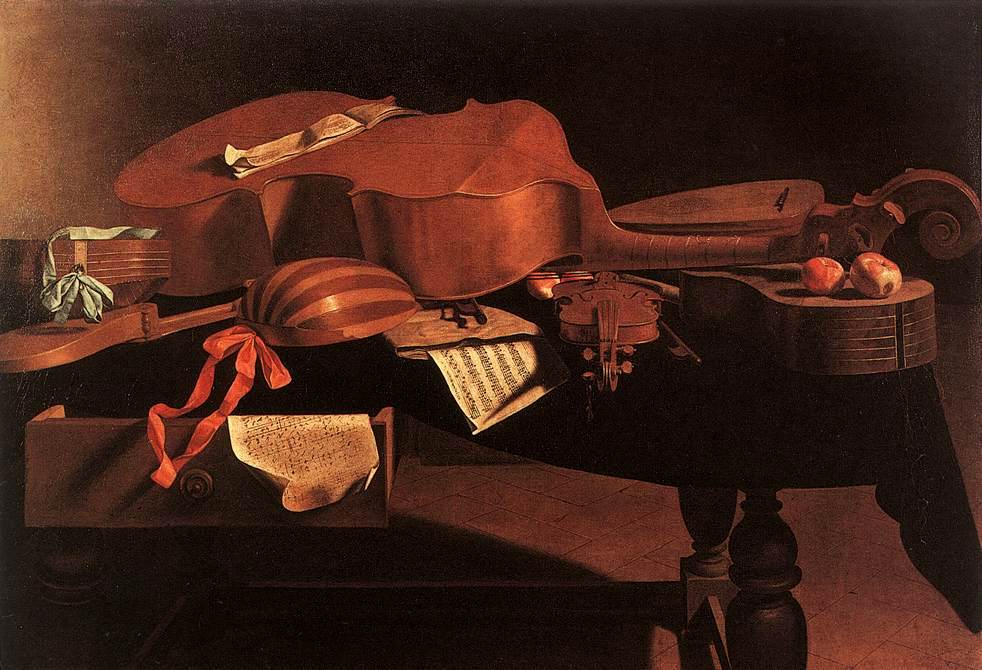
"Musical Instruments," painting by Evaristo Baschenis (1617-1677), via Wikimedia Commons.

The top 10 greatest classical composers — honorable mentions

Now that I've posted my top 10 list of the greatest classical composers, let's look at some people I left off whom others might have included.

Mendelssohn could have easily been in the top 10. His Octet (for the equivalent of two string quartets) is some of the best music I've ever heard by anyone. The achievement would be hard to fathom if he had written it at any age. He was 16 when he wrote it. Here it is played by Janine Jansen on violin and others (click through to YouTube for all the musicians).


Many top 10 lists would also include Schumann. I like his manic Toccata (played here by Do-Hyun Kim).


I noticed a lot of support for Tchaikovsky once the NYT series started. The Nutcracker Suite always puts me in a good mood. Here's the "Waltz of the Flowers" from that suite, which is supposed to be played by orchestra but is redone here by the Los Angeles Guitar Quartet:


Going back in time to the Baroque, there's Handel. Here's the obvious choice (for more Handel, check out his Keyboard Suites, like this one):


Scarlatti's harpsichord sonatas (often played on piano, as in this performance of K. 141 by Martha Argerich) are strikingly individualistic and out of sync with the late Baroque.


How about the 20th century? Bartok would be a leading contender. Here's his audacious String Quartet #4, played by Quatuor Ebène:


I love Shostakovich, who wrote under constant fear of his own Soviet government. Here's his 1st Symphony, which he wrote as a conservatory assignment when he was 19 years old (conducted by Paavo Järvi). This is relatively cheerful for Shostakovich (for something more characteristically bleak, try his 8th String Quartet):


Another Soviet composer is Prokofiev, who wrote some hard-edged, dissonant music, but also popular fare like Peter & the Wolf and Romeo & Juliet. I especially like his piano music, such as the 5th Piano Sonata (played by Boris Berman):


You could include Schoenberg on the list, but would that be mostly a gesture of recognition that he did something new? That's important, but I care more about: "If I could only listen to 10 composers for the rest of my life, who would they be?" I wouldn't put Schoenberg on that list. But if you had to listen to choose just 10 classical compositions to have on a desert island, you might want this haunting early piece, Verklärte Nacht (Transfigured Night) (played here by the NEC Contemporary Ensemble Concert, directed by John Heiss):


There are some giants I still haven't mentioned: Verdi, WagnerMahler. I like opera, but I'm not enough of a fan of it to put Verdi or Wagner in the top 10. I've never found the historical significance of Wagner to be viscerally exciting, as opposed to an academic observation (in contrast with Beethoven or Debussy). And I've never understood the passion for Mahler. I prefer the similar but more introverted and enigmatic Bruckner. Here's part of Bruckner's 9th Symphony (unfinished), conducted by Bernard Haitink:


What about Vivaldi, with his hundreds of masterful Baroque concertos? Here's "Summer" from The Four Seasons, which has no resemblance to summer unless we're talking about a thunderstorm (Mari Silje Samuelsen on violin):


The top 10 format might be skewed against Ravel, since most people would put Debussy ahead of him, and the one impressionist seems like enough for a short list. Here's his Piano Trio (the first two movements), played by Henry Kramer (piano), Arianna Warsaw-Fan Rauch (violin), and Meta Weiss (cello):


Then there's Sibelius. Here's the first movement of his overlooked 6th Symphony, conducted by Esa-Pekka Salonen:


We could keep going like this and end up with a top 50 list of excellent composers. There just isn't room for every worthy composer on a top 10 or 20 list. A top 10 list gets attention because it's restrictive; disappointment is built into the concept.

If you're looking for a fuller guide to classical composers than I could give here, I recommend Jan Swafford's Vintage Guide to Classical Music. He has long essays on the music and lives of the great composers, and shorter blurbs on lesser-but-notable composers. I particularly recommend this over Phil G. Goulding's Classical Music, which ranks "the 50 greatest composers" in order (unlike Swafford's book). Goulding's format is entertaining and eye-catching, but he makes some bizarre choices: he doesn't include Schoenberg or any American composers (no Copland or Ives), yet he includes relatively forgettable composers like Rameau and Donizetti. In contrast, Swafford's choices about which composers to emphasize (including some less obvious choices like Palestrina and Hindemith) and which ones to discuss briefly (Corelli, Scriabin, Poulenc) are close to perfect.

Friday, January 21, 2011

The top 10 greatest classical composers (2, 1)

(The complete list.)

[UPDATE: The New York Times author, Anthony Tommasini, just finished his top 10 list.]

2. Mozart

What's so great about Mozart? Why is it that he's routinely ranked one of the top 2 or 3 composers, and no one would dare leave him off the top 10? Like Bach, he didn't invent a new style; he fit comfortably into an existing one. But has there been any other composer, before or since, whom notes seem to flow out of with such beauty and grace?

Here's Sharon Kam playing the Clarinet Concerto, Mozart's last instrumental composition:


His piano sonatas are not Mozart at his very greatest, but they have an understated wonderfulness. This is Vladimir Horowitz playing the first movement of K. 330:


In the last movement of the "Jupiter" Symphony (#41) (conducted here by Jeffrey Tate), Mozart develops several different melodic themes, ending with a Baroque-inspired outburst of polyphony where all the themes seem to meld together. Sheer genius.


As with everyone on this list, there's so much more to him than I can do justice to here. He was the king of the piano concerto. There are his masses, his chamber music . . . All this would be enough to cement his ranking even if he hadn't been one of the greatest opera composers. He did all that in his cruelly short 35 years of life.


1. Beethoven

Tommasini, the NYT author, says there's a consensus among "thinking musicians" (which surely means "people who agree with me") that Bach was the single greatest composer, but to me Beethoven far surpasses any of the others. He's traditionally classified along with Haydn and Mozart as belonging to the "Classical" (capital C) era, but it's hard to fathom what an advance he was over Haydn, his partial contemporary. (Beethoven started writing in the 1700s, and Haydn was productive until his death at age 77 in 1809.)

Beethoven internalized all the existing concepts in Western music up to the beginning of the 19th century, stretched them almost beyond recognition, and probably gave more inspiration to the next 200 years of classical music than anyone else. Later composers could emulate him (Mendelssohn, Schumann), or stand on his shoulders to progress further (Wagner, Brahms), or react against him (Chopin, Debussy), but no one could ignore him.

His stylistic and emotional range was amazing. He could be wild and visionary, as in the Grosse Fuge . . .


. . . tragic, in the second movement of the 7th Symphony . . .


. . . or joyous and replenishing, in the first movement of the "Pastoral" (6th) Symphony.


I think of the whole history of classical music as a mountain. You start at the bottom of one side, which is medieval chant. You climb up the mountain, go down the other side, and when you reach the ground again, you're at late 20th century minimalism.

Higher up the mountain doesn't necessarily mean "better." It has more to do with how structured the music is. When you go from Baroque up to Classical, the arc of a piece becomes more dramatic. (As the musicologist Donald Francis Tovey said, you can randomly drop into a Classical piece you've never heard and have some clue about whether you're hearing the beginning, middle, or end of the movement; this doesn't work with Baroque.)

In the Romantic era, you start going downhill, with plenty of that old Classical form, but also a looser, more improvisational sensibility.

The 20th century goes steeply downhill, challenging all expectations of structure, harmony, melody, and rhythm.

At the top of the mountain — fusing the best aspects of Baroque, Classical, and Romantic (with a dash of prophetic modernism) in magnificent, awe-inspiring structures — is Beethoven.

Thursday, January 20, 2011

The top 10 greatest classical composers (4, 3 . . .)

(The complete list.)

4. Bach

Bach composed during the late Baroque, so he didn't forge a new style the way Haydn or Debussy or Schoenberg did. And the Baroque style itself is more limited than the music that would follow him. Yet he's so widely called one of the top 3 composers of all time that I feel slightly apologetic at ranking him "only" #4. Evidently, greatness is not just about originality. Bach transcended the limitations of his era and brought an intellectual depth previously unknown to Western music.

I think of him as generally mild-mannered and contemplative, but he was also capable of overwhelmingly intense emotion. Here's "Herr, Unser Herrscher" ("Lord, Our Master") from the St. John Passion, conducted by Jos van Veldhoven:


Bach's Cello Suites allow the cellist to explore melody alone, in a way no other composer has equalled. Here's Hidemi Suzuki playing No. 5 in C minor:


If you wanted to choose one little piece by anyone that perfectly distills the idea of pure, simple music for music's sake, it would be hard to do better than the 1st Prelude of the Well-Tempered Clavier (played here by Lang Lang):


3. Brahms

Schoenberg famously wrote, in an essay called "Brahms the Progressive," that Brahms had been misunderstood as one of the more conservative composers of the Romantic era, and that in fact he foreshadowed the atonalism of the 20th century. Fortunately, we don't need to take a stance on this musicological issue to become immersed in the autumnal world of Brahms, where every note seems to be aching or yearning or striving for something. Brahms, who died in 1897, often sounds to me like he's saying a long farewell to pre-Modern classical music itself.

The first movement of the Piano Trio #1 (Op. 8) has one of the most beautiful melodies I've ever heard (played here by Alexi Kenney, Oliver Herbert, Roman Rabinovich):


Here's the first movement of A German Requiem, where the non-religious Brahms put his individual spin on a traditionally Christian genre. Here's the whole thing, conducted by Jeffrey Thomas. The first 2 movements are spell-binding.


Here's Brahms's 4th Symphony (his last), conducted by Klaus Mäkelä. Does music get any better than the first movement of this symphony?

Wednesday, January 19, 2011

The top 10 greatest classical composers (6, 5 . . .)

(The complete list.)

6. Haydn

Haydn is known as "the father of the symphony." He might not have actually invented the symphony, but he made it great. The same is true of the string quartet.

Most 19th century composers paid little attention to Haydn, but it's hard to imagine Mozart or Beethoven without him.

He claimed he wasn't a very happy person, but who else has ever produced so many compositions (over 1,000) that sound so much like sunshine? Here's the first movement of his 104th Symphony, conducted by Achim Holub:


His comical approach of toying with your expectations was especially strong in his finales; for instance, here's the last movement of the 96th Symphony, with Jan Caeyers conducting Le Concert Olympique:


5. Debussy

You could easily pigeonhole him as a composer of pleasantly "impressionistic" music on the borderline of Romantic and Modern. I prefer to think of him as the most revolutionary composer of the 20th century. If you had to pick just one composition that gave the Modern era permission to disregard everything that came before, you might pick Debussy's Prelude to the Afternoon of a Faun (Prélude à L'Après-Midi d'un Faune). It flows along gently instead of hammering you over the head the way other revolutionary pieces (like the "Eroica" Symphony or the Rite of Spring) do. Here's François-Xavier Roth conducting the London Symphony Orchestra:


A more overtly Modern work is the 12 Etudes. Here's #9, For Repeated Notes (Pour les Notes Repétées), played by Christina McMaster:

Tuesday, January 18, 2011

The top 10 greatest classical composers (8, 7 . . .)

(The complete list.)

8. Chopin

The quintessential lone pianist exploring his soul through the instrument. The most intimate and introverted of the greats.

Some of the most characteristically Chopinesque pieces are his 58 Mazurkas. (A mazurka is a traditional Polish folk dance that might have been fairly obscure if not for Chopin.) Here are 7 of them, played by Evgeny Kissin (for a list of the specific pieces, click through to YouTube):


Here are Chopin's 24 Preludes, played by Yuja Wang:


7. Schubert

Impossible to neatly label or summarize. Is he Classical or Romantic or what? Who cares? His body of work is fascinatingly varied and staggeringly huge, yet he died at only 31 — a terrible loss to music.

He's known for his over 600 songs (in the traditional sense of "short pieces that are sung"). But I'm more interested in classical music without vocals, so here are a few of my favorites:

Schubert's 5th Symphony is like the best Mozart symphony Mozart never wrote. He was only 19 when he wrote this (conducted by Andrés Orozco-Estrada):


His String Quintet (for the unusual lineup of string quartet plus an extra cello, instead of an extra viola) is at the highest level of any chamber music by anyone. It was his last instrumental composition, written just two months before he died. This performance by the Afiara Quartet plus Joel Krosnick starts at 8:20, after Krosnick's introduction:


I had lent a few CDs to a friend who was getting into classical music, and he brought up the last movement of the "Trout" Quintet (which also has an unusual lineup: piano, violin, viola, cello, and double-bass). I've talked before about how it's the rare piece of music that gives me a strong feeling of: "Aha, this is it!" My friend essentially told me he felt that way about the "Trout" finale. So do I, and here it is (played by Julian Rachlin, Mischa Maisky, Mihaela Ursuleasa, Nobuko Imai, and Stacey Watton):


The "Unfinished" Symphony has a profound sense of completeness:

Monday, January 17, 2011

Who are the top 10 greatest classical composers? (10, 9 . . .)

That question has prompted over a thousand readers of the New York Times to give their opinions (here and here and here and here). [Update: Commenters on my mom's blog are also opining.] The Times writer Anthony Tommasini still hasn't given his list yet; he's running a series of pieces where he agonizes over who should be in the top 10 (also at those links).

I'm going to follow Tommasini's rules:

I am focusing on Western classical music. . . . [G]iants like George Gershwin, Duke Ellington and Stephen Sondheim are outside my purview here. And on the assumption that we are too close to living composers to assess their place and their impact, I am eliminating them from consideration.

Finally, I am focusing on the eras since the late Baroque. You could make a good case for Josquin or Monteverdi, but I won’t. The traditions and styles were so different back then as to have been almost another art form.
Now, here's my list. I'll add 2 a day from now to Friday.

[UPDATE: Here's the complete list.]

10. Dvorak

A Czech composer who did better than any American at capturing the essence of our country. Here's the first movement of his famous "American" String Quartet (#12):


His Cello Concerto is the best composition of its kind, and one of the most emotional, invigorating orchestral works I've ever heard. Here it is played by Yo Yo Ma:


9. Stravinsky

Debussy started the ignition of the 20th century, but Stravinsky drove down more of its roads. He would layer one key on top of another, or one rhythm on top of another; this shouldn't work in theory, but he made it work.

To sample a few of his many styles, listen to the playful, childlike Petrushka (conducted by Andrés Orozco-Estrada) . . .


. . . then the ferocious and radical Rite of Spring (Le Sacre du Printemps), conducted by Simon Rattle . . .


. . . then the majestically neoclassical Symphony in C (first movement, conducted by Georg Solti).

Tuesday, January 11, 2011

Sunday, January 9, 2011

2 descriptions of what a good date conversation should be like

1. "The mixing of clever women and clever men brought sex and intellect into a different relationship. Men and women learned to value one another for their character, rather than their appearance, profiting from their differences to try to understand themselves and each other. Their meetings gave birth to epigrams, portraits, eulogies, music, games, which were discussed with extraordinary thoroughness but without spite, for the rule was that the participants had to be agreeable." — Theodore Zeldin (An Intimate History of Humanity)

2. ‎"Talking with her, it was like talking with you, but, you know, obviously much better." — Jerry Seinfeld to George Costanza (pilot episode of Seinfeld)

Friday, January 7, 2011

"It's a chemical world."

"Learn to live with it."

A friend of mine posts that link to Facebook and asks:

Can we ditch "all-natural" while we're at it?

Thursday, December 30, 2010

Metablog

I hate those blog posts that say sorry the blogging has been sparse lately . . . but sorry the blogging has been sparse lately.

Two weeks ago, I accepted a job offer in New York City. Since then, I've gotten an apartment in the East Village and packed up my stuff in Albany. I'm very excited about the new job and the new neighborhood. I spent over a year looking for this, but in the end, I really couldn't have hoped for things to have turned out better for me.

I start the job today, and I'll be going back to Albany tonight in order to move my stuff downstate. On New Year's Day, I'll finally be living again in the city where I was born, and where I belong.

There was also a nice Christmas vacation in the middle of all that. So, things have been pretty hectic, and I haven't been focusing on the blog.

I might not be blogging much in the next week or two either, since I'll still be getting settled in. But I'll be back.

Monday, December 27, 2010

Sitting around listening to Christmas presents

We're playing the remastered version of the Beatles' Revolver. My stepdad reacts to George Harrison in "Love You To": "He sounds so enthusiastic: 'I'll make love to you, if you want me to . . . Or, if not, I'll just play my sitar . . . '"

Friday, December 24, 2010

What would you do if you got hundreds of letters to Santa at your address?

The New York Times might as well be begging bloggers to embed this saccharine mini-documentary today, and I'm happy to oblige:


"I think if you're going to do one, you should do 'em all. Or, none at all. I don't know, is that weird? . . ."

"That to me is like saying, 'Oh, well, I can't fix all the world's problems, so I'm not going to fix any of them.'"

Tuesday, December 21, 2010

The secret to a (subjectively) long life

Be constantly bored. The time (and thus, your life) will seem to pass more slowly.

IN THE COMMENTS: My mom suggests an even better way: "chronic excruciating pain."

Tuesday, December 14, 2010

Our Facebook world

1. A map of the world made up entirely of glowing lines that symbolize Facebook friend connections. (More explanation here.)

2. A sign of the times: one friend writes to another on Facebook:

What did you change your profile picture to raise awareness for?

Monday, December 13, 2010

Sunday, December 12, 2010

Corporate environmentalism

So, I have a CVS card. (For non-US readers, CVS is a pharmacy/store.) CVS wants to give me $1 every 4 times I shop there using my own bags, since this saves plastic bags. But they won't record these transactions on my normal CVS card. They'll only give me the discount if I buy a new card that looks like a green leaf. So I can show how much I care about the environment with my superfluous piece of plastic.

In fact, I just checked that webpage to see if they mention the material of the leaf card. They say it's "made with corn-based material — an annually renewable resource." So they're trying to cue us to feel like using too much corn isn't an environmental problem because it's "annually renewable" — never mind how much energy is required to produce the corn. (Michael Pollan says that corn "is the SUV of plants. Growing it the way we do requires it to guzzle fuel in the form of fertilizer, about a quarter to a third of a gallon of petroleum for each bushel.")

This is what happens when corporations try to "go green." Corporations aren't content simply to help the environment out of the goodness of their hearts; they need to come up with a way to signal how green they are. Then, they have an ulterior motive to prioritize that signal, while downplaying any environmental costs.

Friday, December 10, 2010

Music Friday: My favorite Christmas song

"Sleigh Ride" seems to be most popular in versions with sumptuous female vocals — here's KT Tunstall:


Inevitably, there's a jazz version by Harry Connick, Jr., overflowing with panache. He leaves in a whole section that Tunstall leaves out ("There's a birthday party at the home of Farmer Gray . . .").


(Is that Dwight Schrute standing up in the back at 2:15?)

Bela Fleck and the Flecktones give it their virtuosic bluegrass-jazz treatment:


(Did you catch the bassist Victor Wooten's wink at an even more famous Christmas song near the end?)

The original version brings out the brilliance and harmonic adventurousness of the piece (performed here by the Boston Pops):


That version was composed by Leroy Anderson (a master of orchestral candy) in 1946. Mitchell Parish added the lyrics a few years later. Though the title and orchestration make it clear that Anderson did envision a horse-driven sleigh, Wikipedia tells us that he "had the original idea for the piece during a heat wave in July."

Thursday, December 9, 2010

"A democratic society needs Republican scientists."

So says this Slate article, which complains that only 6% of American scientists are Republicans. (55% are Democrats.)

The author, Daniel Sarewitz, argues:

For 20 years, evidence about global warming has been directly and explicitly linked to a set of policy responses demanding international governance regimes, large-scale social engineering, and the redistribution of wealth. These are the sort of things that most Democrats welcome, and most Republicans hate. No wonder the Republicans are suspicious of the science.

Think about it: The results of climate science, delivered by scientists who are overwhelmingly Democratic, are used over a period of decades to advance a political agenda that happens to align precisely with the ideological preferences of Democrats. Coincidence—or causation? . . .

How would a more politically diverse scientific community improve this situation? First, it could foster greater confidence among Republican politicians about the legitimacy of mainstream science. Second, it would cultivate more informed, creative, and challenging debates about the policy implications of scientific knowledge. This could help keep difficult problems like climate change from getting prematurely straitjacketed by ideology.
Sarewitz concludes that the United States "needs Republican scientists," but by his own account, we already have them: 6% of scientists. That's a lot of people. Why doesn't Sarewitz make any attempt to look at some of these scientists' work and explain how they've made a distinctive contribution that non-Republican (Democratic, independent, or apolitical) scientists wouldn't have made?

Does the New York Times really expect us to believe . . .

. . . that Sarah Wendell is embarrassed to be seen in public reading romance novels, when she clearly agreed to pose for that photo in the New York Times?

It reminds me of scenes on The Real World where two characters would have a "private" conversation about something they were desperate to keep a secret from their other housemates. If they had actually wanted to keep anything private, they wouldn't have agreed to have their lives broadcast on MTV.

Wednesday, December 8, 2010

Professor Robert Summers of Cornell Law School

Professor Robert Summers taught his last class on December 1, marking the end of 42 years of teaching at Cornell Law School. Before that, he taught at the University of Oregon Law School.

Here are some of his many accomplishments, from the article at the link:

Summers is perhaps best known as co-author of the Uniform Commercial Code (West Publishing Co.), written with James J. White in 1972 and now in its sixth edition. The four-volume treatise on the rules that coordinate the sale of goods and other commercial transactions throughout the 50 states is the most widely cited on the Code, which has been adopted by all 50 state legislatures. . . .

In 1993 the Russian government called on Summers to help draft that country's new civil code. He later served as adviser to the Drafting Commission for the Egyptian Civil Code (1998-99) and as principal drafter for the Code of Contract Law for Rwanda (2006-10). . . .

In the 1960s he began advocating for more minority students in law schools, holding summer sessions around the country . . . to recruit and prepare minority undergraduates.

"That was one of the largest, most satisfying public service activities I have ever been privileged to engage in in my life," Summers said. "It was extremely inspiring."
Wikipedia says:
He is well known among Cornell Law School students for his inquisitive, spirited use of the Socratic method in instruction.
That's putting it mildly. That sentence would describe many Cornell law professors, but Summers took the Socratic method to the extreme. He rarely made any direct statement about anything, almost always preferring to ask questions instead.

He mockingly voiced the way he thought students would react:
Isn’t it a pity that you need to analyze cases? You can’t just go around with your mouth open waiting for a spoon that will feed it to you in one big, luscious bite! Students should sue. The teachers should just give you the law.
A student piped up:
We're working on a class action.
The article quotes Summers giving a more straightforward rationale for his teaching method:
"It teaches the students analytical focus, verbal adroitness and articulateness, and it keeps them on their toes," he said. "You've got to hold their feet to the fire."
He had an inimitable style of speaking: self-consciously erudite and even antiquated, often quite stern, but also wryly comical.

Over the summer before our first year, the law school had all of us incoming students read Franz Kafka's novel The Trial so we could discuss it at orientation. Per Wikipedia, "it tells the story of a man arrested and prosecuted by a remote, inaccessible authority, with the nature of his crime never revealed either to him or the reader." In the middle of contracts class, Summers would suddenly attack Kafka:
In very few walks of life can you see the power of human reason when it's at its best — as it is in well-reasoned judicial opinions. In other words, this is not a course that Kafka would recognize. Kafka couldn't possibly see that there was any rationality to the law.
He added sarcastically:
So it's a wonderful thing for the law school to select such an inspiring book for law students to read.
Summers would urge us to write down everything that was said in class. I know that many people look down on this technique (calling it the work of a "stenographer"), but I found the advice useful. On one occasion he started to scold us for not taking notes, but then he seemed to have a flash of sympathy for us:
I see a lot of you just relaxing and not taking notes. These hypos are important. Of course, relaxation is important too!
He ruthlessly mocked judges who wrote opinions he considered irrational. After reading one such opinion, he said:
We would want to be very wary of any majority decisions written by Lindberg, J., if they purport to be contracts case. It might not be a problem if it’s a tort case, because torts is really simple. It’s just: one person bumps into another person!
(Yes, he referred to the judge as "Lindberg, J." This is the standard legal notation, meaning "Judge Lindberg." Summers is the only person I've heard pronounce the "J." as written.)

Summers was a scholar of jurisprudence and felt strongly about the subject, so he would go off on delightful philosophical tangents while we were in the middle of analyzing a contracts case. Here's one I tried to type out close to verbatim in my notes:
Is certainty important from the point of view of justice, legal predictability, treating like cases alike? Do the materials that law students are now studying have a tendency to dull your sensitivity to the value of certainty? Indeed, does Friedman [the author of a passage in our casebook] give law professors a pretty hard time here?
A student responded, reading from the casebook:
“In a complex social and economic system, a legal system on the model of appellate cases selected for law school instruction would be insupportable.”
That line was particularly ironic because not only were we in law school, but Summers edited the casebook and presumably chose to include that passage.

He elaborated on the point:
You have a steady diet of borderline cases. Is this bending up your mind? Is this having the effect of dulling your sensitivity to the 7 major values of certainty in law? If you’re getting accustomed to life on the borderlines — that's what you're in, life on the borderlines — could that have a prejudicial effect on the general standards that you have with regard to what the law is like? And you just take for granted that the law will be open-ended, spongey, discretion-ridden? Some of you do think there’s value to predictability, determinativeness. There are probably not just 3 ways in which it’s valuable, but probably about 15.
(Summers often referred to imaginary numbered lists.)

He went on:
Does certainty facilitate citizen self-direction vs. being ordered around ad hoc by judges and other officials? Does determinativeness limit judicial power, and thus reduce the scope of judicial arbitrariness? Does determinativeness contribute to dispute avoidance? That would be a bad thing, because it would reduce the number of jobs you can get, and that would reduce the number of law professors. What I’m doing is sowing the seeds of self-destruction. So maybe I better shut up.
On another day in class, we read a passage by a former Cornell law professor named Ian MacNeil. Summers said:
MacNeil was a whale of a law professor! Never uttered a declarative sentence! Never uttered a declarative sentence! Not in 35 years! Best law professor we've ever had! Now he's retired. What a mistake that was. What a mistake that was.

Monday, December 6, 2010

Are juries more sympathetic to male or female criminal defendants/victims?

Psychologists at Penn State surveyed 458 people about how they'd vote if they were on a jury in a hypothetical case where a defendant was accused of killing his/her lover "in the heat of passion" after being thrown out of their house and discovering that the lover was cheating. The researchers described the case with 4 different possible gender configurations: male defendant/female victim, female defendant/male victim, both male, and both female. Miller-McCune reports:

Test participants were given “jury instructions” stating the defendant was charged with second-degree murder. They were given the option of convicting the defendant on that charge, going with a less-serious charge of voluntary or involuntary manslaughter, or finding the defendant not guilty by reason of insanity.

To parse out levels of ambivalence, the researchers asked participants to rank, on a 1-to-7 scale, the extent to which they find the defendant guilty. They were also asked to choose an appropriate sentence length, from no prison time to 15 or more years behind bars. . . .

Heterosexual female defendants were given significantly shorter sentence lengths than either heterosexual male defendants or homosexual defendants. They also scored lower than any other group on the question “To what extent do you find the defendant guilty?” And they scored the highest in terms of satisfying specific legal elements that would justify a voluntary manslaughter verdict, such as great provocation and mitigating circumstances.

“The findings from this study suggest heterosexual female defendants are more likely to benefit from using the provocation doctrine in a crime-of-passion case,” the researchers conclude. While straight women appear to be “just as likely to be convicted as all other defendants,” their punishment — at least to the extent it is determined by the jury — is apt to be less severe.

These findings seem to corroborate the conclusions of University of New Hampshire sociologist Murray Straus, who has argued domestic violence is often looked at as less serious if it is perpetrated by a woman. Specifically, Ragatz and Russell found that “violence perpetrated by heterosexual female defendants toward their unfaithful partner was perceived as more acceptable than violence perpetrated by male or homosexual defendants.”

The study can also be interpreted to support . . . the notion that defendants receive harsher sentences when the victim of a crime is female. The researchers noted that “both heterosexual male and homosexual female defendants were found more culpable if the victim was female. Whether the female victim was heterosexual or homosexual did not appear to impact decisions.”

Either way, the results suggest gender-related beliefs play a major role in jurors’ decision-making processes.
Why is there so much less interest in the criminal justice system's possible gender bias than in its possible racial bias?

Wednesday, December 1, 2010

Wikileaks reveals the left's incoherence on U.S. foreign policy, secrecy, and diplomacy.

Good points:

By and large, the hard left in America and around the world would prefer to see the peaceful resolution of disputes rather than the use of military force. World peace, however, is a lot harder to achieve if the U.S. State Department is cut off at the knees. And that is exactly what this mass revelation of documents is going to do. The essential tool of State Department diplomacy is trust between American officials and their foreign counterparts. . . . Destroying confidentiality means destroying diplomacy. . . .

[T]hose on the hard left are usually the loudest critics of America imposing its own values, its own way of doing business, and its own culture on other countries. For better or worse, in many parts of the world there’s a big difference between what government officials are prepared to do publicly and what they’re prepared to say and do privately. We may wish it otherwise, but those are the realities faced by U.S. officials. The hard left, so quick to demand that America accept other countries’ political systems, now seems blind to the fact that other governments want to have the right to say one thing in public and a different thing in private. By respecting that difference, American diplomats are doing their job.
That whole TNR article is worth reading.

Short URL for this post: goo.gl/ToI41

Penelope Trunk's manifesto against "happiness" and "positive psychology"

"I want to help people find conflict and self-doubt."