Monday, December 8, 2014

Pantera's "Dimebag" Darrell died 10 years ago.

On December 8, a great musical artist’s life tragically ended when he was not yet 40 years old, shot by a murderer who’s euphemistically referred to as "a crazed fan." A great guitarist and composer, who must have had plenty more great music to give to the world, although his legendary band for which he'll be best remembered had already broken up. I feel honored to have gotten the chance to see him live in concert. The world lost one of the greatest metal guitarists 10 years ago today.

“Dimebag” Darrell, born Darrell Lance Abbott, died at the cruel age of 38 on December 8, 2004. As the guitarist of Pantera, he pushed the envelope of ultra-heavy rock music, inspired countless guitarists, and was acclaimed by many as the greatest metal guitarist of all time.

Some of Pantera's standouts:

"Hollow" starts out disarmingly gentle for a Pantera song, with some beautiful melodies by Darrell, then descends into a more straightforward metal song halfway through. One line is chilling today:

No one knows what's done is done — it’s as if he were dead . . .


"I'm Broken," which is probably Pantera’s most famous song, was essentially made by Darrell even if he didn't write the lyrics. Both his riffs and his solo in this song are unforgettable. Some of the stretched-out notes of the guitar solo seem to have a playful sense of humor — uncharacteristically for metal.


(And here's what it sounds like for Pantera to be played as chamber music.)

"Mouth for War" — You probably won’t like this. In fact, please don’t click on this unless you like music that’s aggressively heavy. If you do listen, notice how brilliantly the band starts the song with the pre-chorus riff (instead of a more common choice like the verse or chorus), which lends a special, climactic feeling to the actual pre-chorus ("bones, in traction . . .").

"This Love" melds the quiet and heavy sides of Pantera. Darrell plays a soaring guitar solo with some unexpected key changes.

"Walk" is a good example of why Pantera is called "groove metal" (as opposed to the "thrash metal" of Metallica and Megadeth, for instance). Here's a bluesy cover that's faithful to the spirit of the original while being radically different. A commenter at SongMeanings describes how meaningful the song has been to her:

This is the song that gave me back my confidence and self belief. For the years I was at high school I suffered at the hands of bullies who ripped my confidence to shreds and left me in tatters. They basically chewed me up and spat me back out. This song is about attitude and self belief. I got into the metal scene and found an outlet and music I loved. Far from being the victim, I became the victor, this song was my anthem.
Shedding Skin” — I'm surprised this isn’t better known. To me, it’s one of Pantera’s best. But please don’t click that link unless you’re OK with some pretty crude lyrics and brutal music. Starts with a compelling riff, then switches to an eerily soft verse, which flows seamlessly into the heavy chorus. Tempo changes keep things interesting later on: the part where it slows down, in the section right before the guitar solo, is transcendent. The guitar solos (plural) are amazing as usual.

Cemetery Gates” is an earlier song from Pantera — a classic showcase for Phil Anselmo’s singing and Darrell’s guitar virtuosity. This came out in 1990, and you can tell that it's rooted in the '80s in a way their later work wasn't.

"Planet Caravan" is a haunting cover of Black Sabbath. Pantera was so concerned that this un-heavy song would alienate the fans that the liner notes included a message justifying the decision to include it on the Far Beyond Driven album. It gives us a rare chance to hear Darrell soloing with a clean tone.

Sunday, December 7, 2014

The longest word in the English language

A word so long you grow a beard saying it — and (spoiler alert) a plant dies.


Saturday, December 6, 2014

The "old" drive out the young at TNR

"I can no longer in good conscience even imagine my work appearing in the magazine. Your assault on the magazine has nothing whatsoever to do with print versus digital or with age versus youth. Chronologically, you are young — and some of us who are now leaving the magazine are older. But to me you seem old — old in the conventionality of your fast-forward thinking that goes nowhere. What you have done to The New Republic has broken the hearts of many people in their twenties and thirties — people who would like to take part in the great intellectual conversation that The New Republic has been for a hundred years and is no more."

— Jed Perl, resigning as TNR's art critic

Why the end of The New Republic matters

David Greenberg, a former TNR editor, writes in Slate:

The bloodletting this week at the New Republic—the journal of opinion regarded for a century as the flagship of American liberalism—has been rightly taken to herald the end of a great magazine. With the news that its two top editors, Frank Foer and Leon Wieseltier, resigned, that much of the staff subsequently quit, and that the magazine will halve its yearly output and move its headquarters from Washington to New York, the political and intellectual worlds are thrumming with outrage toward the short-sightedness of the magazine’s new leadership and elegies for an august institution. . . .

But one reason for the New Republic’s demise has not been fully appreciated, and that has to do with its unique tradition of heterodox liberalism. The New Republic is being seen as a casualty of the crisis of print journalism that has felled many other newspapers and magazines during the past decade—the drying up of advertising revenue amid free and cheap online commentary. The problem with this line of argument is that “little magazines” have always lost money, relying instead on the largesse of rich owners, whose combination of public-spiritedness and vanity has led them to sponsor high-quality journalism. The New Republic was hurt by something more specific: the polarization of a media environment that leaves little room for a strain of liberal thought that not only attacks the right and the far left but also prods and questions liberalism itself.

Founded in 1914 by some of the leading minds of the Progressive Era—Herbert Croly, Walter Lippmann, and Walter Weyl—the New Republic from the beginning sought to challenge conventional thinking, including among its own readership. These editors recognized that while liberalism (like all political creeds) needs foundational principles, one of those principles specific to liberalism is openness to debate, experiment, and reconsideration. Dogmatism, even more than conservatism, was its bête noire.

Over the years the magazine sometimes wavered in that mission. During the editorial tenure of former Vice President Henry Wallace in the 1940s, it descended into high-minded cliché, and for spells in the postwar years, it lapsed into sleepy predictability. But with its purchase by Harvard professor Martin Peretz in the mid-1970s, the New Republic regained its stature as the most provocative magazine on the left. Peretz hired a bevy of brilliant young minds. Three in particular became the three finest editors of their generation: Michael Kinsley, Hendrik Hertzberg, and Wieseltier. The twentysomethings who cut their teeth at the magazine in these decades include some of the most accomplished nonfiction writers working today. . . .

Under Peretz and his editors, the magazine led the way in questioning left-wing shibboleths on issues such as crime and fiscal policy and especially foreign policy, where it championed a revival of the liberal internationalism that had guided the Democratic Party from Woodrow Wilson through John F. Kennedy, until the disaster of Vietnam. The election in 1992 of Bill Clinton, whose candidacy the magazine supported early on, marked a triumph of this reconstructed liberalism.

Some old-time subscribers and confirmed partisans disliked the magazine for its willingness to publish conservative voices—Fred Barnes was its ace White House correspondent for years while staff writer Charles Krauthammer migrated during his time at the magazine from Walter Mondale speechwriter to neoconservative paragon. Critics assailed its perceived hawkishness and its unapologetic Zionism, which had long been anathema to the hard left and was now becoming distasteful to certain high-minded progressives as well.

But to other readers, the sense of freewheeling debate—as opposed to bien-pensant wisdom or party-line doctrine—gave the magazine its exciting appeal. As a college student in the late 1980s, I found its pages more stimulating than those of rival publications, which tended to toe what was already being called the “politically correct” line. I never agreed with all of the magazine’s positions—its support of the Nicaraguan contras, its opposition to affirmative action—but its pieces made me think in ways that few newspaper columnists or television pundits did. . . .

The New Republic’s heterodox liberalism—the willingness (indeed the eagerness!) to test liberal thinking from within the liberal family—is now being squeezed. Internet journalism has made it easy to find opinions that confirm one’s own beliefs and flatter one’s prejudices. Facebook places soothing assurances before our eyeballs. The left and the right are retreating into cocoons of information and opinion, on cable TV and social media.

Accordingly, the New Republic’s fortunes flagged amid the polarization of the Bush years, when its full-throated support for the Iraq war was too much for even many liberal internationalists to bear and when, post-Clinton, liberalism now seemed to need a course correction toward the left, not the center. Though Foer dynamically reinvigorated the magazine, it never regained the wider circulation it once enjoyed.

Wiser ownership could have recognized that although little magazines must adapt to the digital age with strategies for reaching social media users and mobile phone readers, they will never be cash cows. They succeed through influence, not volume. When I worked there in the early 1990s, it was often said that while the magazine had only 100,000 subscribers, it was “the right 100,000” . . . .

The impending transformation of the New Republic from a liberal magazine into a “vertically integrated digital media company” is regrettable for many reasons, not all of them sentimental. Conservatives need a liberal magazine that’s unpredictable enough to make them want to read it. Liberals and leftists need a magazine that will prod them to question their beliefs, and revise or strengthen them. All of us need robust intellectual debate of a high caliber that treats politics and ideas with the seriousness that they deserve.

Thursday, December 4, 2014

Is The New Republic breaking up with itself on its 100th anniversary?

It sure looks like it.

TNR used to be my favorite magazine. I've been reading it since I was in high school. It played a significant role in teaching me how to write and how to think.

It used to be known as a liberal magazine that would question orthodox liberalism and conventional wisdom. TNR's outgoing editor, Franklin Foer, even wrote an article in 2001 challenging the conventional wisdom that conventional wisdom is often wrong!

But lately it's become predictably liberal — I can't think of the last thing I've read in TNR that differs from "what you'd expect a generic liberal to say."

The magazine seems to have been taken over by people who are more interested in transforming it into a "digital media company" than in taking over the helm of an august journalistic institution. It's going to move from DC to NYC and switch from 20 to 10 issues a year — not even a monthly. Its top two editors (Foer and Leon Wieseltier) just quit. The new CEO has warned of a "staff restructuring"; some are predicting "mass resignations"; and two of its former writers whose names are still on the masthead (Ryan Lizza and Jon Chait) have asked for their names to be taken off the masthead "immediately."

Chait has written a "Eulogy for The New Republic," and the consensus seems to be that "eulogy" is the appropriate term. This is a sad day for opinion journalism.

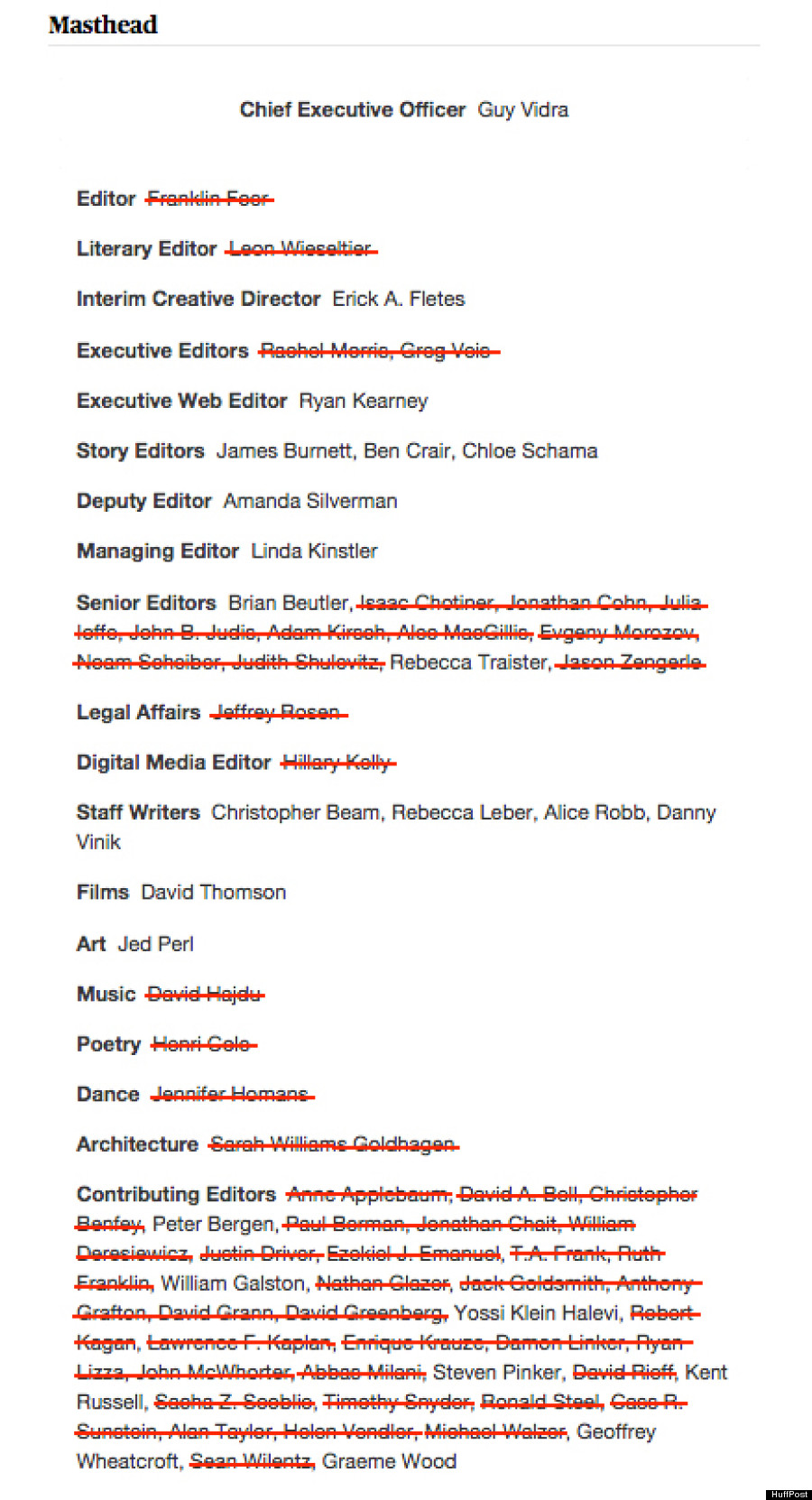
UPDATE: The "mass resignations" prediction was correct — look at TNR's masthead now! (Source.)

UPDATE:

On Friday morning, 28 senior staff and contributing editors resigned from The New Republic en masse. A letter of resignation to Chris Hughes was signed by ten contributing editors, including Lizza, poet and literary critic Helen Vendler and Princeton history professor Sean Wilentz:

“Dear Mr. Hughes,

 We are contributing editors of the New Republic, and our commitment to 
the venerable principles of the magazine requires us now to resign. 
Please remove our names from the masthead. 


"
Yours truly, 

Paul Berman, 
Jonathan Chait, 
William Deresiewicz, 
Ruth Franklin, 
Anthony Grafton, 
Enrique Krauze, 
Ryan Lizza, 
Sacha Z. Scoblic, 
Helen Vendler, 
Sean Wilentz.”

For Foer, Wieseltier and others at the magazine, the brutal shakeup by [Guy] Vidra, 40, who was hired in September, and his 30-year-old patron, [Chris] Hughes--who purchased TNR two-and-a-half years ago for an undisclosed sum from a consortium that included longtime owner Martin Peretz--didn’t come as a surprise. Tensions have been building since the summer. According to multiple sources, Hughes came to think of his writers and editors as “spoiled brats,” and especially disliked the flamboyant, feud-prone, white-maned Wieseltier, who was more than twice his age. Much of Hughes’s distaste was telegraphed in his body language; he strikes many TNR staffers as passive-aggressive and averse to confrontation.

The friction escalated with the arrival of Vidra, who is said to have complained to Foer that the magazine was boring and that he couldn’t bring himself to read past the first 500 words of an article. According to witnesses, Vidra did little to hide his disrespect for TNR’s tradition of long-form storytelling and rigorous, if occasionally dense, intellectual and political analysis--to say nothing of his lack of interest in the magazine’s distinguished history--at an all-hands meeting in early October.

Presiding at the head of a long conference table, Vidra didn’t acknowledge Foer, who was seated beside him; he didn’t look at him; he didn’t mention him. Instead, as he started to speak, Vidra confided that he liked to stand up and move around the room as he communicated his thoughts, as though he were Steve Jobs unveiling the latest technological marvel. Oddly, he stood up, but he didn’t move.

Vidra spoke in what one witness described as “Silicon Valley jargon,” and, using a tech cliché, declared: “We’re going to break shit”--a vow hardly calculated to ingratiate himself with TNR’s veteran belle-lettrists, who feared that he was threatening the magazine’s destruction. Only a few interns dared to ask questions, which Vidra repeatedly dodged. “The senior people were too shocked to speak,” said a witness. “Jaws were dropping to the floor.” Through it all, Chris Hughes nodded approvingly, an unnerving grin on his face.

To be sure, that meeting was a warning sign. But the manner in which the two technology mavens administered their coup de grâce only two months later has left a bitter taste.

According to informed sources, Hughes and Vidra didn’t bother to inform Foer that he was out of a job. Instead, the editor was placed in the humiliating position of having to phone Hughes to get confirmation after Gawker.com posted an item at 2:35 p.m. reporting the rumor that Bloomberg Media editor Gabriel Snyder, himself a onetime Gawker editor, had been hired as Foer’s replacement. Yes, it’s true, Hughes sheepishly admitted, notwithstanding that he and Vidra had given Foer repeated assurances that his job was safe. . . .

“It was cowardly, the way Chris and Guy went about this,” Ioffe said. “Media reporters have been calling for months, asking, ‘Is Frank fired?,’ and they’ve been lying to everybody, including Frank.”

It is far from clear whether the remaining, relatively inexperienced staff will be able to get out the next issue, which is scheduled to close on Wednesday. Two multi-thousand-word pieces slated for publication--a profile of Jeb Bush by Alec MacGillis and a report on Vladmir Putin’s political arch enemy, Mikhail Khodorkovsky, by Russian expert Ioffe--were still being edited when the ax fell. And even if the newbies manage to produce the issue, it will be accomplished in an atmosphere of outrage, recrimination and sorrow over the apparent death--some would say murder--of an American institution that was, for decades, a bulwark of liberal thought, cultural criticism and groundbreaking journalism.

“The New Republic was always a small political magazine that was trying to change the world,” said senior editor John Judis, who was trying to figure out late Thursday night if he could continue to work for the magazine. “My impression of what happened is Hughes and Vidra have decided to transform the magazine into a profit-making media center that is entirely different from what the magazine historically has been and what it has represented and entirely different from what The New Republic has been at its core--and this has led to this cataclysm where Frank and Leon have both left. I liked the old New Republic. I thought it had a really important role to play in America and I’m sorry if it’s no longer going to play that role.”
UPDATE: TNR's Facebook page is flooded with negative comments from readers. Just look at the comments on any recent article. Example:
A once storied institution with unsurpassed journalistic prestige & my source for thoughtful engaging content. An unfortunate end to The "old" New Republic. I will be unliking your page . . .
So much for adapting to the digital age.

UPDATE: If there was any doubt about whether TNR as we know it has gone, the fact that Noam Scheiber and Jonathan Cohn just quit today (December 5) has put an end to any suspense. Scheiber says:
So I just resigned from @tnr. People do muuuuch harder things every day. But boy was it brutal. A great ride for 14 years.
Cohn says:
Feel so lucky that I got to work at Herbert Croly's and Walter Lippmann's magazine for 17 years. Thanks to readers and my great colleagues.
UPDATE: Julia Ioffe quit but still attended the staff meeting — and she tweeted it:
Chris Hughes at staff mtg: "This is a setback. These are great journalists that we lost this morning. But we are incredibly well positioned."

Chris Hughes at the meeting: "This institution has been around for 100 fucking years." no fucking kidding

Guy Vidra treats the remaining staff to more deep thoughts at mtg: "This is hard. But we will get through it and we will be better for it."

Chris Hughes telling the staff that he is different from other FB founders bc he cares about institutions, that he's always sent that signal

Thing is, neither Chris Hughes nor Guy Vidra bothered to communicate anything to the editorial staff. Nothing. It's been silence for months.

Chris Hughes, some advice for you: instead of "sending signals" to your staff, talk to them. Honestly.
UPDATE: The New York Times reports:
Some staff members have asked that their work be pulled from the coming issue of the magazine, which will have to be completed without an editor, and a greatly diminished staff.

Mr. Foer was replaced by Gabriel Snyder, the former editor of The Atlantic Wire, who will start on Dec. 22.
The next issue is supposed to come out on Wednesday, but TNR won't have an editor-in-chief from now through then!

It looks like Hughes was right about his announcement to the staff: TNR is no longer a magazine.

Wednesday, December 3, 2014

"If lobbyists aim to empower the rich, they’re doing a lousy job."

Robert Samuelson argues:

How often have you heard that we have the best government money can buy? Washington is overrun, it’s said, with fat-cat lobbyists whose lavish campaign contributions and insider connections manipulate the White House and Congress to serve big corporations and the rich. Meanwhile, the poor and middle class are ignored. This damning and demoralizing indictment has only one major defect: It’s about 98 percent untrue.

What we actually have is government that’s beholden to the poor and middle class. It redistributes from the young, well-off and wealthy to the old, needy and unlucky. To be sure, Washington is awash with lobbyists who do secure tax breaks, congressional preferences and regulatory advantages for wealthy clients. But these triumphs — often cited to prove the system’s “unfairness” — are small potatoes in the larger scheme of things.
Read the whole article for the supporting evidence.

Monday, December 1, 2014

Bill Clinton on "our one remaining bigotry"

Here's former President Clinton giving the keynote address at a gala for the 100th anniversary of The New Republic:

So we need inclusive economics. We need inclusive governance. And we have to give back to systems of cooperation which minimize the happening of big, bad things and maximize the chances that good things will flow. And we have to do it through networks. That is the business of the 21st century. We can do it. But . . . you can't do it if you refuse to talk to people that disagree with you and to work with them.

You know, Americans have come so far since, let's say, the era of Joe McCarthy. I mean, think about it. We're less racist. We're less sexist. We're less homophobic than we used to be. We only have one remaining bigotry. We don't want to be around anybody who disagrees with us. And if you look, actually residential patterns in America are changing. I mean, not just on by Congressional Districts. I mean fixed-line borders, like counties, the internal, social and political complexion of them are changing, and we also are siloing our information sources.

I read the other day that 47 percent of self-identified conservatives will only watch Fox News on television. That's good for Fox News. I mean, it's a good business model. My mother-in-law, who died a couple years ago at 91, and whom I love dearly and who lived with Hillary in our Washington home while she was secretary of state and senator, was the most liberal member of our family. She watched Fox News every day. I asked her if she was trying to give herself a heart attack. She said, "No, I'm just trying to keep my blood pumping."

But then my—but then she seriously said—she said, first of all, Bill, I need to know what they're saying so I have an answer and I need to know what they're saying in case they're right. She said, nobody's wrong all the time. It's like almost biologically impossible.

So it was really interesting to see for me—as I had time to study this in the last few years—how much we are disaggregating ourselves from people who disagree with us.

So one of the things that I hope The New Republic will do in the coming century of its life and innovation is to actually make people debate an issue instead of labeling each other. I was shocked—you know, campaigns I used to be a part of, you'd see these negative ads or positive ads. But they were usually like reasonable ads subject to fact-checking, like, "My opponent wants to vaccinate cows against mad cow disease, and I think it's a terrible waste of money." And the other one said, "No, we really should do this, because just one mad cow can make a lot of people sick."

In other words, they would hit each other over something real. This was, "My opponent voted with the president 93 percent of the time." Well, what did they vote on? Would that include all the budgets? What is it? There's all this sort of dark labeling business going on. And I think the differences are healthy, but not if they're meaningless designed to shut people's brains down instead of fire them up, because unfortunately if you want to return to the kind of broad-based prosperity we had in the 1990s, it will require some really clever thought.

For example, I was blessed because the information technology revolution moved out of Silicon Valley, and the exchange companies here in northern Virginia, and the videogame companies in Texas, and Route 28, and it went into every aspect of the American economy. So all I had to do was put the pedal to the metal and try to figure out how to get it to places and people that would otherwise be left out and left behind. And it was 8 percent of our employment, 20 percent of our job growth, 33 percent of our wage growth, guaranteeing broad-based prosperity. The bottom 20 percent of our workforce's income grew as much as the top 5 percent, the only time in more than 40 years. A hundred times as many people moved out of poverty into the middle class as during the Reagan presidency, which was the high point of trickle-down economics.

Now there are people who say, if you look at Uber, Airbnb, all the fun stuff, that now we're on the 100 percent downside of that and all these technological innovations are by definition using less labor and not starting enough economic activity in some other place to generate more jobs. I don't believe that, by the way, because we're still a couple million jobs or more we could be generating in America on the energy revolution, which would in turn create a lot of other jobs, and because the biotechnology revolution is just getting underway, and because there are four or five categories in which there will be more jobs created in health care, even if we continue to implement the law and we continue to lower the price of it relative to our competitors.

But this is the first thing we have to do. We have got to focus on having an economy where prosperity is more broadly shared. And we have to think about it for the rest of the world, too, because a lot of the appeal of a lot of these groups comes to young, angry people who don't have anything to do when they get up in the morning and don't have anything to look forward to and think, unless they go pick up a rifle or a bomb, every tomorrow will be just like yesterday.

When I was born at the end of World War II, more than half The New Republic's life ago—alas, way more than half—my native state's income was 56 percent, I think, of the national average, the second poorest state in the country. But if you could put clothes on your back and food on the table and feed a neighbor who walked up unannounced, nobody really thought they were poor. And it was relatively rare to see somebody who had nothing to do and no way to earn any money.

When I was in law school, I had six jobs, never more than three at once. I never felt burdened or put upon, because I always knew that I could do something. I became a lawyer because I wanted a job where nobody could ever force me to retire. I wanted to die with my boots on. . . .

But the point is there was this sense of possibility in our country. So we had to do the civil rights revolution, because we were cutting too many people out of it, but once we did that, there was a sense of possibility. We have got to recover that. And we have to understand, in my opinion, that immigration reform is a part of that.

Having lost it, I can tell you: Youth matters. The youth of a workforce matters. One of the problems is, according to Fareed Zakaria's show last Sunday, Americans think 31 percent of our population are immigrants. And in fact, it's about 12 percent or 13 percent.

But I really was almost physically ill at the—what some people say when all those Central American immigrants showed up at the border. I don't even know if everybody here knows this, but there had been zero net in-migration from Mexico in the last four years. Zero net in-migration from Mexico, partly because the previous president, Mr. Calderon, established 140 tuition-free universities. And last year, Mexico, barely a third our population, graduated 113,000 engineers, the United States 120,000. They're in the innovation business. All you got to do is go to Mexico City now and look around. . . .

George W. Bush signed a bipartisan bill saying that if somebody showed up on our border and they felt they were at risk, they had a right to a hearing. It was a good and decent thing. It's fine if the administration is trying to protect people where they live so they can process there and they're not all lined up on the border, but to think that this means, oh, the border's out of control, the world's coming to an end, we don't need immigration reform, it's wrong. Those people will make America's future.

Do we have to have fair rules? Do we have to make people wait in line, do you not want people jumping? Yeah, all of that's true. But the more prosperous our neighbors get, the less illegal immigration we'll have and the more we'll want people to come here and, if they get an education, to stay here, particularly, and contribute to us. So I'm looking forward to what will be said tomorrow. . . .

The New Republic can affect that, not by pretending there's only one side of the story, but making sure people at least know what's going on. We've got—if you want to have inclusive governance, there has to be a conversation that has some rough relationship to the facts. And I don't mean just the facts that are useful in a political debate. Everybody in a busy life has to be careful not to become vulnerable to the storyline and have it then turn out to be inconsistent with the story.

But I'm just telling you, you should not be pessimistic about America. And you should not be pessimistic about the world. These guys are not going to win over the long run in the Middle East with the strategy of decapitating everybody that disagrees with them. The local people (inaudible) now, the Kurds are fighting back. It may be a long, hard fight, so nobody wants to live that way. They are recruiting by and large who are looking for a quick trip to Heaven because they think all those tomorrows on Earth are going to be just like yesterday.

Sunday, November 30, 2014

John McWhorter and Glenn Loury on the ethics of Ferguson


John McWhorter: [Michael Eric] Dyson thinks that a Michael Brown doesn't have any control. . . . The idea is that it's unfair to even suggest that the black community has control . . . . It's considered to be a special case, I think, in human history. The idea is that slavery plus Jim Crow and all these 400 years, then deindustrialization . . . makes it so that we have a group of people who cannot be expected to control themselves. It's on society.

Glenn Loury: That's a . . . category mistake. It mixes up two different kinds of things. Suicides will go up if the unemployment rate stays above a certain level for a certain period of time. I don't have the data at my fingertips, but I bet it's true. So, a social scientist can learn that, and that's worth knowing. This individual who hung herself — you can't account for that action with that reference. That's absurd. It's just mixing up two different kinds of things. There's no inconsistency between the simultaneous existence of a collective and an individual responsibility. Societies are responsible for the conditions in which people live; people are responsible for what they do in those conditions. I see no contradiction there.

McWhorter: You know, I know what you mean, but I honestly think that a lot of people, including a great many academics and intellectuals, would disagree with that point. You and I would be considered a little bit backward in understanding that there's a point beyond which individuals really cannot be held responsible. I think that in terms of that suicide example, many people would say: "No! You can't talk about what's going on inside of her! It's the larger issue!"  . . . The main flashpoint of Ferguson is that Michael Brown and his friend refused to step aside. And I'm not saying that in blame; I'm saying that because that shows you what their attitude toward law enforcement was. And I think that ultimately, that's law enforcement's fault. . . . Now, do I think of Michael Brown as responsible for the fact that he really could have just moved aside? I do. But on the other hand, I also see a society where I don't think that a representative number of people are going to be convinced by that. . . .

Loury: There's an ethical question here. . . . What does it mean to treat people with dignity and with respect? Withholding from them the presumption of their being responsible and capable, in terms of the management of their own lives, is a profound move of disrespect, in my opinion. I don't know how you can possibly have equality under such conditions. Those people then become infantile. The people about whom you say: "Oh my! Look at their conditions! They can only do this!" They become outside the orbit of any kind of moral discourse. They're not moral agents anymore. . . . You've gotta treat people as moral agents, man, or else you're not taking them seriously as human beings.

McWhorter: Well, isn't it sad that the fact is: we're backward! That is exactly why people hate the kinds of things that you and I write, because the idea is that this kind of Kantian — you might even call it "enlightened" — way of looking at it doesn't work when it comes to the descendants of African slaves in the United States of America. . . . I cannot stand the idea that part of my racial identity is supposed to be that I'm supposed to only pay lip service to the idea that we can do anything about our fate — that I'm supposed to just watch this steamroller rolling over us, and have a sense of heroicness in undergoing it and making sure that people see me undergoing it. That doesn't work.

Saturday, November 29, 2014

Is now the time to have a National Conversation About Race?

Some people think so. But no, now is the worst time to have that conversation. To have a good conversation about race, we should get as far away from "now" as possible. Right now, the conversation is happening in the context of pointlessly heightened racial tension, riots, theft, arson, lawlessness, and presumptions of guilt. That's a terrible context in which to try to have a thoughtful conversation about a sensitive topic.

Friday, November 28, 2014

Siskel & Ebert on Back to the Future

It's hard for me to imagine going into this movie for the first time, not knowing what to expect. (I have almost no memory of when I first saw it, since I was so young.) Interesting to hear Siskel describe how the movie "fooled" him . . .


(In case you're wondering, Siskel & Ebert split, in different directions, on Parts II and III.)

Wednesday, November 26, 2014

The cycle of cause célèbres

This is the second time in as many years that something remarkably similar has happened, and it's starting to feel like a bad rerun. There's a national outcry over a young black man being killed by a "white man" (as he's almost invariably described). Of course, killing a person isn't always a crime; there are defenses to murder. Yet it seems as if the nation just needs to see him convicted and sent to prison. But that can only happen through a legal process. And when the case is commenced not under the usual standards, but under political pressure, it turns out to be a weak case, and there's no conviction.

All good people are supposed to understand that this is not just a tragedy, but a national tragedy. Somehow, it's supposed to be particularly tragic when a black man is killed by a white man. And many look to the legal system as if it existed to provide therapeutic relief to the whole country. When that doesn't happen, after all the talk about how the defendant symbolizes this country's problems with race, the legal result strikes some people as so outrageous that they riot, harming innocent people and casting whatever political movement they might represent in the worst possible light.

We need to think more carefully about the way we elevate a single criminal case into something that's supposed to take on larger meaning, resonate throughout the country, and resolve lingering, longstanding national wounds. This approach is highly likely not to work out, and to backfire.

I work on a lot of felony cases; many are murder cases. I regularly see cases that feel just as important to me as any case I see in the news. They feel anything but routine. They contain so much vivid detail and emotion and meaning, that it can be jarring to stop and think that this was an everyday occurrence. Only a few people paid any attention to it, and everyone else went about their business. I don't understand why the 1-in-a-million case becomes a cause célèbre, when other cases of horrible crimes don't. The fact that the alleged perpetrator was white and the alleged victim was black in the cases we care about, and there was a different racial configuration in most of the cases we don't care about, would seem to be a very poor criterion. It's certainly not a reason to reach a national consensus that a man is guilty before we've afforded him due process.

Tuesday, November 25, 2014

Do you need to go college?

Peter Thiel writes:

Perhaps the least controversial thing that President Obama ever said was that “in the coming decades, a high school diploma is not going to be enough. Folks need a college degree.” This vision is commonplace, but it implies a bleak future where everyone must work harder just to stay in place, and it’s just not true. Nothing forces us to funnel students into a tournament that bankrupts the losers and turns the winners into conformists. But that’s what will happen until we start questioning whether college is our only option. . . .

If a college degree always means higher wages, then everyone should get a college degree: That’s the conventional wisdom encapsulated by Obama. But how can everyone win a zero-sum tournament? No single path can work for everyone, and the promise of such an easy path is a sign of a bubble.

Of course, you can’t become successful just by dropping out of college. But you can’t become successful just by going to college, either, or by following any formula. Bill Gates, Steve Jobs and Mark Zuckerberg aren’t famous because of the similar ways in which they left school. We know their names because of what each of them did differently from everybody else.

Learning from dropouts doesn’t require closing colleges but rather questioning them carefully. Higher education holds itself out as a kind of universal church, outside of which there is no salvation. Critics are cast as heretics or schismatics endangering the flock. But our greatest danger comes from the herd instinct that drives us to competition and crowds out difference.

A Reformation is coming, and its message will be the same as it was 500 years ago: Don’t outsource your future to a big institution. You need to figure it out for yourself.
The whole article is worth reading.

Monday, November 24, 2014

"Why Democrats Can’t Win Over White Working-Class Voters"

This is a pretty good Slate article, though I could have done without the accusations that people who prefer Bill Clinton's welfare reform to the previously open-ended welfare are "racist."

Also, this part of the article doesn't make sense:

in the 2012 presidential election, Republican nominee Mitt Romney ran a series of ads—concentrated in the white working-class areas of Ohio and Pennsylvania—attacking President Obama for “gutting welfare” and “cutting checks” to people who wouldn’t work.
According to that link, Romney ran ads attacking Obama for "gutting welfare reform" — not "gutting welfare," but expanding welfare.

Saturday, November 22, 2014

Twitter

The illusion that you're hanging out with celebrities.

Friday, November 21, 2014

Wednesday, November 19, 2014

"Schools Implement Explicit Racial Bias in Suspensions"

Reason reports:

The good: Minneapolis Public Schools want to decrease total suspensions for non-violent infractions of school rules.

The bad: The district has pledged to do this by implementing a special review system for cases where a black or Latino student is disciplined. Only minority students will enjoy this special privilege. . . .

[P]ublic schools have gone discipline-crazy over the years, punishing students all-too-harshly for silly reasons every day. Any respite from overcriminalization is welcome. Any respite, except this one. . . .

[D]on't all students, regardless of skin color, deserve to have their disciplinary issues adjudicated under the same standards? And yet [Superintendent Bernadeia] Johnson is committed to reducing suspensions for minority students by a specific percentage, irrespective of the facts of the individual cases.
Some will defend this policy on the ground that minority students are probably more likely to be suspended without good reason. But if that's true, then reviewing all students' suspensions should be especially good for minorities. And wouldn't it be nice to have evidence of whether it's really true that suspensions of minorities are more likely to be unfounded? And wouldn't reviewing suspensions of all students be a good way to collect such evidence?

Monday, November 17, 2014

"We protect women and children, but these are dark-skinned men"

TNR reports on human trafficking in Iraq and Afghanistan, paid for by US tax dollars:

It is not surprising that labor trafficking is seen as a lesser evil than sex trafficking. The argument often goes: Is it really so bad to charge a worker in India a one-time fee in exchange for a job overseas with higher wages than he could find in his own country? But recruitment fees essentially create a system of indentured servitude. Workers usually take out high-interest loans in their home country to pay the fee, and the payments can trap them in their new jobs. Recruiters often mislead workers about their salary and the location of their job—promises of high-paying jobs in Jordanian hotels turn into custodial positions on U.S. military bases in warzones.

"The government says it has a zero tolerance policy, and yet there’s fairly credible allegations that these guys have been involved in trafficking and they continue to win government contracts,” says Steven Watt, a human rights attorney at the ACLU. “It’s pretty far from a zero tolerance policy.”

McCahon is more blunt: “This is the only situation in which the government uses U.S. tax dollars to fund human trafficking,” he says. “It’s not that we’re idly sitting by; we’re actively paying for it. It’s like the U.S. government is the John, telling the pimp, ‘We need bodies here, but we aren’t going to look at how you got them, or if they are even getting paid.’” . . .

He cited one case where an Indian college graduate named Ramesh paid $5,000 upfront to an agent who promised an $800 per month salary to work for a U.S. contractor in Iraq. Once in Iraq, he was only offered $150 per month, but took the job because he felt he had no other choice. When the loan shark became dissatisfied with the repayment rate, he sexually assaulted Ramesh’s sister. His sister hung herself and his mother fell into a state of shock. When Ramesh returned home to India, he and his surviving family members poisoned themselves.

While labor trafficking is clearly a human rights issue, McCahon is quick to point out that recruitment fees are also procurement fraud. Under the current contract, Dyncorp and Fluor pay Ecolog to bring them a specified number of workers. The contractors assume responsibility for transporting and housing their workers and are reimbursed by the government for the associated costs. “So if a subcontractor brings over 8,000 workers, and each worker comes with a $2,500 recruitment fee, that’s a $20 million black money kickback,” explained McCahon. “This is the largest contract fraud in the history of reconstruction.” The Army reimburses Dyncorp and Fluor for all of their allowable costs, plus 3 to 6 percent of their costs as profit—so the higher the costs, the higher the profit . . .

No contractor has ever been disciplined for a trafficking violation under the current Federal Acquisition Regulation, the set of rules for government purchases of goods and services. This means that even though there has been evidence of contractors violating anti-trafficking rules, there is no official negative past performance record, so they continue to be eligible to receive top-dollar government contracts.

Saturday, November 15, 2014

The author of the Choose Your Own Adventure books has died

R.A. Montgomery died in his Vermont home at the age of 78, a few days ago.

This website collects the unhappy endings to your adventures.

A commenter on Metafilter says:

I remember as a child being aghast at a The Cave Of Time ending where you were enslaved for the rest of your life building The Great Wall. Certainly made a 9 year old me stop to think what things were like for others.

Friday, November 14, 2014

OK Go — "I Won't Let You Down"

You have to watch this to the end — amazing. (I recommend watching it in "full screen" by clicking the button in the lower-right corner.)

Thursday, November 13, 2014

"If you have nothing to hide, you have nothing to worry about"

Next time you hear someone say that cliche about surveillance, remember . . . Martin Luther King had "something to hide." He did some wrong things in his life.

Now, even if you happen to be a perfect saint who has "nothing to hide," do you want to live in a society where your money is used to spy on someone like Martin Luther King? Our government spied on him to try to destroy him.

4 takes on Jonathan Gruber's remarks on Obamacare

Gruber, an MIT economics professor who's considered a key architect of Obamacare (and Romneycare), infamously said:

Lack of transparency is a huge political advantage. And basically call it the stupidity of the American voter, or whatever, but basically that was really, really critical in getting the thing to pass . . . . And I wish Mark was right, we could make it all transparent, but I'd rather have this law than not.
Howard Dean:
The problem is not that he said it. The problem is that he thinks it. The core problem with the damn law is it was put together by a bunch of elitists who don’t really, fundamentally understand the American people. That’s what the problem is.
(That's my own transcription of Dean; the quote at that link is incorrect.)

Ann Althouse (my mom):
MIT prof Jonathan Gruber is sorry he was transparent about the lack of transparency in getting Obamacare passed. . . . He wants his old lack of transparency back. He revealed what he liked so much about it. Now, why can't he have it back? Well, Professor Gruber, it just doesn't work that way. Once you've let us see that you mean to deceive us, we won't get fooled again . . . unless you're right, and we really are stupid.
Tyler Cowen:
It’s a healthy world where academics can speak their minds at conferences and the like without their words becoming political weapons in a bigger fight. . . . I’m simply not very interested in his proclamations on tape, which as far as I can tell are mostly correct albeit overly cynical. (If anything he is overrating the American voter — most people weren’t even paying close enough attention to be tricked.) Criticisms of Gruber are not criticisms of a policy, and it is policy we should focus upon and indeed there is still a great deal of health care policy we need to figure out. It’s hardly news that intellectuals who hold political power, even as advisors, very often do not speak the truth. If anything, I feel sorry for Gruber that he has subsequently felt the need to so overcompensate by actively voicing such ex post cynicism, it is perhaps the sign of a soul not at rest.

In the meantime, I’d like to see more open discourse, not less. Perhaps we should subsidize people who end up looking foolish, rather than taxing them.
Bryan Caplan responds to Tyler Cowen:
Tyler and I start at the same place yet end continents apart. We see the same facts: Lying politicians and the elite intellectuals who craftily decorate their masters' lies. But Tyler starts with a strong moral presumption that Whatever People in Our Society Routine[ly] Do is morally acceptable. Indeed, he bends over backwards to see the world from their point of view.

I, in contrast, start with a strong moral presumption in favor of scrupulous honesty. Unless you have strong reason to believe that lying will have awesome consequences, you shouldn't lie. Instead of bending over backwards to make excuses for liars, we should bend over backwards to tell the truth. The fact that most people fall short of this puritanical standard shows that most people ought to shape up and fly right.

And when people fleetingly realize that every society is ruled by liars, they are right to shudder.

Wednesday, November 12, 2014

In defense of reason and arguments

Over at The New Republic, where they're celebrating their 100th anniversary, Leon Wiesltier defends reason itself (which is sadly necessary):

There are people who prefer ardent thought to clear thought, and loyal thought to strict thought. There are people who mistrust thought altogether and prefer the unarguable authenticities of the heart—the individual heart and the collective heart. There are people who regard thought . . . as an activity of an elite; and there is some sociological truth to their misgiving, though the social provenance of an idea says nothing about its value. (Hardship may make one wise, but it does not make one smart.) Yet the ideal of “clear and intelligent thought,” stripped of its condescension and its indifference to the non-rational dimensions of human life, deserves to be defended. We need not be a nation of intellectuals, but we must not be a nation of idiots. . . .

[T]he cultural reputation of reason needs to be revised. Reason is an intensely romantic pursuit, especially if one finds romance in struggle. Reason’s victories are almost never final. It is always surrounded by unreason, which is always more popular. Reason is the stout resistance, the flickering lamp in the darkness, the perpetual underdog, the stoic connoisseur of defeat, the loser that dusts itself off and fights another day. If, as some of its enemies claim, reason aspires to control, it is a futile aspiration. The anti-rationalist mob in contemporary thought can relax: reason will never come to rule. Not a chance. Thomas Mann once remarked, against Nietzsche, that the world never suffers from a surfeit of reason. And he never went online! . . .

The application of reason to public affairs is sometimes confused with technocracy. Yet there are no technocrats of first principles, no specialists in what to believe. Some people regard themselves as such experts, of course; but too much authority is conceded to them. Good judgment cannot be prescribed or outsourced. There are no blue-ribbon panels on truth and goodness. The responsibility for belief falls equally on all of us. The search for values, and for the grounds of values, is catch-as-catch-can: it may lead the thoughtful individual to books, to films, to travel, to participation, to conversation, to friendship and love . . .

There are many questions that call for expertise, but this does not settle the matter: there arise warring experts. Sometimes the disagreement is honest, sometimes it is not. The dissent from a scientific or scholarly consensus is sometimes nothing more than the doubt that powerful interests cunningly sow for their own purposes. (Where there are experts there are pseudo-experts.) But the work of natural scientists and social scientists will never relieve the ordinary citizen of his obligation to arrive at some basis for a view. It falls to us, who are not economists or biologists or climatologists, to support a position. We must support what we cannot ourselves verify.

By what authority do we choose between authorities? And yet an open society is founded upon the faith in precisely such a choice. The confidence of an open society in the intellects of its citizens is astounding. Has it ever been completely vindicated? . . .

A democracy imposes an extraordinary intellectual responsibility upon ordinary people. Our system is finally determined by what our citizenry thinks. This is thrilling and this is terrifying.

A thoughtless member of a democracy is a delinquent member of a democracy. Anti-intellectualism has been one of the regular features of populism, but in this respect populism is an offense against the people, because it denies their mental capability and scants their mental agency. Anti-intellectualism is always pseudo-democratic. In enshrining prejudices and dogmas, it robs the citizen of his exacting and proper role.

What was the democratic breakthrough? Among other things, it was the triumph of opinion. We are governed by what we think. What is wrong with being opinionated? Opinionation is an expectation of democracy. But the triumph of opinion was a mixed blessing, or at least a tremendous gamble. Opinion, after all, is fantastically manipulable. In 1920, Walter Lippmann wrote glowingly of “the manufacture of consent”—the phrase was made famous in his book Public Opinion two years later—but for us the phrase is infamous, and more than a little sinister. For this reason, there is nothing more consequential for the workings of a democratic order than its methods of opinion-formation. Lippmann, again: “The protection of the sources of its opinion is the basic problem of democracy. Everything else depends upon it. Without protection against propaganda, without standards of evidence, without criteria of emphasis, the living substance of all popular decision is exposed to every prejudice and to infinite exploitation.” . . .

“It’s just my opinion”: this bizarre American locution, which is supposed to provide an avenue of escape in a disputation, suggests that there is something illegitimate, even disrespectful, about insisting upon the defense of a proposition. Yet the respect we owe persons we do not owe their opinions. Political respect is axiomatic, but intellectual respect must be earned. . . .

The refinement of opinion cannot be accomplished except in a spirit of criticism. Describing and explaining will not suffice (though they may account for whole genres of journalism); the moment must come for judging. It was a dark day in America when “judgmental” became a term of opprobrium. In a universe without judgment, what is admiration worth?

Long live negativity! We must learn again to think negatively. Negations may be emancipations. Negations may operate in the service of affirmations. But happy talk, the uplift of pure positivity, is the rhetoric of the status quo.

The polemical temperament advances the aims of an honest and decent society more than the blurbing temperament.

An aversion to controversy is an aversion to democracy. Since all the views do not go together, and since the stakes in the validity of the respective views are very high, a free people should be a quarrelsome people. The quarrels of an open society are evidence of extraordinary philosophical and political development. They are the proof of our progress. The quarrels are not the problem, they are the solution.

Are our fights nasty? Not as nasty as their absence would be. . . . Ferocity is as essential to our system as civility. It is easy to be tolerant of ideas about which one is indifferent. . . .

Dictators employ intellectuals, but finally they fear intellectuals. They live in dread that their liars will one day decide to tell the truth. Sooner or later, therefore, they destroy them.

A just order is an order in which truth has no need of courage.

Tuesday, November 11, 2014

"The Berlin Wall Fell, but Communism Didn’t"

That's the headline of this WSJ article:

"In January 1973, a young mother named Ingrid hid with her infant son in a crate in the back of a truck crossing from East to West. When the child began to cry at the East Berlin checkpoint, a desperate Ingrid covered his mouth with her hand, not realizing the child had an infection and couldn’t breathe through his nose. She made her way to freedom, but in the process suffocated her 15-month-old son. . . .

1.5 billion people still live under communism. Political prisoners continue to be rounded up, gulags still exist, millions are being starved, and untold numbers are being torn from families and friends simply because of their opposition to a totalitarian state.

As important as the fall of the Berlin Wall was, it was not the end of what John F. Kennedy called the “long, twilight struggle” against a sinister ideology. By looking at the population statistics of several nations we can estimate that 1.5 billion people still live under communism. Political prisoners continue to be rounded up, gulags still exist, millions are being starved, and untold numbers are being torn from families and friends simply because of their opposition to a totalitarian state.

Today, Communist regimes continue to brutalize and repress the hapless men, women and children unlucky enough to be born in the wrong country.

In China, thousands of Hong Kong protesters recently took to the streets demanding the right to elect their chief executive in open and honest elections. This democratic movement—the most important protests in China since the Tiananmen Square demonstrations and massacre 25 years ago—was met with tear gas and pepper spray from a regime that does not tolerate dissent or criticism. The Communist Party routinely censors, beats and jails dissidents, and through the barbaric one-child policy has caused some 400 million abortions, according to statements by a Chinese official in 2011.

In Vietnam, every morning the unelected Communist government blasts state-sponsored propaganda over loud speakers across Hanoi, like a scene out of George Orwell ’s “1984.”

In Laos, where the Lao People’s Revolutionary Party tolerates no other political parties, the government owns all the media, restricts religious freedom, denies property rights, jails dissidents and tortures prisoners.

In Cuba, a moribund Communist junta maintains a chokehold on the island nation. Arbitrary arrests, beatings, intimidation and total media control are among the tools of the current regime, which has never owned up to its bloody past.

The Stalinesque abuses of North Korea are among the most shocking. As South Korea’s President Park Geun-hye recently told the United Nations, “This year marks the 25th anniversary of the fall of the Berlin Wall, but the Korean Peninsula remains stifled by a wall of division.” On both sides of that wall—a 400-mile-long, 61-year-old demilitarized zone—are people with the same history, language and often family.

But whereas the capitalist South is free and prosperous, the Communist North is a prison of torture and starvation run by a family of dictators at war with freedom of religion, freedom of movement and freedom of thought."

Monday, November 10, 2014

A conversation about politics

This is me and Alex Knepper talking about politics a few weeks ago on IM. It should go without saying that I would never post something like this without the other person's permission! I've added links and rearranged the text into a coherent dialogue.

A: You voted for Kerry in 2004, right?

J: Yes

A: Did you think that was a particularly dirty campaign?

J: Well, I ignored the swift boat stuff.

A: Interesting. The right-wing base was obsessed with it.

J: That just didn't interest me. I voted for him because I was inclined to vote Democratic, he seemed solid and reasonable, and Bush wasn't very good. I wasn't going to be influenced by personal attacks.

A: Do you think, though, I mean, that the election was a particularly poor display of democratic campaigns at work?

J: Well, my view of a presidential race is mainly based on the debates, plus random TV interviews and speeches and stuff like that, not the ads. I thought the 2004 debates were incredibly serious and substantive, almost to a fault.

A: Who was the last Republican candidate you voted for before Romney?

J: I didn't vote for Romney.

A: Oh yeah. You voted for Gary Johnson. But you preferred Romney to Obama, no?

J: I couldn't decide. For a while, I considered voting for Romney. I wrote up a whole blog post about why I would vote for him, but I didn’t publish it. I can't bring myself to vote for someone who's against legal abortion, against gay rights, etc.

A: I really was stunned that he continued to advocate for the FMA. If he runs in 2016 will he still support the FMA? Geez

J: I voted for Joe Lhota for Mayor. That's the most significant Republican I've voted for. Lhota is pro gay rights, and abortion rights don't matter for NYC mayor. Note: when social issues are off the table, I suddenly start voting Republican — an example of how Republicans lose young voters through their unreasonable social views.

A: I’m at the point now where as long as the Democrat is basically reasonable on economics and foreign policy, even if I disagree a bit (to the right), I'd prefer to vote for the Democrat over a socially conservative Republican. These social issues are clearly being resolved in favor of the liberal position, as is usually the case in American history, and it's time to let these issues go. The longer the GOP holds onto them the more of a drag it is on their ability to do anything substantive.

J: Another reason I wouldn't say I thought Romney was definitely better: I found him appealing because he seemed really smart on economics, more so than Obama. But then I had to step back and say: OK, he can talk about economics smartly, but what is he going to do? And I thought: well, he wants to take money away from Medicaid and spend it on the military. And I just think that's wrong.

A: I was deeply disappointed when he sort of shelved Ryan's Medicare plan, and shamelessly started criticizing the Medicare cuts in Obamacare. The GOP freakin' ran ads in 2010 that juxtaposed the words 'government takeover of healthcare' with 'Obama getting in your Medicare.’

J: Romney was obviously in a bind on health care. What a weird choice for a nominee! I can't believe the Republicans nominated the governor responsible for the precursor to Obamacare.

A: Yeah, well, what was the alternative? Newt Gingrich? Rick Santorum? Herman Cain? All the serious candidates declined to run.

J: Yeah, there was no good candidate. But why was there no good candidate?

A: Because Romney blocked them from entering.

J: Oh, Romney didn't stop anyone from doing anything!

A: Ever since 2008, when I first started writing, I've been mystified by Romney's appeal.

J: I find him appealing! I think he's gotten a bad rap. There's plenty of stuff I disagree with him about. But considering that the Republican party exists, I like him about as much as any Republican. I hope he runs again. And I think he probably will. When I watched Romney, I thought: that's probably what I'd be like if I ran for president. I'd be stilted and awkward and overly calculating. Probably most people I know would be. Most normal people would be uncomfortable as national politicians. Very few people would be as cool and effortless as Obama.

A: Given how lukewarm my opinion about Romney is, it is sad to say that I'd still prefer him to just about anyone else the Republican Party is putting up. I just don't trust him.

J: We should never trust any politician.

Sunday, November 9, 2014

Kristallnacht

It's the 76th anniversary of the beginning of Kristallnacht ("the night of broken glass"), in which a thousand synagogues and thousands of Jewish businesses were attacked, in what's considered to mark the beginning of the Holocaust. The New York Times reports:

When watershed Holocaust dates come up on the calendar, like the anniversary of Kristallnacht, the pogrom in Germany and Austria on Nov. 9 and 10 in 1938, Anne [Frank]’s surviving relatives and friends are invited to share tidbits as well as tell their own often harrowing stories. . . .

Eva Schloss, 85, is an elegant, articulate woman who worked as a photographer, ran an antiques shop, raised three daughters and wrote a 1988 book, “Eva’s Story: A Survivor’s Tale by the Stepsister of Anne Frank.” She was born Eva Geiringer in Vienna on May 11, 1929, a month before Anne. Hers was an assimilated family that owned a shoe factory. In school, children were separated for religious classes.

“Everybody knew who was a Jew,” she said. “So after the Nazis came, we were immediately attacked and beaten up and the teachers were watching it and not doing anything.”

Her family ended up in Amsterdam, also living in the Merwedeplein apartments across from the Franks. The two girls were in a loose gang that played together in the square. Anne, she said, had a leader’s personality; she was a “big know-it-all,” occasionally “domineering,” who demanded attention.

When the Nazis occupied Holland in May 1940, Jews were forbidden, among other things, to go to movies. “They showed the Disney film ‘Snow White and the Seven Dwarfs,’ and the Christian children talked about it,” Mrs. Schloss recalled. “For us it was already a tragedy.”

In July 1942, when the Nazis began calling up Jews like Margot and Eva’s brother, Heinz, for work assignments in Germany, the Frank and Geiringer families went into hiding, with the Geiringers splitting up among a succession of Dutch resistance families. In May 1944, Mrs. Schloss’s family was betrayed and wound up in Auschwitz. Only she and her mother survived.

Otto Frank, knowing his wife had died, was also liberated at Auschwitz and returned to Amsterdam to await news about his daughters. Mrs. Schloss’s mother and Otto became friends and eventually lovers.

“He looked like a ghost,” she said. “One day he came to us with a little parcel. It was a diary. It took him three weeks to read it, . . . and he said, ‘I didn’t really know my own child.'”

Saturday, November 8, 2014

"The gay people pushed to change their gender" in Iran

"My father came to visit me in Tehran with two relatives. They'd had a meeting to decide what to do about me... They told me: 'You need to either have your gender changed or we will kill you and will not let you live in this family.'" (via)

Thursday, November 6, 2014

Which Democrat secretly won the 2014 election?

Jim Webb?

"Choices We Don’t Want Women to Make"

Mona Charen brilliantly dissects President Obama's rhetoric on women:

Speaking to a Rhode Island College group last week, the president uttered a gaffe that opened a window to his stale, doctrinaire thinking.

He was decrying the lack of “affordable, quality child care” in America. “Too often,” he said, “parents have no choice but to put their kids in cheaper day care that maybe doesn’t have the kinds of programming that makes a big difference in a child’s development . . . or the best programs may be too far away. And sometimes, someone, usually mom, leaves the workplace to stay home with the kids, which then leaves her earning a lower wage for the rest of her life as a result. And that’s not a choice we want Americans to make.”

Many commentators have given the president the benefit of the doubt and assumed that what he meant was that mothers shouldn’t be obliged to choose between staying home with their children and earning higher wages. Let’s assume that’s right; it’s still a nonsense statement. What will the government do — mandate that employers offer women who took perhaps years off to care for children the same pay and promotions they would have earned had they remained in the workforce? How would that be remotely possible?

You’d have to assume that the woman in question would have remained for all those years at the same firm, and would have been a good employee. You’d also have to assume that the employer remains in business, that the kind of work the mom did is still needed and hasn’t been superseded by technological or other changes. And what would become of the employee, male or female, who was doing the mom’s work while she stayed home with the kids? Besides, if firms were required to pay above the market value to returning mothers, wouldn’t that discourage hiring?

Liberals like Obama don’t think in those terms. They apply the “wave the magic wand” school of policy analysis, as in “If I could wave a magic wand, there would be no trade-offs in life. Child care would be plentiful, staffed by Ivy League graduates, convenient to everyone’s homes, and dirt-cheap. Moms would be able to work while their kids were young, and never feel a tug of regret. Or, they could choose to stay at home for a few years and return to the workforce without missing a step or a paycheck.”

This is the sort of talk that liberals and progressives have been feeding eager audiences for decades. It glides past economic realities without so much as a backward glance. How, for example, are you going to get those highly educated college grads to work in day-care centers when they expect large returns for their very expensive educations? Is the pay going to start at $100,000? Where will the money come from?

President Obama, faithful foot soldier of the Left, is eager to free women from child-care responsibilities. “That’s not a choice we want Americans to make.” It’s odd, isn’t it, that the Left, always hostile to business and money, elevates marketplace participation above family life so consistently? Nancy Pelosi thinks Obamacare is wonderful because it will supposedly free people from work so that they can be artists, but God forbid that women voluntarily take time off to nurture children.

Most mothers want to be able to raise their own children. Some even believe that the fanciest child-care center in the world can’t compete with a parent’s love. A Pew Survey found that among parents who had taken significant time off from work to care for children, 94 percent said they were glad they did.

Wednesday, November 5, 2014

What happened?

Jonathan Cohn of TNR explains:

It was a horrible night for the Democrats. They lost control of the Senate, which was to be expected. But they lost nearly all of the close races and appear to have held onto seats in New Hampshire and Virginia only by the thinnest of margins. Democrats also failed to oust Governor Rick Scott in Florida and Scott Walker in Wisconsin. More troubling still: Democratic candidates lost governor’s races in Illinois and Maryland. In Vermont, land of Ben and Jerry's, the Democrat barely edged his GOP counterpart but couldn't get 50 percent of the vote, sending the contest to the State Legislature. He should get elected anyway, but when Democrats are struggling in deeply blue states like Vermont, you know it's a really bad night.

Oh, and Republicans padded their majority in the House. They should have around 250 seats when final results are in everywhere.

What the heck happened? Everything that was true 24 hours ago is true now. The states with Senate races tended to be Republican-leaning, yielding an electorate substantially more conservative than the country as a whole. And turnout was lower than in presidential elections, with participation disproportionately lower among groups that vote Democratic. In 2012, as John Judis points out, voters between 18 and 44 made up nearly half the electorate. In Tuesday's elections, they were less than one-third of the electorate. Don't let anybody tell you that these two factors, geography and turnout, weren't a huge part of the story.

But they're not the whole story, as Judis also notes. Turnout among young people [was] low even by midterm standards. That suggests the Democrats, and particularly the president, failed to rally them. More generally, Obama’s approval rating is in the low 40s—better than George W. Bush in his sixth year, but worse than President Clinton’s or President Reagan’s. With those kinds of ratings, the president’s party is not going to fare well, even in states where Democrats are typically more competitive. . . .

Republicans can’t honestly claim a mandate tonight. They can’t even claim a mandate to undo Obamacare, the program that they claim to hate most. No, all Republicans did was say they were opposed to the president. On Tuesday night, that was enough to win.

Sunday, November 2, 2014

Dancing traffic lights could save lives


"[T]he dancing traffic light made 81% more people stop and wait before crossing. When you’re entertained, you’re less likely to cheat a red light, which is of course a dangerous habit especially in busy streets."

Saturday, November 1, 2014

Government in a nutshell

"You will be arrested . . . to protect you from yourself."

"They" singular

Megan McArdle feels strongly about it:

Let me make my position clear: In situations with a generic singular antecedent, "they" is not OK. It is preferable. The attempted abolition of singular "they" was a hypercolossal blunder by 18th- and 19th-century fusspots who thought grammar should follow the same sort of simple rules as a steam engine, that Latin and Greek grammars were a good model for English diction, and that in public-facing activity, men absorbed the women in their circle like a sort of social sponge. We should stop perpetuating their error. We should rip this rule from our grammar texts and obliterate it from our stylebooks. We should fling it down and dance upon it.

Consider the reasons that we are supposed to oppose singular “they” . . .

Wednesday, October 29, 2014

"The Red Cross' relief effort was 'worse than the storm.'"

ProPublica exposes the American Red Cross:

In 2012, two massive storms pounded the United States, leaving hundreds of thousands of people homeless, hungry or without power for days and weeks.

Americans did what they so often do after disasters. They sent hundreds of millions of dollars to the Red Cross, confident their money would ease the suffering left behind by Superstorm Sandy and Hurricane Isaac. They believed the charity was up to the job. They were wrong. . . .

During Isaac, Red Cross supervisors ordered dozens of trucks usually deployed to deliver aid to be driven around nearly empty instead, “just to be seen,” one of the drivers, Jim Dunham, recalls.

“We were sent way down on the Gulf with nothing to give,” Dunham says. The Red Cross’ relief effort was “worse than the storm.”

During Sandy, emergency vehicles were taken away from relief work and assigned to serve as backdrops for press conferences, angering disaster responders on the ground.

After both storms, the charity’s problems left some victims in dire circumstances or vulnerable to harm, the organization’s internal assessments acknowledge. Handicapped victims “slept in their wheelchairs for days” because the charity had not secured proper cots. In one shelter, sex offenders were “all over including playing in children’s area” because Red Cross staff “didn’t know/follow procedures.”

According to interviews and documents, the Red Cross lacked basic supplies like food, blankets and batteries to distribute to victims in the days just after the storms. Sometimes, even when supplies were plentiful, they went to waste. In one case, the Red Cross had to throw out tens of thousands of meals because it couldn’t find the people who needed them.

The Red Cross marshalled an army of volunteers, but many were misdirected by the charity’s managers. Some were ordered to stay in Tampa long after it became clear that Isaac would bypass the city. After Sandy, volunteers wandered the streets of New York in search of stricken neighborhoods, lost because they had not been given GPS equipment to guide them.

The problems stand in stark contrast to the Red Cross’ standing in the realm of disaster relief. President Obama, who is the charity’s honorary chairman, vouched for the group after Sandy, telling Americans to donate. “The Red Cross knows what they’re doing,” he said.

Two weeks after Sandy hit, Red Cross Chief Executive Gail McGovern declared that the group’s relief efforts had been “near flawless.”

The group’s self-assessments, drawn together just weeks later, were far less congratulatory.

“Multiple systems failed,” say minutes from a closed-door meeting of top officials in December 2012, referring to logistics. “We didn’t have the kind of sophistication needed for this size job,” noted a Red Cross vice president in the same meeting, the minutes say. . . .

[Isaac] lingered over Mississippi and Louisiana, causing major flooding and more than $2 billion in damage. In some low-lying areas, residents had to be rescued from the rooftops of their submerged homes.

The Red Cross mobilized hundreds of volunteers, equipment, emergency vehicles and supplies. But it couldn’t marshal them promptly enough to help many Isaac victims.

When Rieckenberg arrived in Mississippi to help coordinate victim care, he witnessed the incident that so troubled Dunham, the emergency vehicle driver. An official gave the order to send out 80 trucks and emergency response vehicles — normally full of meals or supplies like diapers, bleach and paper towels — entirely empty or carrying a few snacks.

The volunteers “were told to drive around and look like you’re giving disaster relief,” Rieckenberg says.
A commenter on Metafilter quips:
I know this can't be right, because I've been told private initiative is always better than government initiative.
Yeah, except . . . the Red Cross was created by the government, and it has a government mandate to work with the government (FEMA). So it's not exactly a case study in unbounded private enterprise.

Is the "affirmative consent" law going to cause rape and sexual assault to be taken less seriously?

There's a good but poorly spelled article in Reason with this headline:

Half of MIT Students Think It's Possible to "Accidently" Rape Someone (Thanks, Affirmative Consent!)
Elizabeth Nolan Brown writes:
Folks from President Obama to swearing 5-year-olds princesses have been citing a statistic that 20 percent of women on college campuses, or one in five, will be sexually assaulted while there—a stat that has also been routinely debunked. However, a new sexual assault survey from the Massachusetts Institute of Technology (MIT)—one of the first schools to release broad data on campus sex crimes—seems to corroborate everyone's favorite sketchy stat. . . .

But students are confused about how alcohol and intoxication affect consent, which perhaps speaks to increasing progressive activism around the idea that drunk people can't give consent. Only about three-quarters of respondents said they feel confident in their own ability to judge whether someone is too intoxicated to consent to sex. And more than half agreed that "rape and sexual assault can happen unintentionally, especially if alcohol is involved."

I just want to repeat that one more time: Half of the MIT students surveyed think it's possible to "accidently" rape someone. When you consider undergraduates alone, this rises to 67 percent.

This is what we get when people push an idea that rape is really often a matter of consent confusion or a drunken misunderstanding and not something that one person (the rapist) intentionally does to another. This is exactly what those of us opposed to affirmative consent standards mean when we worry about it muddying the waters of consent and confusing the definition of rape. About a fifth of female undergraduates and a quarter of male undergraduates surveyed agreed that "when someone is raped or sexually assaulted, it’s often because the way they said 'no' was unclear or there was some miscommunication."
The supposedly progressive new law may actually cause us to retrogress.

As for the spelling: an adverb is based on an adjective, not a noun. Thus, "accidentally," the adverb, is based on "accidental," the adjective, not the noun "accident."

Tuesday, October 28, 2014

How much does it matter that Islamic extremists are only a small minority of Muslims?

Jon Krier writes:

Saying that Muslim extremists comprise only a minority of Muslims is factually accurate. Suggesting that the minority of extremists does not mean that there is a problem with Islam for the West is wrong.

There is a commonly used chestnut that "Hitler was democratically elected." In reality, the Nazis only got ~1/3 of the vote. The Nazis were a minority in Germany leading up to WWII. That didn't mean the world didn't have a Germany problem.

Marxist rebels were a minority in Russia before the October Revolution, that didn't mean the Tsar didn't have a Marxism problem.

Less than 50% of the white population of the original 13 colonies that formed the US supported independence, but Britain certainly had a revolutionary problem.

Just because an agitating group is a minority within a larger group does not insulate the larger group from blame. If the larger group does not actively work against the minority agitators then it only takes a minority to effect change. . . .

The majority is harder to organize than a minority. It is easier to find agreement in a minority. And an organized minority is stronger than a disorganized majority. . . .

If we want to stop ISIS and other groups of that ilk from gaining power we need to be able to talk about why they are able to rise to power. We can't get there if we treat Islam as anathema to our society. We also can't get there if we are stuck on politically correct evasions.
ADDED: Isn't it odd that so many people want to credit Islam with any good things that have been done by Muslims, like inventing algebra? Is that inherent in the religion? Is it to be found in the original texts? No, it's something that happens to have been done by a tiny minority of Muslims!

Friday, October 24, 2014

"White men are not the enemy"

Greta Van Susteren writes:

As election day approaches, many (not all are doing this) Democrats (and others) might want to stop denigrating ALL white males as though they are the reason for any and all woes of the nation. Any time you denigrate an entire group, regardless of what the group is, you are showing bigotry. . . .

It seems to me that white men – as a group – are getting slapped around unfairly. Many accuse white men — as a group — of having some sort of sinister motive against others. I think it has gotten to the point where some white men feel like that have to tip toe around some topics and issues in fear of being accused of being something awful. White men are not the enemy – to women or anyone else. Some may want to step back and ‘give them a break.’
I think she's obviously right. The kind of "reverse" sexism and racism she's describing is helpful to no one. (I'd actually be happy to omit that "reverse.") I wonder if someday in the future, this kind of thing will seem as shockingly backward as we now recognize our own history of misogyny and racism to be.

And why has this been happening? Here's my theory. (Just a theory!) A lot of people have an impulse to be prejudiced. But at the same time, they're like almost everyone in that they want to avoid being socially unacceptable. So they want to vent sexism and racism somehow — but only in ways that are considered socially acceptable. And how can one do that? It's obvious: by expressing sexism/racism against men and whites only. If they'd been born long ago, they might have vented against women or blacks instead. That's why when I hear people expressing shamelessly anti-man or anti-white views, it doesn't strike me as a dramatic improvement over the expression of anti-woman or anti-black views.

And no, that doesn't mean I "don't understand the nature of historic oppression and privilege." Everyone knows that men and whites have historically gotten a lot of unfair advantages, and it's a serious problem. I just think that if your solution to that problem is to endorse the concept of sexism and racism (as long as they're directed against the right people), you lose a bit of credibility to claim that you're fundamentally opposed to sexism and racism.

Saturday, October 11, 2014

Why have we stopped being optimistic about the future?

Virginia Postrel writes:

I sympathize with science-fiction writer Neal Stephenson and venture-capitalist Peter Thiel, whose new books lament the demise of grand 20th-century dreams and the optimistic culture they expressed. “I worry that our inability to match the achievements of the 1960s space program might be symptomatic of a general failure of our society to get big things done,” writes Stephenson in the preface to "Hieroglyph," a science-fiction anthology hoping “to rekindle grand technological ambitions through the power of storytelling.” ...

[W]e have plenty of big projects. The human genome has been sequenced. Enormous libraries of books and collections of paintings and drawings have been scanned and made searchable online. James Turrell is making great monumental art in the Arizona desert. Three -- three! -- billionaires are running their own space programs. Space is so popular among his peers that Bill Gates, whose own modest goals run to conquering malaria and other tropical scourges, finds himself telling interviewers that “it’s not an area that I’ll be putting money into.” If there’s public malaise about progress, it isn’t because nobody is doing anything bold....

The reason mid-20th-century Americans were optimistic about the future wasn’t that science-fiction writers told cool stories about space travel. Science-fiction glamour in fact worked on only a small slice of the public.... People believed the future would be better than the present because they believed the present was better than the past. They constantly heard stories -- not speculative, futuristic stories but news stories, fashion stories, real-estate stories, medical stories -- that reinforced this belief. They remembered epidemics and rejoiced in vaccines and wonder drugs. They looked back on crowded urban walk-ups and appreciated neat suburban homes. They recalled ironing on sweaty summer days and celebrated air conditioning and wash-and-wear fabrics. They marveled at tiny transistor radios and dreamed of going on airplane trips.

Then the stories changed. For good reasons and bad, more and more Americans stopped believing in what they had once viewed as progress. Plastics became a punch line, convenience foods ridiculous, nature the standard [warning: New York Times link] of all things right and good. Freeways destroyed neighborhoods. Urban renewal replaced them with forbidding Brutalist plazas. New subdivisions represented a threat to the landscape rather than the promise of the good life. Too-fast airplanes produced window-rattling sonic booms [NYT link]. Insecticides harmed eagles’ eggs. Exploration meant conquest and brutal exploitation. Little by little, the number of modern offenses grew until we found ourselves in a 21st century where some of the most educated, affluent and culturally influential people in the country are terrified of vaccinating their children. Nothing good, they’ve come to think, comes from disturbing nature.

Monday, October 6, 2014

Why did the Supreme Court decide not to decide the same-sex marriage cases?

So, everyone's trying to figure out why the Supreme Court decided not to decide the same-sex marriage cases. I can't believe the reason is that the court didn't consider the issue very important because almost all lower federal courts have agreed on the issue. Of course it would be important for the Supreme Court to have the authoritative last word on the issue!

Amy Howe of SCOTUSblog says:

Strategy may have also played a role in the decision to deny review. The Court’s four more liberal Justices – Ginsburg, Breyer, Sotomayor, and Kagan – may have been content to leave well enough alone, from their perspective. Put another way, they may have preferred to let the tide of decisions striking down state bans continue to flow steadily, rather than risk a broader decision which might turn back that tide altogether.
OK, that's fairly clear. I'd also add Kennedy to that list.

But she finds it "harder to imagine ... why some of the Court’s more conservative Justices didn’t join forces to grant review":
Indeed, it was nearly impossible to fathom that they would allow the lower-court decisions striking down state bans on same-sex marriage to go into effect without a fight, even if (as the conventional wisdom has surmised) they remained concerned about their ability to persuade Justice Anthony Kennedy to join them in upholding the bans. But apparently they did, and we may never know the full story until a Justice’s private papers are released, many years from now.
Here's how I see it. The 4 conservatives should assume, based on what they know about their other 5 colleagues, that any Supreme Court decision on this issue would conclude that same-sex marriage is a constitutional right. And they might dislike that result, but they're smart enough to realize that's the only result that can possibly be supported by citations to Supreme Court case law. Or perhaps they basically think that'd be a fine result, but they're uncomfortable enough with it that they'd rather not be the ones to make the decision. Even if they're firmly convinced that the bans are constitutional, surely they realize that the most they could accomplish is a dissenting opinion with no legal effect; the only effect would be to tarnish their legacies and forever associate themselves with "the wrong side of history." In short, the conservatives had no good way to decide the case, so they decided they'd rather not decide it.

ADDED: One more possibility I left out: Perhaps the 4 conservatives have a strong desire for a ruling saying the bans are constitutional, so they want to do anything possible to increase the chances of that happening. And they think there's no chance with the court's current personnel, but there's some chance if at least one liberal or Kennedy is replaced by a Republican president. So they might not think they're very likely to win, but they at least want to give it a chance, and they've figured out that their chances are better if they wait.