The psychologist Elizabeth Loftus put false memory on the map decades ago by showing how easy it is to permanently insert new narrative elements when someone is recalling an event. This kind of research has since moved to the neurological level. Kenneth Norman, a psychologist at Princeton, studies how memories get distorted via “interactions between medial temporal structures and [the] prefrontal cortex.”
On a more anecdotal level: Norman likes to tell students about the time he was recounting to a friend something that had happened to him when he realized that it actually hadn’t happened to him. How did he know? Because it had happened to the friend he was talking to, who had once recounted the experience to Norman—and who now helpfully reminded him of this fact. Norman, somewhat like Williams, had conflated his experience with someone else’s.
The parallels go beyond that. The memory Norman had appropriated was of seeing a famous actor in a particular restaurant. It was a restaurant he had actually been in, and the actor was someone he had seen—just not in person. So the key visual elements for the false memory were in place, ready for a little dramatic tweaking.
So too with Williams: He had been in the kind of helicopter that was hit and damaged, he had made an unplanned landing after experiencing a violent jolt (from the release of heavy equipment the helicopter was carrying), and he had then seen the damaged helicopter on the ground—not to mention subsequently seeing images of it juxtaposed with images of himself. So a minor reshuffling of his mind’s archival imagery was all that was necessary.
Most of us have no way of knowing how far our memories depart from reality, since we rarely find ourselves in the situation Norman found himself in—recounting a “memory” to its actual owner. Nor do we do what Williams did—retell the same stories on videotape over many years and then suddenly have that whole database subjected to crowdsourced fact-checking.
Of course, Williams knew these retellings were being videotaped. And in the case of many of the retellings that are now being scrutinized, he knew there were other witnesses to the original story. And, since he’s not stupid, that probably means his fabrications weren’t conscious and intentional, but, rather, were an illustration of human memory working as human memory often works.
Why would human brains be so fallible? The best guess is that, from the point of view of the brain’s creator, natural selection, unreliable memory is a feature, not a bug.
It makes sense when you think about it: In both Williams’s and Norman’s cases, the false memory put them closer to something important—to a famous actor, to a brush with death. So too with the helicopter pilot who on CNN at first vouched for Williams’s story. He said—and apparently believed—that he had been Williams’s pilot, but it turned out this was just his memory’s way of placing him closer to something important: a star anchorman. He later realized he had actually been flying a helicopter near the one Williams was in.
The foundational premise of evolutionary psychology is that the human brain was designed, first and foremost, to get our ancestors’ genes into subsequent generations. During our evolutionary past, high social status could help do that. Believably telling stories that connect you to important people or underscore your daring can elevate your social status. And the best way to believably tell those stories is to believe them yourself. So genes for this kind of self-deception could in theory flourish via natural selection.
If this was the only kind of natural self-deception—all of us retelling our fishing stories until trout turn into a barracuda—the world would probably be a better place, and journalism would be a more consistently honest enterprise. But unconscious dishonesty runs deeper than that.
Before elaborating, I should say that I know Williams slightly. I haven’t spoken to him, or otherwise communicated with him, in more than three years, and (if memory serves!) I communicated with him on about half a dozen occasions in all the preceding years. But my encounters were always friendly, and I’m sure that makes me look at his plight sympathetically. So judge the above paragraphs in that light.
This source of bias—when a journalist is acquainted with someone who figures in a story—is well known, and the standard remedy is to either do full disclosure or recuse yourself from writing about the story. Which is fine, but what about when the subject of our journalism is someone we may not know yet we still have strong feelings about?
Suppose, for example, that you hated Saddam Hussein. I doubt it’s a coincidence that the journalist who most doggedly and credulously circulated accounts of Hussein’s aiding and abetting Al Qaeda had already advocated war partly on the grounds of how horrible Hussein was.
But I also doubt that, in peddling this story, he was being consciously dishonest. He was just subject—as all of us are—to “confirmation bias.” We’re especially attentive to evidence that supports our predispositions—including the predisposition to believe our enemies are up to no good or that our friends are up to no bad.
In fact, it’s even subtler than that. When our friends do good things, or our enemies do bad things, we tend to attribute these deeds to “dispositional” factors. In other words: that’s just the kind of people they are. But when our friends do bad things, or our enemies do good things, we tend to chalk that up to transient situational factors—peer pressure, etc.
The social scientist Herbert Kelman has spelled out the implications: “Hostile actions by the enemy are attributed dispositionally and thus provide further evidence of the enemy’s inherently aggressive, implacable character. Conciliatory actions are explained away as reactions to situational forces—as tactical maneuvers, responses to external pressure, or temporary adjustments to a position of weakness—and therefore require no revision of the original image.”
Translation: Saddam Hussein may comply with our demands by letting weapons inspectors into his country, but that’s a temporary expedient and won’t change his long-term plans to conquer America. So we must invade. Or, to take a contemporary example: if the Iranian regime does agree to a deal that limits its nuclear program, that’s just a trick—don’t fall for it.
All of this suggests that one of the most important things journalists can do is try to report accurately and soberly about foreign governments that many of their fellow citizens consider enemies. If ever there was a case where they should try to be fair and balanced, this is it.
And if ever there was a case where that’s hard, this is it. The reason isn’t just that journalists naturally form opinions of foreign governments, and these opinions then shape their view of the facts. It’s also because our brains seem to be designed to keep us in good standing with our peers; following the crowd is natural, and fervently nationalistic crowds are especially hard to resist. This alone probably accounts for much of the media’s credulity about Iraq’s supposed weapons of mass destruction. . . .
[I]f . . . someone famous is “lying,” that makes for a better story than if he’s just being human. It is, as we say in journalism, a story that’s too good to check.
Friday, February 13, 2015
Is Brian Williams being punished just for being human?

What can we learn from the lawmaker who used the word "beautiful" to describe a child born from rape?
West Virginia state representative Brian Kurcaba infamously said:
For somebody to take advantage of somebody else in such a horrible and terrifying and brutal way is absolutely disgusting. But what is beautiful is the child that could come as a production of this.My mom, Ann Althouse, has some incisive points about this:
[W]e are all descendants of rapists, aren't we? In the genetic line that led to each of us, there must be ancestors who were the product of a rape. How could it be otherwise? . . .I posted this to Facebook and one of my friends said my mom's "What are we like?" point was very interesting. I added:
If every woman who was raped in all of human history and pre-history had had the ability to abort and had done so, not one single person who now lives on the face of the earth would exist. We all contain the inheritance of rape, and if life is beautiful, Kurcaba had a point. But it's a point they can kill you with in our aggressive American political discourse. That's the lesson here.
Imagine the completely different set of persons who would populate the earth instead of us if no rape-conceived child had every been born. What would they be like?!
Another perspective is: What are we like? What part of our cruelty and selfishness comes from this genetic inheritance?
A third thought experiment: If, beginning now, every woman would terminate every pregnancy caused by rape, how would humanity change?
Yeah, and it's the kind of interesting point that our conversations would happen upon more often if most people weren't so stifled by the prevailing political correctness.
Thursday, February 12, 2015
Who should replace Jon Stewart on The Daily Show?
This article gives a lot of ideas, from obvious choices (Samantha Bee, Jessica Williams, Brian Williams), to veteran comedians who would seem pretty hard to get at this point (Chris Rock, Al Franken). As long as we're considering the latter, how about Steve Carell, Tina Fey, or Alec Baldwin?
The article as a whole is disappointing — I was hoping to see some analysis of who would actually be good at doing what Jon Stewart does. Instead, it's just a list of available funny people. The new host needs to be not just someone who can tells jokes about the news from cue cards and make some funny faces in between, but also someone with the gravitas to sit down face-to-face with the Secretary of Defense or Secretary of State and ask hard-hitting questions.
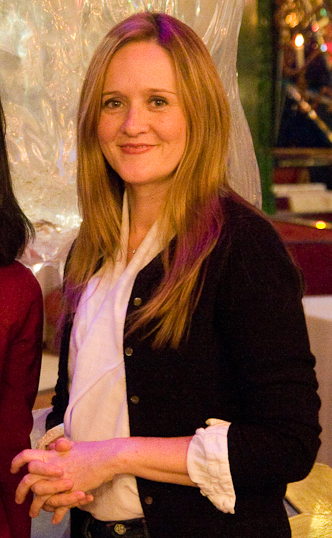
"SamanthaBeeFeb2011" by Justin Hoch. Licensed under CC BY 2.0 via Wikimedia Commons.
UPDATE: Jessica Williams has taken herself out of the running:
I'm not hosting. Thank you but I am extremely under-qualified for the job! At this age (25) if something happens politically that I don't agree with, I need to go to my room & like not come out for, like, 7 days.
Tuesday, February 10, 2015
Ron Paul on libertarians and vaccines

Perhaps those "libertarians" actually mean what they say when they say: you should have a right to do whatever you want — as long as you're not hurting anyone else.
Sunday, February 8, 2015
"No-brainers" to make the world a better place

“THE lives of people in poor countries will improve faster in the next 15 years than at any other time in history. And their lives will improve more than anyone else’s.” So predict Bill and Melinda Gates in their annual letter, published on January 22nd. The wealthy philanthropists expect the rate of infant mortality to halve by 2030, from one child in 20 dying before turning five to one in 40. They also forecast the eradication of polio and perhaps three other deadly diseases. Improvements in agriculture will mean that Africa will be able to feed itself. Financial security will improve as the 2 billion people who do not have a bank account start storing money and making payments using mobile phones. And affordable online courses will open up huge educational opportunities for poor people, especially girls.
Yet the letter has surprisingly little to say about the United Nations initiative that is intended to bring such predictions to fruition: the “Sustainable Development Goals” to be agreed by world leaders at the UN General Assembly in September. . . .
One of the loudest voices calling for greater focus is Bjorn Lomborg, a Danish economist, who has launched the Post-2015 Consensus, an effort to draw up a shortish list of goals and targets the benefits of which, if achieved, would far outweigh the costs. This is a souped-up version of the Copenhagen Consensus he has run for the past decade, bringing together leading economists to calculate the cheapest ways to improve the state of the world.
Mr Lomborg has commissioned some 60 teams of economists, plus representatives from the UN, NGOs and business, to review the proposed targets to work out which would generate the most bang for the buck (he rates less than a tenth of them “phenomenal” value for money). . . . A panel of three Nobel Prize-winning economists will then write an overview of the work and make recommendations for how best to spend the $2.5 trillion in international development assistance Mr Lomborg expects over the years to 2030.
Some of the results are surprising. For instance, a recent paper by Bjorn Larsen looked at ways to reduce deaths from air pollution, which currently kills around 7m people a year. It found that shifting 1.4 billion people from traditional cooking methods to stoves with outdoor vents could save half a million lives a year and generate an economic benefit to the world of $10 for every $1 spent. Using higher-tech smoke-free stoves would bring an even bigger reduction in deaths. Yet the cost would be much higher, so the benefit would be only $2 per dollar spent.
Perhaps more surprising, the most beneficial measure Mr Lomborg’s teams evaluated was lowering barriers to trade, which achieves far more per dollar spent than any other option (see chart). Completing the treaty currently under negotiation at the World Trade Organisation, for example, would bring developing countries $3,426 for every dollar spent. A free-trade deal encompassing China, Japan, South Korea and the ASEAN countries would be worth $3,438 per dollar spent.
Most poverty-reduction measures are more expensive than cutting tariffs, but many are still well worth it. Providing contraception and other reproductive-health services to all who want them would cost $3.6 billion a year, according to Mr Lomborg’s researchers, yet generate annual benefits of $432 billion, $120 per dollar spent. Increasing the nursery school enrolment rate in sub-Saharan Africa to 59% from its current 18% would generate benefits of $33 per dollar spent. Reducing by 40% the number of children whose growth is stunted by malnutrition would be worth $45 per dollar spent; reducing deaths from tuberculosis $43. Increasing mobile broadband penetration from 32% of the world’s population to 90% by 2030 would deliver benefits of $17 per dollar spent. Stopping tax evasion in sub-Saharan Africa (where it currently costs 20 governments around 10% of GDP a year) would also pay off handsomely, at $49 per dollar spent. Increasing by 20% the worldwide availability of work visas would generate benefits of $15 per dollar.
Saturday, February 7, 2015
Wednesday, February 4, 2015
Why anti-vaxxers are liberal and conservative
Michael Gerson writes in WaPo:
[A] significant minority of parents — often well-educated parents — are opting out of vaccination. Many states (including California) make it relatively easy to refuse vaccination for “philosophic” reasons. This does not, I suspect, mean that people are reading Immanuel Kant or John Stuart Mill; it means they are consuming dodgy sources on the Internet.
Resistance to vaccination on the left often reflects an obsession with purity. Vaccines are placed in the same mental category as genetically modified organisms (GMOs), DDT and gluten. But the problem with organic health care is that the “natural” rate of child mortality is unacceptably high. Organically raised children can get some very nasty diseases.
Opposition to vaccination on the right often reflects an obsession with liberty — in this case, freedom from intrusive state mandates. It has always struck me as odd that a parent would defend his or her children with a gun but leave them vulnerable to a microbe. Some conservatives get especially exercised when vaccination has anything to do with sex — as with the human papillomavirus (HPV) vaccine — on the questionable theory that teenagers are more likely to fornicate if they have a medical permission slip (or less likely to without it).
Whether hipsters or home-schoolers, parents who don’t vaccinate are free riders. Their children benefit from herd immunity without assuming the very small risk of adverse reaction to vaccination. It is a game that works — until too many play it.
Herd immunity requires about 90 percent vaccine coverage. Some children with highly vulnerable immune systems — say, those being treated for leukemia — can’t be vaccinated for medical reasons. When the number of non-medical exemptions from vaccination gets large enough, the child with leukemia becomes the most vulnerable to the spread of disease.
The government (in this case, state governments) has the responsibility to keep vaccination rates above 90 percent, which benefits everyone. This requires burdening the freedom of parents in a variety of ways — not putting them in jail if they refuse to vaccinate but instead denying them some public good (such as public education) and subjecting them to stigma (which they generally deserve). As the rate of vaccination goes lower, the level of coercion must increase — making exemptions more difficult and burdensome to secure (as California needs to do).
Tuesday, February 3, 2015
What happens when each domino is 1.5 times as big as the one that knocked into it?
Keep watching till the end to hear how big they would have gotten if there were 29 of them.
Monday, February 2, 2015
"There are moments when there is nothing more urgent than the defense of what has already been accomplished."
In an insightful article called "Crimes Against Humanities," about the need to prevent "science" from "invading the liberal arts," Leon Wieseltier responds to Steven Pinker's essay, "Science Is Not Your Enemy," in the New Republic (this is from last year, back when they were New Republic editors):
The question of the place of science in knowledge, and in society, and in life, is not a scientific question. Science confers no special authority, it confers no authority at all, for the attempt to answer a nonscientific question. It is not for science to say whether science belongs in morality and politics and art. Those are philosophical matters, and science is not philosophy, even if philosophy has since its beginnings been receptive to science. Nor does science confer any license to extend its categories and its methods beyond its own realms, whose contours are of course a matter of debate. The credibility of physicists and biologists and economists on the subject of the meaning of life . . . cannot be owed to their work in physics and biology and economics, however distinguished it is. The extrapolation of larger ideas about life from the procedures and the conclusions of various sciences is quite common, but it is not in itself justified; and its justification cannot be made on internally scientific grounds, at least if the intellectual situation is not to be rigged. Science does come with a worldview, but there remains the question of whether it can suffice for the entirety of a human worldview. . . .(Here's Pinker's response, followed by another response from Wieseltier.)
Rejecting the various definitions of scientism—“it is not an imperialistic drive to occupy the humanities,” it is not “reductionism,” it is not “naïve”—Pinker proposes his own characterization of scientism, which he defends as an attempt “to export to the rest of intellectual life” the two ideals that in his view are the hallmarks of science. The first of those ideals is that “the world is intelligible.” The second of those ideals is that “the acquisition of knowledge is hard.” Intelligibility and difficulty, the exclusive teachings of science? This is either ignorant or tendentious. Plato believed in the intelligibility of the world, and so did Dante, and so did Maimonides and Aquinas and Al-Farabi, and so did Poussin and Bach and Goethe and Austen and Tolstoy and Proust. They all share Pinker’s denial of the opacity of the world, of its impermeability to the mind. They all join in his desire to “explain a complex happening in terms of deeper principles.” They all concur with him that “in making sense of our world, there should be few occasions in which we are forced to concede ‘It just is’ or ‘It’s magic’ or ‘Because I said so.’”
If Pinker believes that scientific clarity is the only clarity there is, he should make the argument for such a belief. He should also acknowledge its narrowness (though within the realm of science it is very wide), and its straitening effect upon the investigation of human affairs. Instead he simply conflates scientific knowledge with knowledge as such. In his view, anybody who has studied any phenomena that are studied by science has been a scientist. It does not matter that they approached the phenomena with different methods and different vocabularies. If they were interested in the mind, then they were early versions of brain scientists. If they investigated human nature, then they were social psychologists or behavioral economists. . . . If they contributed to knowledge, then they must have been scientists, because what other type of knowledge is there? . . .
[I]t was the imperative to keep up, to be “progressive,” which led to “the disaster of postmodernism” and other unfortunate hermeneutical fashions of recent decades. More importantly, the humanities do not advance the way the sciences advance. . . . The history of science is a history of errors corrected and discarded. But the vexations of philosophy and the obsessions of literature are not retired in this way. In these fields, the forward-looking cast backward glances. The history of old art and thought fuels the production of young art and thought. Scientists no longer consult Aristotle’s scientific writings, but philosophers still consult Aristotle’s philosophical writings. The present has the power of life and death over the past. It can choose to erase vast regions of it. Tradition is what the present calls those regions of the past that it retains, that it cherishes and needs. Contrary to the progressivist caricature, tradition is not the domination of the present by the past. It is the domination of the past by the present. . . .
There are moments when there is nothing more urgent than the defense of what has already been accomplished. . . . Sometimes wisdom is conventional. The denigration of conventional wisdom is itself a convention. . . .
The technological revolution will certainly transform and benefit the humanities, as it has transformed and benefited many disciplines and vocations. But it may also mutilate and damage the humanities, as it has mutilated and damaged many disciplines and vocations. My point is only that shilling for the revolution is not what we need now. The responsibility of the intellectual toward the technologies is no longer (if it ever was) mere enthusiasm. The magnitude of the changes wrought by the new machines calls for the revival of a critical temper. Too much is at stake to make do with that cool vanguard feeling. But Pinker is . . . waxing on like everybody else about how “this is an extraordinary time” because “powerful tools have been developed” and so on. . . . With his dawn-is-breaking scientistic cheerleading, Pinker shows no trace of the skepticism whose absence he deplores in others. His sunny scientizing blurs distinctions and buries problems. If there was one thing for which the humanities, the old humanities, the wearyingly traditional humanities, could be counted on, it was to introduce us also to the darkness and prepare us also for the worst.
Sunday, February 1, 2015
Good question, overheard at brunch
Why is it considered OK to emulate someone else's gender but not OK to emulate someone else's race or ethnicity?
Are energy-saving light bulbs going to be an environmental disaster?
"Approximately 90 per cent of compact fluorescent light bulbs are being tossed in the trash, potentially contaminating the environment with mercury . . ."
As my mom, Ann Althouse, wrote back in 2008:
I hate fluorescent bulbs anyway, for aesthetic reasons. I'm willing to save energy by turning off or dimming more lights. But maybe you don't feel the aesthetic problem and you don't care about my trivial suffering. Why don't you care about the mercury?
"Why Government Money Can't Fix Poverty"
A mini-documentary about public schools in Camden, NJ — "the poorest small town in America," and also "one of the highest-spending [school] districts in the nation."
"A lack of resources is not our problem. I actually despise that argument. I think it's a scapegoat. 'We need more money. If we had more money, we could do this, or do this.' It's just a Band-Aid for the problem. Why not address the real issue, which is what's broken right in front of you?" — Bridget Cusato-Rosa, Principal of Freedom Prep Charter School
"Is money important? Yes, the teachers must be well-paid, or you can't recruit teachers to work in Camden or Jersey City or Elizabeth. But . . . you look at urban salaries and they're paid very, very well, as are the principals and superintendents. So, that's not a money issue. . . . And the proof of the pudding is: it hasn't changed because of the money." — Saul Cooperman, former New Jersey State Commissioner of Education
Saturday, January 31, 2015
Andrew Sullivan
You've probably seen that Andrew Sullivan plans to retire from blogging soon.
I can't tell you how proud I was when he linked to my post about him for the 10th anniversary of his blog, in 2010.
So many other writers were paying tribute to him that day, and many of them were being more complimentary than I was. He had solicited "toasts and roasts," but they seemed to be mostly the former.
My post lauded him for some things but was quite critical of him in other ways, and I even mentioned that I had stopped reading his blog.
I thought the fact that he would link to a post by an obscure person like me, and even quote the critical parts on his blog, when he had so many more positive posts to choose from that day, really said something about his character.
From my post on his 10th bloggiversary:
Self-righteousness and dogmatism are generally not a perfect fit with foreign policy. Sullivan's style is what it is. It isn't perfect, as even he admits. But he has done far more good than most cheerleaders for the Iraq war by exposing and analyzing his own shortcomings in thinking about war.
But when I think of Sullivan's political voice, I won't think first about foreign policy. I'll think about the issue he showed me how to think about.
His opening remarks about same-sex marriage in that video (back in 1997, before he was a blogger) are dated. He thought Hawaii was soon to be the first state in the US with same-sex marriage; the first such state was Massachusetts in 2004, and Hawaii still doesn't have it. [That was true when I wrote this in 2010; the law recognizing same-sex marriage in Hawaii was signed in 2013. — JAC] He didn't do a great job at predicting the future, but his message still has great resonance today.
I was going to find some choice moment of this video, transcribe it, and quote it here to draw your attention to it. But I would have felt like just transcribing the whole thing. So please, watch the whole thing. To say this is Sullivan at his best would be an understatement.
I love how he starts by giving definitions of homosexuality and heterosexuality that seem so uncontroversial as to be hardly worth explaining — and then leverages those definitions into his case for same-sex marriage (both as something that should happen and as the most important front in the gay rights movement).
Though he's often criticized as overly emotional about political issues, he took the political issue he feels the most strongly about in his life and made his case with lucid logic. He did it when it was a lot less popular than it is now, and he did it over and over.
Thank you, Andrew Sullivan. You have made a difference.

(Photo of Andrew Sullivan by Trey Ratcliff.)
What to make of Mitt Romney's announcement that he's not going to run for president?
My mom (Ann Althouse) offers this analysis:
I've been more or less positive about Romney's running again, . . . but even though I do like him, I was concerned that he was becoming the front-runner mostly on name recognition, and that was not good for the overall competition within the GOP. I'd like to see the plausible candidates go through a process of presenting themselves to us — especially in debates — and giving us a chance to scrutinize them and maybe warm up to them, and it's appropriate for Romney to stand back and allow that to happen.Romney did just enough to put the idea in everyone’s heads that he’s still a real possibility. So if the field turns out to be weak, people will naturally think of him.
If various seemingly plausible candidates fail to get traction or crash for some reason, there's the elder statesman Romney, prepared to serve if needed. I like him there. It fits with the idea that he was going to use as his pitch: That he's a dutiful, modest man, a humble servant, who responds to a calling.
So: Don't call us, we'll call you.
Wednesday, January 28, 2015
The wife of the Prime Minister of India
She’s waiting for him, as she has been all her life. But when Indian Prime Minister Narendra Modi dined with Barack and Michelle Obama at a glittering banquet Sunday night, his wife wasn’t by his side. Modi, 64, kept his teenage marriage a secret for decades during his political ascent and only last year admitted that his wife exists.
The wife, Jashodaben Chimanlal Modi, is a retired teacher who lives in a small town in Modi’s home state of Gujarat. Although she had not heard from her husband in years, she says she still hopes to join him one day in the capital as his spouse.
“If he calls me, I will go,” she said in an interview. “I hear all his speeches on TV. I feel very good when I hear him speak. I want him to fulfill all his promises to the people. That’s my prayer to God.”
Narendra Modi, the son of a man who sold tea in a railway station, comes from a lower caste called Ghanchi. He and his wife were promised to each other as young adolescents in keeping with the traditions of their community. They were then married in a small ceremony when she was 17 and he was 18. . . .
Nearly a dozen guards watch her around the clock and follow her in a shiny car as she takes auto rickshaws and public transportation, they say. When she visits friends or relatives, they have to cook for the guards, she said.
“The security travels in an air-conditioned car. But my sister takes buses, trains and auto rickshaws. What kind of justice is this? Should a prime minister's wife not get a car?” her brother asked.
Tuesday, January 27, 2015
The new political correctness
Insightfully analyzed by Jon Chait:
Under p.c. culture, the same idea can be expressed identically by two people but received differently depending on the race and sex of the individuals doing the expressing. This has led to elaborate norms and terminology within certain communities on the left. For instance, “mansplaining,” a concept popularized in 2008 by Rebecca Solnit, who described the tendency of men to patronizingly hold forth to women on subjects the woman knows better, . . . has now grown into an all-purpose term of abuse that can be used to discredit any argument by any man. (MSNBC host Melissa Harris-Perry once disdainfully called White House press secretary Jay Carney’s defense of the relative pay of men and women in the administration “mansplaining,” even though the question he responded to was posed by a male.) . . .
If a person who is accused of bias attempts to defend his intentions, he merely compounds his own guilt. (Here one might find oneself accused of man/white/straightsplaining.) It is likewise taboo to request that the accusation be rendered in a less hostile manner. This is called “tone policing.” If you are accused of bias, or “called out,” reflection and apology are the only acceptable response — to dispute a call-out only makes it worse. There is no allowance in p.c. culture for the possibility that the accusation may be erroneous. A white person or a man can achieve the status of “ally,” however, if he follows the rules of p.c. dialogue. A community, virtual or real, that adheres to the rules is deemed “safe.” The extensive terminology plays a crucial role, locking in shared ideological assumptions that make meaningful disagreement impossible. . . .
The Marxist left has always dismissed liberalism’s commitment to protecting the rights of its political opponents — you know, the old line often misattributed to Voltaire, “I disapprove of what you have to say, but I’ll defend to the death your right to say it” — as hopelessly naïve. If you maintain equal political rights for the oppressive capitalists and their proletarian victims, this will simply keep in place society’s unequal power relations. Why respect the rights of the class whose power you’re trying to smash? And so, according to Marxist thinking, your political rights depend entirely on what class you belong to.
The modern far left has borrowed the Marxist critique of liberalism and substituted race and gender identities for economic ones. “The liberal view,” wrote MacKinnon 30 years ago, “is that abstract categories — like speech or equality — define systems. Every time you strengthen free speech in one place, you strengthen it everywhere. Strengthening the free speech of the Klan strengthens the free speech of Blacks.” She deemed this nonsensical: “It equates substantive powerlessness with substantive power and calls treating these the same, ‘equality.’ ”
Political correctness appeals to liberals because it claims to represent a more authentic and strident opposition to their shared enemy of race and gender bias. And of course liberals are correct not only to oppose racism and sexism but to grasp (in a way conservatives generally do not) that these biases cast a nefarious and continuing shadow over nearly every facet of American life. Since race and gender biases are embedded in our social and familial habits, our economic patterns, and even our subconscious minds, they need to be fought with some level of consciousness. The mere absence of overt discrimination will not do.
Liberals believe (or ought to believe) that social progress can continue while we maintain our traditional ideal of a free political marketplace where we can reason together as individuals. Political correctness challenges that bedrock liberal ideal. While politically less threatening than conservatism (the far right still commands far more power in American life), the p.c. left is actually more philosophically threatening. It is an undemocratic creed. . . .
The p.c. style of politics has one serious, possibly fatal drawback: It is exhausting. Claims of victimhood that are useful within the left-wing subculture may alienate much of America. The movement’s dour puritanism can move people to outrage, but it may prove ill suited to the hopeful mood required of mass politics. Nor does it bode well for the movement’s longevity that many of its allies are worn out. “It seems to me now that the public face of social liberalism has ceased to seem positive, joyful, human, and freeing,” confessed the progressive writer Freddie deBoer. “There are so many ways to step on a land mine now, so many terms that have become forbidden, so many attitudes that will get you cast out if you even appear to hold them. I’m far from alone in feeling that it’s typically not worth it to engage, given the risks.” [The Nation's Michelle] Goldberg wrote recently about people “who feel emotionally savaged by their involvement in [online feminism] — not because of sexist trolls, but because of the slashing righteousness of other feminists.” Former Feministing editor Samhita Mukhopadhyay told her, “Everyone is so scared to speak right now.”
That the new political correctness has bludgeoned even many of its own supporters into despondent silence is a triumph, but one of limited use. Politics in a democracy is still based on getting people to agree with you, not making them afraid to disagree. The historical record of political movements that sought to expand freedom for the oppressed by eliminating it for their enemies is dismal. The historical record of American liberalism, which has extended social freedoms to blacks, Jews, gays, and women, is glorious. And that glory rests in its confidence in the ultimate power of reason, not coercion, to triumph.
Monday, January 26, 2015
Revering the irreverent
In an article called "Satire Lives," Adam Gopnick writes this in the New Yorker:
The staff of the French magazine Charlie Hebdo, massacred in an act that shocked the world last week, were not the gentle daily satirists of American editorial cartooning. Nor were they anything like the ironic observers and comedians of manners most often to be found in our own beloved stable here at The New Yorker. (Though, to be sure, the covers of this magazine have startled a few readers and started a few fights.) They worked instead in a peculiarly French and savage tradition, forged in a long nineteenth-century guerrilla war between republicans and the Church and the monarchy. There are satirical magazines and “name” cartoonists in London and other European capitals, particularly Brussels, but they tend to be artier in touch and more media-centric in concern. Charlie Hebdo was—will be again, let us hope—a satirical journal of a kind these days found in France almost alone. Not at all meta or ironic, like The Onion, or a place for political gossip, like the Paris weekly Le Canard Enchaîné or London’s Private Eye, it kept alive the nineteenth-century style of direct, high-spirited, and extremely outrageous caricature . . . .So Charlie Hebdo was nothing like the Onion, eh? Did the New Yorker writer see the Onion's article "No One Murdered Because Of This Image" — with an illustration showing several religious figures, including Jesus, in an orgy, with genitals and breasts on display?
For those who recall Charlie Hebdo as it really, rankly was, the act of turning its murdered cartoonists into pawns in a game of another kind of public piety—making them martyrs, misunderstood messengers of the right to free expression—seems to risk betraying their memory. Wolinski, Cabu, Honoré: like soccer players in Brazil, each was known in France by a single name. A small irreverent smile comes to the lips at the thought of the flag being lowered, as it was throughout France last week, for these anarchist mischief-makers, and they would surely have roared at the irony of being solemnly mourned and marched for by former President Nicolas Sarkozy and the current President, François Hollande. The cartoonists didn’t just mock those men’s politics; they regularly amplified their sexual appetites and diminished their sexual appurtenances. It is wonderful to see Pope Francis condemning the horror, but also worth remembering that magazine’s special Christmas issue, titled “The True Story of Baby Jesus,” whose cover bore a drawing of a startled Mary giving notably frontal birth to her child. (Did the Pope see it?)
The New Yorker article goes on:
[Charlie Hebdo] was offensive to Jews, offensive to Muslims, offensive to Catholics, offensive to feminists, offensive to the right and to the left, while being aligned with it—offensive to everybody, equally. . . . The right to mock and to blaspheme and to make religions and politicians and bien-pensants all look ridiculous was what the magazine held dear, and it is what its cartoonists were killed for—and we diminish their sacrifice if we give their actions shelter in another kind of piety or make them seem too noble, when what they pursued was the joy of ignobility. . . .While it may be ironic to imbue Charlie Hebdo with too much nobility or piety — attitudes that would seem to be the opposite of what the publication stands for — I actually think it's important to revere the irreverent. We've certainly been doing that with the Marx Brothers for 80 years, for instance. It's a strength, not a weakness, for a society to be able to not take itself too seriously.
“Nothing Sacred” was the motto on the banner of the cartoonists who died, and who were under what turned out to be the tragic illusion that the Republic could protect them from the wrath of faith. “Nothing Sacred”: we forget at our ease, sometimes, and in the pleasure of shared laughter, just how noble and hard-won this motto can be.
Now, I don't find Charlie Hebdo particularly funny (what little I've seen of it), and maybe they haven't always exercised the best judgment about how to walk the fine line humorists often need to walk between being outrageously funny and causing pointless outrage. But there's no way to make sure that all comedians always show the most sensitive judgment; by their very nature, they're sometimes going to slip up and land on the wrong side of the line. This will occasionally cause offense. But that's the price of living in a world with humor and satire — which serve a vital role in puncturing pretense, deflating pomposity, giving us permission to laugh at authority figures.
Humorists are like the child in "The Emperor's New Clothes," who points out what everyone else is thinking but no one else has the nerve to say: the emperor isn't wearing any clothes. And if anything in the world is ripe for this kind of treatment, it's religion!
Something fundamental about the enemy has been revealed by its decision to carry out summary mass executions, and to arrogate worldwide jurisdiction in doing so . . . over cartoons. The Charlie Hebdo killings, the Danish cartoon killings, and the North Korea/The Interview incident have made clear that we need to send a serious message to the world about the freedom to be unserious — as Tina Fey put it, "the right to make dumb jokes."
Sunday, January 25, 2015
Saturday, January 24, 2015
How to tell when a naive person is trying to sound intelligent
They'll take a simple idea and try to make it sound complex. As if they haven't noticed how much of a waste of time this is, and how much more there is to gain from making complex ideas simple.
Friday, January 23, 2015
Do Obama's anti-homemaker proposals make sense?
Ramesh Ponnuru says they don't:
He wants to triple the existing tax credit for child-care expenses, and create a new credit for second earners. Those proposals will help some parents and couples, but have nothing to offer families where one parent concentrates on home-based tasks. The second-earner credit is probably too small to affect couples’ decisions about work and child-care arrangements. So its main effect will be to lower the share of the tax burden paid by two-earner couples who were going to be working even without the credit.
Why do that?
There are two standard economic justifications for shifting the tax burden in this way, neither of them convincing.
One is that two-earner couples have higher costs than single-earner couples making the same income, so it's harder for them to pay the same taxes. But that seems like using the tax code to counteract the efficiency advantages of a particular way of dividing a family's labor, which doesn't make much sense. And it seems like an especially weak argument since, in the real world, single-earner couples have smaller incomes.
The second justification is that a progressive tax code, when applied to families rather than individuals, can penalize second earners. A second earner will often pay a higher tax rate than she would if she were single and making the same income, because she moves to a higher bracket when she marries a wage earner. The tax code thus discourages her from working. That's true, but it's just a special case of the way taxes discourage work, and not one that seems especially unjust or destructive. Marriage is (among other things) an economic partnership, and this feature of the tax code reflects that it involves pooling resources.
If the second-earner credit ignores that feature of marriage, Obama's other proposal ignores how little Americans like commercial child care. Surveys suggest that most parents prefer that small children be primarily cared for by a parent at home, and the Census Bureau reports that less than a quarter of them are in organized care facilities.
Given these preferences, it would make more sense to enlarge the child tax credit -- not the child-care credit -- and let parents use it as they see fit rather than requiring them to use the commercial day care most of them try to avoid. Some of them, it's true, might use the extra money to let one parent scale back from full-time to part-time work, or from part-time work to leaving the labor force.
Thursday, January 22, 2015
Wednesday, January 21, 2015
Auto-tuned conversations
A comic from Zach Weiner's Saturday Morning Breakfast Cereal, which is worth checking out regularly:

Tuesday, January 20, 2015
State of the Union
I can't believe I missed the chance to see Obama repeat the same proposals I've been reading about for weeks but with soaring rhetoric, a very determined tone of voice, and the occasional humorous aside.
President Obama's community-college plan
The Washington Post Editorial Board is unimpressed with Obama's plan to subsidize community-college tuition, which he's going to announce in tonight's State of the Union address. The plan would supposedly save an average of $3,800 per student for 9 million students a year, three-quarters of which would be paid for by the federal government, with the rest covered by state governments. Here's what WaPo has to say:
[U]nder Mr. Obama’s plan, taxpayers would pay even for those who could pay for themselves. If additional money can be found for education, why not direct it to those who face the highest barriers? Further increasing the size of Pell Grants, for example, would be a more progressive way to help very needy students. Larger Pell Grants would also be usable at four-year colleges and universities, which could give some poor students a better chance at success, and not just at community colleges. The government should at least make Pell Grants available year-round, so that students could study over the summer, rather than just during the school year. These are all higher priorities.
If the president wants to help those who earn just too much to qualify for Pell Grants, he could consider means testing community college tuition assistance some other way. The White House, however, hasn’t gamed out how means testing would affect the proposal, in part, apparently, for philosophical reasons. “The president believes that it is time to make college education the norm, and that about 100 years ago this country decided that high school would be the norm and that now is the time to make sure that all Americans, regardless of age, have access to higher education,” White House spokesman Eric Schultz said Friday. That’s a fine goal. But in an era of constrained resources, there are better ways of improving access to higher education than establishing a new middle-class entitlement.
Monday, January 19, 2015
Sunday, January 18, 2015
Call it the scientific ignorance of the American voter — but don't call it the stupidity . . .
"Over 80 percent of Americans support 'mandatory labels on foods containing DNA.'"
But why? And who cares? Ilya Somin explains why this is a big deal:
"A recent survey by the Oklahoma State University Department of Agricultural Economics finds that over 80 percent of Americans support “mandatory labels on foods containing DNA,” about the same number as support mandatory labeling of GMO foods “produced with genetic engineering.” Oklahoma State economist Jayson Lusk has some additional details on the survey. If the government does impose mandatory labeling on foods containing DNA, perhaps the label might look something like this:
WARNING: This product contains deoxyribonucleic acid (DNA). The Surgeon General has determined that DNA is linked to a variety of diseases in both animals and humans. In some configurations, it is a risk factor for cancer and heart disease. Pregnant women are at very high risk of passing on DNA to their children.The Oklahoma State survey result is probably an example of the intersection between scientific ignorance and political ignorance, both of which are widespread. The most obvious explanation for the data is that most of these people don’t really understand what DNA is, and don’t realize that it is contained in almost all food. . . .
Polls repeatedly show that much of the public is often ignorant of both basic scientific facts. . . . A 2012 National Science Foundation survey even found that about 25% of Americans don’t know that the Earth revolves around the sun rather than vice versa. . . .
It would be a mistake to assume that widespread political and scientific ignorance are the result of “the stupidity of the American voter,” as Obamacare architect Jonathan Gruber put it. Political ignorance is not primarily the result of stupidity. For most people, it is a rational reaction to the enormous size and complexity of government and the reality that the chance that their vote will have an impact on electoral outcomes is extremely low. The same is true of much scientific ignorance. For many people, there is little benefit to understanding much about genetics or DNA. Most Americans can even go about their daily business perfectly well without knowing that the Earth revolves around the sun. Even the smartest people are inevitably ignorant of the vast majority of information out there. We all have to focus our time and energy on learning that information which is most likely to be instrumentally useful, or at least provide entertainment value. For large numbers of people, much basic political and scientific information doesn’t make the cut.
Unfortunately, this is a case where individually rational behavior leads to potentially dangerous collective outcomes. While it doesn’t much matter whether any individual voter is ignorant about science or public policy, when a majority (or even a large minority) of the electorate is ignorant in these ways, it can lead to the adoption of dangerous and counterproductive government policies. In this case, excessive and unnecessary warning labels on food products could confuse consumers, and divert their limited attention from real dangers.
Saturday, January 17, 2015
Mitt Romney's plan for 2016
[Romney] sketched out the basic outlines of a potential campaign, saying the nation would be focused on a post-Obama era and taking a swipe at the front runner for the Democratic presidential nomination by saying, “The results of the Hillary Clinton-Barack Obama foreign policy have been devastating," he said, adding that "terrorism is not on the run."So his plan is to flip-flop on whether he's concerned about the poor.
Sounding every bit like a candidate, Romney said the party needed to be focused in 2016 on three things: Making the world safer; ensuring that all Americans have an equal chance at opportunity; and lifting the poor out of poverty.
Weigel dryly adds:
Whether Romney is the best messenger for those points remains unclear. Some Republicans declined to put their skepticism on the record after the speech.
"Hate speech"
I hate this article!
This might be the worst paragraph:
Speech that offends, insults, demeans, threatens, disrespects, incites hatred or violence, and/or violates basic human rights and freedoms has absolutely no place in even the freest society. In fact, it has no place in any free society, as bigotry is fundamentally anti-freedom by its very nature. The human right to freedom of speech must always be balanced against the human rights to dignity, respect, honor, non-discrimination, and freedom from hatred. Civilized countries consider hate speech to be among the most serious crimes around, with many countries even placing it on par with murder. In some countries, people are automatically declared guilty of hate speech and other hate crimes unless they can absolutely prove their innocence beyond any reasonable doubt. The principle of guilty until proven innocent may seem a bit harsh to some, but it makes sense when you consider how severe the crime of hate speech is – it is a crime that simply cannot be tolerated in a democracy. Hate speech is not merely speech, but is, in fact, a form of violence and the international community has established hate speech to be a form of violence many times. Hate speech doesn’t merely CAUSE violence. Hate speech IS violence.What I'd like to know is: how does the author think government should deal with someone who says, "I hate men," or "Men are stupid"? I don't agree with those statements. They're hurtful, sexist, and offensive. But I don't want the government to stop people from saying them. And if government can't stop people from saying those things, it also can't stop people from making hateful statements about women, blacks, whites, gays, etc.
In the comments: some suspect the article was intended to be satirical. (But it's not very funny . . .)
Thursday, January 15, 2015
France suppresses speech at the free speech rally
Andrew Napolitano writes, in Reason magazine:
The photos of 40 of the world's government leaders marching arm-in-arm along a Paris boulevard on Sunday with the president of the United States not among them was a provocative image that has fomented much debate. The march was, of course, in direct response to the murderous attacks on workers at the French satirical magazine Charlie Hebdo by a pair of brothers named Kouachi, and on shoppers at a Paris kosher supermarket by one of the brothers' comrades.
The debate has been about whether President Obama should have been at the march. The march was billed as a defense of freedom of speech in the West; yet it hardly could have been held in a less free speech-friendly Western environment, and the debate over Obama's absence misses the point. . . .
[E]ven though the French Constitution guarantees freedom of speech, French governments treat speech as a gift from the government, not as a natural right of all persons, as our Constitution does.
The French government has prohibited speech it considers to be hateful and even made it criminal. When the predecessor magazine to Charlie Hebdo once mocked the death of Charles de Gaulle, the French government shut it down—permanently. . . .
And how hypocritical was it of the French government to claim it defends free speech! In France, you can go to jail if you publicly express hatred for a group whose members may be defined generally by characteristics of birth, such as gender, age, race, place of origin or religion.
You can also go to jail for using speech to defy the government. This past weekend, millions of folks in France wore buttons and headbands that proclaimed in French: "I am Charlie Hebdo." Those whose buttons proclaimed "I am not Charlie Hebdo" were asked by the police to remove them. Those who wore buttons that proclaimed, either satirically or hatefully, "I am Kouachi" were arrested. Arrested for speech at a march in support of free speech? Yes.
Wednesday, January 14, 2015
The Wall Street Journal is skeptical of Romney 2016.
Mr. Romney is a man of admirable personal character, but his political profile is, well, protean. He made the cardinal mistake of pandering to conservatives rather than offering a vision that would attract them. He claimed to be “severely conservative” and embraced “self-deportation” for illegal immigrants, a political killer. But he refused to break from his RomneyCare record in Massachusetts even though it undermined his criticism of ObamaCare. A third campaign would resurrect all of that political baggage—and videotape.
The businessman also failed on his own self-professed terms as a superior manager. His convention was the worst since George H.W. Bush’s in 1992, focusing more on his biography than a message. This left him open to President Obama’s barrage against his record at Bain Capital, which Mr. Romney failed to defend because that would have meant playing on Democratic turf, as his strategists liked to put it. The unanswered charges suppressed GOP turnout in key states like Ohio.
Mr. Romney’s campaign team was notable for its mediocrities, led by a strategist whose theory of the race was that voters had already rejected Mr. Obama so the challenger merely needed to seem like a safe alternative. He thus never laid out an economic narrative to counter Mr. Obama’s claim that he had saved the country from a GOP Depression and needed more time for his solutions to work.
And don’t forget the management calamity of Mr. Romney’s voter turnout operation, code-named Orca. Mr. Romney likes to say he reveres “data,” but Mr. Obama’s campaign was years ahead of Mr. Romney’s in using Big Data and social media to boost turnout. The Romney campaign was so clueless on voter mobilization that well into Election Night the candidate still thought he would win. He lost a winnable race 51%-47%, including every closely contested state save North Carolina.
Mr. Romney had his good moments, notably choosing Paul Ryan as running mate and the first debate. He also, eventually, adopted solid proposals on tax and Medicare reform after his initial and forgettable 59-point plan. More comfortable with slide decks than ideas, he still struggled to make a compelling argument for the agenda he claimed to favor.
Mr. Romney’s post-election diagnosis also doesn’t inspire confidence that he has learned the right lessons. He said Mr. Obama won because he promised “extraordinary financial gifts” to voters. “It’s a proven political strategy,” Mr. Romney said. “Giving away free stuff is a hard thing to compete with.” Maybe so, but if he can’t sell a larger message of growth and opportunity, he won’t defeat Hillary Clinton’s gifts either.
Monday, January 12, 2015
Let the negative campaigning begin!
The New York Times reports on former Senator Rick Santorum's attacks against some of the other (potential) Republican candidates:
Discussing [Mike] Huckabee, the former Arkansas governor and winner of the 2008 Iowa caucuses, Mr. Santorum raised four policy issues that he said would prompt questions about Mr. Huckabee’s fealty to conservative principles. Mr. Santorum was even harsher when discussing [Rand] Paul of Kentucky and [Ted] Cruz of Texas, both first-term senators, dismissing them as “bomb throwers” with scant achievements. . . .
The criticisms . . . illustrate the two simultaneous campaigns already taking shape. While former Gov. Jeb Bush of Florida, Gov. Chris Christie of New Jersey and perhaps [Mitt] Romney begin vying for commitments from center-right contributors, elected officials and activists, a parallel race is taking place among more conservative contenders including Mr. Santorum, Mr. Huckabee and the two senators.
Already, there is notably less restraint in the language used by the more conservative aspirants than in the public statements from the establishment-backed potential candidates.
“Do we really want someone with this little experience?” Mr. Santorum asked, referring to Mr. Paul, Mr. Cruz and Senator Marco Rubio of Florida, who is also in his first term. “And the only experience they have basically — not Rubio, but Cruz and Paul because I don’t think Rubio is going to go — is bomb throwing? Do we really want somebody who’s a bomb thrower, with no track record of any accomplishments?”
Mr. Paul’s top strategist responded that the party should not take advice from a politician who was soundly defeated in 2006.
“Senator Santorum lost re-election in [Pennsylvania] by 18 points nearly a decade ago, and has spent the time since then trying to convince people to elect him to an even higher office than the one he was booted out of,” said Doug Stafford, senior adviser to Mr. Paul. “We will pass on responding to his alleged wisdom.”
Sunday, January 11, 2015
Why are sports so popular?
This 4-minute voice memo helped me understand why sports are so popular.
I might have put some of his points in a different way. But I think Joel van Vliet has hit on something important here.
Friday, January 9, 2015
Romney 2016
Mitt Romney, the 2012 Republican presidential nominee, told Republican donors in New York on Friday that he is seriously considering a third presidential campaign in 2016, according to a source present at the meeting. . . .If that's one of the more interesting things he said, I'd hate to hear the more boring things . . .
“One of the more interesting things was Mitt said, ‘People ask if I really want to be president,’ and he said, ‘I’ve run twice. Yeah, I want to be president.’”
Wednesday, January 7, 2015
Free speech
Monday, January 5, 2015
How does raising the minimum wage affect employment levels?
A large literature has examined the effects on employment of raising the minimum wage, with different researchers arriving at conflicting conclusions. The core reason that economists can’t answer questions like this better is that we usually can’t run controlled experiments. There is always some reason that the legislators chose to raise the minimum wage, often related to prevailing economic conditions. We can never be sure if changes in employment that followed the legislation were the result of those motivating conditions or the result of the legislation itself. For example, if Congress only raises the minimum wage when the economy is on the rebound and all wages are about to rise anyway, we’d usually observe a rise in employment following a hike in the minimum wage that is not caused by the legislation itself. UCSD Ph.D. candidate Michael Wither and his adviser Professor Jeffrey Clemens have some interesting new research that sheds some more light on this question. . . .(Source.)
Clemens and Wither found that the federal minimum wage hike resulted in about a 6% decrease in the probability that low-wage individuals would have a job based on this comparison of states in which the minimum wage hike would have been binding and those for which it would not. The hike in the minimum wage thus appears to have raised the wage for low-skilled workers but made it harder for them to find jobs.
Two things to remember to keep this in perspective:
1. Reducing employment is just one of many ways workers can be hurt by raising the minimum wage. It can also cause employers to avoid giving raises to higher-level employees, cut benefits, offer less hours, raise prices (paid by low-wage workers who are also customers at their own companies or other companies), etc.
2. Unemployment is a particularly bad problem for a person to have — it's a far worse problem than not being paid quite enough. So even a small disemployment effect could be good reason to oppose raising the minimum wage.
Friday, January 2, 2015
Thursday, January 1, 2015
"Correction . . ."
". . . This article was totally wrong."
[T]he problems seem systemic, not the kind that can be fixed simply by asking writers to slow down or hiring a few more editors. Vox has hired a number of Bright Young People—and is run by the Brightest Young People—and the house style seems to be, "Write as if you are an expert, in a tone assuming that everything one needs to know about a subject can be found in your article." These Bright Young People may well be near-experts on one or two subjects, or at least close enough to pass as such online, but Vox publishes at the same rapid pace as the rest of the internet, on an exceptional and ever-growing number of topics, and there's only so much authoritativeness to go around.I lost interest in Vox after I noticed that an article about law was clearly written by someone who wasn't a legal expert; the writer seemed to have mistakenly believed s/he was well-versed in a certain criminal procedure issue just by reading some news reports about a Supreme Court case.
Sunday, December 28, 2014
When Siskel and Ebert and Roeper gave thumbs down — way down
"There are 3 good things in [Catwoman]: Halle Berry's face, Halle Berry's body, and Halle Berry's costumes. Those are first-rate. Everything else in this movie is unbelievably bad." — Roger Ebert
"When I saw She's Out of Control, I became so depressed, I actually thought about quitting my job as a film critic, feeling as though the movies had abandoned me. Because what I was seeing there really wasn't a movie. It was some sort of strange concoction by someone who didn't understand what movies are all about. Fortunately, however, I would see the movie Say Anything later in the same day, and all is right with the world. I'm still on the job." — Gene Siskel
At the end, Siskel and Ebert correctly foresee that Siskel will die before Ebert.
Friday, December 26, 2014
Tuesday, December 23, 2014
Memes of yesteryear
So many internet memes are rehashed versions of things that were already cringe-inducingly trite when I was a kid.
". . . said no one ever!" is a throwback to ". . . not!"
"First-world problems!" is a throwback to "Finish your dinner — there are starving children in Africa who would love to have that food!"
Monday, December 22, 2014
The "real college rape hoax"
For months we've been told that there's a burgeoning "epidemic" of rape on college campuses, that the system for dealing with campus rape is "broken" and that we need new federal legislation (of course!) to deal with this disaster. Before the Rolling Stone story imploded, Sens. Claire McCaskill, D-Mo., and Kirsten Gillibrand, D-N.Y., were citing the Virginia gang rape as evidence of the problem, but now that the story has been exposed as bogus, they're telling us that, regardless of that isolated incident, there's still a huge campus rape problem that needs to be addressed as soon as possible.
And that's the real college rape hoax. Because the truth is that there's no epidemic outbreak of college rape. In fact, rape on college campuses is — like rape everywhere else in America — plummeting in frequency. And that 1-in-5 college rape number you keep hearing in the press? It's thoroughly bogus, too. (Even the authors of that study say that "We don't think one in five is a nationally representative statistic," because it sampled only two schools.)
Sen. Gillibrand also says that "women are at a greater risk of sexual assault as soon as they step onto a college campus."
The truth — and, since she's a politician, maybe that shouldn't be such a surprise — is exactly the opposite. According to the Justice Department's Bureau of Justice Statistics, the rate of rape and sexual assault is lower for college students (at 6.1 per 1,000) than for non-students (7.6 per 1,000). (Note: not 1 in 5). What's more, between 1997 and 2013, rape against women dropped by about 50%, in keeping with a more general drop in violent crime nationally.
Upshot: Women on campus aren't at more risk for sexual assault, and their risk is nothing like the bogus 1-in-5 statistic bandied about by politicians and activists. So why is this non-crisis getting so much press?
It's getting press because it suits the interests of those pushing the story. For Gillibrand and McCaskill, it's a woman-related story that helps boost their status as female senators. It ties in with the "war on women" theme that Democrats have been boosting since 2012, and will presumably roll out once again in 2016 in support of Hillary Clinton, or perhaps Elizabeth Warren.
Saturday, December 20, 2014
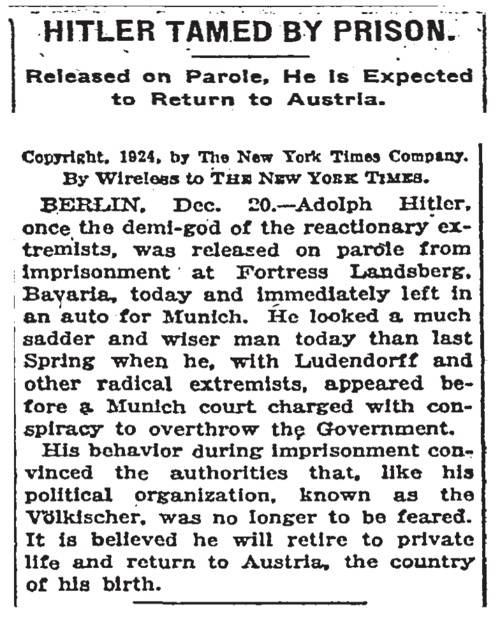
Friday, December 19, 2014
Thursday, December 18, 2014
Hollywood didn't always yield to dictatorships
How is it that Hollywood was willing to release this scathing satire of Hitler in 1940, in the middle of World War II and the Holocaust, yet we're not allowed to see The Interview for fear of North Korea in 2014? I thought we were supposed to be "the land of the free and the home of the brave". . .
The Obamas on their "racist experiences"
Actually, these are not necessarily "racist experiences." The reason a woman asked Michelle Obama to hand her something from a shelf in a store is that Michelle Obama was much taller than the woman. Michelle Obama is apparently 5'11" — an inch taller than me — and I often get asked by other customers in stores to get things from the high shelves. This is not because of prejudice against me; it's because I happen to be of average height for a man. Relatively tall people like us are advantaged by having an easier time reaching products in stores; how can we complain about occasionally being asked for help by someone who's too short to comfortably reach some of the products?
I've also been mistaken for a store clerk. I've also been closely followed by store clerks, and interrogated while trying to leave a store without buying anything. I've also been refused entry into my own workplace, when I was wearing a suit and tie and had been working there for a long time, because the security guard (a white man) didn't believe I worked there. (I should mention that this was not at my current job.) Yes these things are annoying, but they happen to people of all races.
Many of the Obamas' examples reflect a certain classism: Don't you know who I am?! How could you possibly mistake me for a lowly waiter?!
There's something unseemly about the most famous, powerful couple in America expressing dismay that a random citizen would ever fail to recognize how important they are.
UPDATE (December 21): I was looking around for help in a clothing store today, and it wasn't totally clear who was a customer and who was an employee. The employees had no obvious dress code or name tags, and some of them walked around nonchalantly in a way that blended in with the customers (which could be a good sales technique). It occurred to me that if I had taken seriously what Michelle Obama said about racist microaggression, I should have avoided asking any of the black or Hispanic employees for help, and sought out the white employees instead. But that would mostly help whites and hurt minorities! They're all working for commissions, and they can benefit from the sales experience of interacting with me even if they don't make a sale. That seems to be a worse "microaggression" than occasionally mixing up a customer with a store employee, which isn't going to prevent anyone from making money.
Wednesday, December 17, 2014
An idea
If I were Lorne Michaels, I'd offer Dan Aykroyd tons of money to rejoin the cast of Saturday Night Live to play Jeb Bush.
What should "white privilege" mean?
I wonder if the racial self-flagellation of #CrimingWhileWhite is like buying an indulgence. If you engage in ritualized expressions of white guilt, you are free to enjoy your white privilege, comfortable in the knowledge that you are nothing like those ignorant and presumably terrible white people who refuse to do so. I have little patience for this kind of privilege-checking. As Phoebe Maltz Bovy observed back in May, invocations of white privilege are more often than not a way for one privileged person to “win a sensitivity competition” with another privileged person. What, then, is a useful way to think about what white privilege means and how it works? . . .There's an interesting analogy to be made between Asian Americans and Jewish Americans. Both groups are richer than the average white American. But they reached that point only by doing a lot to compensate for discrimination and historic oppression.
It’s also important to understand the social and economic components of white privilege. The basic idea, as described by scholars like Nancy DiTomaso, author of The American Non-Dilemma, and Daria Roithmayr, author of Reproducing Racism, is that all kinds of valuable social goods are transmitted through social networks. If you hear of a job opening at your company, you will likely pass that information along to a close friend or relative. I’ve shared information in this insider-y way, and I’m guessing that you have as well—if you don’t, then the people you value and respect might value and respect you a little bit less.
Why does white privilege come into play here? Because most Americans, like most humans, associate with people much like themselves. Robert P. Jones of the Public Religion Research Institute has found that the social networks of white Americans are 91 percent white, and three-quarters of whites have entirely white social networks. This shouldn’t be too shocking, as most Americans are non-Hispanic whites and there are many neighborhoods in which making nonwhite friends would take a great deal of effort. Looking at these relationships through an exclusively racial lens can be misleading, as factors like the neighborhood you live in, the high school you attended, and your religious background could be doing more of the work than any preference for associating with other people of your own race. But the neighborhoods we live in and the high schools and churches we attend tend to be segregated by race, so even the mildest same-race preference will get magnified by these other avenues. Since white people hold a disproportionately large share of the most lucrative and the most powerful jobs, the natural tendency to help those you care about most ends up reinforcing racial inequality.
There is nothing intrinsically white about helping your friends and relatives. When it comes to building self-reinforcing social networks, one could even make the case that other groups are beating whites at their own game. Recently, Chris Martin, a graduate student in sociology at Emory University, and John Nezlek, a social psychologist at the College of William and Mary, found that people consistently underestimate the median household income of Asian Americans, and that people who believe that whites are highly privileged were particularly likely to assume that Asian-American households earn less than white households. This is despite the fact that Asian-American households have had higher incomes than white households for more than 30 years.
Does this mean that we ought to talk about Asian-American privilege more and white privilege less? Not without acknowledging what “privilege” means in the context of different groups. If anything, newcomers to American society and their children might find themselves more dependent on friends and relatives than deeply rooted whites, and thus more likely to cultivate and maintain these ties in an environment that seems alien and at times hostile. Those who arrive with high levels of educational attainment are particularly well-positioned to take advantage of job opportunities, and to share inside information with their co-ethnics. Virtually all Taiwanese immigrants benefit from the fact that 74.1 percent of American adults of Taiwanese origin have at least a bachelor’s degree. Similarly, the life chances of college-educated Hmong Americans are affected in all kinds of ways by the fact that 37.9 percent of American adults of Hmong origin have less than a high school diploma.
Imagine if we could rigorously apply a similar subgroup analysis to white Americans. The Census doesn’t capture data on educational and labor market outcomes for religious minorities like Jews and Mormons, yet there is evidence that people have a much greater tendency to associate with narrower ethno-religious groups than with fellow members of larger racial groups. Even so, we don’t generally speak of Jewish privilege or Mormon privilege. The language of white privilege also obscures the ravaging effects of poverty in heavily white regions like Appalachian Kentucky, where drug abuse is rampant and privilege-checking seems almost totally irrelevant.
Why does the white privilege conversation ignore the ways in which Asian Americans have used their social ties to achieve success, or the yawning chasm that separates upper-middle-income Mormon Californians from impoverished Appalachian whites? The simple answer is that we talk about white privilege as a clumsy way of talking about black exclusion.
Even white Americans of modest means are more likely to have inherited something, in the form of housing wealth or useful professional connections, than the descendants of slaves. In his influential 2005 book When Affirmative Action Was White, Ira Katznelson recounts in fascinating detail the various ways in which the New Deal and Fair Deal social programs of the 1930s and 1940s expanded economic opportunities for whites while doing so unevenly at best for blacks, particularly in the segregated South. Many rural whites who had known nothing but the direst poverty saw their lives transformed as everything from rural electrification to generous educational benefits for veterans allowed them to build human capital, earn higher incomes, and accumulate savings. This legacy, in ways large and small, continues to enrich the children and grandchildren of the whites of that era. This is the stuff of white privilege.
Tuesday, December 16, 2014
"Warren's present-tense denial adds to speculation she will run in 2016"
A correct headline.
"I am not running for president" is what you say when you want to leave the door wide open to the possibility that you might start running for president any day now.
Someone else who said he was not running for president was a junior Senator named Barack Obama.
Monday, December 15, 2014
Lennon or McCartney?
My favorite answer is by Adam Duritz of Counting Crows (starting at 4:44):
I think Lennon's a great lyricist especially … a great writer, really. But melody is unquantifiable. I mean, you live your day, so you've got shit to write about. I don't know where people get melody from. The ability to write something that sticks in people's heads for 10, 20, 50, couple hundred years — the ability to be Puccini or McCartney … I don't know where that comes from. And I don't know how one guy wrote so many pieces of music that I can hum 50 years later. I don't know how it's possible. And that to me is such a rare thing.… All the dark … cool songs in the world are great, but the only reason we love music is because melody gets to the gut.… The ability to write something that we're all humming … that's how I remember the Beatles. Not that Lennon didn't write a lot of great songs too, but McCartney's abilities there are … without peer.
Hillary Clinton vs. Elizabeth Warren
Howard Dean and my friend Ben Wikler debate the Democratic primaries, focusing on Hillary Clinton and Elizabeth Warren. At one point, the host seems a little disappointed that they're both being too positive, and Howard Dean responds that he's not going to "fight" Ben Wikler — who Dean calls one of the smartest Americans under 35.
Saturday, December 13, 2014
Things that have become less annoying than people complaining about them
• smartphones
• people who don't have a TV
• hipsters
Thursday, December 11, 2014
Sam Cooke died 50 years ago.
50 years ago today, on December 11, 1964, Sam Cooke died at the age of 33.
There’s a home video of me at about age 5, where my mom asks if I want to sing a song. I sing a couple verses of “You Send Me." Then I point out that it's really "a grownup song." Sam Cooke had clearly touched me from very early on. He had a light, warm, amiable quality that could appeal to a young child, while having the depth and maturity to appeal to adults. And he had a passion and feeling that’s allowed his music to endure for 50 years.
Wikipedia sums up his career:
Samuel "Sam" Cooke (January 22, 1931 – December 11, 1964) was an American recording artist and singer-songwriter, generally considered among the greatest of all time. Influential as both a singer and composer, he is commonly known as the King of Soul for his distinctive vocals and importance within popular music. His pioneering contributions to soul music contributed to the rise of Aretha Franklin, Bobby Womack, Al Green, Curtis Mayfield, Stevie Wonder, Marvin Gaye, Billy Preston and popularized the likes of Otis Redding and James Brown. AllMusic biographer Bruce Eder wrote that Cooke was "the inventor of soul music", and possessed "an incredible natural singing voice and a smooth, effortless delivery that has never been surpassed."Here's "Good News," followed by a short interview of Sam Cooke (by Dick Clark), in which he tells "the secret" to his songwriting:
Cooke had 30 U.S. top 40 hits between 1957 and 1964, plus three more posthumously. Major hits like "You Send Me", "A Change Is Gonna Come", "Cupid", "Chain Gang", "Wonderful World", and "Twistin' the Night Away" are some of his most popular songs. Cooke was also among the first modern black performers and composers to attend to the business side of his musical career. He founded both a record label and a publishing company as an extension of his careers as a singer and composer. He also took an active part in the Civil Rights Movement.
Cooke wrote "Chain Gang," after meeting some chain-gang prisoners on a highway while he was on tour. (Chain gangs have been almost entirely abolished from the United States.)
Cooke concisely answers the question: "What is soul?"
That recording shows that Cooke wasn't the most technically perfect singer — his voice breaks a little. And he didn't have the biggest range. I've read that he had the exact same range as Justin Bieber, of all people.
But just listen to this — a scorchingly intense performance of "Bring It on Home to Me," with an extended intro that brilliantly includes some of "You Send Me":
"Bring It on Home to Me" is probably one of Cooke's most covered songs — it's been done by Wilson Pickett (who gave a shout-out to "the late Sam Cooke" in the beginning of that 1968 recording), Aretha Franklin, John Lennon, Paul McCartney, and She & Him.
He clearly brought something extra to his live show that isn't on the studio recordings:
Though he generally wrote his own songs, he was also a gifted interpreter of classics. Here's "Summertime" (by George Gershwin and DuBose Heyward):
"Nobody Knows the Trouble I've Seen" (a traditional spiritual):
Before Cooke switched to pop, he sang gospel with the Soul Stirrers. Here's a rousing, 9-minute "Nearer My God to Thee":
But to many people, the most soul-stirring Sam Cooke song is his civil rights anthem, "A Change Is Gonna Come." He recorded it in January 1964, a little less than a year before he died.
When Rolling Stone ranked Cooke the 4th greatest singer of all time, Van Morrison wrote this for the magazine:
If a singer is not singing from the soul, I do not even want to listen to it — it's not for me.Let's keep his music alive for 50 more years.
Sam Cooke reached down deep with pure soul. He had the rare ability to do gospel the way it's supposed to be — he made it real, clean, direct. Gospel drove Sam Cooke through his greatest songs, the same way it did for Ray Charles, who came first, and Otis Redding.
He had an incomparable voice. Sam Cooke could sing anything and make it work. But when you're talking about his strength as a singer, range is not relevant. It was his power to deliver — it was about his phrasing, the totality of his singing.
He did a lot of great songs, but "Bring It on Home to Me" is a favorite. It's just a well-crafted song with a great lyric and melody. It's a song that's written to allow you to go wherever you can with it.…
Not many people can play this music anymore, not the way Sam Cooke did it, coming directly from the church. What can we learn from a singer like him, from listening to songs like "A Change Is Gonna Come"? It depends on who the singer is and what they are capable of, where their head is and how serious they are. But Sam Cooke was born to sing.
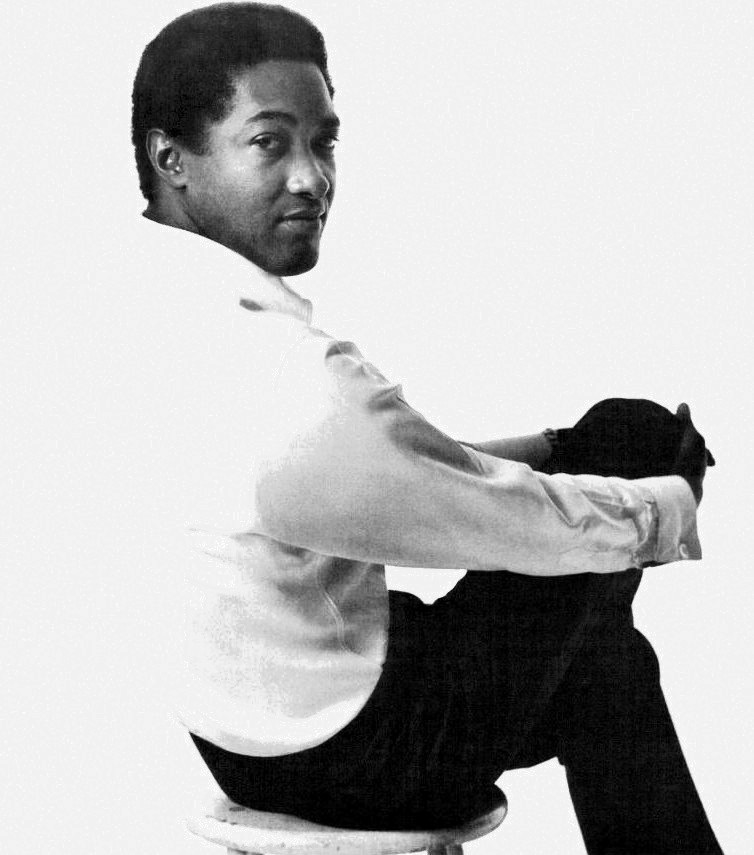
(Sam Cooke in Billboard magazine, from Wikipedia.)
Wednesday, December 10, 2014
Should you "follow your heart" or your "head" when it comes to dating/relationships?
Your head, according to this Psychology Today article:
One famous study conducted in Jaipur, India, compared couples there who married for love—"the Chosen"— to those who wed for family—"the Arranged." As you’d expect, Chosen couples reported being significantly more in love at the start of the marriage than the Arranged. But by the five-year mark, the figures had reversed—with the Arranged couples reporting being in love at the same levels as newlywed Chosen couples had, and the Chosen couples now declined to the newlywed levels of the Arranged couples.
And at the 10-year mark? The effect had doubled. Arranged marriages just kept getting better.
Does that mean that love’s not important in arranged marriage cultures? Hardly. It just means that here, we expect love before marriage; and there, afterward. Here, we expect love to conquer all; there, they expect similarity to pave the way for love.
And, factually speaking, they’re usually right. . . .
I’m not suggesting that you let your family arrange your marriage. If you’re not from such a culture, it could be intensely weird, and daunting for your parents. But I am suggesting we would be wise to emulate arranged-marriage cultures by valuing our heads as much as our hearts—starting with logic and ending with love. To that end:
• Define your standards, making sure they’re realistic and vital;
• Only date those who seem to meet them—ditching those who lack your required qualities, no matter how appealing they might otherwise seem; and
• Let yourself fall for someone from the small group that fits.
In other words, arrange your own marriage. You can do it with the help of the Internet, of course—and recent research suggests that online dating may be associated with longer, happier marriages than those that are launched in person.
Tuesday, December 9, 2014
What Facebook does with your face
Sterling Crispin’s “Data Masks” are haunting portraits that don’t actually depict any one person. Instead, they use raw data to show how technology perceives humanity. Reverse-engineered from surveillance face-recognition algorithms and then fed through Facebook’s face-detection software, the Data Masks “confront viewers with the realization that they’re being seen and watched basically all the time,” Crispin says.(Quoted from "This Is What Your Face Looks Like to Facebook" by Kyle Chayka.)
“Facebook actually makes masks out of everyone’s faces,” the artist explains. The social network analyzes every face that appears in photos on its servers and renders them into three-dimensional models. “It’s happening whether you get tagged in the photo or not” . . .
As the U.S. government builds biometric databases like its Next-Generation Identification face-recognition system, it’s more important than ever to know how our identities are captured and processed by the technology we adopt. Crispin’s work is a reminder.
Subscribe to:
Posts (Atom)


